I’ve been behind on… well, everything, but especially on my gaming posts. Our gaming club is coming along nicely, and since I’ve sent Carcassone out to the next library on the rotation, the kids are back to playing the games we’ve got in house and the goodies I bring from my home stash. The last couple of weeks, Nightmarium has been all the rage here – and why not? It’s creating monsters that turn on one another with glee! I backed Nightmarium as a Kickstarter a few years ago, and it has been a mainstay of gaming in my own home. You don’t need to read to play, the monsters are hilariously weird, and game play moves along at a good pace. Let’s dig in.
 Nightmarium: A Game About Conquering Nightmares, Ares, Igrology, et al (2014)
Ages The box says 10+; I’ve actively played this with my then 5-year-old, and easily explained to 7-10 year-olds here at the library. I’d go 7+
Play time: 20-30 minutes, depending on number of players
Number of players: 2-5
Find Nightmarium on Board Game Geek
The monsters featured in this game are a group of Night Terrors ready to haunt your dreams. The backstory is fun, organizing the monsters, by color, into four Legions of Horror. The backstory isn’t necessary for game play, but it adds to the fun. Each legion has its own color: blue stands for Necromunculi, brown for Constricti, green for Chimeridae, and red for Mansters.
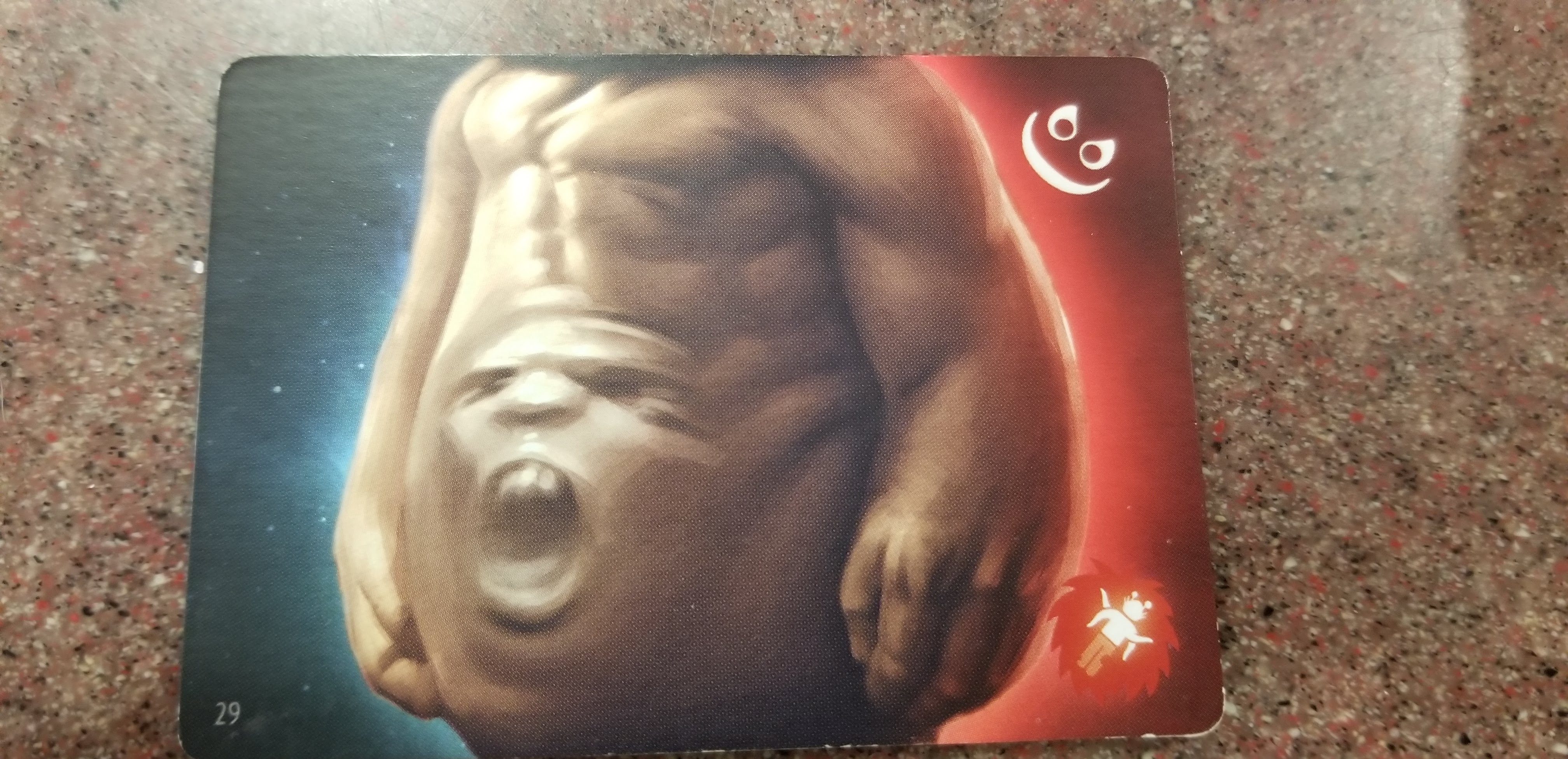
Cards come in three types: feet/legs, trunks/bodies, and heads. Some cards can serve multiple functions, like this striking fella, who can be either a head or a body:
Players get two actions per turn. You can:
- draw a card from the top of the deck
- play a card from your hand
- discard cards and redraw: one card for every two you discard
If you draw a card and play a card, that’s two actions. If you draw two cards, that’s two actions. If you draw two cards and you want to play the second card, you have to wait until it’s your turn again; playing that card would be a third action. You can discard two cards, draw one card to replace them, AND play or draw another card. That counts as two actions.
You have to assemble your monsters from the bottom up. Feet first; if you have a handful of really great heads, that’s awesome, but you have to start from the feet. There’s no hand minimum or maximum; if you don’t want to get rid of any of your cool head cards, keep them, and keep drawing until you get feet you want to play to start things off.
When you complete a monster, congrats! See those See those pictures in the upper right hand corner of most cards (not all have them)? Those are different abilities that activate once you complete a monster.
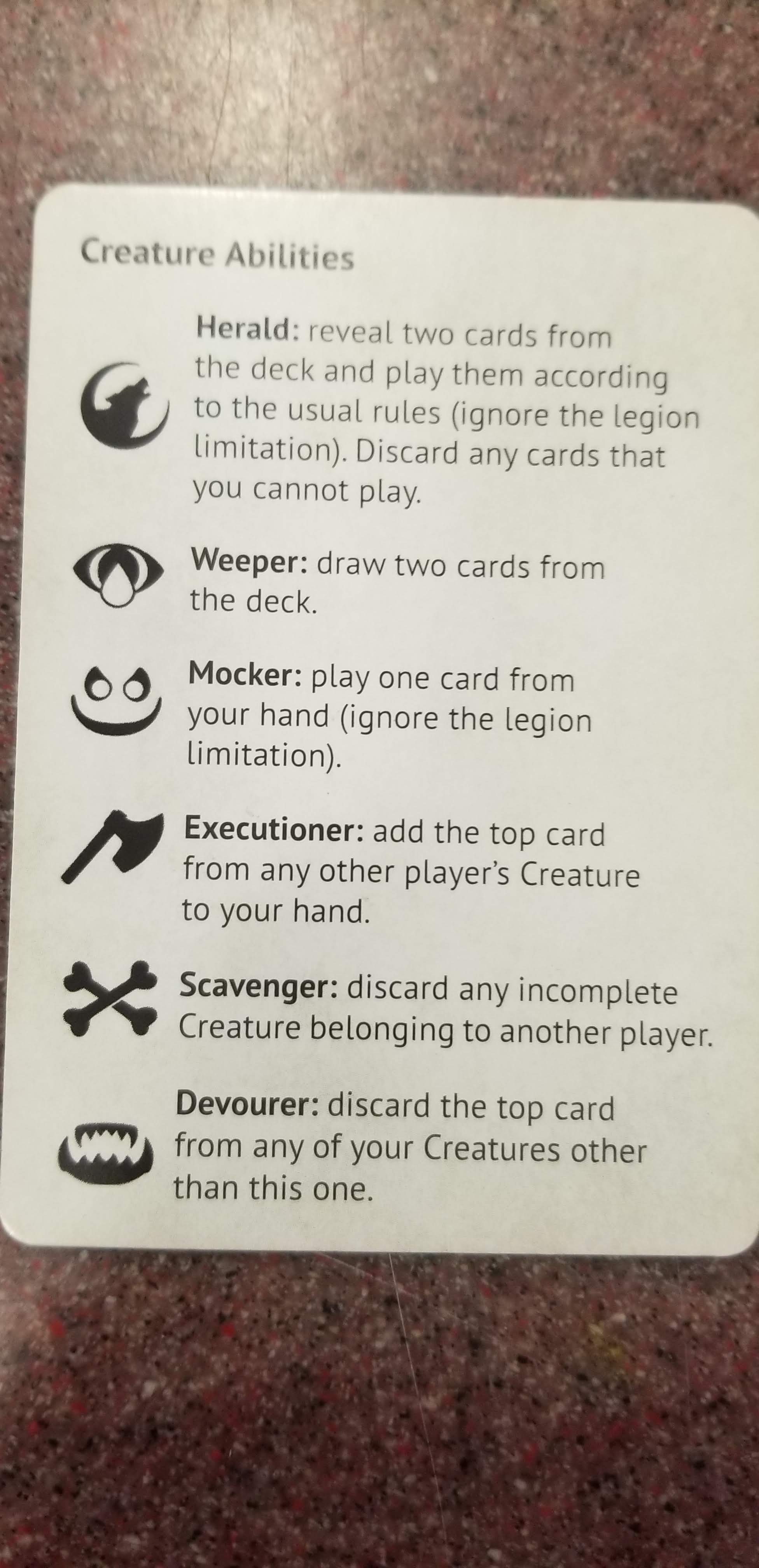
Watch out for that Devourer – you have to cut one of YOUR Creatures’ heads off, not your opponents! This can actually be a good thing, because you can add another head and reactivate powers, if you have good ones. It’s a good secret weapon to have. Creature powers are only active when the Creature is completed – not every turn, and not while under construction.
Okay, let’s talk about Legions. I don’t tend to play Legions at the library, because I modify to make things as simple and fun as possible for my younger gaming kids. Legions, like I said before, are organized by color. You don’t HAVE to create Creatures with all parts from the same Legion, though – you’ll still get your abilities when you complete one. Look:
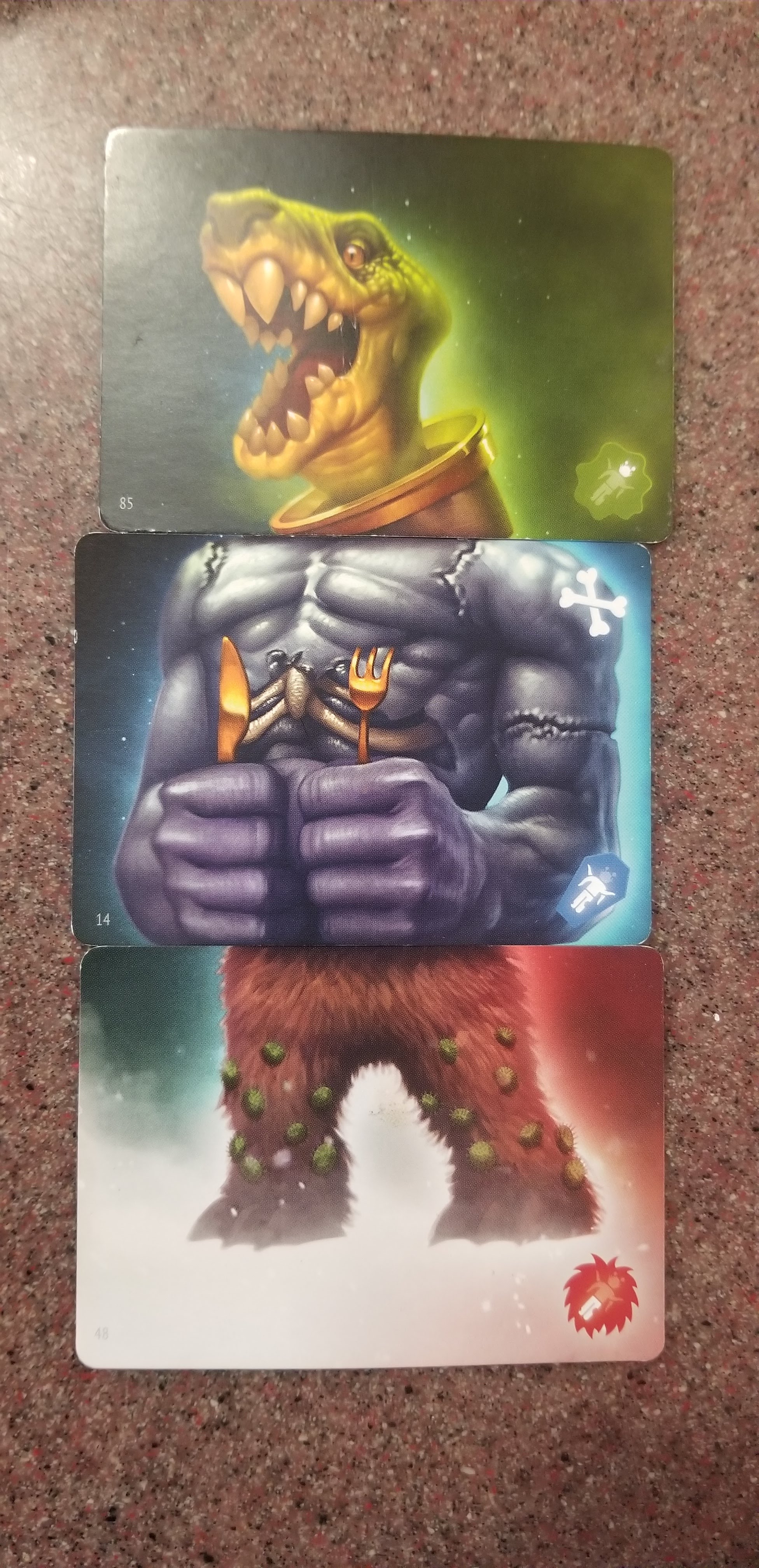
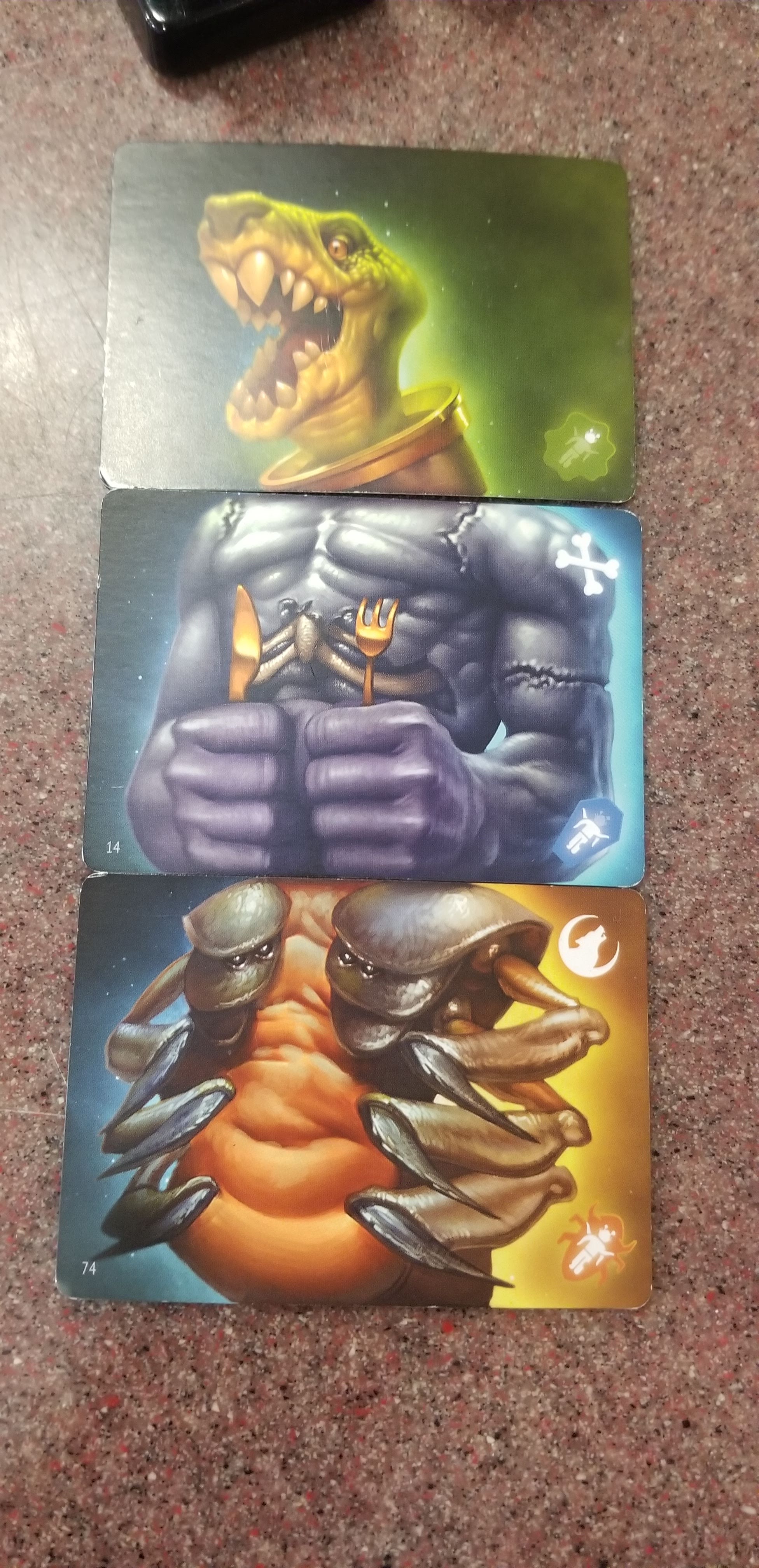
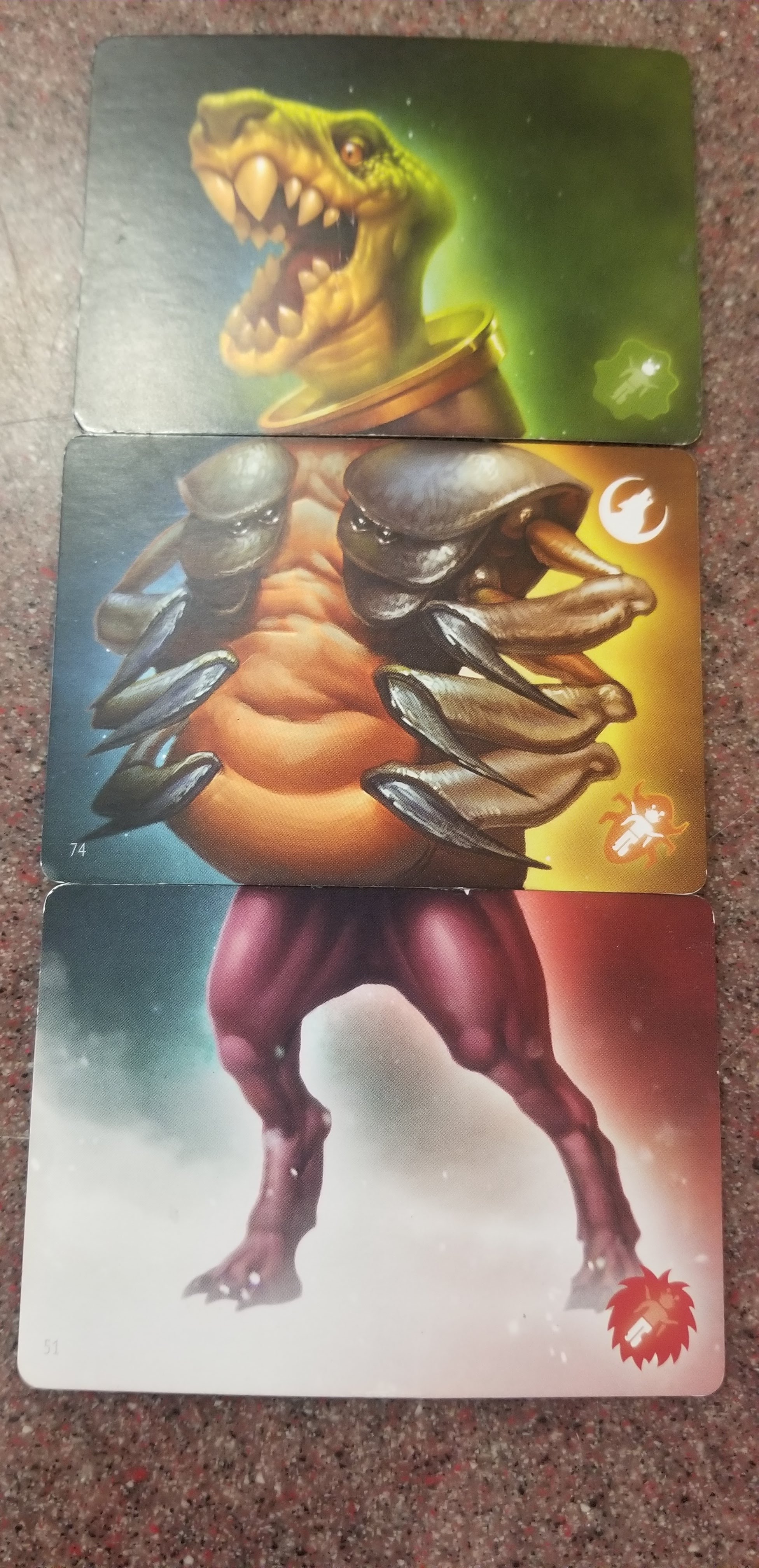
Here’s a creature composed of parts from all different Legions (Notice the bottom in #2 can also function as the middle in #3). In #1, the Creature has only one power to activate: the Scavenger, where the player can discard any incomplete creature belonging to another player. If I’m playing against this player, and I have a 2- or 1-card Creature under construction, that player can say goodbye to it, and I have to put it in the Discard pile.
The #2 Creature has Scavenger and the Herald, which lets that player reveal two cards from the deck, face up, so all other players can see it, and play them if they can. If the player gets a pair of feet, awesome; they can play it. If the player draws a body and a head, they can only play them if they have under construction Creatures that can use those cards. Anything that the player can’t use right then and there goes in the Discard pile.
Other powers include the Weeper, which lets the player draw two cards from the deck. They don’t have to play them, they just add them, regardless of what they are.
The Mocker lets you play one card from your hand.
The Executioner lets you take another player’s top card – heads, but also anything that’s on top – if you have a monster under construction and the top card you have is a body, your opponent can take that with Executioner. Cards claimed when someone plays Executioner goes into the player’s hand, not the Discard pile.
Playing abilities does NOT count toward your actions! If the first move you make during your turn is to complete a monster, you play the abilities, and THEN play your second action. It’s pretty awesome.
Okay, so let’s talk about Legions. Like I said, I tend not to play Legions because it’s easier for younger kids to just get used to playing cards, but playing Legions can mix things up for extra fun. Match the colors of your creatures to trip up your opponents: when you finish a monster with cards from the same Legion, everyone else has to discard a card of that Legion OR discard any two cards. Look:
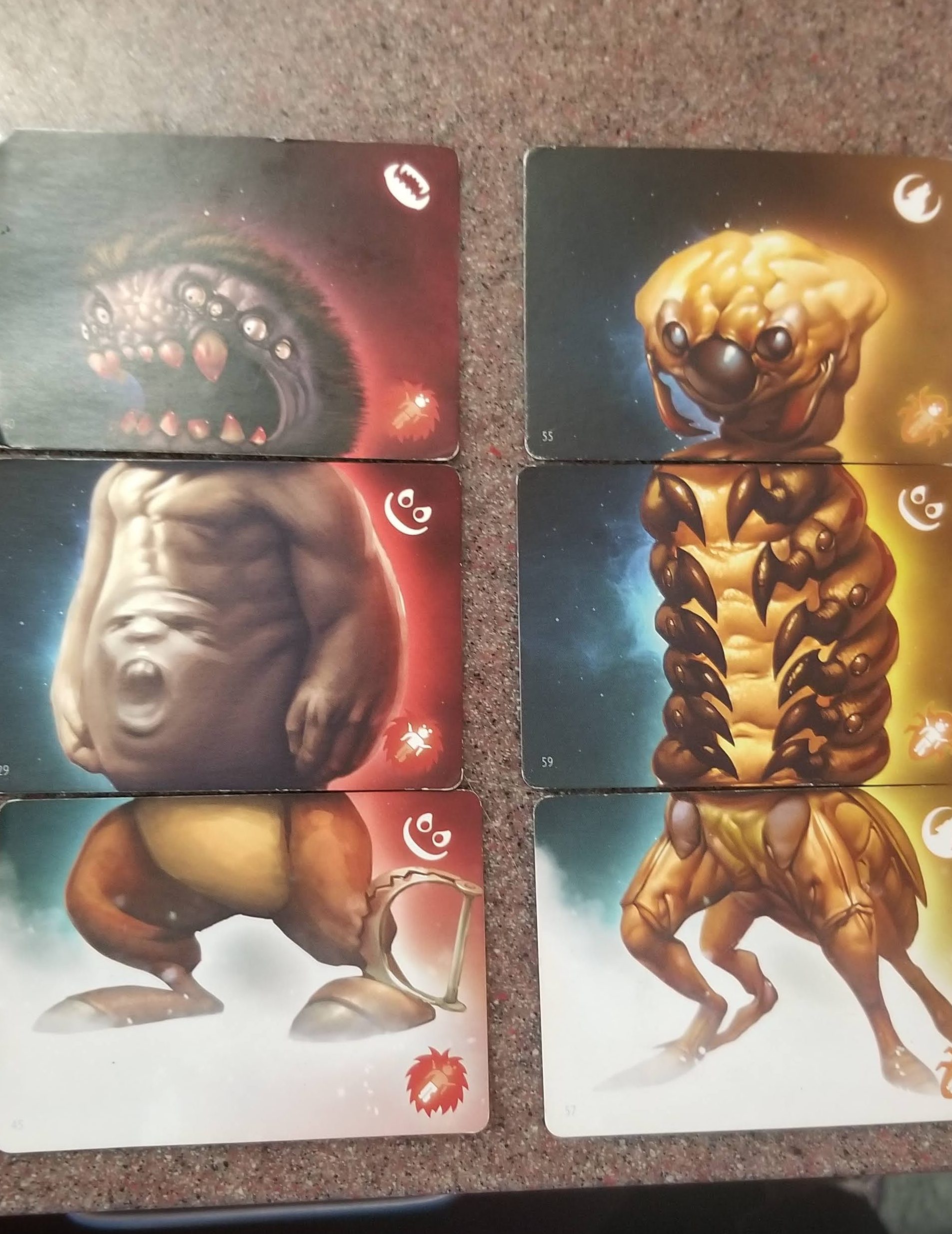
Here’s we’ve got a Manster and a Constricti. If you were to complete these guys on your turn, everyone else would have to discard either one red card and one brown card. If your opponents don’t have those colors? Get rid of any TWO cards per color. Have a red, but no brown? Discard a red and two other cards. Have only blue and green in your hand? Discard four.
You don’t have to complete two at a time; I just took a picture of these two together. But you catch my drift.
Okay, if you are playing Legions, you also have to be careful when you’re putting down cards. If you play a card belonging to a certain Legion, your second action cannot be to play a card from another Legion. If you put down a red pair of legs, you can’t play a blue pair of legs or put a brown body down next. (This is why I don’t play Legion with my library kids yet.)
That’s about it! First player to complete five Creatures wins the game! I play this game pretty regularly at home with my own family; it’s one of my 10-year-old’s favorite games. The library kids ask for this every Monday and Tuesday (our gaming days), too; it’s fun, you can be as silly as you want, and the opportunity for good-natured smack talk is mighty. While Board Game Geek lists it as only available via eBay, I’ve seen it available in several places online, including GameNerdz, Boarding School Games, and Target. Average price is about $20, and it’s well worth the cost. This one will become a foundation game for a lot of collections.
If you feel like testing before you buy, head over to Tabletopia and play online for free!
Happy Gaming!

 Mom Read It