Posted in picture books, Preschool Reads

Live your dreams! Donut: The Unicorn Who Wants to Fly

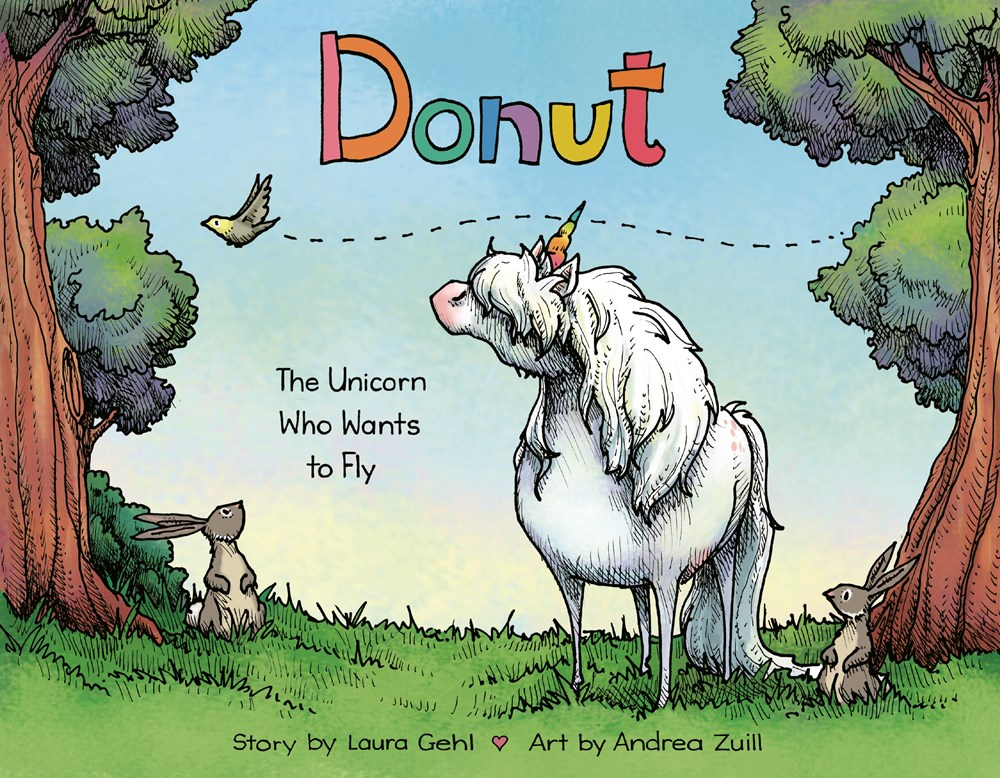
Donut: The Unicorn Who Wants to Fly, by Laura Gehl/Illustrated by Andrea Zuill, (Apr. 2022, Random House Studio), $17.99, ISBN: 9780593376256

Ages 3-8

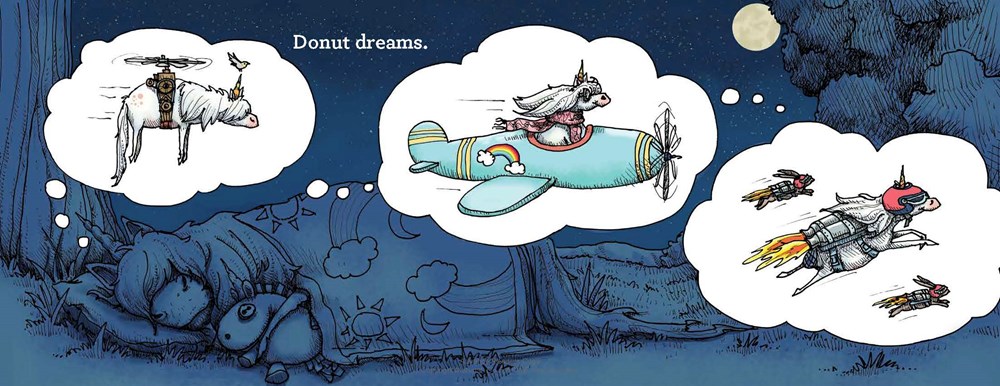
Donut is a shaggy unicorn with a thick white mane and a rainbow-striped horn who sees birds and butterflies fly, and wants to join them. Envisioning herself flying next to her winged compatriots, she jumps, thumps, and flumps; she even tries making her own wings, but she’s not able to get airborne. Can her friends give her a hand? The story is told in two-word rhyming phrases, with occasional speech bubbles for emphasis. Ink and digital artwork is colorful and light, with expressive body language and movement; Donut’s stunts get more and more laughable as she does mental math to figure out how to get in the air and flails, Wile E. Coyote-like, once gravity takes hold. Endpapers add to the story.

Honestly, kids love unicorns. EverydayMom has some fun unicorn craft ideas for a post-storytime extension. Donut: The Unicorn Who Wants to Fly is a great readaloud choice and a testament to imagination and the power of having friends on your side.


Posted in Fantasy, Historical Fiction, Science Fiction, Teen, Tween Reads

Traveling through Time via my TBR: Ripped Away by Shirley Vernick

Ripped Away, by Shirley Vernick, (Feb. 2022, Fitzroy Books), $15.95, ISBN: 9781646032037

Ages 10-14

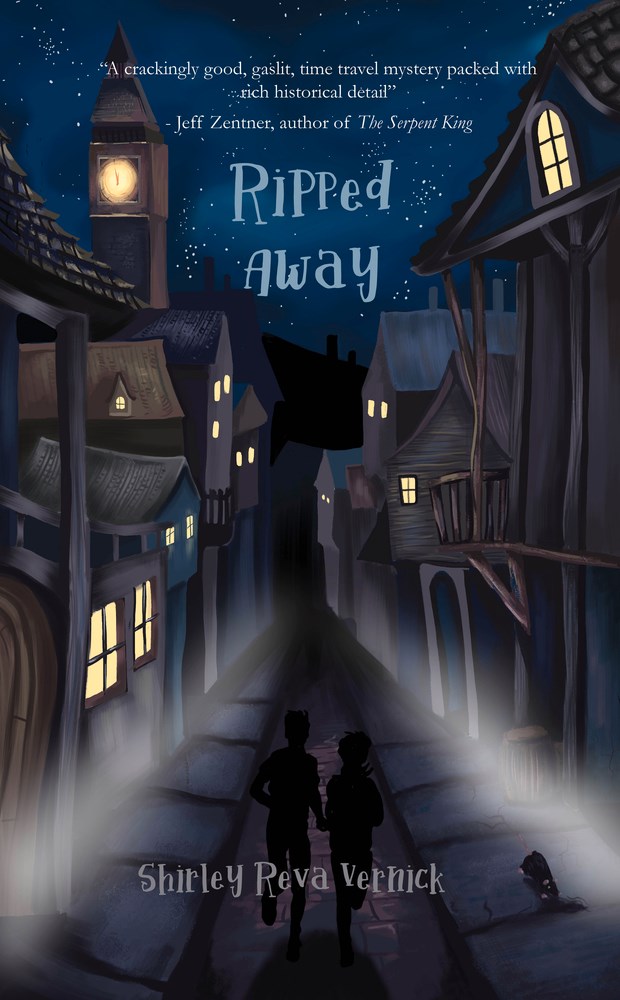
Abe Pearlman is a kid that who’s a bit of a loner. He’s got a kinda-sorta crush on his classmate, Mitzy Singer, but he doesn’t think she really notices he’s alive. When Abe spots a new fortune teller shop in his neighborhood, he goes in, figuring it’s worth a shot. Zinnia, the fortune teller, tells him he can save a life, and Abe leaves, only to discover that he’s not in his neighborhood anymore: he’s somehow been transported back in time to the slums of Victorian-era London, England! He’s now working as an assistant to a jewelry salesman named Mr. Diemschutz, living with his mom in a tenement apartment, and discovers that Mitzy has been sent back in time, too. She and her mother are living with her deceased father’s brother, in the same tenement building as Abe, and Mitzy is blind. Both were given cryptic clues by Zinnia, and now they have to figure out how to get back to their own place and time… but they also have to try and figure out how their fortunes are connected to Jack the Ripper, who’s on the loose in their neighborhood, and they have to survive the hatred directed toward Jewish refugees, already being accused to stealing jobs and housing from the English, and now being accused of possibly counting The Ripper among their community. Inspired by true events, Ripped Away is a great time-traveling story with a strong historical fiction backbone. Characters are realistic and have strong personalities that extend beyond the main plot; the author brings the history of anti-Semitism in Victorian Europe, particularly in the Jack the Ripper case, to light, and there are great points for further discussion throughout the story, including comparing and constrasting the plights of refugees, anti-Semitism, and family structures, from Victorian England (and further back!) through the present day. Back matter includes an author’s note that touches on the Victorian England, Jack the Ripper, and the anti-Jewish sentiment that gave rise harmful theories about the killer’s identity. An excellent read.

The Forward has an interesting article on Jack Ripper and anti-Semitic hysteria.

Shirley Vernick is an award-winning author. Visit her website for more information about her books and to follow her on social media.

Posted in Intermediate, Middle Grade, Non-fiction, Non-Fiction, Preschool Reads, Toddler Reads

Animals, Animals, Animals! Books for everyone!

I’ve got a bunch of great animal books, courtesy of NatGeo Kids, to talk up today, so sit back and start your program and collection planning!

Can’t Get Enough Shark Stuff: Fun Facts, Awesome Info, Cool Games, Silly Jokes, and More!, by National Geographic Kids, (May 2022, National Geographic Kids), $14.99, ISBN: 9781426372582

Ages 7-10

The latest NatGeo Kids offering fits perfectly with the CSLP “Oceans of Possibilities” Summer Reading theme, and it’s a good add to your collections and programming. Filled with fun spreads and facts, quizzes, and experiments, this is part workbook (remind kids that we don’t write in library books!), part STEM/Discovery Club handbook, and part primer on sharks for shark fans. A glossary “Catch and Match” game challenges readers to match terms with their definitions and a “Find Out More” section offers resources for further reading and a list of scientists and researchers who contributed to this volume. Over 250 color photographs show a variety of sharks, many labeled with names. A great resource to create shark-related scavenger hunts, trivia programs, and science projects for the summer and beyond.
Don’t forget that Shark Week starts on July 24th! STEAMsational has some great Shark Week activities that I want to try out with my Queens Kids (my affectionate term for my library kiddos); TeachersPayTeachers has some great freebies, too, including these coloring sheets courtesy of The WOLFe Pack; these Facts vs. Opinion cards from A Classroom for All Seasons would make for fun trivia or debate programs, and Simply Learning Life’s Feed the Shark Counting Game is a quick and fun printable for busy bags.

Critter Chat, by National Geographic Kids, (May 2022, National Geographic Kids), $9.99, ISBN: 9781426371707

Ages 8-12

If animals used social media, it would probably look like this amusing digest from NatGeo Kids. Using imagined screenshots, webpages, and social media accounts like “Llamazon”, “Dolphinstagram”, and “Yowl”, Desert_long-eared_bat reviews the Algerian Desert (5 stars – “…everything I could ever want in a dining establishment! It’s hot, it’s dry, it’s sandy, and it’s packed with scorpions”) and Upside_down_jellyfish posts selfies from the Caribbean Sea. Animals chat to one another via “Critter Chat”, and Animal Influencers spotlight famous animals like Fiona the Hippo, Punxsutawney Phil, and Brigadier Sir Nils Olav, the only penguin who’s also a knight. Hashtags and selfies communicate fun facts about animals, habitats, and more. It’s a fun way to learn little tidbits about animals, and perfect for middle graders to relax with and enjoy. Great for trivia and a side project – ask readers what they think animals would post to social media!

TeachersPayTeachers has fun social media templates that your kids can customize to make their own Critter Chats: here’s one from ZippaDeeZazz, and The Cute Teacher has phone screen layouts.


Little Kids First Nature Guide: Bugs, by National Geographic Kids, (May 2022, National Geographic Kids), $9.99, ISBN: 9781426371493

Ages 4-8

Great for younger nature fans, the Little Kids First Nature Guide: Bugs introduces little learners to all sorts of bugs. Full-color photos are labeled and accompanied by easy-to-read and understand facts, scientific terms, and diagrams. Spreads on insect life cycles of demonstrate a photo-by-photo, step-by-step explanation, using photos of different bugs. Profiles on ants, bees, beetles, and other bugs give readers a close-up look at different insects, with facts and related (but not the same!) bugs. Fun activities like Hide-and-Seek and Move Like a Bug! encourage readers with extension activities, and a glossary of terms keeps all that new vocabulary on hand. The flexible binding is made of sturdy cardboard and will hold up to many, many nature walks. Fully indexed for easy reference. A fun, informative guide for preschoolers and early school-age kids.

Education.com has fantastic butterfly activities you can download and print for free; ditto for sheets on bugs in general. There are some adorable activities on Pocket of Preschool that you can do on a budget.


Little Kids First Big Book of Baby Animals, by National Geographic Kids, (March 2022, National Geographic Kids), $14.99, ISBN: 9781426371462

Ages 4-8

The Little Kids NatGeo Kids books are adorable, aren’t they? I’ve got a bunch here at my library, and my now 10-year-old loved them when he was in Pre-K and Kindergarten. (As he’s 10, he is no longer a “little kid”, as he tells me. Often.) The Little Kids First Big Book of Baby Animals contains over 120 pages of squeal-worthy color photos of baby animals with their families. You pull this out and show it to your kids – library or otherwise – and you will have a roomful of little ones in the palm of your hand. And when you tell them things like a panda cub’s cry sounds like a human baby’s cry? Or that a hippo can’t swim yet, so it gallops underwater? They will tell you ALL about their favorite animals, and the cute things that the animals in their lives do, so get ready to have the best, cutest conversations about baby animals. Fun facts and thought-provoking questions run throughout the book, and text is larger in size, making it easier and less dense for younger kids and emerging readers. A map of the world at the end of the book is color coded to show where animals referenced in the book live, and parent tips help caregivers extend the knowledge from the book into the real world. There is a glossary of terms, a list of additional resources, and a full index. Add this book to your animals collections.

123Homeschool4me has some free printables where kids can match baby and adult animals and learn the terms for different baby animals.


Little Kids First Board Book: Birds, by National Geographic Kids, (March 2022, National Geographic Kids), $7.99, ISBN: 9781426371448

Ages 0-3

I love NatGeo Kids’s First Board books! They’re so bright and cheery, and the photos and activities are perfect for engaging littles during a lapsit storytime. The latest is Birds, and contains 12 spreads with color photos of different birds. Each spread has a simple, one-sentence factual statement and a colorful callout fact about birds, and each picture is labeled with the name of the bird in a colorful box with bold black lettering. Names of birds and key phrases get a nice, colorful font that sets them off from the rest of the text. A final spread invites readers to try different activities to identify six featured birds: “Tap the toucan’s beak. / Flap your arms like the eagle.”

This is the seventh Little Kids First Board Book. It’s a great series for beginning learners, with sturdy cardboard to hold up to many circs and readings. NatGeo Kids has a birds website where learners can watch videos, see maps, and learn facts about 24 different birds, presented in alphabetical order. Also check out their Strange Birds website for photos of more feathered friends.

Happy Hooligans has a great list of 25 bird crafts for little ones that are easy on easily done on a budget.


National Geographic Readers: Mythical Beasts: 100 Fun Facts About Real Animals and the Myths They Inspire, by National Geographic Kids, (Jan. 2022, National Geographics Kids), $4.99, ISBN: 9781426338939

Ages 7-10

Unicorns, dragons, and krakens all have one thing in common: they’re mythical creatures with origins in very real history. NatGeo Kids’s Mythical Beasts is a Level 3 Reader, good for most readers ages 7-10, that provides 100 facts on real animals and the myths they’ve inspired or are named for. A helpful key to NatGeoKids’s leveling system is right on the back cover, and I like using the 5-finger rule for choosing a book when I do my Readers Advisory. The book is organized into 3 chapters and two 25 Facts spreads that give readers the roundup on history’s mysteries: mermaids were most likely manatees, who have fishy tales but can turn their heads from side to side like humans; the giant Kraken was most likely a giant squid. Using research and the fossil record, color photos and illustrations, NatGeo Kids author Stephanie Warren Drimmer takes kids through the process of figuring out why ancient people mistook a distant ancestor of the elephant was mistaken for a cyclops, and how dinosaur fossils led folks to believe that they discovered proof of dragons. We get some modern-day mythical behavior, too: the basilisk lizard can run across water, and adult jellyfish can age in reverse and regrow into adults again, like the phoenix’s power to be reborn (sans ashes, though). The back matter rounds up all 100 facts across a spread (and makes for great trivia questions).

Fun for a STEM/Discovery Club, fun for collections. And you can extend the activity with mythical creature-inspired crafts. Give kids a manatee coloring page and let them create mermaid friends. They can create a giant squid of their own, or try their hands at this fun paper roll squid craft. Make a handprint unicorn and give it a narwhal friend.


Posted in Fantasy, Fiction, Middle Grade, Tween Reads

Exciting Afrofuturistic middle grade reading: Onyeka and the Academy of the Sun

Onyeka and the Academy of the Sun, by Tolá Okogwu, (June 2022, Margaret K. McElderry Books), $17.99, ISBN: 9781665912617

Ages 8-12

Onyeka is a tween living in the UK with her mom. She’s got a thick head of hair that makes people stop, stare, and whisper, but her best friend, Cheyenne, couldn’t be bothered what other people think, which helps calm Onyeka’s anxiety. When the two head to the pool for some swimming, Cheyenne almost drowns, until Onyeka – or, is it Onyeka’s hair? – saves her. Everything moves quickly from here: Onyeka’s mother reveals that she is Solari, a secret group of people with unique powers, unique to their home in Nigeria. Her scientist father has disappeared while trying to research the Solari, and her mother brings Onyeka to Nigeria, to the Academy of the Sun, a special school – think the X-Men’s school run by Charles Xavier – for Solari, where they are trained to work with their powers. But nothing’s ever that easy; as Onyeka starts learning more about her family and the Rogues, a group of Solari working against the school, she and her new friends have to figure out where they stand.
Onyeka and the Academy of the Sun is the first in a new series, written by British-Nigerian author Tolá Okogwu and inspired by a lack of representation in children’s books. The decision to empower Onyeka by channeling her power through her hair is a deliberate move, as she notes in her author’s note: “our hair has never just been hair… the lie we’ve all been fed that Afro textured hair is somehow inferior because it doesn’t conform to the Western standards of beauty”. Onyeka’s hair is incredible: it shields her; it saves Cheyenne’s life; it curls around her to comfort her. The characters are African; the Solari are all Nigerian, and the school is organized into different areas, according to student’s Ike – the Igbo word for “power”. The story moves at a brisk pace while still bringing these characters to life, fully-fleshed out with backstories and personalities. The students will empower and inspire readers, and the family relationships are beautifully realistic, with conflict and love often sharing the same space. A glossary of words and an explanation of Nigerian Pidgin English provides even further depth and educates readers. I can’t wait for the second book.
Give this to your Rick Riordan Presents fans; your Black Panther readers (not just the comics! Remember, Shuri and Black Panther have middle grade novels, and Okoye’s got a YA novel, too!), and your Tristan Strong readers. Give this to any of your readers who love reading about different cultures, and are always up for adventure. It’s awesome.

Onyeka and the Academy of the Sun is an Indie Next pick.

Posted in gaming, Librarianing, Middle Grade, Teen, Tween Reads

Tabletop Tuesdays with Nightmarium

I’ve been behind on… well, everything, but especially on my gaming posts. Our gaming club is coming along nicely, and since I’ve sent Carcassone out to the next library on the rotation, the kids are back to playing the games we’ve got in house and the goodies I bring from my home stash. The last couple of weeks, Nightmarium has been all the rage here – and why not? It’s creating monsters that turn on one another with glee! I backed Nightmarium as a Kickstarter a few years ago, and it has been a mainstay of gaming in my own home. You don’t need to read to play, the monsters are hilariously weird, and game play moves along at a good pace. Let’s dig in.

Nightmarium: A Game About Conquering Nightmares, Ares, Igrology, et al (2014)
Ages The box says 10+; I’ve actively played this with my then 5-year-old, and easily explained to 7-10 year-olds here at the library. I’d go 7+
Play time: 20-30 minutes, depending on number of players
Number of players: 2-5

Find Nightmarium on Board Game Geek

The monsters featured in this game are a group of Night Terrors ready to haunt your dreams. The backstory is fun, organizing the monsters, by color, into four Legions of Horror. The backstory isn’t necessary for game play, but it adds to the fun. Each legion has its own color: blue stands for Necromunculi, brown for Constricti, green for Chimeridae, and red for Mansters.

Cards come in three types: feet/legs, trunks/bodies, and heads. Some cards can serve multiple functions, like this striking fella, who can be either a head or a body:


Players get two actions per turn. You can:

  • draw a card from the top of the deck
  • play a card from your hand
  • discard cards and redraw: one card for every two you discard

If you draw a card and play a card, that’s two actions. If you draw two cards, that’s two actions. If you draw two cards and you want to play the second card, you have to wait until it’s your turn again; playing that card would be a third action. You can discard two cards, draw one card to replace them, AND play or draw another card. That counts as two actions.

You have to assemble your monsters from the bottom up. Feet first; if you have a handful of really great heads, that’s awesome, but you have to start from the feet. There’s no hand minimum or maximum; if you don’t want to get rid of any of your cool head cards, keep them, and keep drawing until you get feet you want to play to start things off.

When you complete a monster, congrats! See those See those pictures in the upper right hand corner of most cards (not all have them)? Those are different abilities that activate once you complete a monster.

Watch out for that Devourer – you have to cut one of YOUR Creatures’ heads off, not your opponents! This can actually be a good thing, because you can add another head and reactivate powers, if you have good ones. It’s a good secret weapon to have. Creature powers are only active when the Creature is completed – not every turn, and not while under construction.

Okay, let’s talk about Legions. I don’t tend to play Legions at the library, because I modify to make things as simple and fun as possible for my younger gaming kids. Legions, like I said before, are organized by color. You don’t HAVE to create Creatures with all parts from the same Legion, though – you’ll still get your abilities when you complete one. Look:


Here’s a creature composed of parts from all different Legions (Notice the bottom in #2 can also function as the middle in #3). In #1, the Creature has only one power to activate: the Scavenger, where the player can discard any incomplete creature belonging to another player. If I’m playing against this player, and I have a 2- or 1-card Creature under construction, that player can say goodbye to it, and I have to put it in the Discard pile.

The #2 Creature has Scavenger and the Herald, which lets that player reveal two cards from the deck, face up, so all other players can see it, and play them if they can. If the player gets a pair of feet, awesome; they can play it. If the player draws a body and a head, they can only play them if they have under construction Creatures that can use those cards. Anything that the player can’t use right then and there goes in the Discard pile.

Other powers include the Weeper, which lets the player draw two cards from the deck. They don’t have to play them, they just add them, regardless of what they are.

The Mocker lets you play one card from your hand.

The Executioner lets you take another player’s top card – heads, but also anything that’s on top – if you have a monster under construction and the top card you have is a body, your opponent can take that with Executioner. Cards claimed when someone plays Executioner goes into the player’s hand, not the Discard pile.

Playing abilities does NOT count toward your actions! If the first move you make during your turn is to complete a monster, you play the abilities, and THEN play your second action. It’s pretty awesome.

Okay, so let’s talk about Legions. Like I said, I tend not to play Legions because it’s easier for younger kids to just get used to playing cards, but playing Legions can mix things up for extra fun. Match the colors of your creatures to trip up your opponents: when you finish a monster with cards from the same Legion, everyone else has to discard a card of that Legion OR discard any two cards. Look:

Here’s we’ve got a Manster and a Constricti. If you were to complete these guys on your turn, everyone else would have to discard either one red card and one brown card. If your opponents don’t have those colors? Get rid of any TWO cards per color. Have a red, but no brown? Discard a red and two other cards. Have only blue and green in your hand? Discard four.

You don’t have to complete two at a time; I just took a picture of these two together. But you catch my drift.

Okay, if you are playing Legions, you also have to be careful when you’re putting down cards. If you play a card belonging to a certain Legion, your second action cannot be to play a card from another Legion. If you put down a red pair of legs, you can’t play a blue pair of legs or put a brown body down next. (This is why I don’t play Legion with my library kids yet.)

That’s about it! First player to complete five Creatures wins the game! I play this game pretty regularly at home with my own family; it’s one of my 10-year-old’s favorite games. The library kids ask for this every Monday and Tuesday (our gaming days), too; it’s fun, you can be as silly as you want, and the opportunity for good-natured smack talk is mighty. While Board Game Geek lists it as only available via eBay, I’ve seen it available in several places online, including GameNerdz, Boarding School Games, and Target. Average price is about $20, and it’s well worth the cost. This one will become a foundation game for a lot of collections.

If you feel like testing before you buy, head over to Tabletopia and play online for free!

Happy Gaming!

Posted in Uncategorized

Happy Book Birthday to Rosa’s Song by Helena Ku Rhee and Pascal Campion

Rosa’s Song, by Helena Ku Rhee/Illustrated by Pascal Campion, (June 2022, Random House Studio), $17.99, ISBN: 9780593375495

Ages 4-8

Jae, a young boy from South Korea, and his mother move into a new building in a new country. Missing his home and friends, Jae is withdrawn, but his mother urges him to get out and meet other kids in the building; Jae meets Rosa, a friendly young girl whose pet parrot, Pollito, sits on her shoulder and warbles a sweet song. Rosa and Jae become fast friends, and engage in imaginative play that evokes memories of each of their home countries; scaling sofa mountains and exploring lost Incan cities and rainforests. When Rosa and her family suddenly leave one night, she leaves her parrot to console the heartbroken Jae. Shortly after Rosa leaves, Jae meets two new children in the building, and follows Rosa’s example, becoming their friend and guide to their new home and world. Helena Ku Rhee’s childhood inspired the story, which shows the need for connection and highlights the often erratic home lives of immigrant families, who often have to move suddenly, whether because of immigration status, employment, financial stress, or family issues. Pascal Campion’s digital artwork gives vision to Helen Ku Rhee’s voice: Jae stares out a window at a brick wall while standing in a beige room with faded wallpaper; upon meeting Rosa, his world becomes more colorful. Touches of each child’s home country are represented, with Asian brush paintings decorating the walls of Jae’s home, and colorful parrots and lush green trees in the rainforest of Rosa’s memory. When Rosa leaves, Jae’s world goes gray again, and the portrait of Jae in Rosa’s vacated apartment is absolutely devastating. Endpapers show Rosa and Jae at imaginative play, with Pollito flying around them. A touching and lovely book on empathy and friendship.

Rosa’s Song has a starred review from Booklist.

Posted in Fiction, Fiction, Graphic Novels, Intermediate, Middle Grade

Coping with Loss: Burt’s Way Home

Burt’s Way Home, by John Martz, (July 2022, Tundra Books), $12.99, ISBN: 9780735271029

Ages 6-9

Burt is an “intergalactic, transdimensional time traveler”. His parents, also time travelers, have been separated from him during a journey, and now he’s stuck on Earth, living with a woman named Lydia, until he can figure out the antiquated Earth technology and find his way home. Lydia, however, tells a very different story. A graphic novel created with two narratives, Burt’s Way Home is an aching look at a child in foster care, dealing with confusion and grief, and the caregiver who tirelessly works at understanding him, supporting him, and caring for him. Illustrated in two-color blue and white, with bold black outlines, John Martz creates an unfussy atmosphere that carries cartoon appeal while delivering a poignant message. This is a completely different story about grief and loss, and I want this in my collection first and foremost, for any child that may need it – for a child living in a foster situation, or for any children whose primary caregiver is not their parents: a grandparent, an aunt or uncle, an older sibling, a family friend – and to explain and engender empathy in others. Sensitive and respectful, this is a great book to have in your collections.

Burt’s Way Home was originally published in 2016 by Koyama Press.

Posted in picture books, Preschool Reads

Authenticity is Epic: Kick Push

Kick Push, by Frank Morrison, (Apr. 2022, Bloomsbury USA), $18.99, ISBN: 9781547605927

Ages 3-7

Ivan – better known as Epic – is a skateboard king: “He’s been grinding the streets with moves to big, his friends call him EPIC”. He’s just moved to a new town, and he doesn’t know anyone, and trying out new tricks without anyone to cheer you on is no fun. Epic tries out some other sports, trying to fit in and find his new crew, but it’s just no good. Luckily, his dad is there to give him the best advice: stay true to yourself, and be EPIC. Sure enough, Epic gets back on his skateboard and discovers that the self-confidence that comes from doing what you love and being yourself is the best introduction of all. this is Frank Morrison’s first time out as author-illustrator; you may have seen his work on books like I Got the Rhythm and I Got the School Spirit, both by Connie Schofield-Morrison, or the award-winning Little Melba and her Big Trombone by Katheryn Russell-Brown. His illustration work and his storytelling pulse with life, giving an urban beat to the story. Epic is a brown-skinned boy with natural hair and flies through the air on his skateboard, soaring past a vibrant urban inner city landscape. He speeds by ice cream trucks and graffiti-adorned buildings; bright orange construction cones mark sidewalks under construction; kids play with super soaker water guns in a park; a hip-hop dance troupe runs through their moves in a studio; a kid gets a high-top fade at the local barber shop. Kick Push embraces authenticity, community, and pride.

Frank Morrison is an award-winning illustrator. He received a Coretta Scott King Illustrator Award for RESPECT: Aretha Franklin, the Queen of Soul, an NAACP Image Award for Our Children Can Soar, and a Coretta Scott King/John Steptoe New Talent Award for Jazzy Miz Mozetta.

Posted in picture books, Preschool Reads

The joy of self-expression: John’s Turn

John’s Turn, by Mac Barnett/Illustrated by Kate Berube, (Feb. 2022, Candlewick Press), $17.99, ISBN: 9781536203950

Ages 4-8

Every Friday, a school cafeteria turns into a place where kids put on performances for one another: an artistic show and tell. This week, it’s John’s turn, and he’s a little nervous. When it’s time, he changes into his leotard, pants, and ballet slippers, and begins to dance. It’s tense at first, as John’s fellow students watch him, but as John gives himself over to the music and the dance, his confidence builds; his joy is evident. At the end of his dance, his classmates cheer and applaud, and John beams, having shared a special moment with them. Kate Berube’s ink and paint illustrations gracefully capture the tension and anticipation that goes into a performance; those moments where the performer goes through the day with butterflies in their stomach, the worry, the pre-show jitters. He knows kids, and the thinking that ballet dancing is largely thought of as “a girl thing”, and the nervous snickers when the music begins. Mac Barnett’s narration is simple, elegant, to the point, and pausing to let Kate Berube shine during the performance: she beautifully captures the shifting emotions surging through John as he begins his dance; a nervous, almost nauseated feeling on his face at first, moving into a slight smile as he moves through the routine, and the background color shifts from a dull brown to a positively incandescent rose as he loses himself in the emotion of his dance, ending with soft pastels as, cheeks flushed, he takes a bow. It’s a gorgeous story.

John’s Turn has starred reviews from Publishers Weekly, The Horn Book, and BookPage.

Posted in picture books, Preschool Reads

The Pineapple Princess is a benevolent ruler… kinda.

Pineapple Princess, by Sabina Hahn, (May 2022, Roaring Brook Press), $18.99, ISBN: 9781250798367

Ages 4-8

“I am deeply, deeply misunderstood.” Who hasn’t felt like this? The little girl in this story just knows she’s a princess, but no one wants to believe her. So what does she do? She carves her own crown out of a pineapple and pronounces herself The Pineapple Princess! She’s got some devoted subjects, too: a swarm of flies surrounds her, drawn to her sticky, sweet pineapple-y self. At first, she’s delighted to have the attention, but she quickly tires of having bugs follow her around; turning to more tyrannical measures, she decides that she doesn’t want to be a princess anymore… she’s evolved into a warrior queen. Witty, with a touch of chaotic hilarity, Pineapple Princess touches everyone’s – kids and adults alike – inner benevolent dictator. Sabina Hahn’s illustrations give an impish wink to the reader as the princess sets about carving her rule, certain that her deniers will rue the day they didn’t listen to her. And, in the most playful, childlike way, we see her tire of her Pineapple Princess persona, and change gears to something more fun. It’s a perfect storytime book, and embraces the joy of childhood imagination and endless summer days.

See Sabina Hahn’s storytime video here, and download a free storytime kit here. Visit Sabina Hahn’s website and her Instagram page for more of her illustration work.

Pineapple Princess has a starred review from Booklist and is a Kids Indie Next pick.