Posted in Post-apocalyptic/Dystopian, Teen

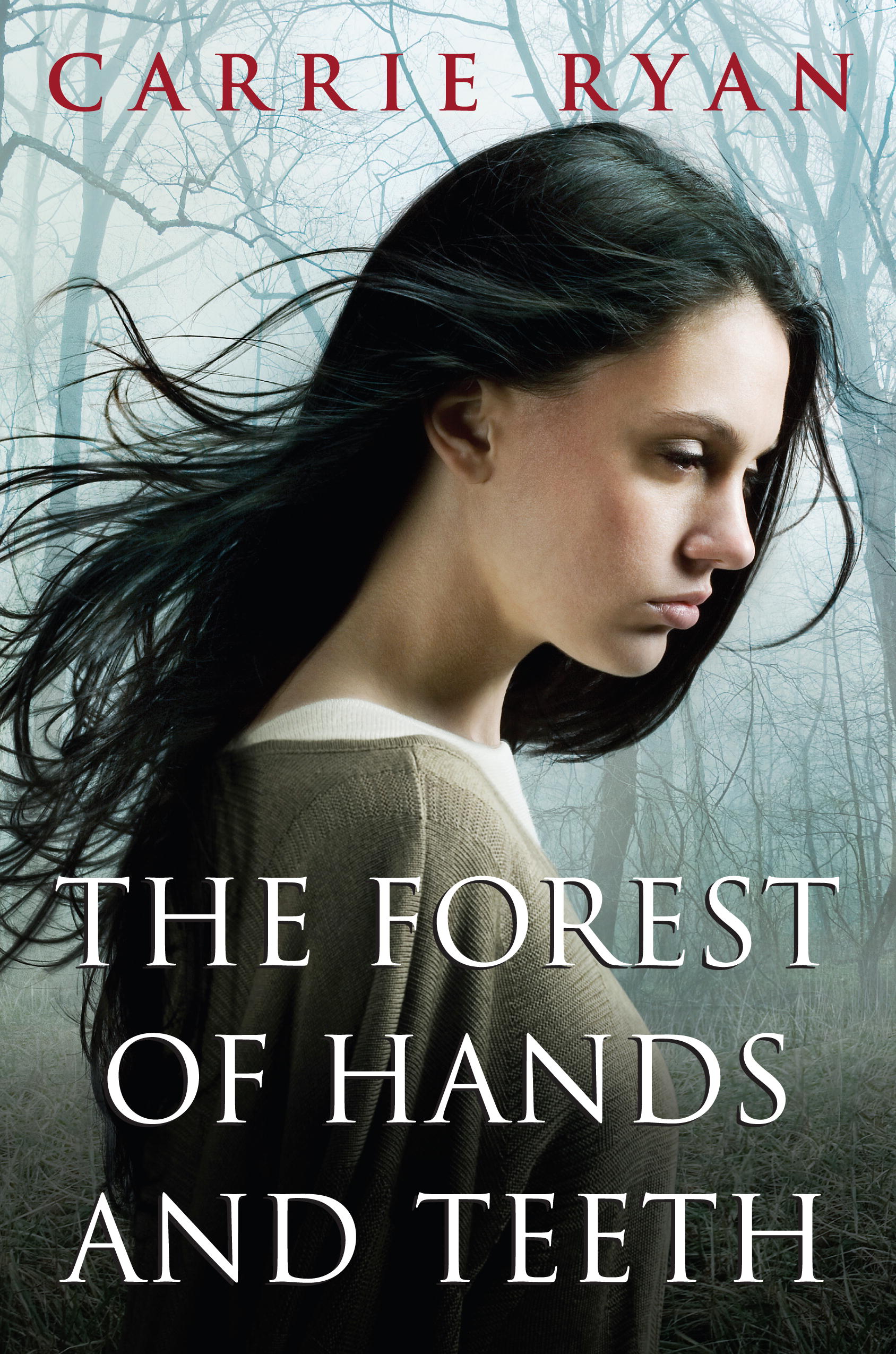
Book Review: The Forest of Hands and Teeth, by Carrie Ryan (Random House, 2009)

the-forest-of-hands-and-teethRecommended for ages 14+

Mary and her brother Jed live in a post-apocalyptic world, in a small village overseen by the Sisterhood and the Guardians. The Sisterhood is the reunion of church and state, a governing body that rules through their faith. The Guardians keep them safe from the Forest of Hands and Teeth, always outside their gates.

The Forest of Hands and Teeth refer to the zombies that wander, ever-present, just outside of the settlement. When the settlement fences are breached, Mary, her brother and a small group of survivors escape and seek the ocean, where Mary believes they will be able to start over. But they have to make it through the forest first.

The Forest of Hands and Teeth is one of those books that has layer upon layer of complex storytelling, all centered around the main character, Mary. Ms. Ryan explores her relationships – with her mother, her brother, her best friend, fiance, and his brother, her true love – against the backdrop of the aftermath of a zombie apocalypse. She is an obsessive character, driven by her drive to question. What lies beyond the settlement? Are there more settlements, more people, out there? What secrets does the Sisterhood keep from everyone? Where is the ocean, that her mother raised her on stories about? At times, the character appears cold and self-serving; she is single-minded in her purpose.

As the first in a post-apocalyptic series (The Dead-Tossed Waves and The Dark and Hollow Places are the sequels), the book is bleak but compelling. It doesn’t focus on the zombie horror, but it’s an ever-present threat that crawls down the reader’s spine and makes one’s heart beat with a sense of urgency at key points.

Author Carrie Ryan writes for middle grade and young adult readers, and has a full list of work available on her website, where readers can also follow her blog, follow her on social media, find out about appearances and news, and download icons, buttons, banners, and bookmarks.

Posted in Preschool Reads

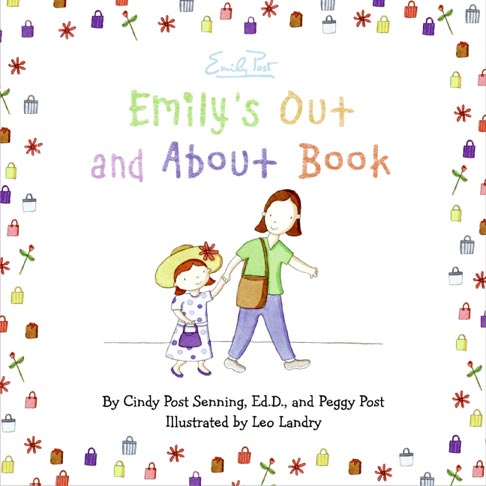
Book Review: Emily’s Out and About Book, by Cindy Post Senning and Peggy Post/illus. by Leo Landry (Collins, 2009)

emilys out and aboutRecommended for ages 4-6

Little Emily and her mother have errands to run: they go to the library, the doctor’s office, the market, and then stop for lunch before going home. At each stop, Emily demonstrates good manners, from using her inside voice in the library to asking a neighbor before petting her dog. Emily shows young readers that remembering good manners makes the day more enjoyable for everyone!  Written by manners maven Emily Post’s great-granddaughter Cindy Post Senning and great-granddaughter in-law Peggy Post, Emily’s Out and About Book never reads like a rule book for children; the watercolor illustrations and subtle text, dressed in fiction, communicates the valuable information that preschoolers should know about manners as they get ready to enter Kindergarten. The colors are sedate and colorful on a white background, and the perspective changes from neighborhood spreads to individual pages featuring Emily and her mother. The endpapers provide a map of the neighborhood featured in the story. The plain black font tells the story simply and plainly. A word from the authors to parents at the book’s end explains the importance of manners and encourages parents to use the book as a teaching opportunity.

With preschool-age children getting ready to enter Kindergarten, a manners-related storytime would be a valuable way to reinforce positive social skills. Bay Views offers Manners/Etiquette storytime suggestions that suggests the song “Where is Thumbkin?”, which includes proper etiquette for greetings  and  saying thank you; it also links to Step by Step CC, a page that offers manners-themed activities. For a smaller storytime group, a tea party, serving iced tea and cookies, would be a good way to reinforce manners learned in the book. Other works by the authors include Emily’s Caring and Sharing Book; Emily’s New Friend; and Emily’s Christmas Gifts.

Posted in Uncategorized

Book Review: Baby Shoes, by Dashka Slater/illus. by Hiroe Nakata (Bloomsbury, 2006)

baby shoesRecommended for ages 2-5

A toddler’s new white shoes with a blue stripe turn into multicolored shoes after an eventful day in the park with his mother.

Mama buys Baby gets a new pair of white shoes with a blue stripe and then head to the park, where Baby proceeds to get those new white shoes covered in chalk, grass, plum juice, and yellow paint as he barrels through his day. With every new “decoration” on his shoes, Baby and Mama exchange an “Uh-oh!” and an “Oh, no!”, but those shoes just go, go, go! The repetitive, rhyming text invites young audiences to jump in and participate, and the watercolor illustrations provide inviting images the draw readers into Baby and Mama’s eventful day. There is a great deal of action in the book, with dotted lines tracing Baby’s path and Mama in a perpetual runner’s crouch, hands extended, to catch the active Baby. The endpapers invite the reader into the story, showing Baby’s shoes in a variety of situations that arise in the book: getting caught in the path of a red chalk line, running through grass, and negotiating a yellow line of paint. The plain black font is bold enough to stand out from its sedate but colorful background, and curves around the text to continue the feeling of action.

This is a great story to bring into a lapsit read-aloud, especially as the book is targeted at active toddlers and young preschoolers. The repetitive text engages young listeners and offers them the opportunity to chime in with Mama, Baby, or both as baby collects a new color on his shoes. Rhymes and fingerplays will get the active toddlers playing and moving. A Raffi CD would add enjoyable music, allowing a dance time to bring a successful storytime to a close.


Posted in Horror, Post-apocalyptic/Dystopian, Teen

Book Review: Ex-Heroes, by Peter Clines (2012, Crown)

exheroesRecommended for ages 16+

Peter Clines’ Ex series, beginning with Ex-Heroes, is one of those series created for adults but easily crosses over into the teen readers’ market. It provides an interesting new take on the zombie apocalypse, with this universe offering superheroes who continue protecting humanity by creating a haven in an abandoned Hollywood movie lot for survivors.

As with the best post-apocalyptic/zombie tales, the interplay between people facing the end of the world is what makes Ex-Heroes compelling reading. You not only have survivors, The survivors are split into those inside the sanctuary and those outside – inside the sanctuary, we have the superheroes – metahumans – and “regular” people. Outside, there are predatory gangs that have turned the surrounding areas into their kingdom. They try to infiltrate or sabotage the heroes’ camp and supply runs, but have been largely unsuccessful until they find themselves with a terrifying advantage that could destroy everything the heroes have striven to build. Add in the fact that within the sanctuary, there’s dissension in the ranks as more and more people find themselves uneasy about being governed by superpowered individuals, and you have a the makings of a compelling post-apocalyptic saga.

The best zombie stories are not so much about the undead, but about the survivors and how people break down – or endure – life at the end of the world as they know it. Here, Ex-Heroes shines. The relationships between heroes is complex to begin with, and the stress of the situations around them, added to the fact that there are now superpowered undead to compound the situation, amp up the action and the desperation. We get origin stories and back stories for the major heroes: Stealth. Gorgon. Regenerator. Cerberus. Zzzap. and The Mighty Dragon, and the action shifts pretty seamlessly from past to present, giving us a full picture.

While written for adults, Ex-Heroes is an accessible book for teen audiences who enjoy horror/post-apocalypse fiction. The violence is not gratuitous and while there are allusions to sex and some language and overall content, I see no reason why a mature teen would not be able to read and enjoy this book.

Ex-Heroes is the first book in Peter Clines’ Ex series, which also includes Ex-Patriots, Ex-Communication, and Ex-Purgatory.

Posted in Preschool Reads

Book Review: Bumble-Ardy, by Maurice Sendak (HarperCollins, 2011)

bumble-ardyRecommended for ages 2-6

Beloved author Maurice Sendak’s Bumble-Ardy is inspired by a short, developed by Mr. Sendak and Jim Henson, for Sesame Street.

Bumble-Ardy is a young pig who has never had a birthday party because his family “frowned on fun”. When he was eight, his parents “got ate” and he went to live with his Aunt Adeline. Finally, for his ninth birthday, Aunt Adeline gives him a “hotsy tottsy cowboy costume” and leaves for work; Bumble decides to throw himself a masquerade birthday party that quickly escalates out of control, just as his aunt returns home from work. Sendak uses watercolors to illustrate his story, and the rapidly escalating party brings to mind the Wild Rumpus from Where The Wild Things Are.

The number nine is a major theme throughout the book: the party takes place at ten past nine; Aunt Adeline kisses Bumble-Ardy nine times over nine, and the number shows up in a great deal of  the artwork, from a birthday candle on Bumble’s cake to the signs partygoers make for the celebration.  Readers and listeners will enjoy the story of a little pig who wanted a birthday party so badly that he threw one for himself; they will also be reassured by the theme of forgiveness; Aunt Adeline can be angry, yet still kiss him  and tell him she loves him.

This would be a fun addition to a birthday-related read-aloud. I would set up the read-aloud like a birthday party, with mini-cupcakes rather than cake, and milk, and decorate the storytime area as I would for a birthday party, with streamers and a sign. I would ask if there were any birthday boys or girls in the room, and have birthday ribbons for any birthday children to wear. Singing the Happy Birthday is a must, and the Perry Public Library has a Happy Birthday theme that includes other birthday-related songs and rhymes. Bumble-Ardy would also be a fun book to use a flannel board with, particularly for the party scenes.

Posted in Preschool Reads

Book Review: Moonlight, by Helen V. Griffith/Illus. by Laura Dronzek (Greenwillow Books, 2012)

moonlightRecommended for ages 2-6

Told in rhyme, Moonlight tells the story of a rabbit that is so sleepy, he cannot wait for the moon to come out from behind the clouds, and heads to his burrow to sleep. When the moonlight emerges from behind the clouds, it coats everything it touches in a “butter trace”. It even reaches into Rabbit’s burrow and into his dreams, waking him up.

The illustrations, done in deeply saturated acrylics, set a drowsy, sleepy tone as readers see the moon lazily “butter” everything in its path with its light. The stars and comets look almost like Van Gogh’s Starry Night; the animals bathed in its light all sleep peacefully, and the landscapes  – mountains, trees, and  streams  – all seem soft, relaxed. The brief text itself seems quiet and relaxed, showing up unobtrusively on each spread and without punctuation to halt the eye or the mind.

This would be a wonderful addition to a bedtime read-aloud. Audiences can attend in their pajamas with a favorite stuffed animal, and serving milk and cookies would add to the storytime atmosphere. There are many bedtime rhymes and songs that can fit in with this theme. Using a flannel board may add to young audiences’ appreciation of the story.

Posted in Preschool Reads

Book Review: Ride, by Stephen Gammell (Harcourt, 2001)

rideRecommended for ages 3-6

A mother and father decide to take their children on a Sunday ride. The siblings don’t share their parents’ enthusiasm. Once in the car, it begins. First come the insults: “You’re a poopy face.” “You have booger breath.” The argument escalates into an all-out fantasy brawl, with furniture flying, rockets blasting off, and a dinosaur showdown. Mother offers a snack, which calms things down momentarily: but for how long?

Mr. Gammell’s pastel-pencil-watercolor illustrations are bursting with color and energy. His rainbow palette is reminiscent of a Spin-Art machine, with splatters and smudges throughout each page. The text is woven into the story, as there is no narrator, only the dialogue between family members. The bold text exists in the same space as the illustration, with exaggerated sizes, colors, and splatters. The book will appeal to young audiences, especially those with siblings or other family members who can relate to being stuck in a car with someone who drives them crazy, and the imaginative tussles that the siblings create.

This would be a fun addition to a sibling read-aloud. It may also be enhanced by using puppets to act out the family’s interactions; in particular, the brother and sister, whose battle frames the book. There are songs and fingerplays about siblings available that can be easily taught to audiences, including “Here is Sister/Here is Brother”, to the tune of Frere Jacques.

Posted in Preschool Reads

Book Review: Rainstorm, by Barbara Lehman/Illus. by Harry Bliss (Henry Holt & Company, 2004)

rainstormRecommended for ages 3-6

When the moon comes down, in pieces, on a neighborhood street, everyone works together to get it fixed and back up in the sky.

Influenced by the events of September 11th, Jean Gralley wrote this story about a neighborhood’s first responders and citizens coming together in the wake of a potential disaster: the moon falls, breaking into pieces, from the sky. The story celebrates teamwork and its accomplishments as evidenced by the Fire Chief, Rescue Workers, Helper Dogs, and “people everywhere”, all who come running to help, in answer to the question, “Who will make it right again and set it in the air?” A Fred Rogers quote at the beginning of the story reminds children to “Look for the helpers”.

The gouache and mixed media illustrations on white backgrounds soften the images; the author is not interested in focusing on catastrophe, but on collaboration – an important message for a preschool audience. The sparse, rhyming text sits on the page, never intrusive, in a plain black font. Volunteers smile and cheer one another on in their mission, making sure to include everyone: even the Helper Dogs. The book has been used to help children deal with fear and grief surrounding current events like disaster, war, and ever-changing security alerts because of its messages of endurance and optimism.

The book would be a good addition to a read-aloud on rescue workers – firemen, policemen, medical technicians, doctors and nurses – for its positive portrayal of these first responders and their ability to work with everyone around them. Displaying toy fire trucks, police cars, and ambulances around the storytime area will set a mood for the storytime and allow for play. There are firemen and policemen printables available online that children can color and bring home.

Posted in Preschool Reads

Book Review: Diary of a Worm, by Doreen Cronin/illus. by Harry Bliss (Joanna Cotler Books, 2003)

diary of a worm

Recommended for ages 2-6

A young worm journals his daily life, writing about his friends, his family, and the pluses and minuses of being a worm.  His observations are often very funny, as when he talks about spending the day above ground with his family after a rainstorm, and then notes, “Hopscotch is a very dangerous game”, with illustrations from a worm’s point of view. The story includes facts about earthworm behavior that gives young audiences a fun lesson in science: earthworms dig tunnels that help the earth breathe; worms cannot walk upside down, and worms have no teeth being just a few fun factoids to take away.

The artwork adds to the appeal of the book. Mr. Bliss uses watercolor and ink illustrations to bring Worm, his family and friends to life; while not overly anthropomorphizing them, he does infuse them with personality. The worm’s-eye view of the world provides a different point of view that young audiences will appreciate, and could lead to a good post-storytime discussion of how things look different from a worm’s point view as opposed to a human’s. The text looks almost like a printed font, and the entries are dated, like a real diary would be. The endpapers are set up like a scrapbook or diary, with photos of Worm’s friends, family, and accomplishments – report cards, a web made for him by his friend, Spider, a comic strip – “taped” to the pages.

The “Ðiary Of” series includes Diary of a Fly; Diary of a Spider; and Diary of a Worm.

A Wiggling Worms/Garden read-aloud would be a fun idea for the Spring. Diary of a Worm may be a tricky read-aloud if done conventionally, as there is a lot of activity within each page. Bringing in puppets may be a fun way to accomplish a fun read-aloud, with assistants or another librarian acting out with puppets of worms, spiders, and flies, while the librarian narrates the journal entries. Amazon offers a Diary of a Worm & Friends Finger Puppet Playset that would connect the puppet show to the book even further. An after-story discussion about worms would involve children, inviting them to share what they have learned about worms after reading the book. A fun craft would let children make worms out of modeling clay, which they could take home. Scholastic has a Diary of a Worm DVD that may be fun viewing for younger audiences.

Diary of a Worm has received numerous awards and accolades since its publication, including designation as a School Library Journal Best Book for Children (2003).

Posted in Preschool Reads

Book Review: Clumsy Crab, by Ruth Galloway (Tiger Tales, 2007)

clumsy-crabRecommended for ages 3-6

Nipper the Crab’s claws always seem to get in his way, until one day, when he discovers how helpful they can be. Clumsy Crab is a very good story about accepting yourself that should resonate with preschoolers. Nipper the Crab hates his claws because they always seem to get in his way; one day, though, playing hide and seek with his friends, he discovers that having claws to snip, snap and clip, clap can come in handy when he is the only one that can rescue a friend. All of the sea creatures are friendly and helpful to Nipper; there is no bullying, only encouraging. The cartoon artwork is bright and the sea creatures have expressive, happy faces. The endpapers offer an underwater welcome, with Nipper and some sea life friends greeting readers. The text is rounded, almost cartoonish to match the illustrations, with larger, bolded words for emphasis.

The book’s use of alliteration and onomatopoeia makes this a good storytime selection that will keep readers interested. Storytime Katie’s blog offers songs and fingerplays for a Sea Creatures read-aloud; if possible, stock the storytime area with plastic and plush sea life toys to allow for playtime after the read-aloud. Enchanted Learning offers ocean life printables for a coloring craft. The Raffi CD, Baby Beluga, is a fun music choice to for children to listen to while playing and coloring.