Posted in Toddler Reads

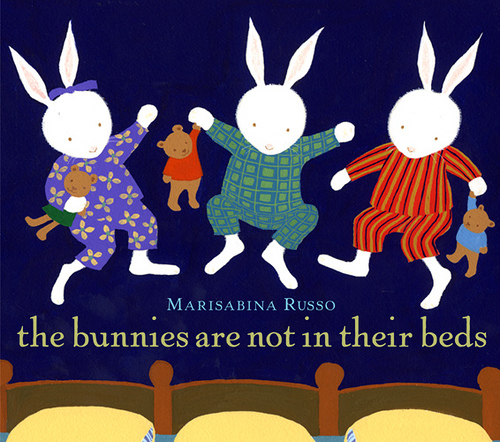
The Bunnies Are Not in Their Beds: A Book About Not Going to Sleep.

The Bunnies Are Not in Their Beds, by Marisabina Russo (Dragonfly, 2013), ISBN: 978-0307981264
Recommended for ages 3 – 7

bunnies It’s bedtime for three bunny siblings. Mama and Daddy put them to bed, and settle in to have some relaxing time together, when all sorts of noises erupt from the baby bunnies’ room! Mama and Daddy go up to check and discover that the bunnies are not in their beds – they’re playing! Will Mama and Daddy ever get the bunnies to go to sleep for the night?

The book is perfect for a preschool age group, who will identify with the young bunnies. Parents and caregivers will see themselves in the tired, near-exasperated parents, who hear a ruckus every time they put the bunnies to bed and start to relax. The story itself is perfect for a fun read-aloud; there is repetition and fun noises that make the story interactive: the parents saying, “good night, good night, sleep tight”, and the bunnies playful chaos: clips and clops, zooms and vrooms, and clashes and smashes give listeners a chance to jump up and act out the post-bedtime play.

The soft, gouache art lends itself to a relaxing atmosphere that allows the children to focus on the characters – a quiet bedtime read – and bold, big text for the bunnies play allows the reader to punch up the story for a more playful reading. Ms. Russo’s use of collage adds another dimension of fun to the artwork.

The author’s website offers contact information and information about her books.

This would be a great addition to a read-aloud about bedtime; I can see it being paired with a book like Jane Yolen’s How Do Dinosaurs Say Good Night? or Mercer Mayer’s Little Critter story, Just Go to Sleep. Allow listeners to jump around until they get themselves ready for nap time (and the caregivers will likely be grateful!). There are many songs and fingerplays about bedtime available online.

Posted in Fantasy, Preschool Reads, Uncategorized

When You Wish Upon the Moon… Randy DuBurke’s Moon Ring Takes You on a Trip

Book Review: The Moon Ring, by Randy DuBurke, Chronicle Books 2002
Recommended for ages- 4-8

the moon ring

Maxine, a young girl, sits on the porch, with her grandmother, seeking relief from the summer heat, when a magic ring seemingly falls from the blue moon. Maxine is swept away on a magic ride around the world – to the South Pole, a wild savannah, and New York City, accompanied by some new friends. But what happens when she runs out of wishes?

The book is a fun fantasy tale about magic and the moon. We always hear about wishing on a star, but the moon is the star of the show here (no pun intended). Randy DuBurke gives readers a classic fairy tale elements – granting wishes, being transported to exciting adventures and locales, and the temporary scare – the wishes have run out!

Young readers will enjoy the close relationship Maxine and her wise grandma who knows that magic is out there. Maxine is drawn with a wonderfully expressive face – it makes for fun reading, with prompts to children learning about facial expressions and emotions. The exciting, changing landscapes are beautifully rendered in pen, ink, and acrylics on cold waterpress paper. The story uses its space well, alternating between full-bleed spreads and framed panels. I read the digital version of this book, so I can’t speak to the fonts, but I’m sure a read-aloud with the actual book will work better with a young group.

The Moon Ring is a playful, fun book that makes for a good read-aloud session. This would be a great addition to a read-aloud about magic, imagination, or the moon. There are many rhymes and fingerplays about the moon that would be good companions to this book – Hey Diddle Diddle would be a fun start!

Posted in Fiction, Tween Reads

Blank Slater, the Boy with the Dry-Erase Face – a WhatchaReading Review!

You may or may not know this, but I review comics and graphic novels for the comics and comic culture site, WhatchaReading. Recently, Chuck over at WhatchaReading gave me the opportunity to review Blank Slater: The Boy with the Dry-Erase Face, written by Matt Bergin and illustrated by Zach Wideman. I was so impressed by this book, which provides a creative way to teach kids about self-esteem, emotions and feelings, and discovering who they are.

BlankSlater (1)


When this book hit WhatchaReading’s inbox, I got a chuckle out of the cute cover and figured I’d give it a shot – sounds like it could be fun, a kid with a Dry-Erase face, right? Draw silly faces and stuff? And then I dug in, and realized that there is so much more to this story than that.

Blank Slater is a kid born with a Dry-Erase face. He’s a blank slate (see what they did there?), and he goes through life pretty miserable – wouldn’t you? – until the day where he wanders away and discovers someone just like him! Nada Trace is a girl with a Dry-Erase face, but she isn’t wallowing at all – she grabbed some markers, pencil, and glitter, and made a face of her own! She helps Blank try on different faces, but nothing fits quite right until one day, Blank discovers his own face – and more important, a friend.

For the rest of the review, head on over to WhatchaReading!

Posted in Fiction, Graphic Novels, Humor, Tween Reads

Frank and His Friend: A Pre-Calvin and Hobbes Cartoon About Friendship

Book Review: Frank and His Friend: Special Collector’s Edition, by Clarence “Otis” Dooley (Curio & Co, 2013)

Recommended for ages 8+

I’m trying something new and fun with this blog, and creating more interesting (I hope!) titles for the reviews. I’ll still note the book title and bibliographic info at the top, as you see above, but I’m hoping that the review titles give you a little more information to draw eyes to the reviews and the great books I write about here.

FF3_Book_Cover_PRESS

This time around, I’ve read a trade paperback of a 1970s-era serial comic strip, Frank and His Friend. The premise will remind readers of Calvin and Hobbes, a favorite of mine: a young boy and his stuffed toy, Frank, go on adventures and experience life through a child’s eyes. While Frank doesn’t speak, as Hobbes does, readers will still get some pretty serious life advice from his pairing with his “friend” as they spend time in nature, playing, embracing chocolate chip cookies and avoiding broccoli.

The black and white artwork is simple and elegant, and gets the point of each short story across. There are a mix of panels and full pages in the book, and adults and kids alike will enjoy Frank and His Friend’s stories, which encourages readers to use their imaginations. One on page, the boy clings tightly to Frank with one hand, a balloon clutched in the other, and says, “Hang on tight. You don’t want to get lost in the ether of space.”

The stories invoke some thoughtful moments. When fighting their advancing enemy who suddenly becomes invisible, the boy looks at Frank and sighs, “Typical Monday.” The boy tries on a pair of eyeglasses, presumably belonging to a parent, and declares that he’d “rather look at the world through my own eyes.”

The book is a good idea to give to kids who are surrounded by the chaos of electronics, school, and extracurricular moments, to introduce them to the quiet, peaceful moments of childhood. And adults will enjoy returning to that peaceful time.

FrankAndHisFriendSCE_Prev1

Frank and His Friend: Special Collector’s Edition

Writer and Artist: Clarence “Otis” Dooley
Price: $19.95
Pages: 128
Pub Date: December 11, 2013
ISBN: 9783950296631
Diamond Order Code: OCT131033

Posted in Fiction, Graphic Novels, Tween Reads

Book Review: Drama, by Raina Telgemeier (Graphix, 2012)

Recommended for ages 10-14

drama

Drama geeks have their day in Raina Telgemeier’s Drama, a winner of the 2013 Stonewall Book Award from the American Library Association. Seventh-grader Callie loves the theatre, even if she can’t hold a tune with a bucket. She’s active on the crew with her school’s theatre group and is set designer for their upcoming production of Moon Over Mississippi. But, as with most tweens, there’s drama in Callie’s personal life in addition to the drama unfolding in the production as she crushes on Greg, who doesn’t seem to be able to give up his on-again, off-again girlfriend Bonnie. She becomes fast friends with new-to-the-school twin brothers Justin and Jesse, both of whom get involved in the production, and she finds herself falling for one of the twins… but he’s sending mixed messages. Can Callie use her shoestring budget to pull together a great set, and figure out her crush drama at the same time?

j6206_drama_ENDS.indd

Raina Telgemeier won an Eisner Award for her previous graphic novel, Smile – another tween drama – and she knows tweens. She can tap into the not-so-in-crowd with ease, telling a great story about the kids you may not see at the cool table, but who aren’t at the angsty goth table, either. Their drama is self-contained, part of growing up, but these seem to be overall happy kids, most of whom have a decent idea of who they are or are on their way to figuring it out. She includes positive, honest-feeling portrayals of LGBT characters. The cartoon art allows the reader to relax into the story and just melt into the setting. I enjoyed spending time with Raina’s characters, and look forward to meeting some more when I pick up Smile.

Ms. Telgemeier’s website offers free webcomics and media, her blog, author appearance information, and a store.


Posted in Fantasy, Preschool Reads

Book Review: Doug Unplugged, by Dan Yaccarino (Knopf, 2013)

Recommended for ages 4-8

Doug Unplugged!-1

This fun, retro story by Dan Yaccarino tells the story of a little robot boy who decides to “unplug” one day and explore the world. Little Doug is a robot boy whose parents plug him in every day so that he can learn while they head to work. One day, while learning about the city, Doug spies a pigeon at his window, and he’s fascinated. He unplugs himself and heads off on a day of exploration where he rides the train, scales a skyscraper, and makes a friend. After reuniting his friend with his parents, Doug decides to head home and tell his parents about his exciting day.

The story is sweet and packs a powerful message in our highly technological society. When most of our kids spend their days behind their iPads and computer screens, this simple message – unplug and learn by getting outside and doing – is a welcome sigh of relief. Packed with Yaccarino’s fun, adorable retro-futuristic artwork, Doug is a little boy on a big adventure that kids will enjoy living through vicariously. He may be a robot, but he’s easily distracted – there are many kids who can relate to the excitement of a pigeon landing on the windowsill at school or while doing homework at home. He spends a day exploring the city, yet manages to find a friend, and knows that he must go home at the end of the day. The art consists primarily of blues, greens and yellows, with other colors showing up to punch up the landscape. I read the digital version of this book, but encourage adult readers to use the physical storybook, which has smaller black font (it’s a great read-aloud book), usually at the bottom of the page or individual pictures so as not to detract from the artwork.  There are whole spreads and chunked panels throughout the book, giving a fully-fleshed-out feeling to this story. 

This would be a fun addition to a storytime on robots and would provide a more human perspective on a robot read-aloud. There are many robot printables and crafts online, and the author’s website offers information about his books, blog, social media, and speaking engagements.

Posted in mythology, Preschool Reads

Book Review: Ganesha’s Sweet Tooth by Sanjay Patel & Emily Haynes/Illus. by Sanjay Patel (Chronicle, 2013)

Recommended for ages 4-8

ganeshas_sweet_tooth

This adorable story puts a new spin on the Hindu myth that tells the story of how Ganesha, the elephant-headed god, came to help write the epic poem, The Mahabharata. Young Ganesha has a sweet tooth and particularly loves laddoos – a kind of jawbreaker candy – until one day, he breaks a tusk on one! What’s a young godling to do? He meets the poet, Vyasa, who offers a surprising way to make the best of the situation.

I can’t say enough about this book. The art is stunning. Sanjay Patel is an animator at Pixar Studios, and the look and feel of the overall story definitely has a fun quality to it that Pixar fans will appreciate and everyone will enjoy. The colors and Indian-influenced artwork are breathtaking. This is artwork I would hang in my kids’ room, it’s so beautiful. It’s colorful and exciting, and introduces children to Indian-influenced art, which many will likely never have seen before.

ganeshas-sweet-tooth_Page_04

At the same time, the artwork is adorable. Children will adore Little Ganesha and his best friend Mouse and relate to them. What child wouldn’t want to sit and eat candy all day long? What child doesn’t believe he or she is invincible, as Ganesha does? When Ganesha breaks his tooth, he is worried about his appearance and becomes angry and frustrated, throwing his tusk at the moon. He loses his temper, like any other child would in a frustrating situation, and there is a friendly adult, in the person of Vyasa, to deflect Ganesha’s anger and channel it into something productive.

There are good lessons to be learned in this story, including making the best of a bad situation and how sharing is important, as illustrated between Ganesha, Mouse, and their other friends. I read the digital version of the book, but encourage adults to read the actual storybook, as the font is playful, round, and fun, attracting young readers’ eyes and directing them to the action and flow of the story. The artwork will keep little eyes busy – there is so much to see! – and the story lends itself to great post-storytime discussions about sharing, listening to your friends, and seeing the good in every situation.

Posted in Graphic Novels, Middle School, Non-Fiction, Tween Reads

Book Review: Donner Dinner Party, by Nathan Hale (Nathan Hale’s Hazardous Tales), Abrams, 2013

Recommended for ages 8-13

donner

Colonial spy Nathan Hale is sentenced to death by hanging – but WAIT! He’s got stories to tell! His executioner and the British soldier standing guard are intrigued. Off he goes into yet another Hazardous Tale from history, this time, about the infamous Donner Party.

You’ve heard of the Donner Party, if only as a horrific joke. During the Westward Expanion, they were a group of pioneers headed for California who got caught in the brutal winter of 1846 and resorted to cannibalism to survive. Nathan Hale’s book tells the story of the Donner-Reed party, focusing primarily on James Reed, whose “shortcut” caused the doomed wagon train to stray off course into brutal territory.

Written as a graphic novel, this book is a great read for middle schoolers and even the reluctant high schooler. The story cuts between Nathan Hale, the British soldier and the executioner as Hale tells the story, and the story of the Donner-Reed party. The characters are detailed, and kids will love the executioner, who really, REALLY doesn’t want to hear bad news about any of the animals in the story. There are well-drawn diagrams and graphics teaching readers about the members of the party, maps of the territory traveled, and informational bits that enhance the story for all.

Hale doesn’t shy away from the more brutal aspects of this story, but he doesn’t glorify them, either. He presents the facts, even illustrating a specter of death coming for the travelers, with their names, as they pass away, listed on Death’s cloak.

This was my first Hazardous Tale from Mr. Hale, but it certainly won’t be my last. Stock this book in your bookshelves, teachers and parents, and watch kids scramble to learn about history.

Mr. Hale’s website offers information about his other books, his blog (which includes sneak peeks at his artwork for future books!), and a section dedicated to Correction Baby, who helps edit all of his books. Check it out!

DonnerSpread

Posted in Toddler Reads

Book Review: Mary Engelbreidt’s Mother Goose, by Mary Engelbreidt (Harper Festival, 2005)

Mary-Engelbreits-Mother-Goose-One-Hundred-Best-Loved-VersesRecommended for ages 3+

Mary Engelbreit’s Mother Goose brings together 100 nursery rhymes – some, well-known and loved; some lesser known – in one volume and illustrated in Ms. Engelbreit’s traditional nostalgic style. In a note at the end of the book, she writes about her granddaughter’s influence and the desire for the innocence of “simpler and slower times”. She created the illustrations by going with the first images that popped into her head after reading the poems over, and takes care to include images of children from different ethnicities. The colorful illustrations are laid out against a plain white background. The text is in a plain, black font, taking no attention away from the pictures. The illustrated characters are dressed in a variety of outfits, from medieval to modern, but always with a retro twist that Mary Engelbreit is known for. The endpapers feature popular nursery rhyme characters set against a sky blue backdrop.

There is usually one rhyme to a page, along with a companion illustration; there are two to a page for shorter rhymes, but the pages are never cluttered. More popular rhymes, like Humpty Dumpty, get their own spread. Some of the rhymes appear to be abridged, but this is not mentioned anywhere in the book. An introduction by Lenoard Marcus, an author, critic, and children’s literature historian, explains the history of nursery rhymes. There is a board book available for this title which is much shorter, for younger audiences. The book is also packaged with a CD, with Academy Award nominated and Golden Globe Award-winning actress Lynn Redgrave performing a full-length reading of the book.

A nursery rhyme storytime would be the perfect venue for this book, as the illustrations will draw young audiences’ attention. The popular nursery rhymes invite interaction, as the children and caregivers can recite rhymes along with the storytime leader. There are fingerplays for many of these rhymes. A reading can be enhanced by either a puppet show or a flannelboard, and there are many CDs with nursery rhymes that can can enhance a storytime craft; Prekinders is one of many sites that provide free nursery rhyme printables.

The author’s website features author information, a shop, and a crafts area where caregivers and educators can download coloring sheets and crafts.

Posted in Adventure, Espionage, Fantasy, Fiction, Science Fiction, Steampunk

Book Review: Etiquette & Espionage, by Gail Carriger (Little, Brown, 2013)

etiquette and espionageRecommended for ages 13+

Gail Carriger, author of the Parasol Protectorate series, kicks off her YA Finishing School series, set in the same universe as the Parasol Protectorate series, with Etiquette & Espionage.

Fourteen year-old Sophronia is driving her society lady mother crazy. She climbs trees. She takes apart things to figure out how they work. She lines her books with rubber from a dumbwaiter in the house. Fed up with Sophronia’s antics, she sends her to finishing school – Mademoiselle Geraldine’s Finishing Academy for Young Ladies of Quality, to be precise.

What neither Sophronia nor her mother bet on, though, was that this is no ordinary finishing school – when they say “finish”, they mean “finish” – the students learn how to curtsey and flutter their eyelashes, but they also learn about poisoning, espionage, and weapons placement. Sophronia is learning to be a spy and an assassin in addition to being a lady. But she also stumbles into a mystery involving one of the students as soon as she boards the coach to school – what is really going on at Mademoiselle Geraldine’s, and what does her newfound nemesis have to do with it?

While I am a big fan of the Parasol Protectorate series and went into this series with high hopes, I was a little let down here. I understand that this is the first book in a new series, with much to be established, but I felt there was an overall lack of plot to drive the story forward. It seemed more a collection of “look what Sophronia’s got herself into now” moments, with some vague subplot surfacing to give her an archenemy in future books.

The dry humor is there, though, and that kept me reading. I love the way Ms. Carriger writes, and I enjoy her stubborn heroines who can lock horns with a werewolf and then stress about their state of dress and look for a cup of tea. I enjoy the Parasol Protectorate universe, and there’s paranormal and steampunk aplenty here, with werewolves, dirigibles, and automatons for all. There are a few pleasant surprises for Parasol Protectorate fans, too.

If you’re a fan of Carriger’s, you’ll at least enjoy the universe and references. I look forward to the next book in the series.