Posted in Preschool Reads, Realistic Fiction

No Water No Bread delivers a powerful message

No Water No Bread, by Luis Amavisca/Illustrated by Guridi, (Oct. 2017, nubeOCHO), $15.95, ISBN: 978-84-945971-3-8

Recommended for readers 4+

Two groups of people live on either side of a barbed wire fence. One side has water. One side has bread. Neither will share their resources, flatly stating: “This is our water.” “This is our bread.” The children gather at the fence and trade bread and water, wondering, “Why are our parents like this?” They play ball over the fence, knowing that life would be much better “without the fence”. When a new group shows up, the barbed wire fence is sectioned off into yet a third area. Again, the adults hoard their resources while the children all approach the fence, ready to share, and wonder why their parents are like this.

In a day and age where some talk about building walls, No Water No Bread asks a simple, powerful question: Why are we like this? Seen through the eyes of a child, we live in a ridiculous society. We tell our children to share, yet decide that others don’t deserve basic needs if we find them lacking: if they’re from the wrong area of the world, if they’re the wrong faith, if they’re the wrong color.

Simple art and simple words deliver a powerful message that children will understand. Let’s hope that the adults do, too.

This book is a project created in Europe by NubeOcho with the support of Amnesty International Spain and Amnesty International Italy. It is also available in Spanish (ISBN: 978-84-946333-7-9).

Posted in Intermediate, Middle Grade, Non-fiction, Non-Fiction

Fairy House Cooking, for fairies and pixies and fun

Fairy House Cooking: Simple, Scrumptious Recipes & Fairy Party Fun!, by Liza Gardner Walsh, (June 2017, Down East Books), $16.95, ISBN: 978-1-60893-641-0

Recommended for readers 4-12

If there’s one magical creature whose popularity is eternal, it’s fairies. Fairy House Cooking is perfect for fairy-themed parties, playdates, or… you guessed it… library programming.

This is a beautifully constructed and photographed cookbook. It’s spiral-bound, so it may take some licks in circulation if you’re putting this in a library; it does help keep the book turned to your recipe while you’re cooking, though, so that’s a big plus, especially for developing chefs. Recipes are rated by difficulty: one fairy wing for, “you got this”, which I love. And which helps make this book perfect for younger creators (and perfect for my no-bake library programs). Two wings is a little more of a challenge – have a grownup in the room. Three wings, you definitely need a grownup and some teamwork to get the job done. Pleasantly, there’s equal time given to recipes of each difficulty level, so little ones can really make some fun recipes, like pretzel and fruit wands and nut-free bird’s nest cookies. There’s sections on safety, allergies, and cleaning up, and author Liza Gardner Walsh uses empowering words to boost kids’ confidence as they read; the words are bolded through the text and Walsh includes a special note on making mistakes, and how it’s okay. It happens. (Don’t ask me about the time I used baking soda to coat the table and roll out my holiday cookies, when I ran out of flour. Just don’t.)

Recipes are collected under five different chapter umbrellas: Fairy Mornings (breakfast foods); Foods Inspired by Fairies and Fairy Homes (featuring some of the most adorable food photography ever); Fairy Foraging (working with fruits… and flowers!); Fairy Parties (finger foods, party foods and drinks); and Recipes for the Fairies and their Friends, a section that encourages your kiddos to get out in there in the backyard and play; create something that the fairies and their friends would like to nibble on – from bird popsicles and birdseed cookies to mudpies of all types. There are recipes for fairy face paint and fairy dust, and everything here is good for the planet: the fairies wouldn’t have it any other way.

There are fun sidebars and callouts with tips to make your projects extra fun, and the photography is vibrant and colorful, with kids working together to make their recipes come together. Boys feature here, too, so make sure to make your party equal opportunity fun. A list of resources and websites links readers to more cookbooks for kids. Make a full-blown fairy day by letting kids make fairy doors, fairy wings, and any number of fairy crafts you can find. Pinterest has OODLES of ideas.

Definitely time for a fairy program at my library.

Posted in Animal Fiction, Fiction, Humor, Intermediate

Claude and Mr. Bobblysock find their way to the Big Screen

Claude on the Big Screen, by Alex. T Smith, (Oct. 2017, Peachtree Publishers), $12.95, ISBN: 978-1-68263-009-9

Recommended for readers

Claude the Dog and his best friend, Mr. Bobblysock, are back for another adventure: this time, they wander onto a movie set, save the day by filling in for the two stars, and save a classically trained gorilla actor who’s afraid of heights! Written and illustrated by Alex T. Smith, the Claude series is a fun, early chapter book series that sports two-color illustrations and a quirky sense of style. The characters and writing are flamboyant fun, with exaggerated fonts, gigantic wigs, a gorilla in a smoking jacket, and a dog in a beret. It’s dry wit for the elementary school set.

There are seven Claude books out right now. Give these to your readers that appreciate humor with a twist. Introduce them in a read-aloud, letting kids hear the tongue-in-cheek manner of the narrative. Dress up socks and have the kids make berets – have fun with Claude!

Posted in Fiction, Historical Fiction, Middle Grade, Realistic Fiction, Tween Reads

Good for historical fiction readers: Great Escapes

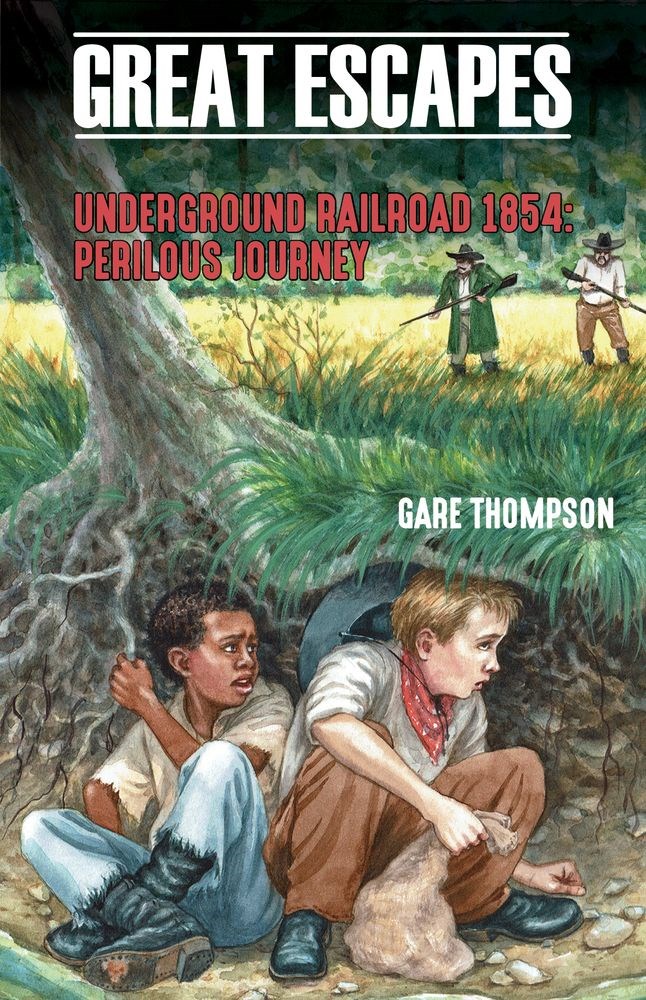
Underground Railroad 1854: Perilous Journey: Inspiring Tales of Courage and Friendship (Great Escapes), by Gare Thompson, (Oct. 2017, Barron’s Educational Series), $7.99, ISBN: 9781438009735

Recommended for readers 8-12

George is a plantation slave who dreams of being free. He’s singled out for abuse by the cruel overseer and threatened with being put on the auction block, like his father was. He can’t bear the thought of being separated from his sister, Ruth, and his mother, so he formulates a plan for the family to escape and seek out Moses, a mysterious woman who helps slaves to freedom. Moses – Harriet Tubman puts them in case of a white teenager, Nathan, who will take them from the deep South to New York, where they hope to find passage to Canada, but it’s not going to be easy. George doesn’t trust Nathan – he doesn’t trust anyone – and the bounty hunters are everywhere, tracking down escaped slaves. The four will have to work together and rely on the kindness of Underground Railroad stations to succeed.

Great Escapes is a fairly new historical fiction series by Barron’s Educational Series. Readers who enjoy the thrill of Lauren Tarshis’ I Survived books will dig into these readalikes, which are a little longer in page length (over 200 pages) and allow for more plot and character development. Stories emphasize working together for change while acknowledging that it’s not always an easy thing to do. Historical figures Harriet Tubman, William Still, and Frederick Douglass make appearances, and interesting facts about the Underground Railroad pop up within the narrative. My favorite? The coded messages communicated through song: songs like “Wade in the Water” told freedom seekers to get off the trail and into the water, so their scent wouldn’t be picked up by dogs. Sections on key terms, phrases used, songs sung, Underground Railroad profiles, and further resources make this a great next step for readers who are ready to take on longer books.

Underground Railroad is the second book in the Great Escapes series, the first being Mount St. Helens 1980: Fiery Eruption! I’ve been plumping up my library’s series fiction collection, and since the kids devoured my I Survived books the second they arrived, I think this will be a smart add to the collection. Like I Survived, readers can pick either Great Escapes book up never having read the other(s); they’re all separate moments in history starring different characters.

Posted in Non-Fiction

Portrait of an American Activist: Listen – How Pete Seeger Got America Singing

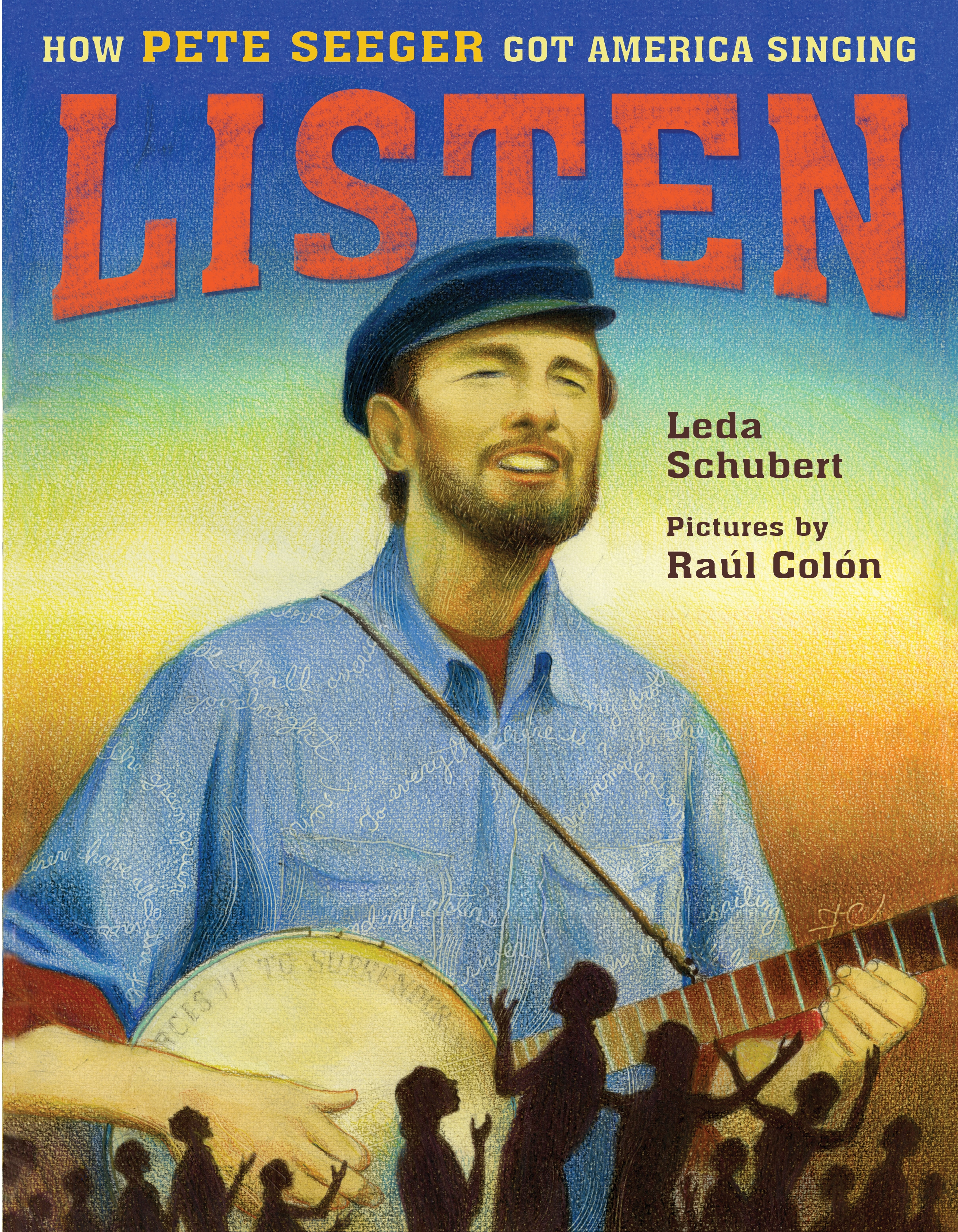
Listen – How Pete Seeger Got America Singing, by Leda Schubert/Illustrated by Raúl Colón, (June 2017, Roaring Brook Press), $17.99, ISBN: 9781626722507

Recommended for readers 5-10

Leda Schubert and illustrator Raúl Colón create a lyrical and beautiful tribute to singer, songwriter, and activist Pete Seeger. From the beginning of his career, strumming his banjo or guitar, Seeger led by example; first, by singing and encouraging his audience to chime in; later, through his activism: standing in peace lines to support unions, protest war, marching for civil rights, and caring for the environment. Whether he was talking to grownups or the children that loved his songs, Seeger always encouraged participation – “That’s what gonna save the human race” – and awareness. Schubert weaves Seeger’s song titles with the story text to highlight the relationship between Seeger’s songs and the causes he supported.

Raul Colon’s art is beautiful. His technique provides both beautiful texture a vintage glow to his images, and his spread featuring Seeger’s boat, the Clearwater, sailing down the Hudson River, is breathtaking. Beautiful artwork and stunning images make Listen a great addition to picture book biography collections and a great read when explaining social justice activism to younger readers.

Leda Schubert holds an MFA from Vermont College of Fine Arts in the Writing for Children and Young Adults and was a core faculty member until 2012. She is the author of many award-winning titles, including The Princess of Borscht, Ballet of the Elephants, and Monsieur Marceau, winner of the Orbis Pictus Award for Outstanding Nonfiction. Leda lives in Plainfield, Vermont, with her husband and two dogs. To learn more, and to download a curriculum guide, visit ledaschubert.com.


Raúl Colón has illustrated several highly acclaimed picture books, including Draw!; the New York Times-bestselling Angela and the Baby Jesus by Frank McCourt; Susanna Reich’s José! Born to Dance; and Jill Biden’s Don’t Forget, God Bless Our Troops. Mr. Colón lived in Puerto Rico as a young boy and now resides in New City, New York, with his family.

Leda Schubert provides some great links to recordings and videos of Pete Seeger here.

Praise for Listen: How Pete Seeger Got America Singing

★“Schubert and Colón ably demonstrate one of their book’s final assertions: ‘there really was nobody like Pete Seeger.’”—Kirkus Reviews (starred)

“A rousing tribute to a singular musician and activist who ‘walked the talk.’” —Publishers Weekly

“This inspiring picture book biography about one of America’s greatest folk heroes is sure to get a new generation of children singing.” —School Library Journal

“An inspiring and heartfelt tribute to, as Schubert calls him, a ‘true American hero.’” —Horn Book

Giveaway!

One lucky winner will receive a copy of Listen: How Pete Seeger Got America Singing (U.S. addresses; one entry per person.) Enter this Rafflecopter giveaway for your chance!

Posted in Adventure, Fantasy, Fiction, Fiction, Middle Grade, Tween Reads

The World’s Greatest Adventure Machine will take you on the ride of your life

The World’s Greatest Adventure Machine, by Frank L. Cole, (Aug. 20017, Delacorte Press), $16.99, ISBN: 9780399552823

Recommended for readers 9-13

Take a little bit of Charlie and the Chocolate Factory, toss in elements of Jurassic Park and The Matrix, and add a dose of Inception, and you have Frank L. Cole’s newest book, The World’s Greatest Adventure Machine. Four kids with varying physiological complexities – Trevor, the daredevil; Cameron, the genius; Devin, the video game master/burgeoning Internet sensation; and Nika, shy and sheltered by her overprotective grandfather – are chosen to test out The Adventure Machine, a ground-breaking new adventure ride from CastleCorp. They set out for the ride of their lives while their guardians watch, but no one expects what happens when the ride breaks down, and they discover that they’re stuck in the middle of a plot that threatens them and their families – or are they?

The World’s Greatest Adventure Machine is a big adventure for middle graders who love twisting plots, action, and a smidgen of conflict. As the kids’ adventure progresses, they grow as individuals and as a team; Trevor and Cameron learn to be aware of the impact their actions have on others, and they all learn the importance of self-advocacy.  It’s a fun read with characters that grow on you, with lots of thrills to keep pages turning.

Posted in Fiction, Historical Fiction, Middle Grade, Realistic Fiction, Tween Reads

Hispanic Heritage Reading: My Brigadista Year, by Katherine Paterson

My Bridgadista Year, by Katherine Paterson, (Oct. 2017, Candlewick), $15.99, ISBN: 978-0-7636-9508-8

Recommended for readers 10-14

It’s 1961, and Lora is a 13 year-old girl who signs up to be one of Fidel Castro’s Brigadistas – groups of students, some as young as 8, most between the ages of 10 and 16 – who went into the rural areas of Cuba to spend a year with families, teaching them to read and write. Lora sees this as an opportunity to grow as a student and a person; she wants to be a doctor, and she wants the space to learn and discover on her own. Her parents protest: she’s lived a comfortable life in Havana, why would she want to live in poverty for a year? With some help from her grandmother, Lora’s parents relent, and she joins the Brigadistas, promising to come home if it gets too hard. Lora is placed with a family to teach, and before she knows it, is teaching a neighboring family, too. The group becomes an extended family as she takes part in the daily chores, taking as much encouragement as she gives, but all is not easy: not everyone is in favor of the Cuban Literacy Initiative. Counter-revolutionaries have martyred those who would lift Cuba out of illiteracy in the past, and the Brigadistas know that risk is part of what they’ve signed on for.

This was the first I’ve read about the Cuban Literacy Initiative. It’s a little-talked about moment in history, and it’s fascinating. Lora is a wonderful character who we see coming of age with each turn of the page, and her students consist of parents, grandparents, and children. Things don’t come easily to Lora, but she never gives up, her larger goals in mind, and her determination at her back. This is a short but powerful book that I’d love to see on summer reading lists next year. An overview of the Cuban Literacy Initiative fills provides more information for readers who want to learn more.

Katherine Paterson is the Newbery award-winning author of Bridge to Terabithia and Jacob I Have Loved. You can visit her website to find her bio, information about her books, and interviews with the author.

As our relations with Cuba continue to open, I’d love to read more first-hand accounts from brigadistas and the rural families with whom they lived. Until then, Tulane University’s Roger Thayer Stone’s Center for Latin American Studies has some information on the campaign, and Al-Jazeera posted an interview with a former brigadista.


Posted in Fantasy, Graphic Novels, Teen, Tween Reads, Young Adult/New Adult

Pashmina is an Indian-American girl’s journey of self-discovery

Pashmina, by Nidhi Chanani, (Oct. 2017, :01FirstSecond), $16.99, ISBN: 9781626720879

Recommended for ages 12+

Priyanka is an Indian-American young woman, living with her single mom, in California. She’s got so many questions: Why did her mother leave India to raise her daughter in the States? What’s India like? Why doesn’t she ever talk about India? And the big question: Who’s her father, and why hasn’t she ever met him? For Priyanka’s mom, though, the topic of India is closed. She will only say that things were different for women in India, and that’s that. Left with her questions, and feeling emotional after her uncle – her only father figure – becomes a new dad, Priyanka stumbles across one of her mother’s old suitcases, containing a beautiful pashmina shawl. She wraps it around herself and is transported to a magical, beautiful place: India. She also meets two guides: Kanta, an elephant, and Mayur, a peacock, who show her a breathtaking India. Priyanka gets the feeling she may not be getting the whole story – especially when the two guides keep shooing away a mysterious shadow that lurks by them – but she’s determined to find out more about her heritage and her birth.

Priya gets the opportunity when her aunt calls to reconnect with her estranged sister. She’s pregnant, and Priya’s mom agrees to let her fly to India to spend time with her. Thrilled, Priya embarks on a journey that will provide more answers than she expected, and learn more about her mother – and herself.

Pashmina is brilliant, bold, and beautiful storytelling. It’s the story of a child walking the line between two cultures, and it’s a story about the search for identity. It’s also a powerful story of feminism; the goddess Shakti guiding women to choose their own paths and the women who are brave enough to answer the call. Nidhi Chanani creates breathtaking, colorful vistas within the pashmina’s world, making Priya’s everyday black-and-white world even more stark and humdrum. This is a must-add to graphic novel collections, particularly for middle schoolers and teens. Booktalk and display with Gene Luen Yang’s American Born Chinese, Na Liu’s Little White Duck, and Sarah Garland’s Azzi in Between.

See more of Nidhi Chanani’s art at her website.

Posted in Preschool Reads, Toddler Reads

Think Board Books teach concepts

Former Romper Room teacher Karen Robbins still keeps her Do-Bees in mind with a trio of concept board books! Think Triangles!, Think Circles!, and Think Squares! are a sturdy series of books that help develop toddler and preschooler thinking skills. Each colorful book has ten flaps that present a a number of shapes to readers, asking where they can be. Lift the flap, and a bright, cheery scene – mountains, birdhouses, watermelon slices – invites kids to count the shapes. Colors are bright and easily identifiable, and inviting readers to “think… and lift the flap to see!” challenges them, asking them to pause and count the shape outlines before moving on to identify them after lifting the flap.

Think Triangles!, by Karen Robbins, (Sept. 2017, Schiffer Publishing), $12.99, ISBN: 9780764353819


Think Squares!, by Karen Robbins, (Sept. 2017, Schiffer Publishing), $12.99, ISBN: 9780764353833


Think Circles!, by Karen Robbins, (Sept. 2017, Schiffer Publishing), $12.99, ISBN: 9780764353826

Recommended for readers 0-3

Posted in geek, geek culture, Middle Grade, programs, Tween Reads

I had a BookPop! party and it was great!

Quirk Books is a… well, quirky, fun book publisher that has a comic book writer and former YA librarian in their ranks, spreading the good word. It’s pretty awesome, because now, my library gets to do things like have a gallery dedicated to horror paperbacks of the ’70s and ’80s (Paperbacks From Hell), and have a mini pop culture con for my kiddos and tweens.

First up, my Paperbacks From Hell gallery, in my teen section. It’s garnering some looks, some chuckles, and some conversations: “What the hell is that?” “That is a giant gila monster. And watch your mouth.” (The display is in the teen area, but you know, little pitchers, big ears). The teens are pretty baffled, the grownups get a kick out of it, and it just makes me happy.

Next up, BookPop: Quirk’s traveling pop culture fest, happening in libraries and bookstores all over the place. I held mine late, because I thought it would be the perfect program to hold when the kids were out of school; last Thursday – since most of the families in my community don’t observe Rosh Hashanah – was the day. Quirk sent me a box o’swag, including ET: The Extra-Terrestrial tattoos (not in the picture: those babies were GONE); posters of the new kids’ books, X-Files: Children are Weird, and the YA novel My Best Friend’s Exorcism; and a spiffy tote bag to put everything in. I downloaded Quirk’s Geek Guides for putting on a great day of programming, and was ready.

First program of BookPop! Day was Superhero Storytime. I had a handful of kiddos and their parents attend, and we made masks and Geek Family Crests when we were done. The kids loved the masks – I downloaded some blank templates from First Palette, handed out scissors, markers, crayons, and lanyard to tie the masks, and the kids loved it. One little one even wore her mask through the next program…

Nick and Tesla’s Science Workshop. The Nick and Tesla books are tons of fun and loaded with STEM experiments, but I wanted something that even my littler ones could do. Enter, bubbles. I told the kids that Nick and Tesla are a brother-sister team that solve mysteries and get out of trouble by creating great science projects, and that we were going to learn about surface tension, and the difference between bubbling your milk and bubbling water with a little dish soap in it. I had a gallon-sized tub filled with water, gave out droppers, straws, and cups, and we bubbled away. Then, I had one of the kids add a cup of plain old liquid dish soap, and they all took turns stirring it. I spread some water on the table and demonstrate how to blow a table bubble, and that was all the kids needed. Look at these bubbles!

The entire table, at one point, was covered in bubbles. They loved it, I loved it, and they want more fun science programming, so win, all around. Next up was…

The Miss Peregrine Photo Workshop. Originally, I planned this for my teen patrons, but they weren’t interested – I had a group of tweens, though, who were all over it. We talked about the movie, I showed them the books, and brought out the equipment: photos I printed onto card stock from a Miss Peregrine-inspired Pinterest board (search on “vintage weird” and I guarantee you won’t be sorry), lots of paper towel, a spray bottle full of coffee, and two containers of coffee and tea. The kids loved aging their photos, and I was amazed by their creativity: one girl laid a paper towel over her photo to give it more texture as the coffee seeped through, and another tore the borders of her photo to make it look even older.

When I told them I wanted to create a photo gallery of their work, they all donated the photos to the library! So today, we have “Queensboro Hill’s Library for Outstanding Children” (forgive the glare, I laminated the photos so they wouldn’t deteriorate further):

I handed swag bags out for most of the day, and everything went except for one tote, two X-Files posters, and a handful of My Best Friend’s Exorcism posters, which will all be prizes for future programs. One kid couldn’t even wait to get home: he gave himself an ET tattoo sleeve, which was pretty fabulous.

I’d call our Queensboro Hill BookPop! a success.