Posted in Intermediate, Middle Grade, Non-Fiction, Non-fiction, Non-Fiction, Tween Reads

Road Trip! Ranger Rick’s Travels: National Parks

ranger-rickRanger Rick’s Travels: National Parks!, by Stacy Tornio & Ken Keffer, (Aug. 2016, Muddy Boots), $14.95, ISBN: 9781630762308

Recommended for ages 8+

In a fabulous love letter to the National Parks of America and the National Park Service, the folks at Ranger Rick Magazine – remember them? They have books now! – put together this beautiful book, featuring each one of the 58 National parks across America. Ranger Rick and his best friend, Deputy Scarlett, appear throughout the book to join readers on a countrywide sightseeing tour.

The book opens with a map of the United States, including Hawaii, Alaska, and the US Virgin Islands. Each park is numbered and corresponds to the Table of Contents, which organizes the parks into 9 groups: Eastern Parks, Midwest Parks, Mountain West Parks, Southwest Parks, Utah and Nevada Parks, California Parks, Pacific Northwest Parks, Pacific Island Parks, and Alaska Parks. Each park’s profile includes stunning photos and facts that will make readers want to pack their bags and take a month or six off from work or school!

rangerrick-rickandscarlettEach park feature provides information in quick bites that read like a tourism guide. About the Park provides a quick overview and basic facts; What to Watch For are Ranger Rick’s top nature picks on what plants and animals to keep an eye out for. Ranger Rick’s Top Things To Do is a bucket list for each park – don’t leave without seeing Old Faithful in Yellowstone Park, naturally, but also make sure not to miss out on a hike through the park! Finally, Ranger Rick’s Amazing Facts are the “WOW” factor for each park: did you know that you can only reach Northwest Alaska’s Kobuk Valley National Park by foot, dogsled, snowmobile, or air taxi? Now you do!

This is a great book to have in collections and to have available when you’re talking about the U.S. There’s 100 years of history in the National Parks Service, but there are far more years in the history of these parks; there are petrified trees, dinosaur footprints and bones, and formations carved out of rock thousands of years ago, here for all to enjoy. Families planning a vacation or two can use this as a jumping off point (I know I am).

Don’t forget to head to the Ranger Rick website, where kids can read more about nature and the environment, play some games, and get craft ideas. Educator resources included lesson plans and webinars.
Ranger Rick and Scarlett image courtesy of Photobucket.
Posted in Early Reader, Fiction, Humor, Preschool Reads

Good advice: Never Follow a Dinosaur!

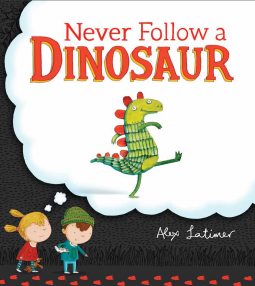
never-followNever Follow a Dinosaur, by Alex Latimer, (Sept. 2016, Peachtree Publishers), $16.95, ISBN: 9781561457045

Recommended for ages 3-8

Siblings Joe and Sally spy a strange set of footprints by their cat’s bowl one morning, setting them off on an investigation. Clearly, it’s a dinosaur. With each spread, they deduce more about the dinosaur: it’s a heavy dinosaur, because the tracks are so deep; it’s a hungry dinosaur, because it’s eaten the cat’s food; footprints in the fish pond clue them in that it’s a dinosaur who likes to swim. Should you follow a dinosaur, though? Especially when it’s a hungry dinosaur? You’ll just have to read to find out!

Never Follow a Dinosaur is a cute book that teaches kids about using clues to figure out more and more about the dinosaur. The spreads are hilarious, as the dinosaur suffers indignity on top of indignity (bumped head, stubbed toe… the humanity!). The layouts give a lot of space to the kids’ imagination as they conjure up visions of their visitor, and the layout the kids come up with to trap the dino are up there with the best Rube Goldberg devices from the old Warner Brothers cartoons (totally dating myself there).

This is a fun storytime read that offers a lot of interactivity and the chance to give the kids’ imaginations a workout. Ask kids to come up with their own dinosaurs, based on the clues in the book, or just have pictures of dinosaurs to color and customize, for younger readers. Pair this with Ed Young’s Seven Blind Mice for a storytime on deduction and investigation, and then turn it on the kids: have them close their eyes and touch a piece of felt, a chair, a book, a plush toy, and use their five senses to investigate and deduce.


Posted in Early Reader, Fantasy, Fiction, Fiction, Intermediate, programs, Storytime, Summer Reading

Storytime: Nobody Likes a Goblin, by Ben Hatke

nobody-likes-a-goblinNobody Likes a Goblin, by Ben Hatke, (Jun 2016, First Second), $17.99, ISBN: 9781626720817

Recommended for ages 5-10

If you read my stuff enough, you know there are a few authors and illustrators that I adore; Ben Hatke is one of them. From Zita the Spacegirl to Mighty Jack and Little Robot, he creates fun, exciting characters, very human stories, and beautiful art. I am eternally grateful that he has also started sharing the love with picture book readers; first, we had Julia’s House for Lost Creatures, and now, Nobody Likes a Goblin.

It’s the sweetest little book about a homebody goblin who lives in his cozy dungeon and hangs out with his best friend, Skeleton. One day, a gang of dumb old adventurers barges in, loots Goblin’s treasure, and makes off with Skeleton – RUDE. Goblin sets out to rescue his friend despite the oft-repeated cautionary advice, “Nobody likes a goblin.” But Goblin doesn’t care, because he has a friend to save!

goblinImage Source: GoodReads

How cute is this book? It’s got adorable messages about friendship and being brave, not worrying who likes you or not, and just doing what you do. I decided to read this one to some of my slightly younger kids on a preschool-aged summer camp visit a few weeks ago, and they seemed to enjoy it. They kind of “ewwww’d” my poor Goblin at first, but when I told them that he was just a nice little guy and didn’t bother anyone, they were more sympathetic. By the end of the book, they were cheering for him. I encouraged them to hiss and boo the adventurers who were mean and went into poor Goblin’s house, breaking things up and stealing his toys, and was that very nice? NO.

Posted in Fiction

Religious thriller: Cradle and All

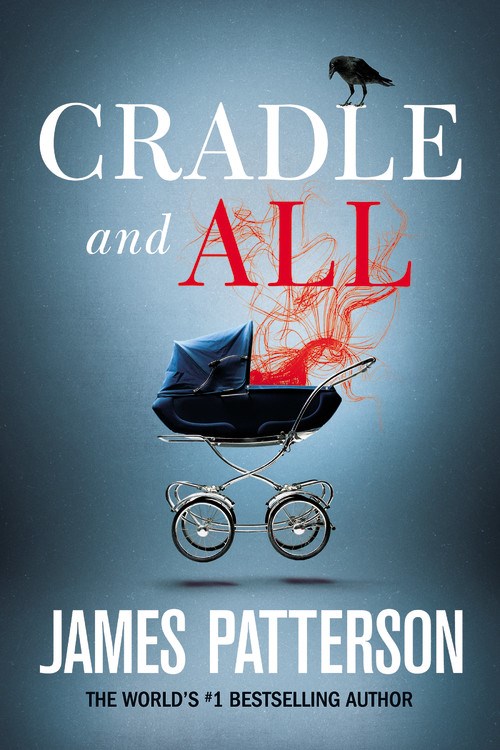
cradleCradle and All, by James Patterson, (Sept. 2016, jimmy patterson), $18.99, ISBN: 9780316315265

Recommended for 18+

Two teenage girls fall pregnant: one in New England, one in Ireland. Both virgins; one blessed with the child of God, the other, with the child of Satan, and no one knows which mother is carrying which child. It seems like the world itself is reacting, with outbreaks of polio, famine, floods, and droughts. Former nun turned private investigator Anne Fitzgerland is sent by the Archdiocese of Boston to investigate.

This is a 1980 James Patterson book that’s been “reworked” to be YA, but I have to be completely frank here: this is not YA. I don’t know what the original book read like, but the only thing that remotely makes this book YA is the fact that there are two pregnant teenagers who aren’t even the main characters in the story. There’s sexual violence, discussions of infanticide, let’s not even get into the religious issues, and the fact that a 23 year-old woman is a Harvard graduate, hard-boiled private investigator, and well-published authority on children and teenagers. Oh, and she’s a former nun who left the convent when she fell in love with a priest, who just happens to be assigned to the same cases.

There are huge plot holes. HUGE. One of which makes the entire premise of the book fall apart at the end, if you’ve read that far. There are over 100 chapters in the book, all ranging from about 1 1/2 pages to 4 pages, which makes for some choppy reading (at least for me). It was a disappointing experience for me, and it’s not because I read children’s and YA books over adult books (because I’ve seen that leveled at some folks, believe it or not) – it just wasn’t that good of a book, and I’m a little irritable that James Patterson and his people would even consider releasing this as a YA novel (again, because, pregnant teens).

I’m clearly not the audience for this book. I’m bemused that the jimmy patterson imprint will release this along with books like his excellent Middle School series, and the Maximum Ride YA series that disappears off my shelves. Read this one for yourselves and use your own judgement; I was not a fan. I’ll go re-read Good Omens next time I want to read about a rumble between Heaven and Hell.


Posted in Fiction, Fiction, Humor, Middle Grade, Middle School, Puberty, Realistic Fiction, Tween Reads

Realistic Fiction that works: Still a Work in Progress

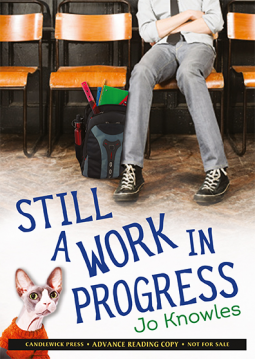
still-a-work-in-progressStill a Work in Progress, by Jo Knowles, (Aug. 2016, Candlewick Press), $16.99, ISBN: 9780763672171

Recommended for ages 9-13

Noah’s trying to make it through seventh grade: his friends are weirding out, girls are weird, and his home life… don’t ask. His older sister, Emma, has been acting strange again. Her increasingly difficult food demands are driving Noah crazy – he really doesn’t like seitan; he just wants a burger – and she’s doing things like wearing lots of bulky clothing layers, moving her food around the plate without actually taking a bite, and arguing with everyone. Just like she did when The Thing They Don’t Talk About began last time. Noah’s only solace these days seems to be in the art room, where he can express himself without stress.

Still a Work in Progress is one of those great middle grade books that tackles tough issues within the framework of every day life: meaning, there’s a lot of laughter, a lot of confusion, and some pain. Overall, the book, narrated by Noah, is hilarious. The dialogue between him and his friends sounds like things I’d overhear my kids talking and arguing about, and Jo Knowles really captures Noah’s inner dialogue beautifully: the mixture of anger and concern for his sister, in particular. Ms. Knowles gives readers a realistic novel that brings together school life, home life, friend life (any kid will tell you friends are a separate sphere), and the frustration of moving through these areas while in the pull of something much, much bigger than you. I also loved the real star of the book: a hairless cat named Curly, who lives at the school and hangs out with the kids (Curly’s on the cover of the book, so you know this is an important cat.)

Great middle grade novel for realistic fiction readers. There’s always a call for good, realistic fiction in my library, so this one will get a good booktalk. Check out Jo Knowles’ author website for a link to the book’s Pinterest page and downloadable discussion guide.

Want more? Here’s Jo Knowles talking about the inspiration behind Still a Work in Progress.

Posted in Fiction, Realistic Fiction, Teen, Tween Reads

Not just the flu: Pandemic

pandemicPandemic, by Yvonne Ventresca, (July 2016, Sky Pony Press), $9.99, ISBN: 9781510703902

Recommended for ages 12+

This is the paperback release of the 2015 SCBWI Crystal Kite Winner for the Atlantic region.

Liliana used to be an outgoing, top student. Until the whole thing with Mr. B happened; now, she’s withdrawn, her grades have plummeted, and her outlook has changed from a glass half full to the glass being smashed on the floor. Only a few people know what happened, and she’s lost some friends over it, but Lil has bigger problems right now: there’s a fast-spreading flu going through her New Jersey town, and friends and neighbors are getting really sick. Her medical journalist father is in Delaware covering the disease’s early stages, and her mother, on business in Hong Kong, is unable to get a flight back home when everything hits. Lil is on her own, and she’s terrified. As the disease marches through her world, she’s got to reach deep down inside herself and become the person she once was to survive.

Pandemic is a good read. It moves fast, has good characters, and puts them in a scary situation that’s all too real for a lot of us watching the news these days. Lil is on a journey without realizing it. Readers don’t know her before the incident with a teacher, but we see her go from a withdrawn, depressed teen to a strong young woman who can think, organize, and act to keep herself and the people around her as safe as she can, all while facing terrifying odds. I love a good, strong heroine, and was really appreciative that Yvonne Ventresca gives readers a take-charge main character who’s flawed but recognizes the need to push forward.

If you know readers who love a good plague story (minus zombies here), add this one to your shelves. For readers who want the gripping lead-up to dystopia, but minus the government-run aftermath.

Pair this with your cataclysm books: Chris Weitz’s The Young World series, Em Garner’s Contaminated books, and Lex Thomas’ Quarantine series are some good starts (and make Pandemic look like everyone’s getting off easy).

Edited to add: Holy cow, I sent this to publish too soon. Yvonne Ventresca’s author page has links to a Pandemic Pinterest board and an educator’s guide. Make sure to check it out!

Posted in Fantasy, Fiction, Fiction, Middle Grade, Teen, Tween Reads

Sacred Geometry: Rebel Genius

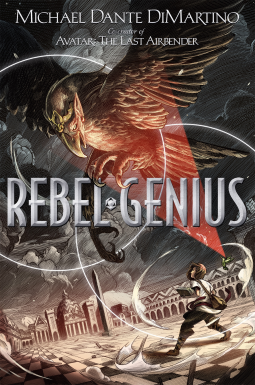
rebel-geniusRebel Genius (Geniuses #1), by Michael Dante DiMartino, (Oct. 2016, Roaring Brook Press), $16.99, ISBN: 9781626723368

Recommended for ages 10+

When the co-creator of Avatar: The Last Airbender and The Legend of Korra writes a new middle grade fantasy series, you read that book ASAP.

In an Italian Renaissance-inspired fantasy world called Zizzolan, we meet 12 year-old Giacomo, a young artist who’s living on the streets after his parents’ death. He lives in a society where Geniuses – animal muses that inspire humans to creativity – are outlawed. When Geniuses are taken from their humans, the humans become empty; dead inside – Lost Souls. This was Giacomo’s parents’ fate. When a Genius discovers Giacomo, he knows he’s in big trouble. He tries to get the bird companion to leave him alone, but the Genius isn’t having it. Just when Giacomo’s luck is about to run out, he’s rescued by a group of teens and tweens that bring him back to the studio where they are students of Pietro Vasari, who trains the kids and their Geniuses in sacred geometry, which will allow them to channel their creative powers. Before Giacomo is able to train for long, though, Vasari tells the group that a renegade artist named Ugolino is on the search for the Sacred Tools that will give him the power to destroy the world and anyone in his way; they need to find him and stop him. Ugolino won’t be so easy to bring down, though – he’s accompanied by his own monstrous work of art: Zanobius, a golem-like sculpture brought to life to carry out Ugolino’s bidding. Giacomo and his new friends set out on a quest that may cost them their lives and their Geniuses – can they save the world?

This is a deep book. DiMartino dives into some massive ideas here, particularly, Sacred Geometry: universal patterns used in the designs of everything in our reality. Think of a spiral: there are spiral galaxies; there are spirals in shells; a chameleon’s tail curls into a spiral, and when you look at it from above, a hurricane appears as a spiral. That’s sacred geometry: math, art, proportion, it all comes together in music and nature. That DiMartino chose such a weighty subject shouldn’t be a surprise; both Avatar and Korra; two hugely popular animated series, delved deeply into Buddhism, religious and cultural conflict, immigration, and identity. DiMartino isn’t afraid to talk to kids about weighty matters; he’s able to communicate layered, complex concepts to his audience. That said, while this is a book aimed at an 8-12 audience, some readers on the younger end of the range may struggle. I’d definitely booktalk this to my 5th and 6th graders, and I’d push this on my teens, too; this is a good crossover to YA. Black and white illustrations add interest and depth to the book, and help illustrate some more abstract concepts.

This is literary fantasy, and it’s beautifully written fantasy. If you’ve got fantasy readers, I think this would be a great book to introduce them to, and it would spark some great discussion. Wnat to read an excerpt? (You know you want to read an excerpt.) Head over to the Rebel Genius Tumblr and download one.


Posted in Middle Grade, Non-Fiction, Non-fiction, Tween Reads

Give your brain a workout with NatGeo Kids’ MASTERMIND!

mastermindMastermind, by Stephanie Warren Drimmer/Puzzles by Julie K. Cohen, (May 2016, NatGeo Kids), $12.99, ISBN: 978-1-4263-2110-8

Recommended for ages 8-12

Loaded with over 100 games, tests, and puzzles designed to “unleash your inner genius,” Mastermind is huge fun – and you learn stuff, too.

Guided through the book by cartoon characters Ima Genius and her canine sidekick Astro, Mastermind is all about the brain: each section is devoted to a different part of our brains and features sections like How it Works, where readers are guided through a step by step process of each part of the brain makes operations like sight, muscle movement, smell, and memory happen; fun facts and wild photos help break it all down for readers. Time Trials challenge readers to solve puzzles while timing themselves, and a final quiz in each chapter, called Test Your S.M.A.R.T.S. (Superior Mental Acuity and Rationality Testing System), pop up in each section, so budding geniuses can witness themselves becoming smarter with each section. A fun Mastermind Meter lets you track the progression of your genius through the book.

I had a great time reading and playing the games in Mastermind. The facts and real-life stories are interesting and fun, and there’s a ton of information to be learned here. Each section of the book looks at a different part of the brain and how we use them, from our senses, to identifying sounds, to mental map making and memory. Beginning with a maze through a highlighted part of the brain (to get your brains ready, naturally), readers learn how animals use their brains for similar purposes, and Weird Science introduces us to people living with brain issues that make them see things differently; for instance, hemospatial neglect causes someone to ignore things on one side – imagine only shaving half your face?

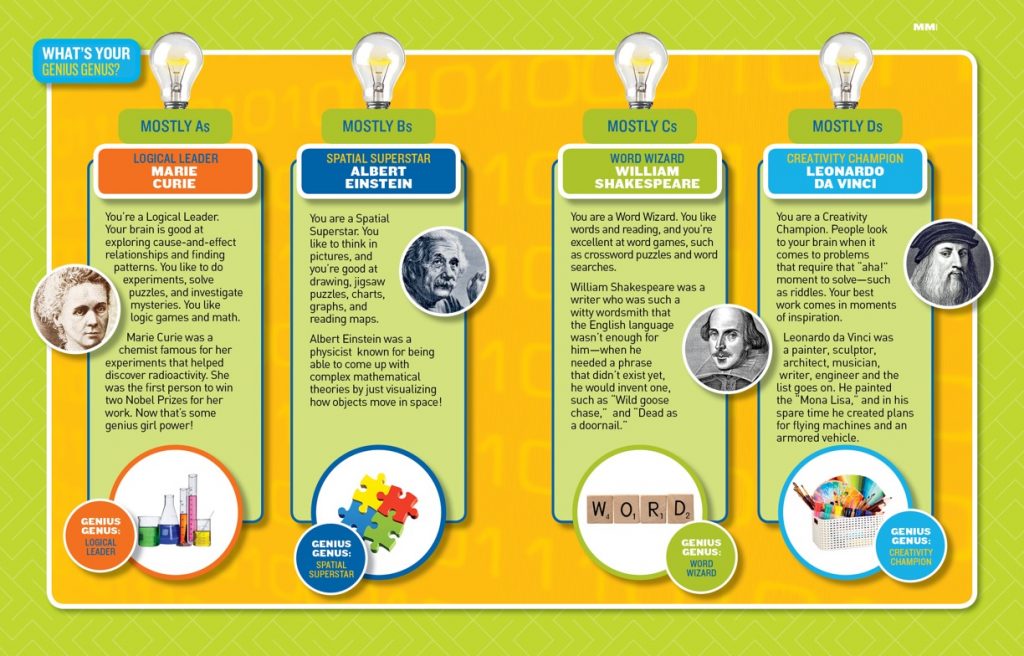
This will be destroyed in circ, because kids are meant to write in this book, but it won’t stop me from adding it as a great birthday or holiday gift to a few budding geniuses on my list. There are tons of ideas in this book for teachers and librarians, though; you can get the kids fired up with your own timed code challenges or have them figure out which genius they gel best with. The Mastermind website offers two downloadable puzzles, and a genius personality quiz kids can take online. All in all, Mastermind provides some fun and makes you think, which is really what learning should be all about.

mastermind_1

Posted in gaming, Graphic Novels, Non-Fiction, Teen, Tween Reads, Young Adult/New Adult

Box Brown gives us the real story of Tetris, the most addictive game EVER

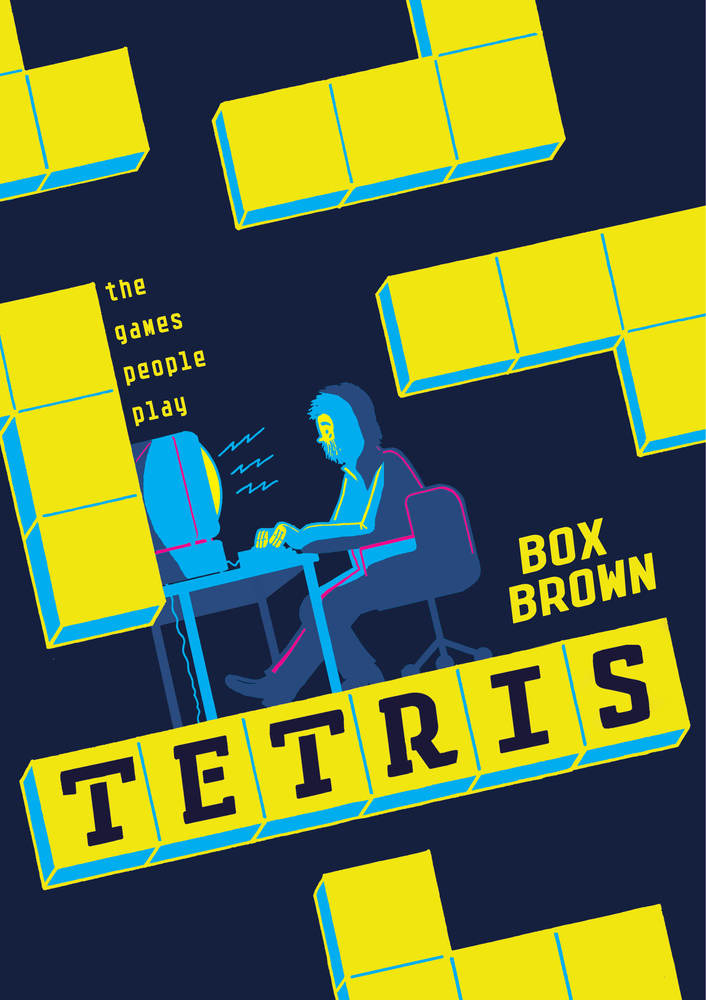
tetris_1Tetris: The Games People Play, by Box Brown (October 2016, First Second), $19.99, ISBN: 9781626723153

Recommended for ages 12+

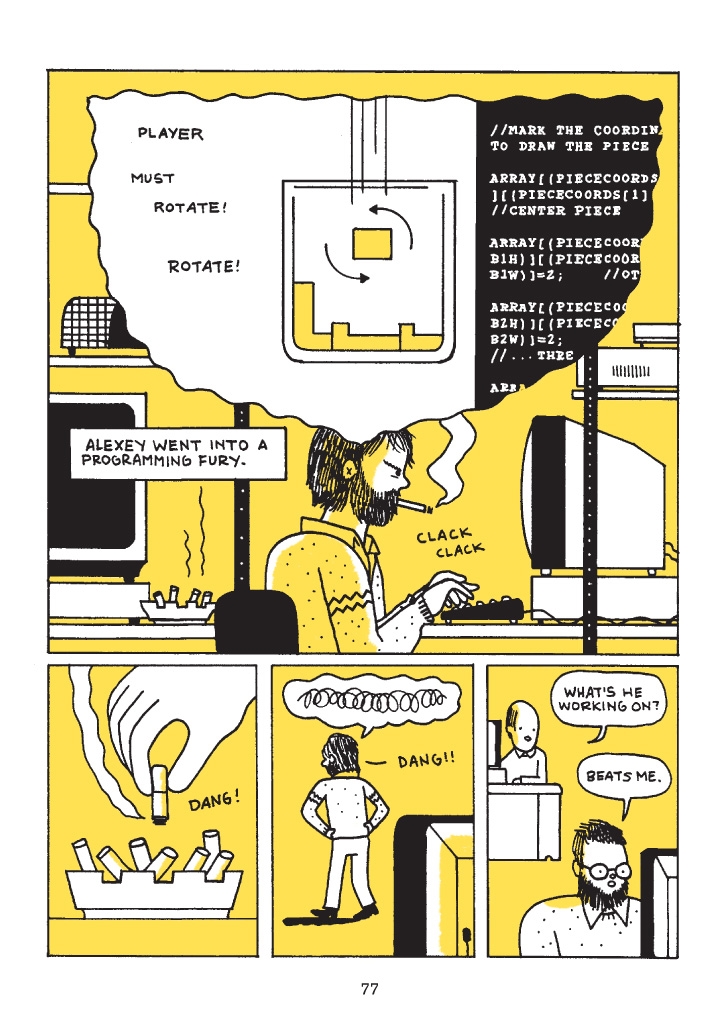
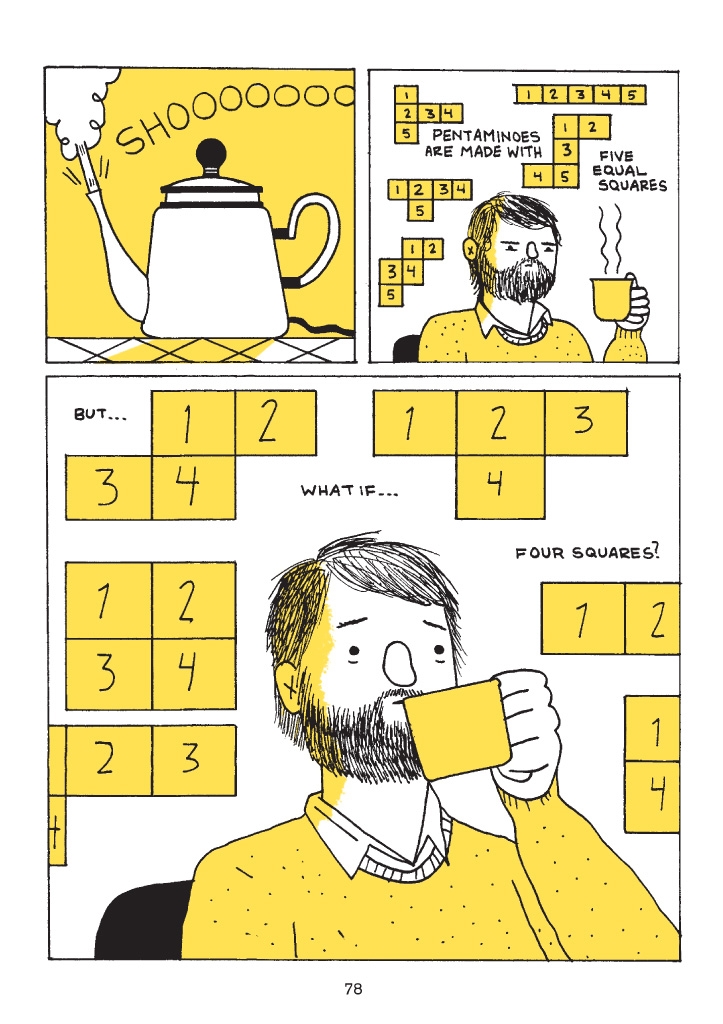
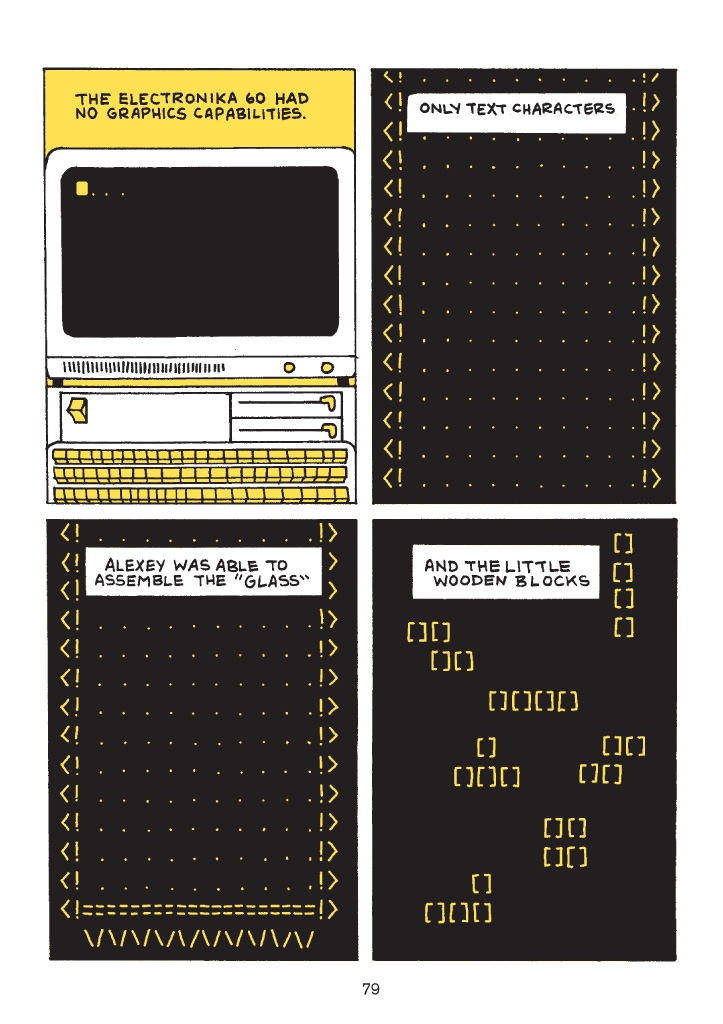
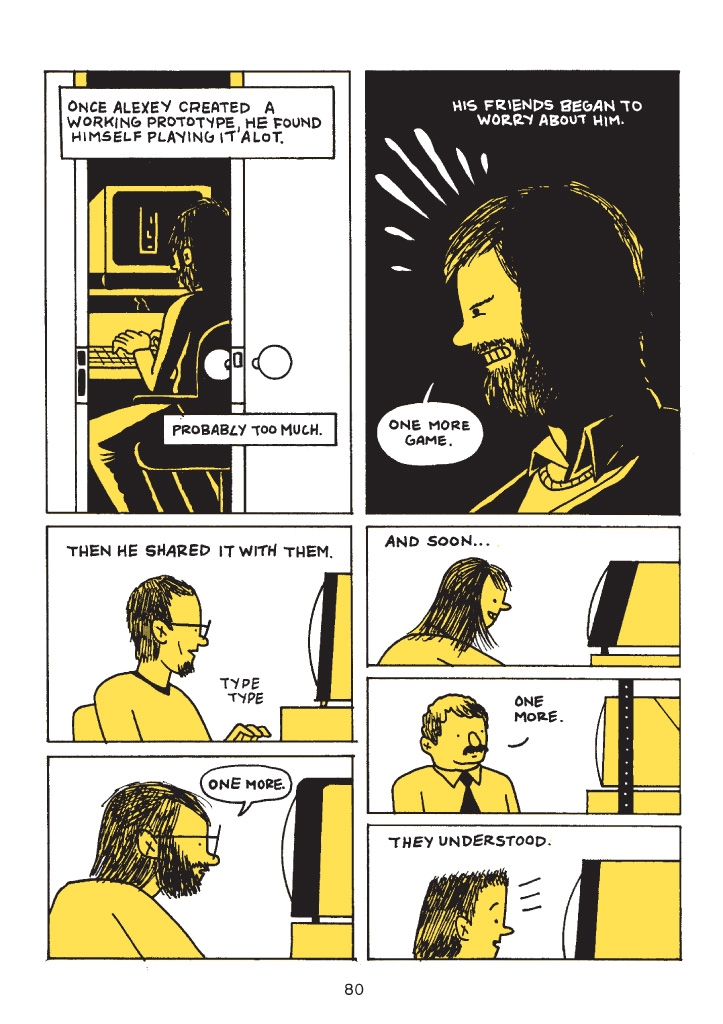
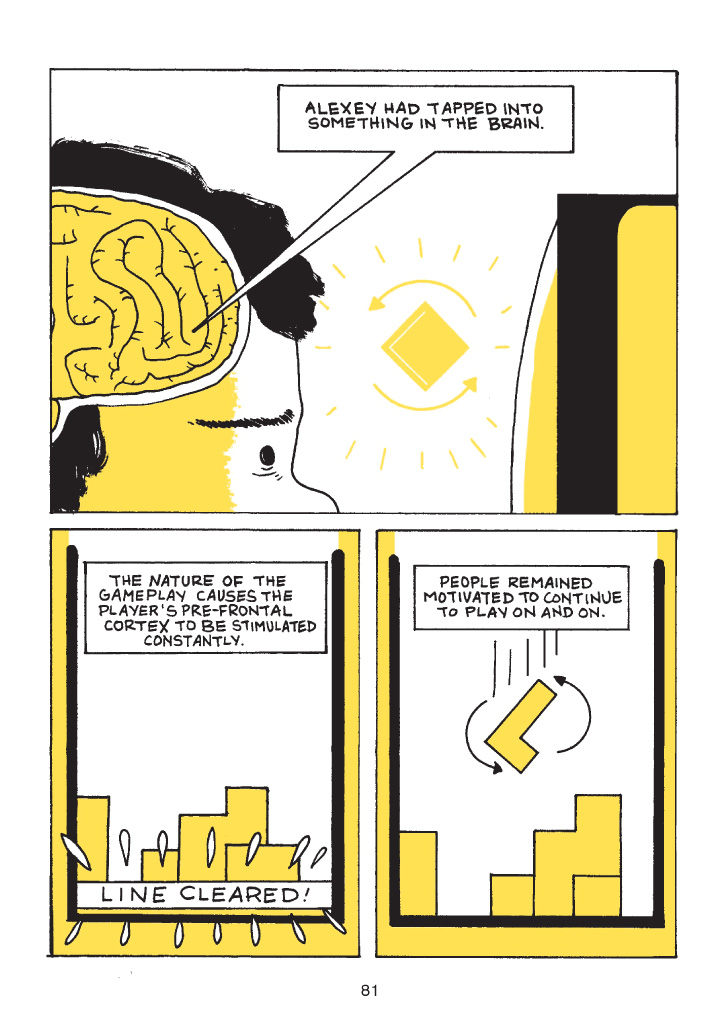
If you spent the better part of the early ’90s glued to your keyboard/gaming console/handheld, immersed in the video game Tetris, you’re not alone. I have logged many hours in front of my NES, rotating those little blocks to achieve the perfect fit. Box Brown’s graphic novel tells the story behind Tetris: the men who created it, and the game developers that almost went to war over bringing it to the masses.

We meet Alexey Pajitnov and his colleague, Vlad Pokhilko, computer scientists at the Moscow Academy of Science. In 1984, Alexey created Tetris in his spare time; it began life as freeware, being passed from friend to friend, coworker to coworker. This game was a phenomenon waiting to happen: it was addicting from the start; people were mesmerized. One story in the book illustrates a manager providing copies to his workplace colleagues, only to take the discs back and destroy them when office productivity declined.

We see the struggle between game developers and the tangled weave of rights for the game: Nintendo, Atari, and Sega all wanted it, and rights 0wnership was downright sketchy, with miscommunication and under the table deals leading to lawsuits. The story reads like an international thriller in parts, with all the trips to Moscow, international dealings, and theft and intrigue.

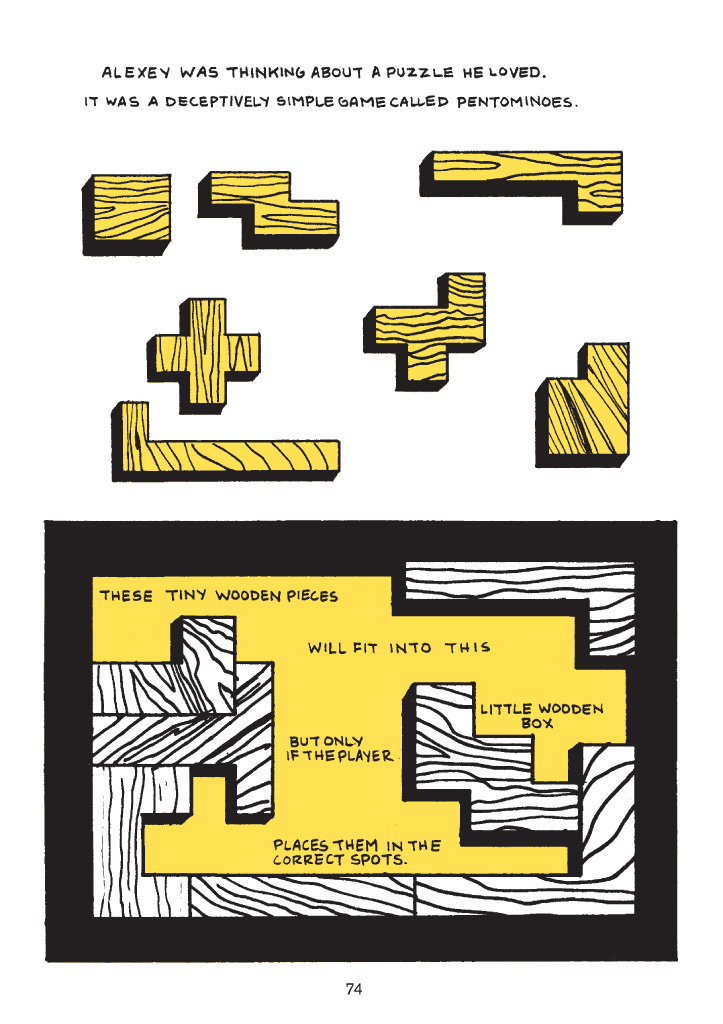
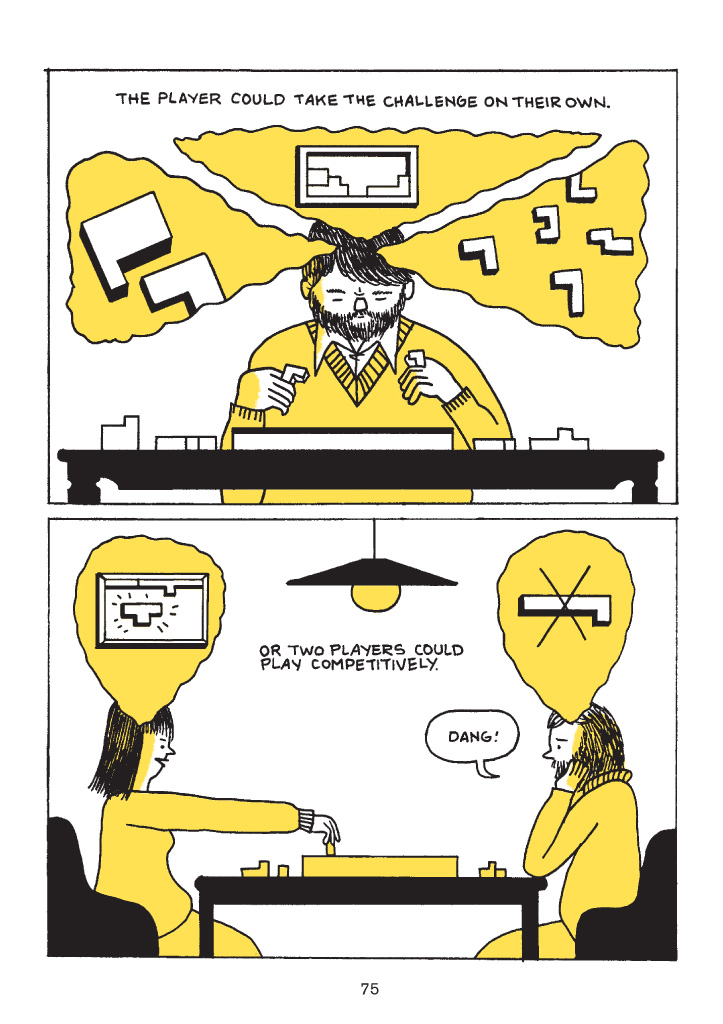
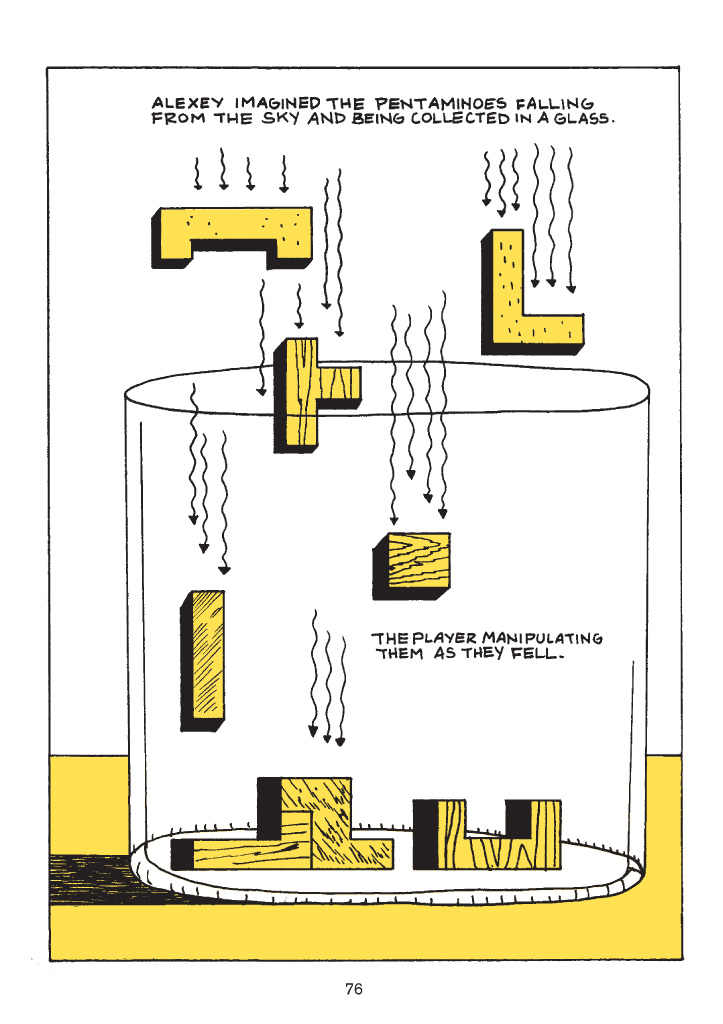
The story unfolds in two-color art, with game screen renderings and simple character drawings keeping readers focused on the story and the complexity of the game itself. In the story of Tetris, Box Brown also gives us the story of gaming: the pursuit of fun, and the role of gaming in art, culture, commerce, and intellect. From Lascaux cave paintings, which depict games, to artifacts of gaming pieces rendered in bone, to Senet, an Ancient Egyptian board game, to dice games, and finally, to smartphone gaming (where Tetris still lives on), the pursuit of fun, the joy of gaming, is part of human history.

This will go over well with gamers and history fans, graphic novel fans and anyone interested in business. There’s some good advice for businesses in the story of Tetris, especially for anyone interested in international licenses. Box Brown’s graphic novel is multilayered and well-rounded, with an abundance of information presented in an interesting and easy to digest format.

Box Brown is a New York Times–bestselling author. He wrote the best-selling graphic biography, Andre the Giant: Life and Legend. Take a look at some more of Tetris here, and head over to Box Brown’s author webpage and see more of his illustration work.

tetris_2 tetris_3 tetris_4


And now, you can’t get the Tetris music out of your head, either. You’re welcome.

Posted in Realistic Fiction, Teen, Young Adult/New Adult

Blog Tour: Playing for the Devil’s Fire, by Philippe Diederich

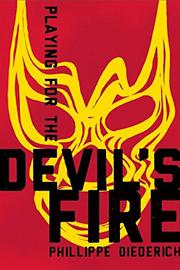
devilsfirePlaying for the Devil’s Fire, by Phillippe Diederich, (March 2016, Cinco Puntos Press), $11.95, ISBN: 978-1-941026-29-8
Recommended for ages 14+

Photojournalist Philippe Diederich wrote his debut novel as a way of communicating his sorrow and anger at the brutual narcoviolence and corruption infecting Mexico. The brutal and gripping story follows 13 year-old Libero “Boli” Flores as he sees his town, Izayoc, crippled by the town’s new inhabitants: men who wear shiny guns, expensive clothes, and drive big SUVs; men who have a lot of money to spend, and men who don’t like to be questioned or crossed. When people speak out, they show up dead.

Boli’s parents know it’s no use to go to the local police, so they head to a neighboring town to seek help, but they never arrive. Boli waits for someone to bring he and his sister, Gaby, some kind of news. Hope comes, briefly, in the form of El Chicano Estrada, a small-time luchador that Boli sees at a wrestling match. Boli, a devoted fan of lucha, particularly the legendary El Santo, begs Chicano to help him locate his parents. Chicano sees the corruption and grim reality facing Boli and the people of Izayoc; it awakens something in him, and he tries to be the hero that Boli needs. But Chicano also knows a truth that Boli hasn’t learned yet: the world is not a good place.

This is a vicious, heartbreaking story about the end of childhood. It’s a grim, powerful, and beautifully written novel, with unforgettable characters: Boli and Gaby are two siblings struggling to move on with their lives in the most horrifying circumstances; their Abuela escapes into her memories of the past to cope; Chicano is someone who just wanted to get by until he found someone that believed in him. Diederich looks at the morality, or lack of it, using Boli as the lens.

Who do you turn to in a town when everyone can either be bought or murdered? This is the question at the heart of Playing for the Devil’s Fire, and it is a very real question facing many Mexican communities. It’s an eye-opening look into a reality many young people face. Philippe Diederich puts a very human face on the cost of the neverending war on drugs.

This is not a book for middle grade or middle schoolers. There is graphic violence (the story begins with a child finding a decapitated head), language, and overall content that is disturbing and upsetting. I’d suggest this for upper high school, young adult, and adult readers, because it is a brilliantly written book that will make readers think, and hopefully, talk.

Playing for the Devil’s Fire has received a starred review from Publishers Weekly.

Philippe Diederich grew up in Mexico City where he played marbles in the streets and became a fan of lucha libre – pastimes he revisits in Playing for the Devil’s Fire. This is his first novel for young adults, but his short stories have been published in literary journals, and his mystery, Sofrito, is a culinary mystery that travels from Havana to New York City. His author website offers a newsletter and more information.

Playing for the Devil’s Fire Blog Tour

August 31: Rich in Color review  (http://richincolor.com)

Sept 1: The Pirate Tree review & interview (http://www.thepiratetree.com)

Sept 4: Guest Post for Clear Eyes, Full Shelves (www.cleareyesfullshelves.com)

Sept 5: Review, The Brain Lair (http://www.thebrainlair.com)

Sept 6: Rich in Color author interview (http://richincolor.com)

September 7: Edi Campbell CrazyquiltEdi review (https://campbele.wordpress.com)

September 8: Anastasia Suen, #KidLitBookoftheday (asuen.com)

September 9: Reading Through Life author highlight plus links to blog tour  (http://readingtl.blogspot.com)

Sept 9: Guest Post, The Brain Lair (http://www.thebrainlair.com)

September 12: Linda Washington (https://lmarie7b.wordpress.com/ )

September 13: Excerpt, Review, Mom Read it (https://momreadit.wordpress.com)