Posted in Fantasy, Historical Fiction, Science Fiction, Teen, Tween Reads

Traveling through Time via my TBR: Ripped Away by Shirley Vernick

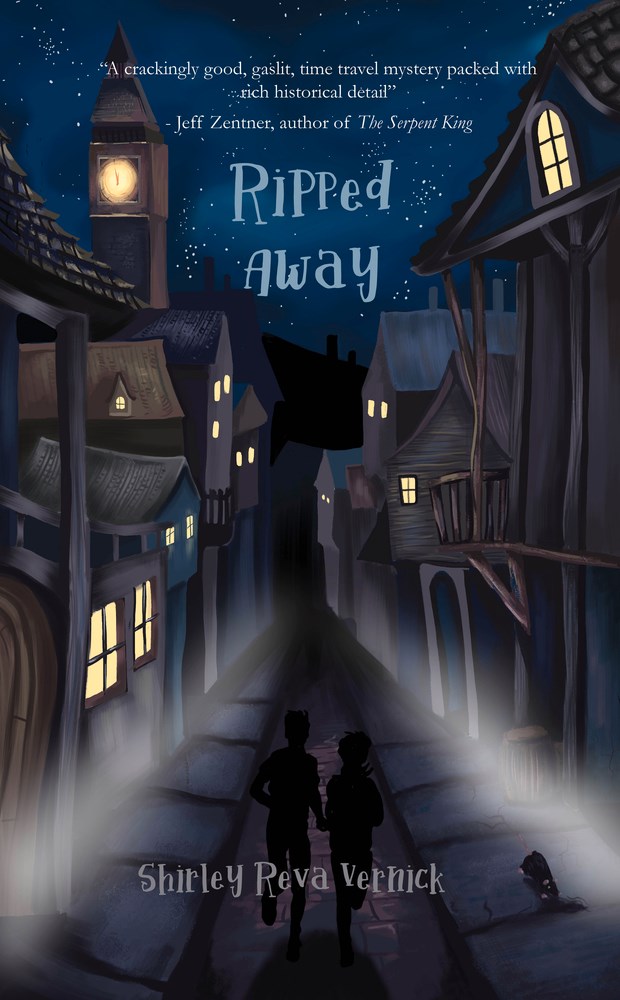
Ripped Away, by Shirley Vernick, (Feb. 2022, Fitzroy Books), $15.95, ISBN: 9781646032037

Ages 10-14

Abe Pearlman is a kid that who’s a bit of a loner. He’s got a kinda-sorta crush on his classmate, Mitzy Singer, but he doesn’t think she really notices he’s alive. When Abe spots a new fortune teller shop in his neighborhood, he goes in, figuring it’s worth a shot. Zinnia, the fortune teller, tells him he can save a life, and Abe leaves, only to discover that he’s not in his neighborhood anymore: he’s somehow been transported back in time to the slums of Victorian-era London, England! He’s now working as an assistant to a jewelry salesman named Mr. Diemschutz, living with his mom in a tenement apartment, and discovers that Mitzy has been sent back in time, too. She and her mother are living with her deceased father’s brother, in the same tenement building as Abe, and Mitzy is blind. Both were given cryptic clues by Zinnia, and now they have to figure out how to get back to their own place and time… but they also have to try and figure out how their fortunes are connected to Jack the Ripper, who’s on the loose in their neighborhood, and they have to survive the hatred directed toward Jewish refugees, already being accused to stealing jobs and housing from the English, and now being accused of possibly counting The Ripper among their community. Inspired by true events, Ripped Away is a great time-traveling story with a strong historical fiction backbone. Characters are realistic and have strong personalities that extend beyond the main plot; the author brings the history of anti-Semitism in Victorian Europe, particularly in the Jack the Ripper case, to light, and there are great points for further discussion throughout the story, including comparing and constrasting the plights of refugees, anti-Semitism, and family structures, from Victorian England (and further back!) through the present day. Back matter includes an author’s note that touches on the Victorian England, Jack the Ripper, and the anti-Jewish sentiment that gave rise harmful theories about the killer’s identity. An excellent read.

The Forward has an interesting article on Jack Ripper and anti-Semitic hysteria.

Shirley Vernick is an award-winning author. Visit her website for more information about her books and to follow her on social media.

Posted in Fantasy, Fiction, Middle Grade, Tween Reads

Exciting Afrofuturistic middle grade reading: Onyeka and the Academy of the Sun

Onyeka and the Academy of the Sun, by Tolá Okogwu, (June 2022, Margaret K. McElderry Books), $17.99, ISBN: 9781665912617

Ages 8-12

Onyeka is a tween living in the UK with her mom. She’s got a thick head of hair that makes people stop, stare, and whisper, but her best friend, Cheyenne, couldn’t be bothered what other people think, which helps calm Onyeka’s anxiety. When the two head to the pool for some swimming, Cheyenne almost drowns, until Onyeka – or, is it Onyeka’s hair? – saves her. Everything moves quickly from here: Onyeka’s mother reveals that she is Solari, a secret group of people with unique powers, unique to their home in Nigeria. Her scientist father has disappeared while trying to research the Solari, and her mother brings Onyeka to Nigeria, to the Academy of the Sun, a special school – think the X-Men’s school run by Charles Xavier – for Solari, where they are trained to work with their powers. But nothing’s ever that easy; as Onyeka starts learning more about her family and the Rogues, a group of Solari working against the school, she and her new friends have to figure out where they stand.
Onyeka and the Academy of the Sun is the first in a new series, written by British-Nigerian author Tolá Okogwu and inspired by a lack of representation in children’s books. The decision to empower Onyeka by channeling her power through her hair is a deliberate move, as she notes in her author’s note: “our hair has never just been hair… the lie we’ve all been fed that Afro textured hair is somehow inferior because it doesn’t conform to the Western standards of beauty”. Onyeka’s hair is incredible: it shields her; it saves Cheyenne’s life; it curls around her to comfort her. The characters are African; the Solari are all Nigerian, and the school is organized into different areas, according to student’s Ike – the Igbo word for “power”. The story moves at a brisk pace while still bringing these characters to life, fully-fleshed out with backstories and personalities. The students will empower and inspire readers, and the family relationships are beautifully realistic, with conflict and love often sharing the same space. A glossary of words and an explanation of Nigerian Pidgin English provides even further depth and educates readers. I can’t wait for the second book.
Give this to your Rick Riordan Presents fans; your Black Panther readers (not just the comics! Remember, Shuri and Black Panther have middle grade novels, and Okoye’s got a YA novel, too!), and your Tristan Strong readers. Give this to any of your readers who love reading about different cultures, and are always up for adventure. It’s awesome.

Onyeka and the Academy of the Sun is an Indie Next pick.

Posted in gaming, Librarianing, Middle Grade, Teen, Tween Reads

Tabletop Tuesdays with Nightmarium

I’ve been behind on… well, everything, but especially on my gaming posts. Our gaming club is coming along nicely, and since I’ve sent Carcassone out to the next library on the rotation, the kids are back to playing the games we’ve got in house and the goodies I bring from my home stash. The last couple of weeks, Nightmarium has been all the rage here – and why not? It’s creating monsters that turn on one another with glee! I backed Nightmarium as a Kickstarter a few years ago, and it has been a mainstay of gaming in my own home. You don’t need to read to play, the monsters are hilariously weird, and game play moves along at a good pace. Let’s dig in.
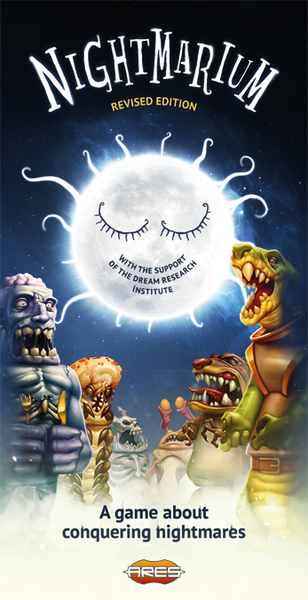
Nightmarium: A Game About Conquering Nightmares, Ares, Igrology, et al (2014)
Ages The box says 10+; I’ve actively played this with my then 5-year-old, and easily explained to 7-10 year-olds here at the library. I’d go 7+
Play time: 20-30 minutes, depending on number of players
Number of players: 2-5

Find Nightmarium on Board Game Geek

The monsters featured in this game are a group of Night Terrors ready to haunt your dreams. The backstory is fun, organizing the monsters, by color, into four Legions of Horror. The backstory isn’t necessary for game play, but it adds to the fun. Each legion has its own color: blue stands for Necromunculi, brown for Constricti, green for Chimeridae, and red for Mansters.

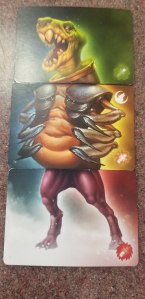
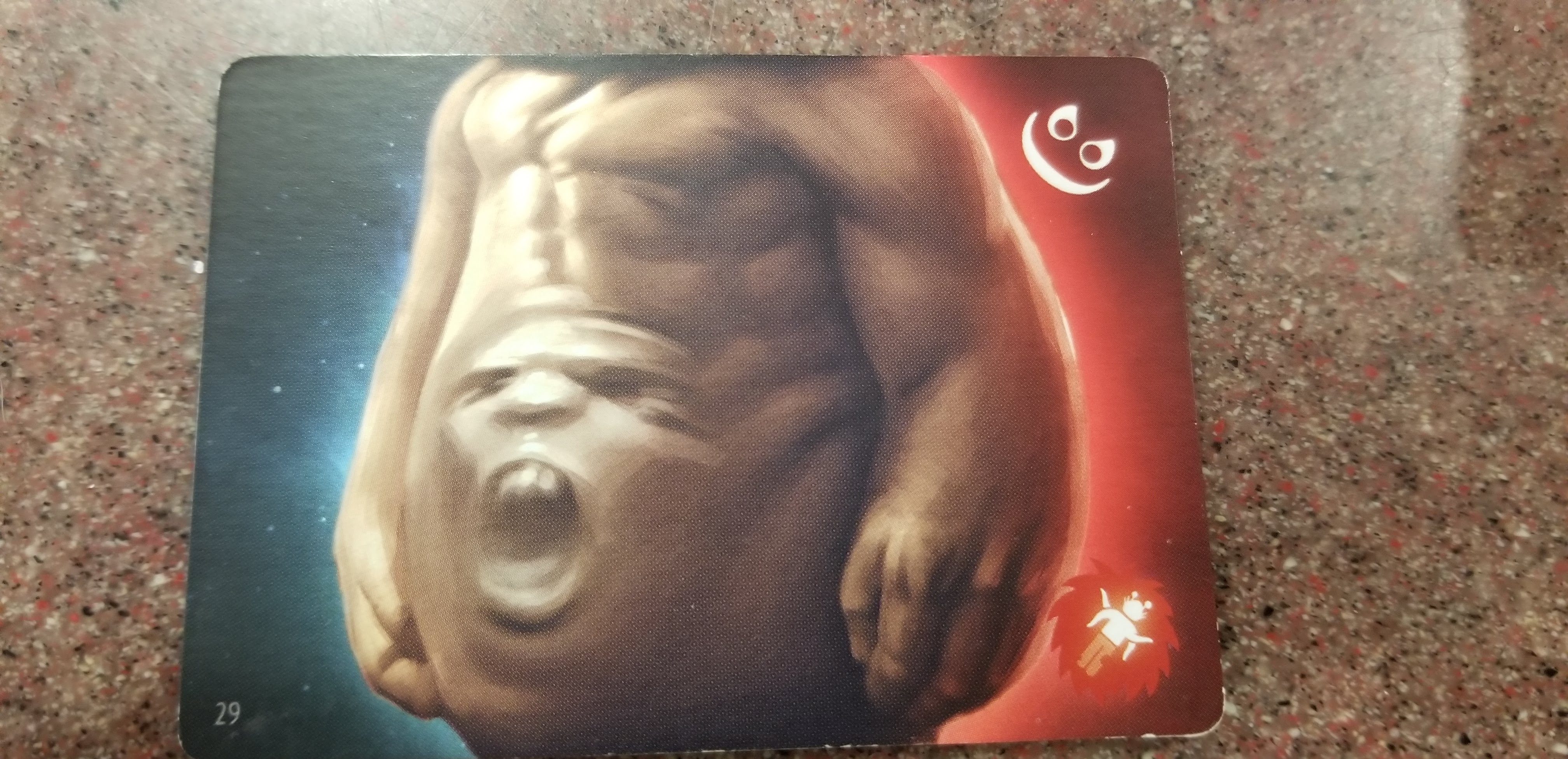
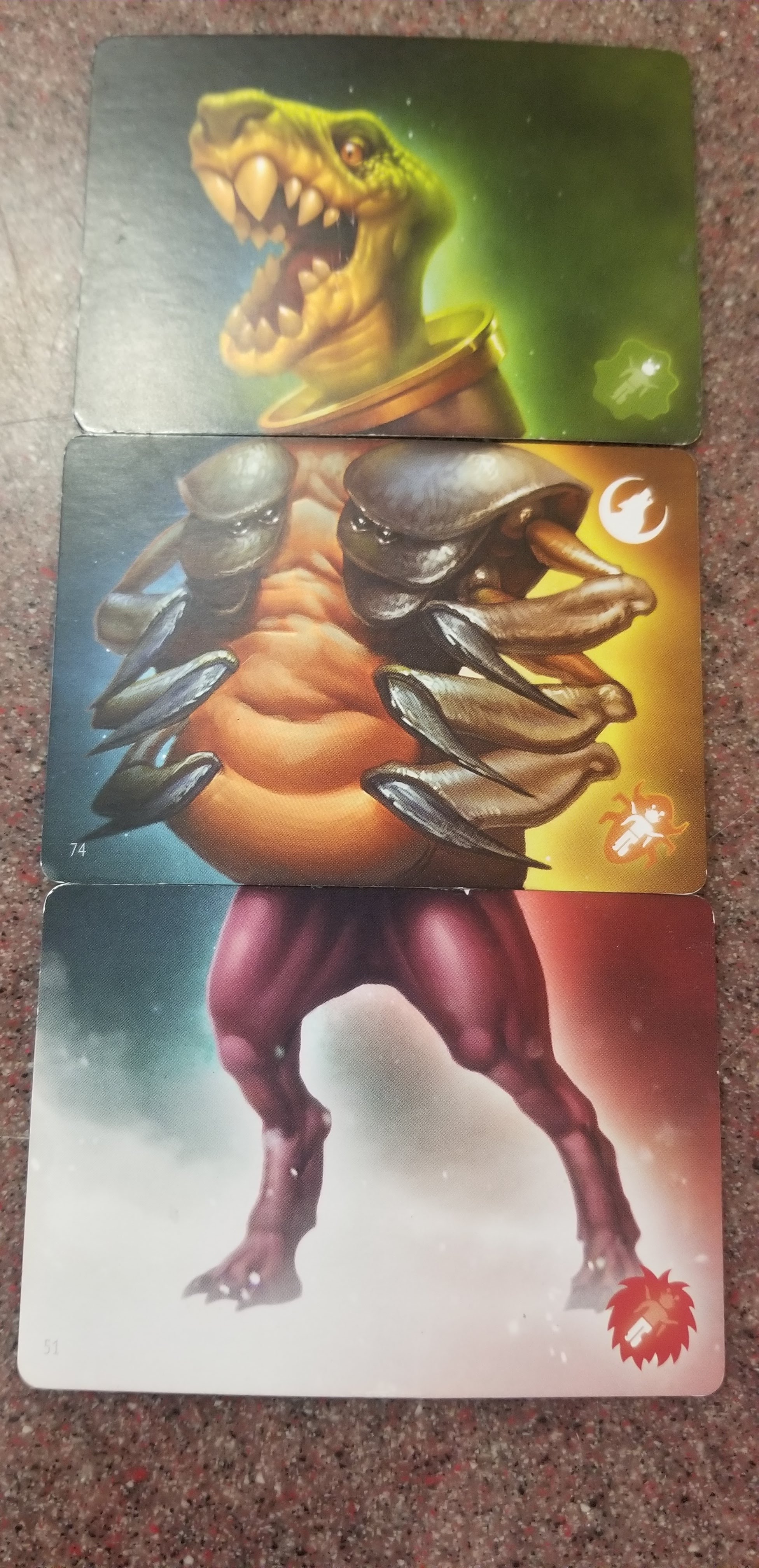
Cards come in three types: feet/legs, trunks/bodies, and heads. Some cards can serve multiple functions, like this striking fella, who can be either a head or a body:

 

Players get two actions per turn. You can:

  • draw a card from the top of the deck
  • play a card from your hand
  • discard cards and redraw: one card for every two you discard

If you draw a card and play a card, that’s two actions. If you draw two cards, that’s two actions. If you draw two cards and you want to play the second card, you have to wait until it’s your turn again; playing that card would be a third action. You can discard two cards, draw one card to replace them, AND play or draw another card. That counts as two actions.

You have to assemble your monsters from the bottom up. Feet first; if you have a handful of really great heads, that’s awesome, but you have to start from the feet. There’s no hand minimum or maximum; if you don’t want to get rid of any of your cool head cards, keep them, and keep drawing until you get feet you want to play to start things off.

When you complete a monster, congrats! See those See those pictures in the upper right hand corner of most cards (not all have them)? Those are different abilities that activate once you complete a monster.
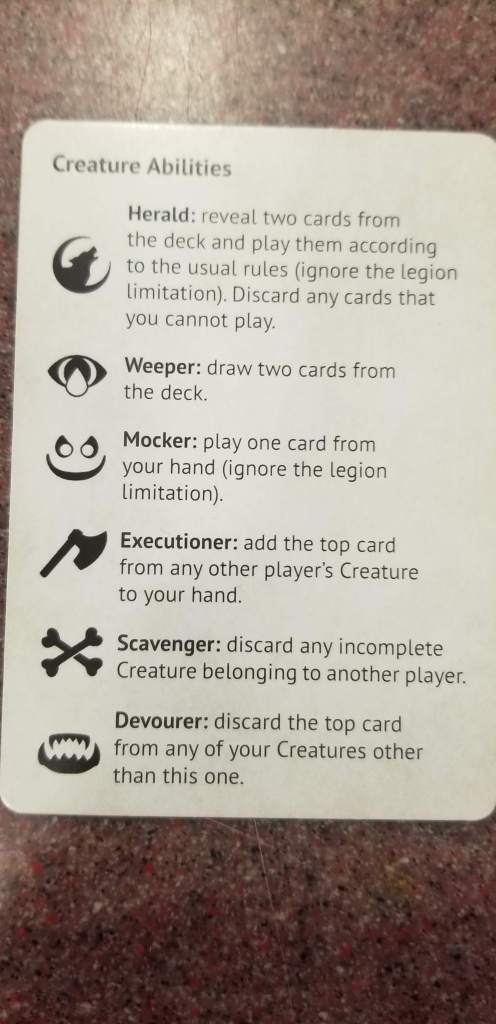
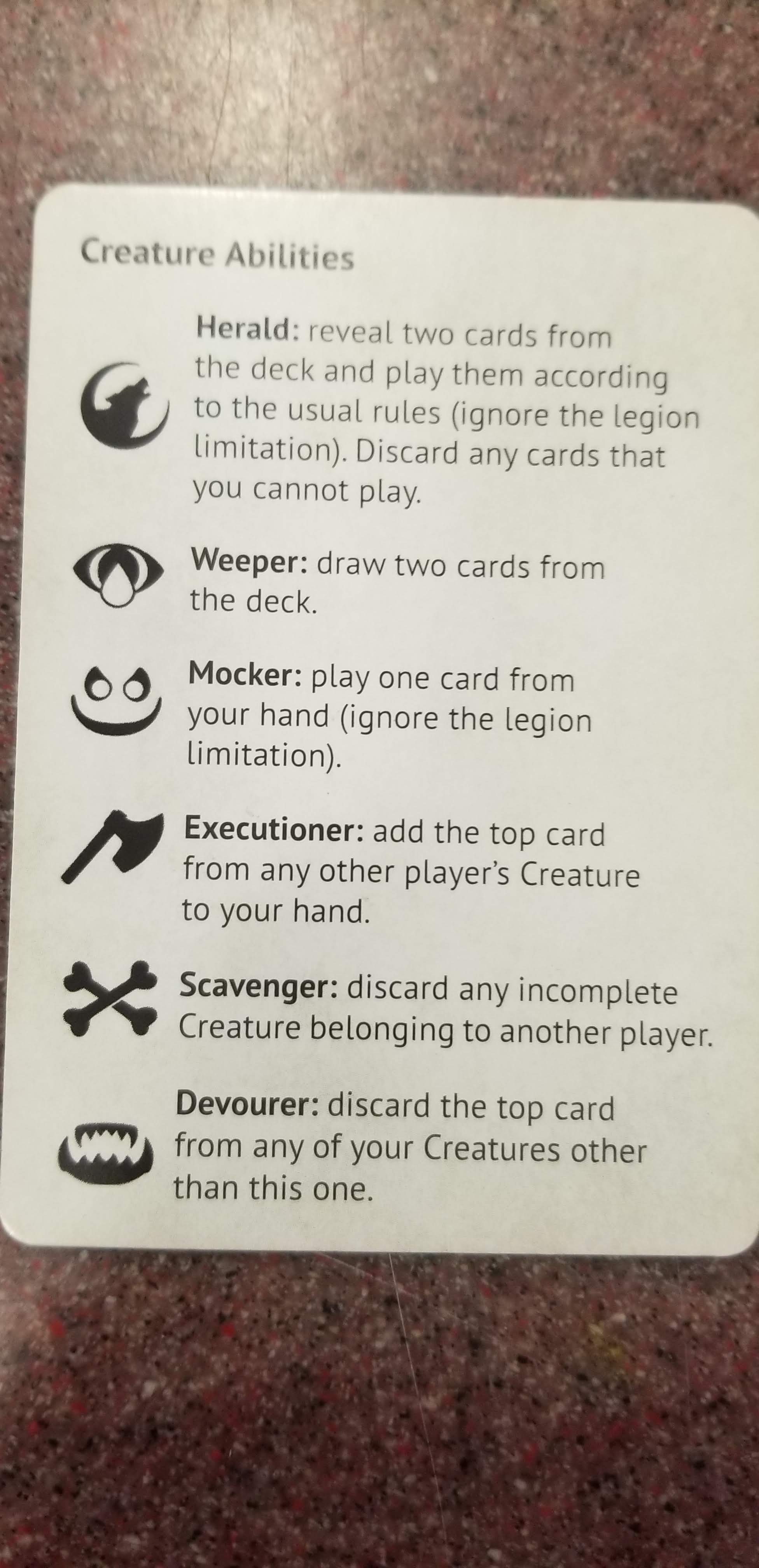
Watch out for that Devourer – you have to cut one of YOUR Creatures’ heads off, not your opponents! This can actually be a good thing, because you can add another head and reactivate powers, if you have good ones. It’s a good secret weapon to have. Creature powers are only active when the Creature is completed – not every turn, and not while under construction.

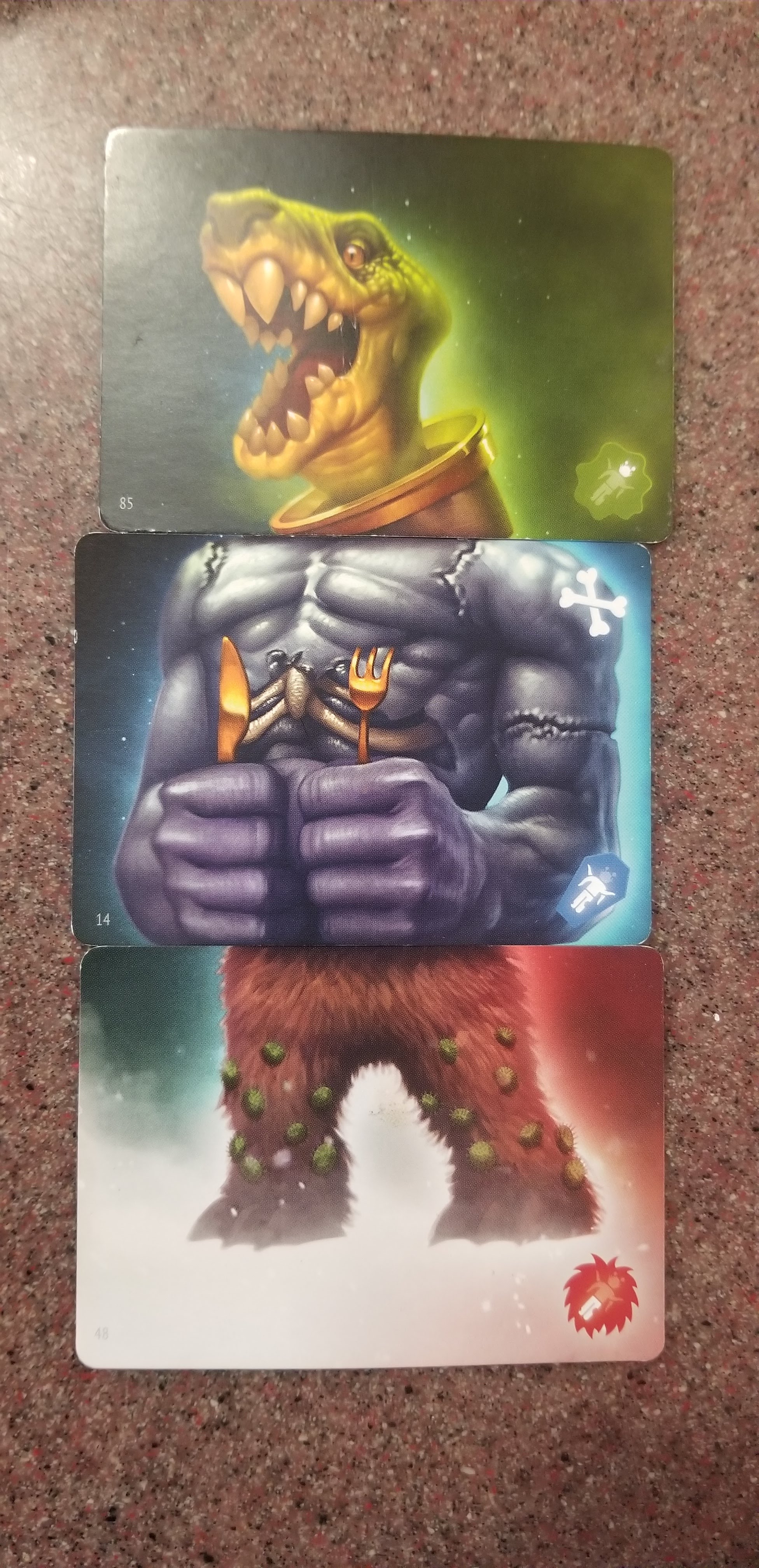
Okay, let’s talk about Legions. I don’t tend to play Legions at the library, because I modify to make things as simple and fun as possible for my younger gaming kids. Legions, like I said before, are organized by color. You don’t HAVE to create Creatures with all parts from the same Legion, though – you’ll still get your abilities when you complete one. Look:
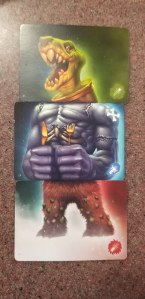
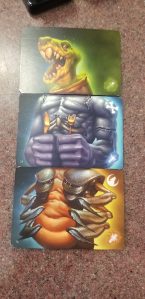
       

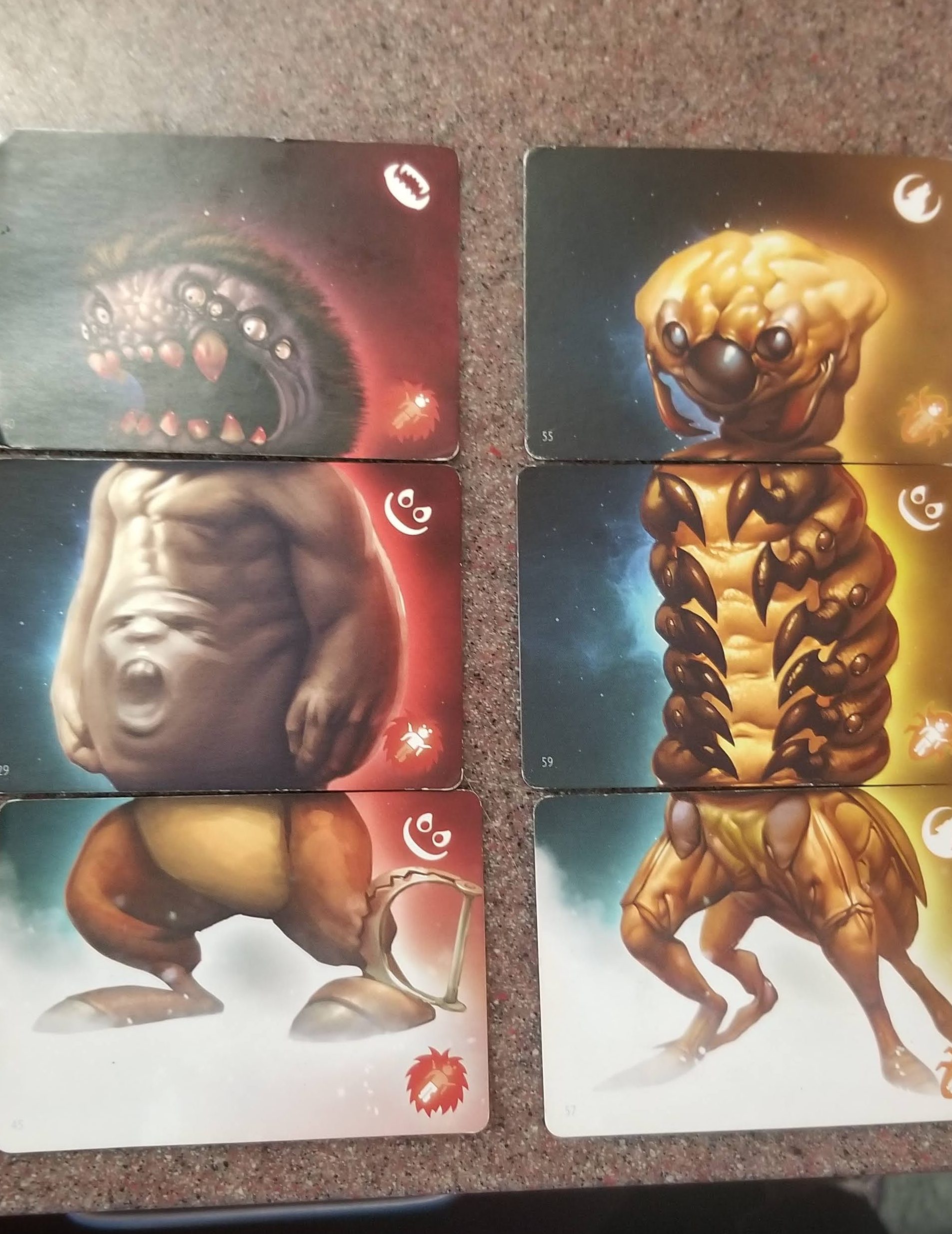
Here’s a creature composed of parts from all different Legions (Notice the bottom in #2 can also function as the middle in #3). In #1, the Creature has only one power to activate: the Scavenger, where the player can discard any incomplete creature belonging to another player. If I’m playing against this player, and I have a 2- or 1-card Creature under construction, that player can say goodbye to it, and I have to put it in the Discard pile.

The #2 Creature has Scavenger and the Herald, which lets that player reveal two cards from the deck, face up, so all other players can see it, and play them if they can. If the player gets a pair of feet, awesome; they can play it. If the player draws a body and a head, they can only play them if they have under construction Creatures that can use those cards. Anything that the player can’t use right then and there goes in the Discard pile.

Other powers include the Weeper, which lets the player draw two cards from the deck. They don’t have to play them, they just add them, regardless of what they are.

The Mocker lets you play one card from your hand.

The Executioner lets you take another player’s top card – heads, but also anything that’s on top – if you have a monster under construction and the top card you have is a body, your opponent can take that with Executioner. Cards claimed when someone plays Executioner goes into the player’s hand, not the Discard pile.

Playing abilities does NOT count toward your actions! If the first move you make during your turn is to complete a monster, you play the abilities, and THEN play your second action. It’s pretty awesome.

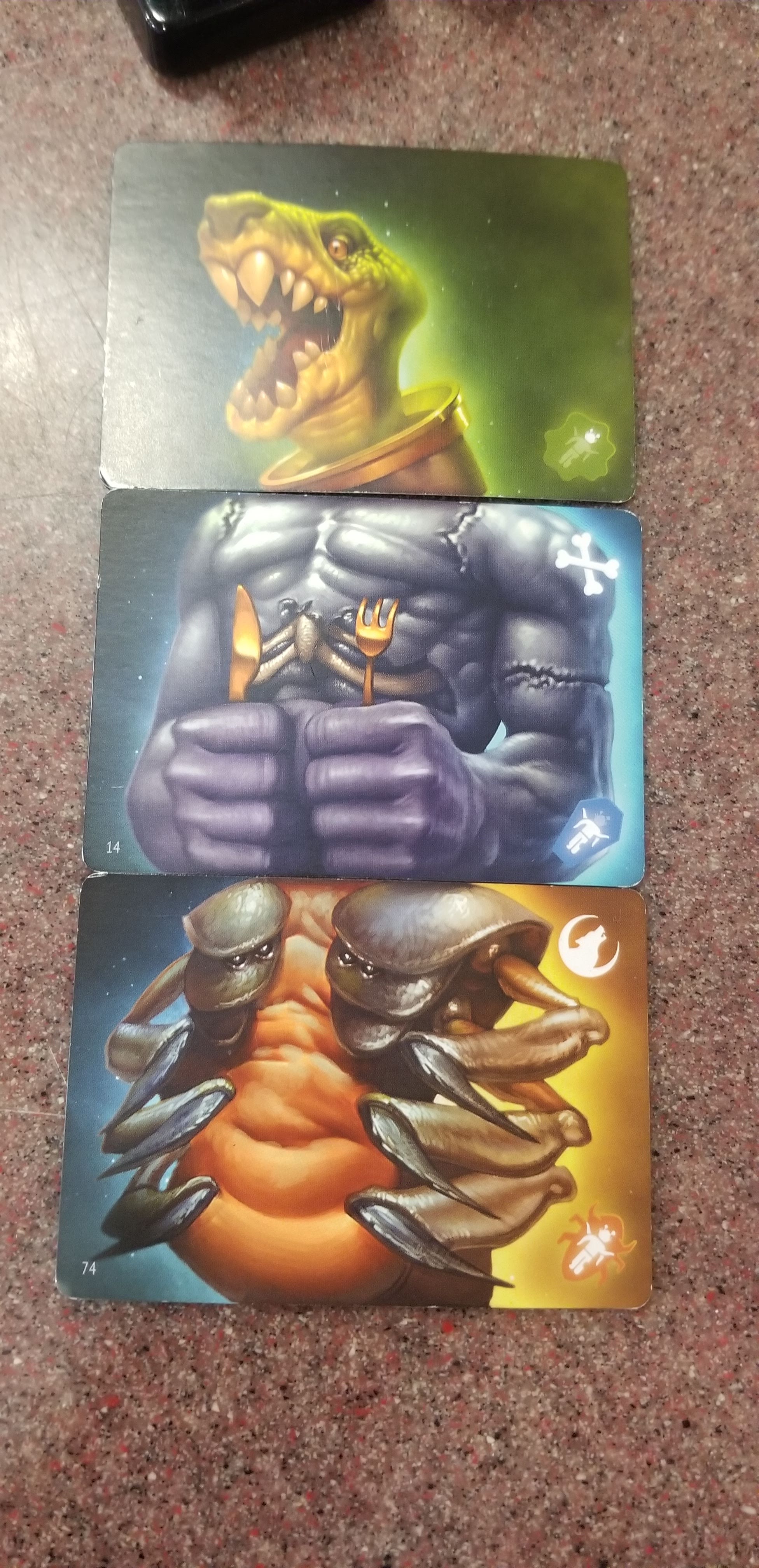
Okay, so let’s talk about Legions. Like I said, I tend not to play Legions because it’s easier for younger kids to just get used to playing cards, but playing Legions can mix things up for extra fun. Match the colors of your creatures to trip up your opponents: when you finish a monster with cards from the same Legion, everyone else has to discard a card of that Legion OR discard any two cards. Look:
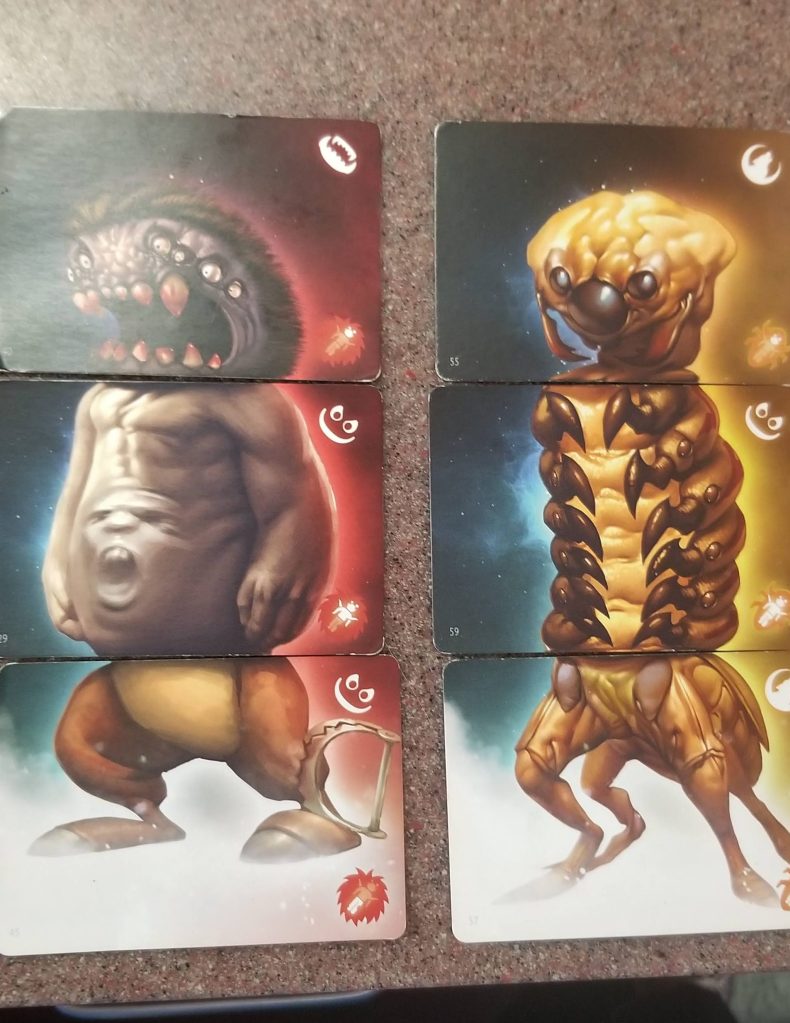
Here’s we’ve got a Manster and a Constricti. If you were to complete these guys on your turn, everyone else would have to discard either one red card and one brown card. If your opponents don’t have those colors? Get rid of any TWO cards per color. Have a red, but no brown? Discard a red and two other cards. Have only blue and green in your hand? Discard four.

You don’t have to complete two at a time; I just took a picture of these two together. But you catch my drift.

Okay, if you are playing Legions, you also have to be careful when you’re putting down cards. If you play a card belonging to a certain Legion, your second action cannot be to play a card from another Legion. If you put down a red pair of legs, you can’t play a blue pair of legs or put a brown body down next. (This is why I don’t play Legion with my library kids yet.)

That’s about it! First player to complete five Creatures wins the game! I play this game pretty regularly at home with my own family; it’s one of my 10-year-old’s favorite games. The library kids ask for this every Monday and Tuesday (our gaming days), too; it’s fun, you can be as silly as you want, and the opportunity for good-natured smack talk is mighty. While Board Game Geek lists it as only available via eBay, I’ve seen it available in several places online, including GameNerdz, Boarding School Games, and Target. Average price is about $20, and it’s well worth the cost. This one will become a foundation game for a lot of collections.

If you feel like testing before you buy, head over to Tabletopia and play online for free!

Happy Gaming!
Posted in Fantasy, Teen, Young Adult/New Adult

The Great TBR Read-Down: The Forgotten Memories of Vera Glass by Anna Priemaza

The Forgotten Memories of Vera Glass by Anna Priemaza, (Nov. 2021, Harry N. Abrams), $18.99, ISBN: 9781419752599

Ages 12+

Do not let the cover fool you: The Forgotten Memories of Vera Glass is a fantasy mystery that will keep you guessing. Vera Glass is a high school student living in a world where everyone has a magic gift; Vera’s is the ability to open locks, while her mother’s intuition magic makes her a wonderfully empathetic and comforting parent. She lives with her scientist parents and siblings, has a strong faith community, and a solid group of friends, but something just isn’t right. No one can quite voice it, but there’s something missing; something leaving a hole in more and more people’s lives, and Vera is determined to find out what it is. There are a few suspects, including a group of “witches” from the Goth kid group and the organization that Vera’s parents work for. The strength here is in the jarring disappearances that pop up throughout the book: a character is part of the scene, and then they’re just… not. And Vera pauses, trying to remember something just outside of her memory, not able to quite grasp what’s changed; just that there’s an ache she can’t quite shake. Heartbreaking and very readable, Vera is the first-person narrator, written with deep feeling by Anna Priemaza. Vera’s faith doesn’t come across as preachy; it’s a facet of her life, and she has an inclusive group of friends that also includes some atheist representation. The Forgotten Memories of Vera Glass examines the feelings we have for those in our lives that go deeper than the surface; deeper than memory.

Posted in Fantasy, Fiction, Middle Grade, Tween Reads

Middle School Twofer: Lightning Girl by Alesha Dixon

As I continue scaling Mount TBR, I’ve got a fun middle grade two-fer today: the first two books in the Lightning Girl series by British singer, dancer, and Britain’s Got Talent judge Alesha Dixon.

Lightning Girl, by Alesha Dixon & Katy Birchall/Illustrated by James Lancett (June 2020, Kane Miller), $6.99, ISBN: 9781684640782

Ages 8-12

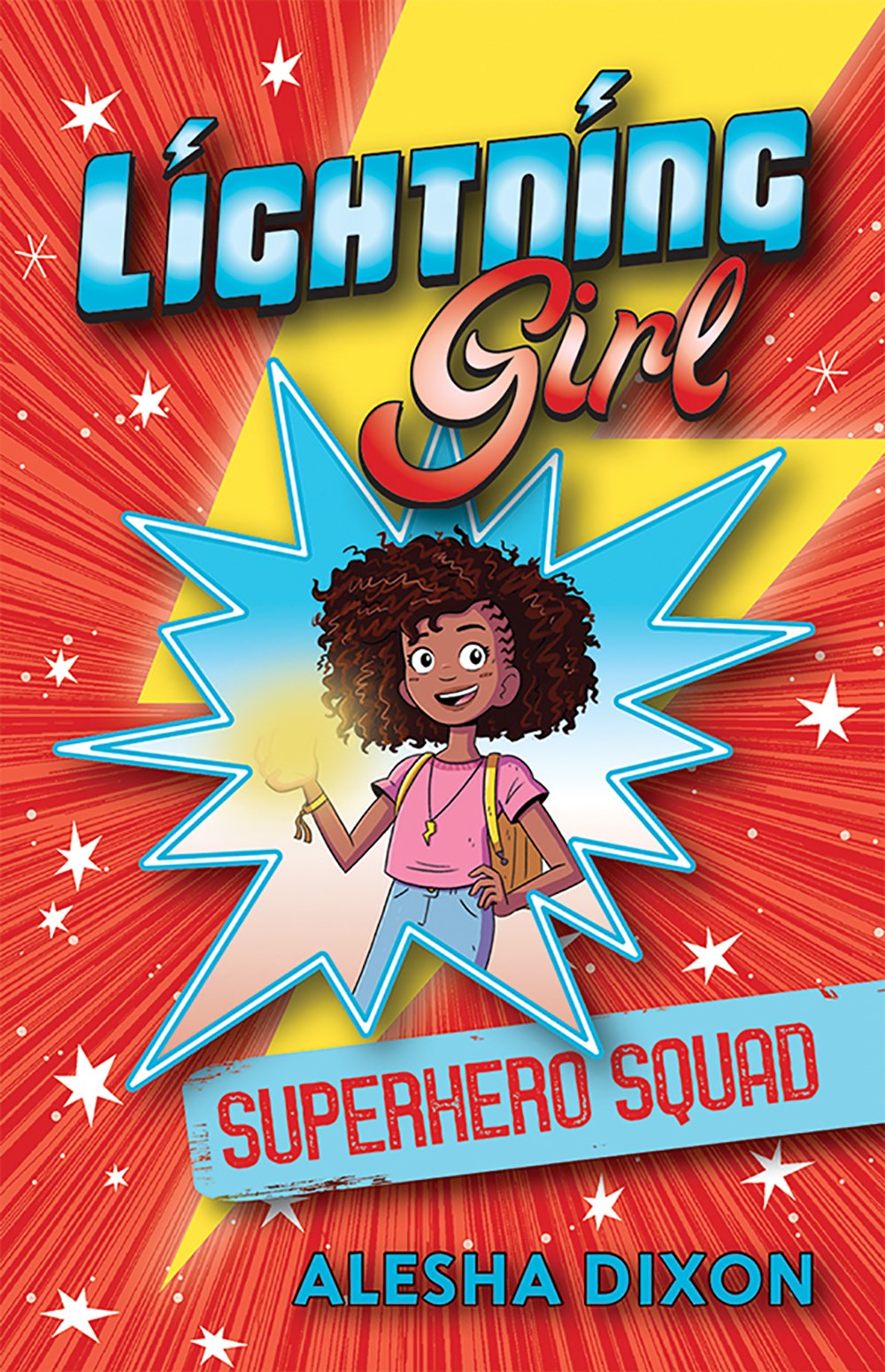
Life isn’t always a breeze for 10-year-old Aurora Beam, a biracial British girl living in a UK suburb, but when she discovers that her hands light up, and that her mom is a secret superhero, things get even wilder! Aurora is descended from a long line of female superheroes, and her mom is delighted to start putting her through training exercises. But how can she keep this a secret from her best friend? And how can she navigate her parents’ separation, school life, and her morally ambiguous auntie while learning about her superpowers? Lightning Girl is absolute fun, using superpowers to communicate all the frustrations of being a tween: Aurora is coping with body changes, weird friendship dynamics, school drama, siblings, and parental ups and downs. The dialogue and action move quickly, and the characters are funny and relatable. Black and white illustrations throughout add to the fun. A great entry into a fun middle grade series.


Lightning Girl: Superhero Squad, by Alesha Dixon & Katy Birchall/Illustrated by James Lancett (Sept. 2020, Kane Miller), $6.99, ISBN: 9781684640799

Ages 8-12

Aurora, aka Lightning Girl, is back and so are her friends, The Bright Sparks! After the events of the first Lightning Girl adventure, Aurora is in high demand: she’s got appearances booked right and left, leaving her almost no time for herself – and the paparazzi is always there to capture her worst moments! Aurora and her family head off to a superhero convention, where she hopes to get away from it all for a little bit, but a crime is committed and all fingers seem to be pointing at her! Can Aurora and the Bright Sparks clear her name, and can she finally get away from the glare of the spotlight? Superhero Squad is Aurora’s second adventure, and takes on the havoc social media can wreak on a person’s reputation and psyche. You don’t need to be a superhero to be bullied on social media; Aurora trying to turn the tide of public opinion is a great discussion point for booktalking and book groups. Themes of friendship and family run strong in this story. Back matter includes stats on the newest members of the Bright Sparks. With a diverse cast and great storytelling, this is a great series to add to your shelves.

There are a total of five Lightning Girl books available.

Posted in Middle Grade, Non-fiction, Tween Reads

Pauli Murray: An activist’s life in verse

Pauli Murray: The Life of a Pioneering Feminist & Civil Rights Activist, by Rosita Stevens-Holsey & Terry Catasús Jennings, (Feb. 2022, little bee books), $18.99, ISBN: 9781499812510

Ages 8-12

Haven’t heard of Pauli Murray before? Remedy that and pick up this biography in verse, written by one of the civil rights activist’s nieces and Terry Catasús Jennings, author of the Definitely Dominguita chapter book series. Born in 1910, Pauli Murray chafed under the Jim Crow South and what she called “Jane Crow”: further prejudice against women. She would become a friend to Eleanor Roosevelt and a voice for the oppressed; she created arguments that would eventually form the Brown vs. Board of Education Topeka backbone (with no credit) and the 1964 decision that won workplace equality for women (credited, thanks to Ruth Bader Ginsburg).

Pauli Murray is told in verse, giving poetic gravitas to her life from her early childhood; the early death of her mother and separation of the siblings, which saw Pauli Murray  move to Baltimore to live with her aunt, who eventually adopted her; her life in the Jim Crow South, which awakened the activist in her, and her work to dismantle the white male patriarchy that sought to “other” her and hold her, and other women and people of color, down. Queer and Black, she was a force for positive change. She went to jail for refusing to sit in a broken seat in the back of a bus long before Rosa Parks, and, like Martin Luther King Jr., was inspired by Ghandhi’s promotion of protest through nonviolence.

Back matter includes author’s notes, a timeline of Murray’s life, endnotes, and a bibliography. An eloquent, powerful biography for upper middle graders and middle schoolers.

Read more about Pauli Murray at the Pauli Murray Center for History and Social Justice’s website and the National Women’s History Museum. VideoNotes and More has a free mini doc on Pauli Murray at TeachersPayTeachers.

Posted in Non-Fiction, Teen, Young Adult/New Adult

Political Memoir: Radical: My Year with a Socialist Senator

Radical: My Year with a Socialist Senator, by Sofia Warren, (June 2022, Top Shelf Productions), $24.99, ISBN: 9781603095129

Ages 14+

New York State senator Julia Salazar first found herself on Brooklyn cartoonist Sofia Warren’s radar in 2018 when the then 27-year-old was a Democratic Socialist running for state senate. Her grassroots campaign inspired and motivated followers, including Sofia Warren. When Salazar won the election, Sofia Warren asked the newly minted state senator if she could chronicle the first year of her tenure; Salazar accepted, and Radical was born. Radical chronicles what happens after the balloons and confetti have been cleaned up and it’s time to get to work. Salazar, whose main focus was affordable housing, had a team of community organizers going up against wealthy landlords and entrenched ways of doing things: the twenty-something Socialist and her followers had their work cut out for them. Sofia Warren spent a year traveling with and speaking to Salazar and her team in order to create an honest portrait of a state senator’s first year in office: traveling to and from Albany; meetings, meetings, meetings; angry public meetings, staff disagreements, gaining and losing ground, all on the way to create legislation. The beginning of the story reads similar to an Alexandria Ocasio-Cortez memoir; something the author is aware of, and Radical will appeal to AOC followers and anyone interested in the inner workings of grassroots politics. Excellent for high school and college courses.

Posted in Middle Grade, Non-fiction, Tween Reads

Art Meets STEM in The Stardust That Made Us

The Stardust That Made Us : A Visual Exploration of Chemistry, Atoms, Elements, and the Universe, by Colin Stuart/Illustrated by Ximo Abadía, (March 2022, Big Picture Press), $24.99, ISBN: 9781536223835

Ages 8-12

This oversized book is a “visual exploration of chemistry, atoms, elements, and the universe”, made accessible to middle grade and middle school students. Organized into five areas, The Stardust That Made Us looks at the history of chemistry in the natural world, the people who have dedicated their lives and careers to studying it, how we use chemistry in our everyday lives, and where the future of chemistry lies. Astronomy author and speaker Colin Stuart uses straightforward language to explain concepts in a way that respects and understands his readers. He uses enticing phrases like, “Nature has an unseen book full of recipes for making everything you’ve ever encountered” to draw readers in and pique their interest. He shares interesting bits of information within the scientific text, too, noting that the green dye that fascinated consumers in Victorian Britain was also slowly poisoning them: the green dye was produced by arsenic; mobile phones vibrate thanks to the chemical element dysprosium, that makes the motor responsible for the vibration, and ancient cave paintings in France were made using paint containing the element manganese. Ximo Abadía’s high contrast illustrations are stunning and colorful. A good addition to STEM collections.

Visit Colin Stuart’s webpage for more information about his books, to sign up for his newsletter (and get a free ebook!), and get information about appearances.

Posted in Fiction, Graphic Novels, Middle Grade, Tween Reads

Graphic Novel Bonanza: Swim Team

Swim Team, by Johnnie Christmas, (May 2022, HarperAlley), $12.99, ISBN: 9780063056763

Ages 8-12

Bree is starting her new middle school and can’t wait to select her electives. She’s got her eye on Math Club, but it’s closed out. In fact, everything is closed out of her time slot, except for Swim 101. Bree, afraid to swim, reluctantly takes the class, but tries to dodge it until she realizes that it will affect her grade point average. A mishap at her apartment complex leads her to Etta, an older woman who lives in the building, who also happens to be a former swim team captain from Bree’s school. As Etta trains Bree, she becomes a confident swimmer who gives the school team a chance at victory over rival Holyoke Prep. A strong subplot about Etta’s time in middle school delves into the history of segregation and public pools, and busts the “Black people don’t swim” myth wide open. Solidly constructed storytelling keeps readers invested and engaged; they’ll be white-knuckling the book and cheering Bree’s team, the Manatees, at every meet. A strong theme of social justice and change provides historical background and back matter includes resources for more reading. Talk this up with realistic fiction graphic novels like Jerry Craft’s New Kid and Class Act; Alyssa Bermudez’s Big Apple Diaries, and Gillian Goerz’s Shirley and Jamila Save Their Summer. Put this book on your shelves!

Swim Team has starred reviews from Publishers Weekly, School Library Journal, Kirkus, and BookPage; it’s also been selected for the Kids’ Indie Next List.

Posted in Fiction, Graphic Novels, Middle Grade, Realistic Fiction, Tween Reads

Graphic Novel Bonanza: All My Friends

All My Friends, by Hope Larson, (Jan. 2022, First Second), $12.99, ISBN: 9780374388669

Ages 10-14

Hope Larson’s third installment in Eagle Rock series keeps the momentum going. When we first met Hope’s main character, Bina, in 2018’s All Summer Long, she was a 13-year-old finding her way through music, and figuring out her evolving friendship with her bestie, Austin. Now, in All My Friends, Bina and her friends are in Fancy Pink, a band getting a lot of notice; she’s in a back-and-forth with her parents as she tries to take her band to the next level, and her parents worry about things moving too quickly, and she’s still figuring out relationships, whether it’s her strained relationship with Austin or how she feels about Cooper, the cute guy in a local band. The Eagle Rock books have captured big moments in a tween/teens’ life: relationships, dating, parents, and growing up. The characters have grown with each book, as Hope Larson’s audience is growing, keeping them invested in the stories of the Eagle Rock friends. Artwork in shades of pink, black, and white keep the focus on the story while using fonts to give the feeling of music moving through crowds. Whether she is weaving magical tales driven by a human story, or a character-driven story with a spark of magic (in this case, through music), Hope Larson always nails it.  A great third act for a popular series.