Posted in Middle Grade, Non-Fiction, Non-fiction, Tween Reads

The National Geographic Kids Almanac Turns 10! Plus, a major giveaway opportunity!

Every year, the NatGeo Kids Almanac hits my library shelf, and I don’t see it for a couple of months after I put it out. It’s a little bit of everything: a desk reference; a current events recap; a guide to conservation and preservation efforts around the world; it’s loaded with gorgeous pictures of animals and amazing places all over the world, and a hilarious joke book – and that’s just for starters.

National Geographic Kids Almanac 2020, (May 2019, National Geographic Kids),
$14.99, ISBN: 9781426332814
Ages 8-12

The 2020 Almanac offers all the usual facts and figures, games, and pop culture/technology/extreme exploration and conservation efforts that we’ve come to expect from NatGeo Kids, plus some new features: there are interviews with NatGeo scientists and explorers in each chapter, a special section on how the world has changed between that first NatGeo Almanac in 2010 and today, and the results of the 2019 Lions Forever Poster Contest. There’s also a new 20/20 Visionary Challenge for kids, inviting them to be futurists and imagine what the world will be like 10 years from now. It’s positive and it inspires and empowers kids to see themselves as the changemakers.

There are quizzes, homework hacks, and a section on Crafts Around the Globe that you can easily incorporate into your summer reading activities; the Space and Earth chapter fits perfectly with this year’s Universe of Stories theme, and includes a sky calendar that gives readers the heads-up on what’s happening in the coolest live show on earth: just look up to see lunar eclipses, meteor showers, supermoons, and even the International Space Station!

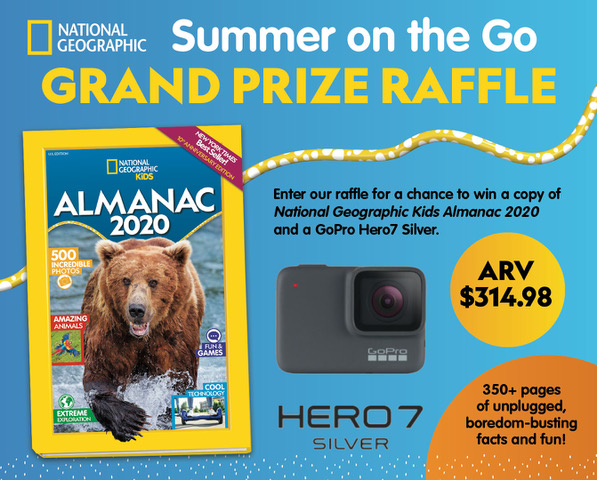
To celebrate the Almanac’s 10th Anniversary, NatGeo is hosting a Summer on the Go Almanac 2020 Grand Prize Giveaway — a GO-PRO!

Don’t miss your chance at winning your own GoPro, to capture your own extreme exploration! Enter this Rafflecopter giveaway today! (U.S. and Canada addresses only, please!)

Good luck!

Posted in Humor, Non-Fiction, Teen, Young Adult/New Adult

Quantum Theory explained in rhyme: The Cat in the Box

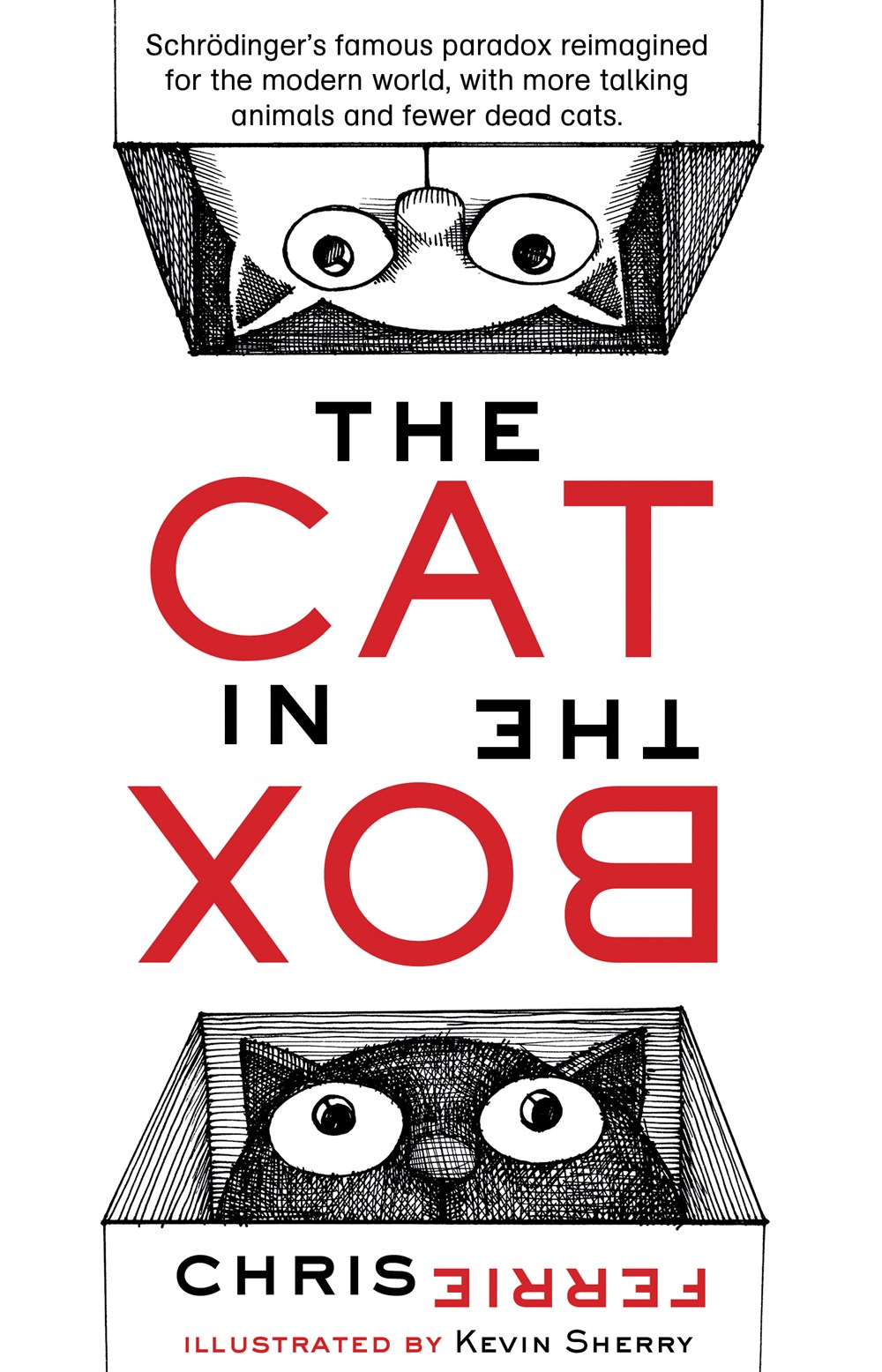
The Cat in the Box, by Chris Ferrie/Illustrated by Kevin Sherry, (June 2019, Sourcebooks), $17.99: ISBN; 9781492671237

Ages 14+

The Cat in the Hat meets quantum physics with Chris Ferrie’s The Cat in the Box. The story is similar in structure to Dr. Seuss’ classic, giving it a tongue-in-cheek twist. The narrator sits with Schrödinger himself, puzzling out a problem, when a box shows up. It’s a cat! Can the cat solve the problem? Schrödinger thinks so – and all the cat has to do in this situation is “see and not see”. Whew! What a relief. The story explains Schrödinger’s theory in rhyme that the folks on The Big Bang Theory would love: “Schrödinger used/this cat in a box/to dream up the first/quantum paradox/A paradox is something/that doesn’t make sense/There must be an assumption/that is causing offense”. The cat is the winner in this story, giving the two humans a lesson in quantum physics and probability, sing-songing, “The more math you know, the happier you’ll be”. An author’s note on Schrödinger recounts the original hypothesis, which didn’t end nearly so well for the cat.

The illustrations are black and white, with a big, googly-eyed scientist and a googly-eyed cat. Mathematical symbols and atomic symbols abound, with occasional reds for emphasis. The fun artwork is a perfect match for the light tone of the rhyme, and makes this a great book to keep around for teens and college students who may need a little brain break from studying.

Can younger kids read this? Of course! It’s a fun rhyme, loaded with math and science terms, and there are adorable cats and wacky scientists telling readers that math is fun. They may not get the bare bones of quantum physics, but they’ll pick up new science and math vocabulary.

Chris Ferrie, bringing a love of science and math to the kiddos.

Posted in Non-Fiction, picture books, Preschool Reads

Three great books about space!

The Summer Reading theme for this year is all about Space, and I am psyched. I love outer space, and I’ve got a growing list of books to add to my own readers advisory lists (I’ll put that together in the next week or two for a post). Meanwhile, Sourcebooks and Barefoot Books have three great books about space that are staggered throughout the year, and perfect for your space-faring STEM fans. Let’s check them out, shall we?
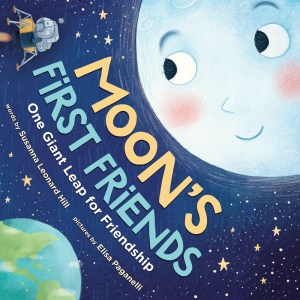
 

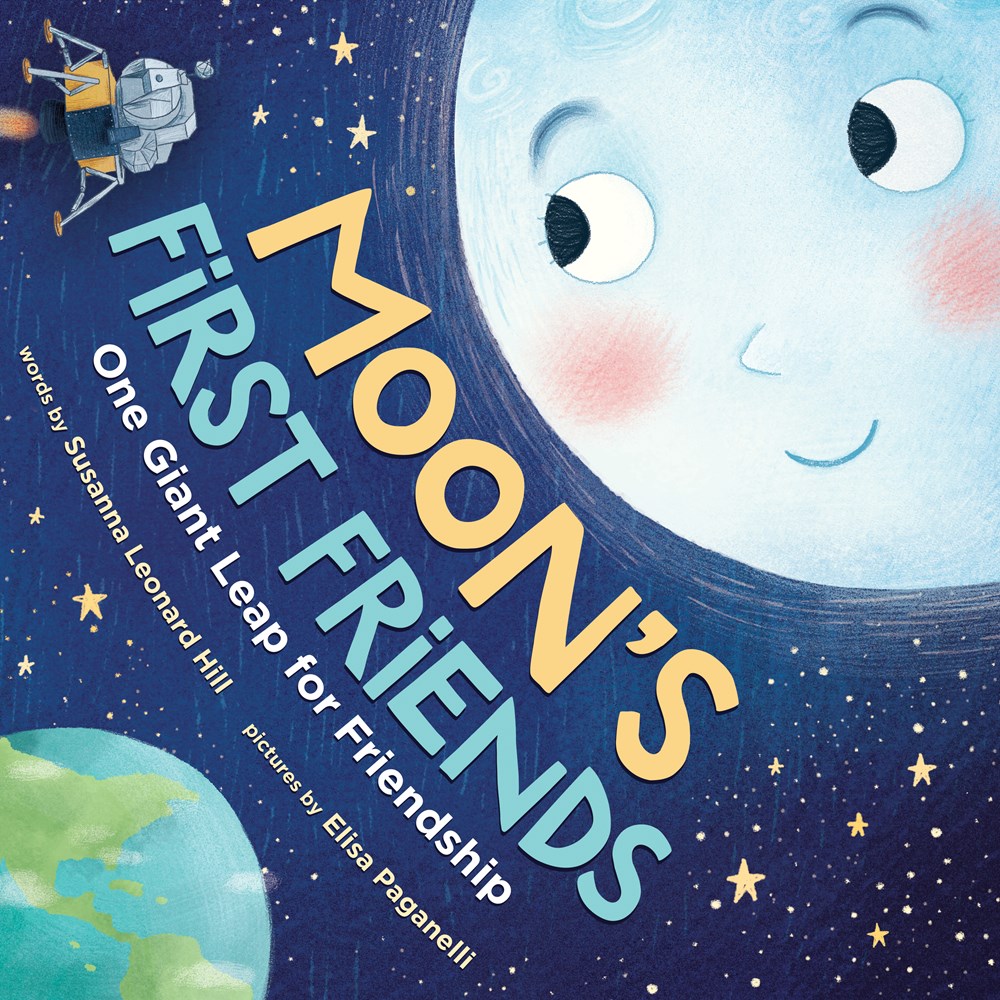
Moon’s First Friends: One Giant Leap for Friendship, by Susanna Leonard Hill/Illustrated by Elisa Paganelli, (June 2019, Sourcebooks Wonderland), $17.99, ISBN: 9781492656807

Ages 4-8

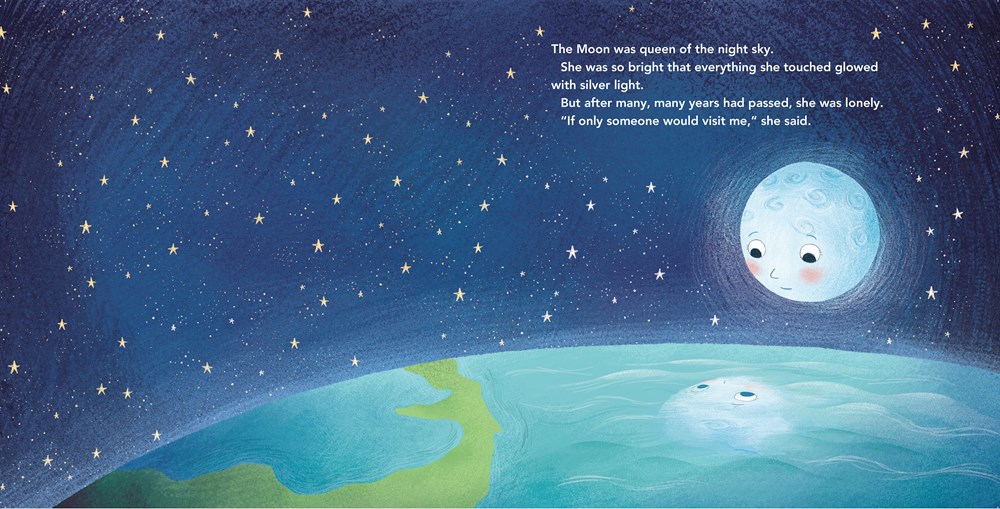
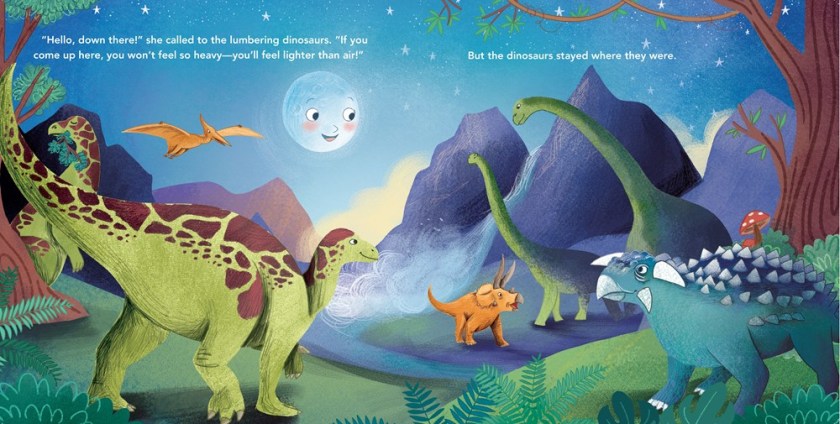
The Moon was so lonely, up in the night sky by herself. When she sees life developing on Earth, she patiently waits for someone to notice and visit her. It takes a while: the dinosaurs don’t notice; early people build pyramids and structures that just aren’t high enough. Eventually, though, she gets some visitors, and she is thrilled! She gives them presents of rocks and dust to take back to Earth, and they give her a beautiful flag and a plaque. Now, Moon is in the sky, happy and waiting for more visitors. Will you be her next guest?

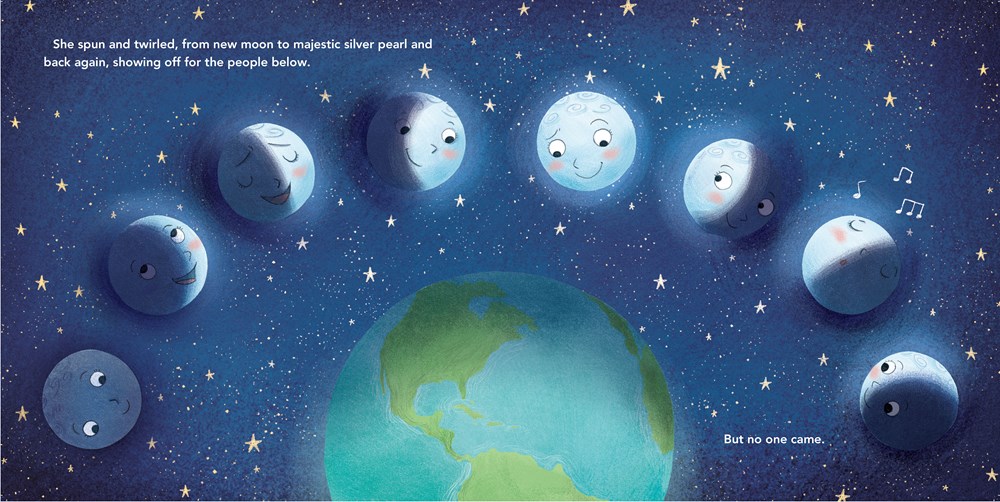
This is the sweetest story I’ve read yet on the Apollo 11 mission to the Moon. The Moon is illustrated as a softly shining, opalescent sphere with kind eyes, rosy cheeks, and a sweet smile; readers are treated to a quick history of Earth’s development as the Moon quietly observes, waiting for a friend to reach out – or up – and say hello. She even dances around the planet, showing off her phases! The actual Apollo mission takes up a brief part of the story, making this sweet book about a lonely satellite who just wants a friend an adorable storytime read for younger kids, and a fun book with solid facts for school-age kids. There’s a brief bibliography on the verso page, and back matter includes several pages dedicated to Mission Moon, the Apollo 11 voyage; moon facts, and moon phases, along with a running timeline of Earth’s formation and development. Endpapers are starry nights, where kids can imagine sailing through the stars to visit their favorite moon. Readers can also scan a QR code to hear Neil Armstrong’s historic first words from the 1969 moon landing. Gentle storytelling and adorable illustration make this a great Summer Reading addition! Display and booktalk with Stacey McAnulty’s Moon, Earth, and Sun trilogy.

 

There Was a Black Hole That Swallowed the Universe, by Chris Ferrie/Illustrated by Susan Batori, (Sept. 2019, Sourcebooks Explore), $17.99, ISBN: 9781492680772

Ages 3-8

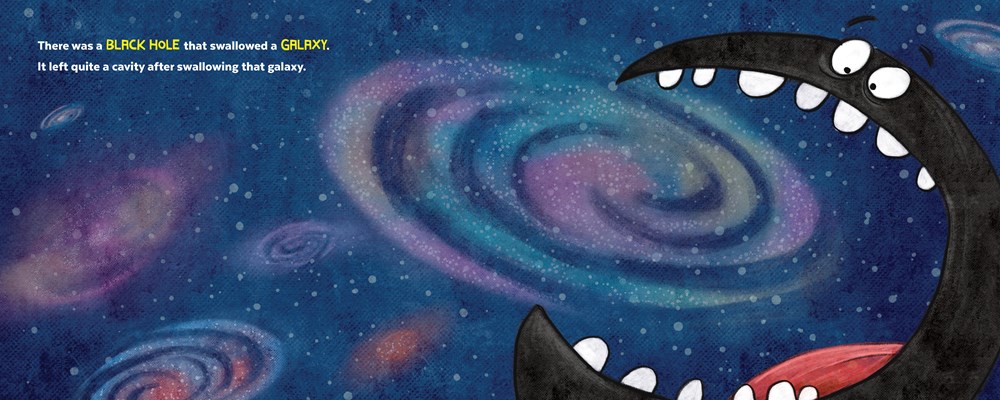
You know if Chris Ferrie is writing a book, I’m reading it. This STEM-errific take on There Was an Old Lady Who Swallowed a Fly is about a giant black hole that swallows… well, everything. He starts with a universe… it couldn’t get worse! But oh, it does: the black hole swallows planets, stars, galaxies, and atoms, molecules, and quarks along with it. Yikes!

I read this to my first grader this morning and he immediately smiled and said, “This is like The Old Lady story!”, so kids familiar with the classic tale (and all of its spin-offs) will immediately jump in and know what’s coming; how the story will progress. With each chomping, the black hole gets bigger, and the planets and heavenly bodies look hilariously terrified as they try to get away from its maw. The storytelling is fun and loaded with humor; it’s cumulative and rhyming storytelling at its scientific funniest. The illustrations are goofy, with exaggerated facial expressions that make the storytelling more dramatic and humorous as you go. Bone up on your keyword knowledge for kids who will ask during the story (neutrons, atoms, quarks, oh my!). Scientific terms are highlighted in bold yellow, and capitalized to stand out and give your readers a nice working STEM vocabulary. Shine a blacklight on the pages from back to front, and you’ll reveal a super-cool, hidden history of the universe’s creation!

Absolute fun and a must-get for your storytime collections. Be a rock star at Science Storytime! Pair this with The Universe Ate My Homework by David Zelster for more black hole-related fun.


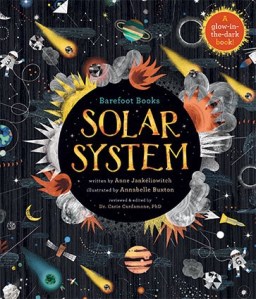
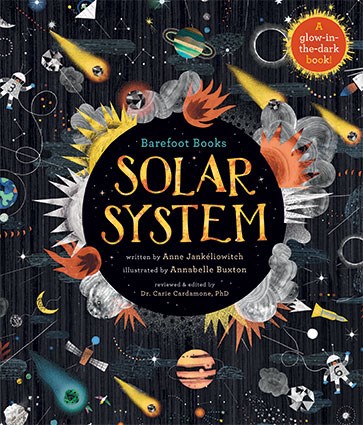
Barefoot Books Solar System, by Anne Jankéliowitch/Illustrated by Annabelle Buxton, Translated by Lisa Rosinsky, $19.99, ISBN: 9781782858232

Ages 8-12

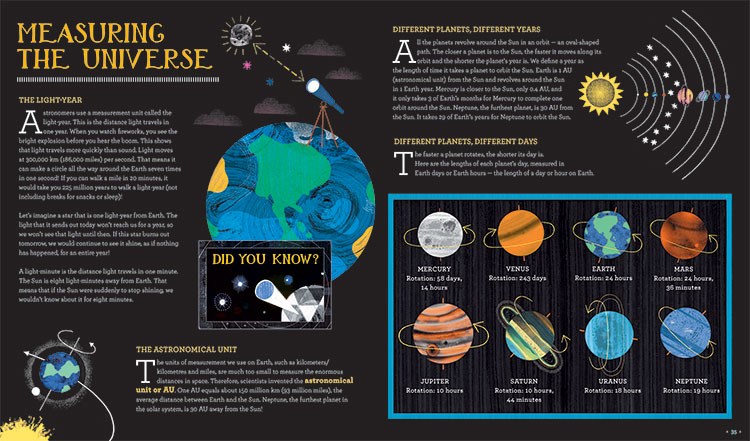
Riding high on the post-Summer Reading wave, middle grade kids can go back school and check out Barefoot Books Solar System, a glow-in-the-dark, interactive guide to our Milky Way, complete with lift the flap booklets, a pull-out map, and beautiful artwork. Originally published in French, the book has been reviewed, edited, and updated by Dr. Carie Cardamone, professor of STEM education and Boston Museum of Science teacher and educator. The text is written with a tongue-in-cheek sense of humor while delivering solid nonfiction goods to middle graders. The book covers each planet, with nicknames like :Saturn: The Space Diva”, and “Uranus and Neptune: The Icy Sisters”; the asteroid belt; differences between solid and gas planets; measuring the universe, and famous outer space voyages. The artwork is bright and bold, seeming to explode off the black pages to grab the reader’s attention.

In keeping with Barefoot’s mission of diversity and inclusivity, there is information about space exploration from around the world, making this a truly global effort. Back matter includes a comprehensive glossary of scientific terms and a note on the units of measurement used in the book. Don’t pass this one up; your 520s will shine a little brighter with Barefoot Books Solar System on your shelf.

Posted in Intermediate, Non-Fiction, picture books

Picture Book Nonfiction in May: Spirit Bears and Teddy Bears

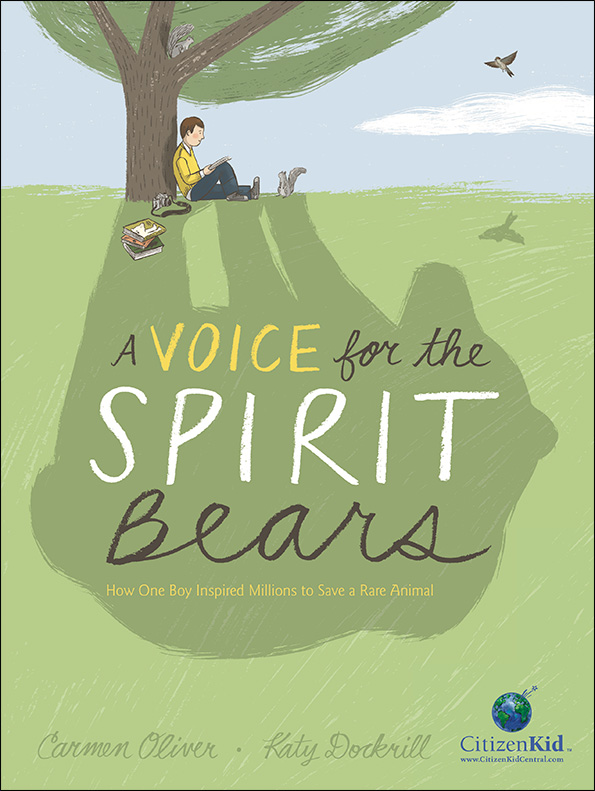
A Voice for the Spirit Bears: How One Boy Inspired Millions to Save a Rare Animal, by Carmen Oliver/Illustrated by Katy Dockrill, (May 2019, Kids Can Press/CitizenKid), $18.99, ISBN: 978-1-77138-979-2

Ages 7-10

Simon Jackson doesn’t quite fit in with the other kids as a child; he was bullied over his stutter, and found himself most at home in the woods, exploring, photographing, and learning about wildlife. As a teen, he found himself fascinated by a rare subspecies of black bear called a Spirit Bear and became an advocate and activist for the bears when their habitats were threatened with deforestation. Jackson founded the Spirit Bear Coalition, met Dr. Jane Goodall, and hiked the Great Bear Rainforest, always using his activism to educate others and advocate for the Spirit Bears. A Voice for Spirit Bears tells Jackson’s story, and shows kids that one is never too young to advocate for change. The book is an inspiring call to action for young activists (suggest a letter-writing exercise for a cause they believe in!). I would have liked to see a little more on the indigenous T’simshian people, for whom the Spirit Bear is sacred, but all in all, A Voice for Spirit Bears is a good biography on a young activist, with lovely, muted artwork. There are discussions to be had on overcoming obstacles, environmentalism and conservation, and activism, and would be a good STEM read-aloud. Check out the downloadable educator guide for discussion questions and an activity.

The Spirit Bear Coalition concluded its mission in 2014, after 20 years of advocacy. Their website is still active and offers education and information.


Teddy: The Remarkable Tale of a President, a Cartoonist, a Toymaker and a Bear, by James Sage/Illustrated by Lisk Feng, (May 2019, Kids Can Press), $18.99, ISBN: 9781771387958

Ages 6-10

Teddy brings together the story of the teddy bear in three parts. First, we have the legend: President Theodore Roosevelt refused to kill a “scruffy, no-account cub” while hunting. This story spread, and the Washington Post ran a political cartoon by Clifford Berryman, entitled, “Drawing the Line in Mississippi“, which led to husband-and-wife toymakers Morris and Rose Michtom creating a bear doll to honor “the President’s big warm heart”. They received permission from President Roosevelt to feature “Teddy’s Bears” in their shop, and an iconic toy was born. The book tracks the evolution of the teddy bear from those first bears, stuffed with wood shavings and with sewed on buttons for eyes, through today and notes how the teddy bear endures. It’s a happy, warm story, and the digital illustrations lend a realistic yet warmly colored feel to the tale. An author’s note mentions the differing versions of the Teddy Roosevelt story. It’s a cute book to have in your nonfiction collections, and would make a nice display with the Caldecott Medal-winning Finding Winnie.

For readers interested in learning more about Clifford Berryman’s political cartoons, the National Archives has a wonderful Clifford Berryman collection, which includes a great piece featuring Berryman drawing a bear, while a black bear stands next to him. The Theodore Roosevelt Center at Dickinson State University has an interesting blog entry on the origin of the teddy bear, and a link to Berryman’s artwork in their digital library.

Posted in Adventure, Espionage, Fiction, Middle Grade, Tween Reads

New NatGeo Explorer Academy: The Falcon’s Feather

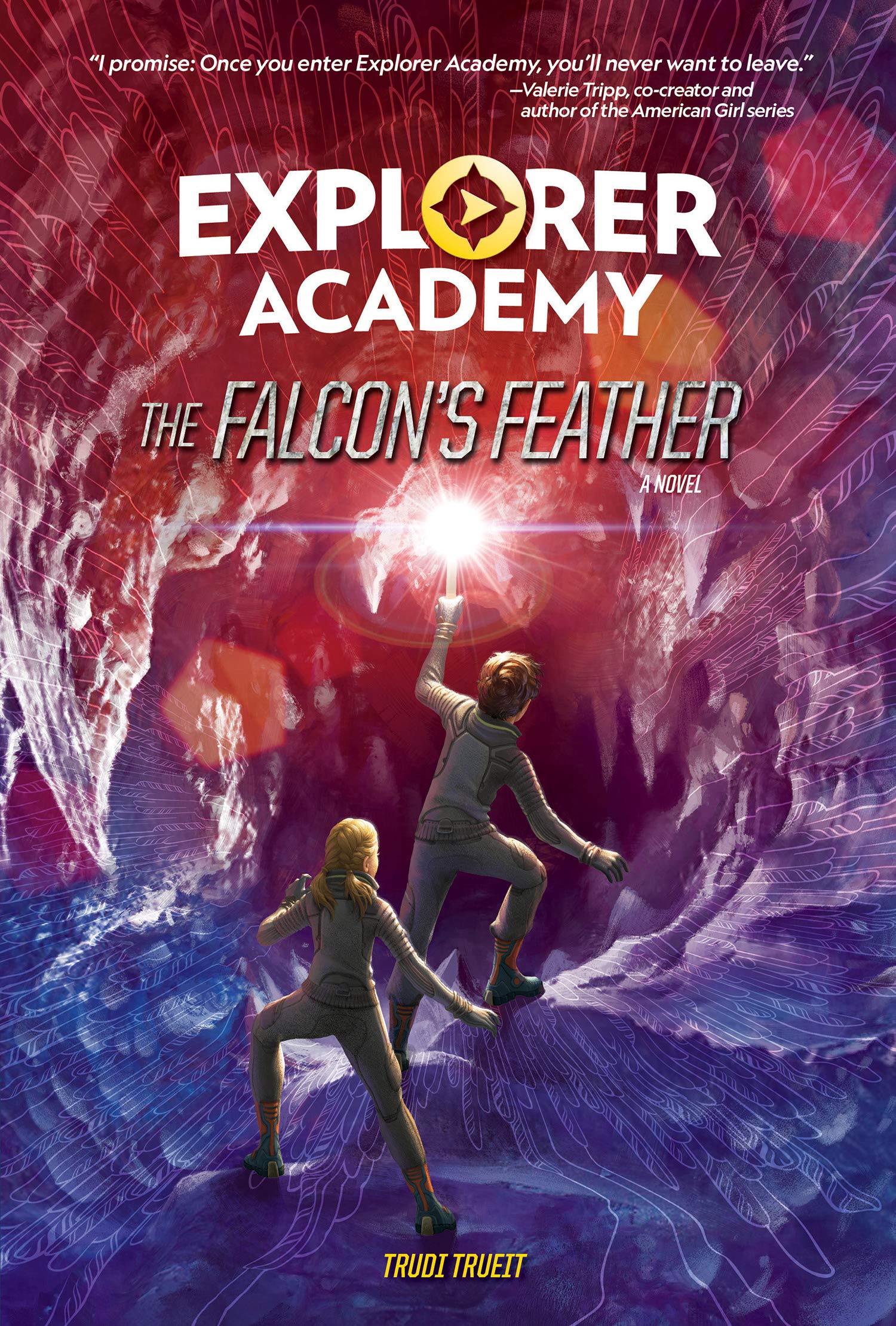
Explorer Academy: The Falcon’s Feather, by Trudi Treueit/Illustrated by Scott Plumbe (interior) and Antonio Javier Caparo (cover), (March 2019, National Geographic), $16.99, ISBN: 9781426333040
Ages 9-13

The second Explorer Academy adventure picks up shortly after the first adventure, The Nebula Secret, concludes, and the action kicks in pretty quickly. Cruz Coronado is back, and he’s on a mission to get the remaining ciphers that his mother hid around the world before her untimely death. His best friends, Emmett and Sailor, are right in the thick of it with him, and his Aunt Marisol is, too. The evil Nebula group is still trying to get Cruz out of the way, and now, there’s something new afoot; something only hinted at: they want Cruz done away with before his 13th birthday. Could it be something to do with that unusual DNA-shaped birthmark on his arm? We’ll have to keep reading to find out, because that’s all you’re going to get here.

In addition to the globe-hopping mystery, The Falcon’s Feather also talks conservation and preservation; this time, Cruz and his friends save a pod of whales entangled in nets, and, while visiting the Svalbard Global Seed Vault in Norway, have a discussion about biodiversity. NatGeo is committed to educating readers about world issues, and this is a great way to do it: put kids in the middle of an adventure and let them experience it! There are all sorts of new gadgets and gizmos in this volume, and Mell, our favorite robot bee, is back. One scientist creates a communication device that allows Cruz to communicate with the endangered whales, and it’s an outstanding moment in the book; Cruz’s world opens up when he not only hears the whales’ songs, but connects them to human understanding. This installment ends on a tense note, assuring that readers (like me!) will be waiting for the next book. The Truth Behind the Fiction section introduces us to the real-life scientists who inspire some of the book’s characters, including a deep-sea submersible pilot, an explorer studying ecosystems and biodiversity, and a geoscientist researching climate change. Color illustrations throughout the book are just gorgeous and will keep readers turning pages. Maps at the beginning of some chapters help place readers when the characters find themselves in a new location.

This series is a no-brainer. Get it on your shelves for your burgeoning explorers/conservationists/secret agents, or just readers who love a good, tight suspense read.


Posted in Non-Fiction, picture books

History via foldout timeline: A Brief History of Life on Earth

A Brief History of Life on Earth, by Clémence Dupont, (Apr. 2019, Prestel Publishing), $24.95, ISBN: 9783791373737

Ages 6-10

A book that touts the claim, “Book folds out the length of a triceratops”, on the cover is a book that I’m going to stop and read. A Brief History of Life on Earth attempts to put the changes our little blue dot has been through into perspective by creating a foldout book that stretches through time and unfolds to reveal the formation of volcanoes and glaciers; the development of aquatic life, to the dinosaurs, early mammals, and modern humans, ending with a modern-day lakeside scene. Each spread folds out, accordion-style; the illustrations are colorful. Each spread has the noted age and time period (Hadean Age, 4.6 to 4 billion years ago; Proterozoic Age, 2.5 billion to 540 million years ago), and a brief, descriptive paragraph. Upon reaching the end of the Holocene Epoch (11,700 years ago to the present day), readers can flip the page over and look through a timeline of Earth’s first 4.6 billion years, really giving kids an idea of how recently we humans arrived on the scene. The book unfolds to a full 26 feet (8 meters), allowing you to see a truly visual timeline. Just get a lot of volunteers in a large space to hold the pages!

This is a handy book for classroom and library reference, and a fun gift for science fans. In circulation, I know my copy would be dead within the first 3-5 circs. But would I buy a copy to use during science storytimes or Discovery Club sessions? Heck, yes. It’s fun, eye-catching, and informative.

A Brief History of Life on Earth was originally published in the UK in 2017. Reference Readalikes would include the Wallbook Timeline books by Christopher Lloyd and the Welcome to the Museum series.

Posted in Early Reader, Intermediate, Non-Fiction, Non-Fiction, picture books

Seashells: More Than a Home, more than decoration

Seashells: More Than a Home, by Melissa Stewart/Illustrated by Sarah S. Brannen, (Apr. 2019, Charlesbridge), $16.99, ISBN: 9781580898102

Ages 6-9

Kids love seashells. They’re the ultimate summer souvenir, coming in all shapes and sizes, with beautiful patterns and colors. Seashells: More Than a Home looks at 13 different seashells and lets readers in on their little world: their colors, patterns, and functions in protecting the marine life that live within them, keeping them safe and fed. For instance, a nautilus’s design allows it to sink and float like a submarine, while the screw-shaped burribella can anchor itself into the sand, allowing its sea snail to stay in place. Watercolor illustrations and soothing earth and sea colors make this a beautiful book to look at and learn from. Endpapers illustrate shells and a map, highlighting their locations, and back matter includes author and illustrator notes, and additional resources.

Seashells: More Than a Home is a companion to Melissa Stewart and Sarah Brannen’s book, Feathers: Not Just for Flying (2014) and a nice addition to nonfiction shelves and STEM storytimes. Get some seashells and pass them around; invite the kids to talk about what they see and feel. Melissa Stewart’s author website has free, downloadable educator activities, readers’ theatre scripts, and curriculum guides.


Posted in picture books, Preschool Reads

Scampers teaches kids the scientific method!

Scampers Thinks Like a Scientist, by Mike Allegra/Illustrated by Elizabeth Zechel, (March 2019, Dawn Publications), $8.95, ISBN: 9781584696438

Ages 4-8

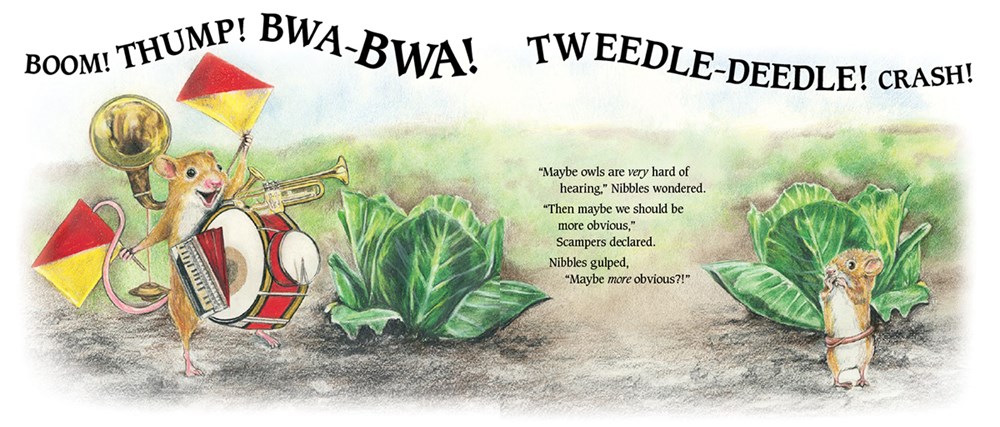
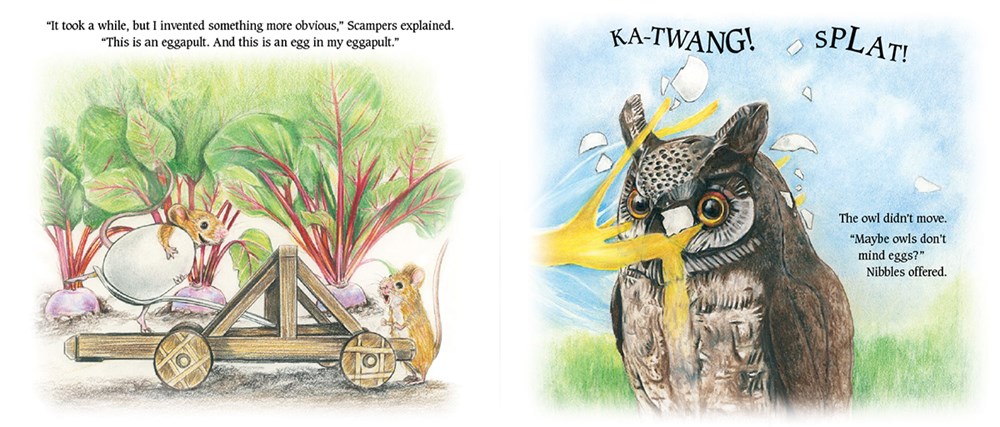
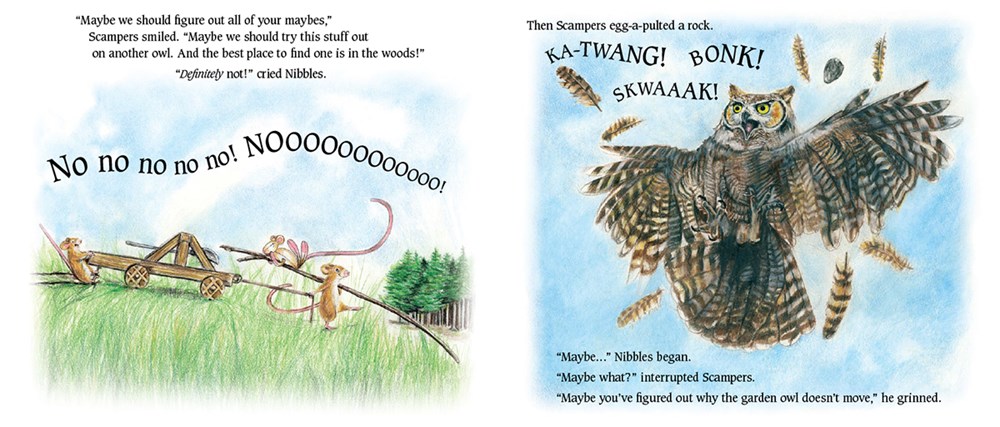
Scampers is a curious little mouse who wants to know what it will take to get a menacing-looking owl out of the vegetable garden, so he and the other mice can go back to getting food. With the help of Scampers’s friend, Nibbles, the two proceed to conduct a few experiments, including waving a rag doll and making noise that will startle the owl, and building an egg catapault to scare it off. No reaction. (Have you guessed yet?) When Scampers and Nibbles figure out the owl’s secret, they let their fellow mice know: the owl isn’t real! Will the mice believe their two scientists?

Scampers Thinks Like a Scientist is an adorable, abbreviated introduction to an scientific method. Scampers has a theory about the mouse, so she conducts some tests, considers her conclusion, and shares her results. The tests are amusing and let caregivers and educators work with readers to reason out the conclusion. It’s a cute way to introduce scientific thinking to younger readers, and publisher Dawn Publications has a free, downloadable companion activities for kids. Add this one to your science storytime.

Posted in picture books, Preschool Reads, Toddler Reads

Out of the nest and into the air! Why Should I Walk? I Can Fly!

Why Should I Walk? I Can Fly!, by Ann Ingalls/Illustrated by Rebecca Evans, (March 2019, Dawn Publications), $8.95, ISBN: 9781584696391

Ages 3-7

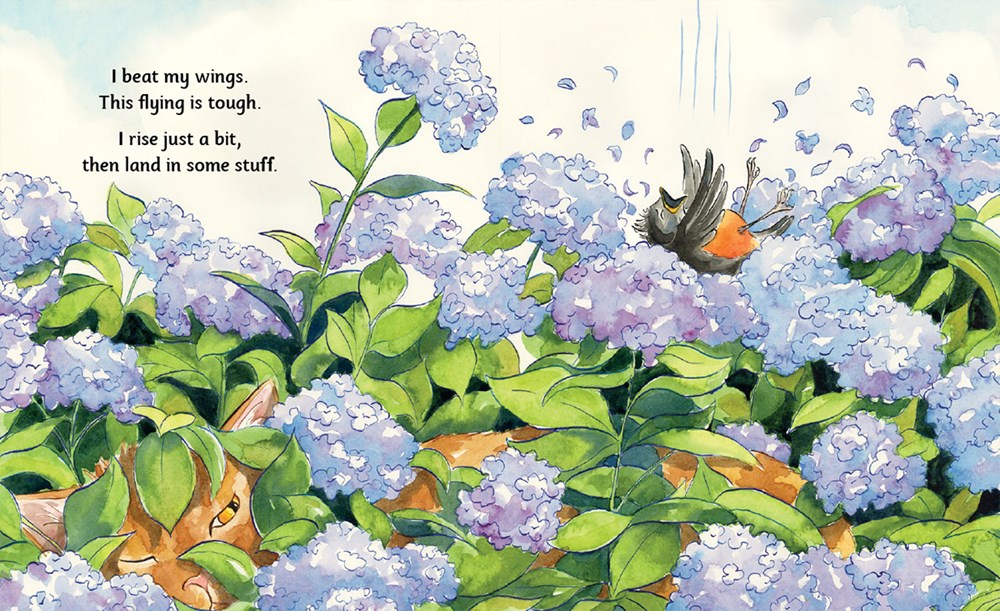
This rhyming story is all about a baby bird who’s ready to take the leap out of the nest and into the air… but maybe brother and sister can go first. The story is all about overcoming fears and persistence; kids will see themselves in the little robin’s excitement to take this next step, and the hesitation of moving out of one’s comfort zone. The kids will chuckle when Momma Bird gives the little bird some help leaving the nest, and parents will smirk in recognition; sometimes, we just have to help nudge our kids out of those comfort zones.

This is an encouraging story that shows kids it’s okay to be nervous, especially when trying something new; it’s perfectly normal to have excitement mixed with being nervous. And, yes, sometimes, we need a little push in the right direction; it’s all worth it, though, when we take off and succeed. Back matter includes a bird Q&A, photos, and STEM activities.

Why Should I Walk? I Can Fly! is a fun story about stretching one’s boundaries, trying new things, and growing up. It’s a good STEM storytime pick.

Posted in Non-Fiction, picture books, Preschool Reads

It’s Spring… time to raise the butterflies!

Butterflies in Room 6, by Caroline Arnold, (March 2019, Charlesbridge), $16.99, ISBN: 9781580898942

Ages 3-7

Spring is getting closer and closer, and that means that science classrooms all over the place are going to introduce their little ones to the life cycle of a caterpillar/butterfly. We’ve done it in my home, and each of my kids has done it in school, and it’s exciting every time. Butterflies in Room 6 revisits the Kindergarten students of Room 6 – a new group, since Hatching Chicks in Room 6 was published in 2017 – as they raise butterflies, starting from teeny, tiny caterpillar eggs.

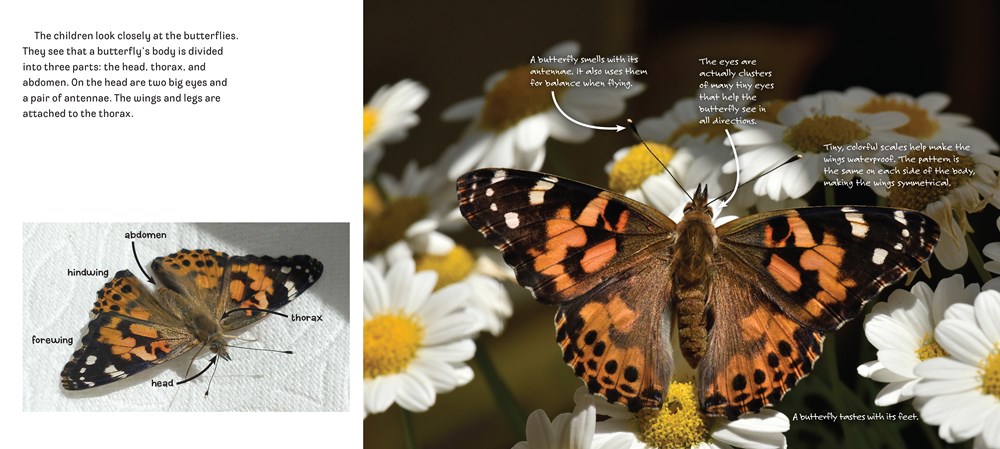
Full-color photographs and informative text take this STEM/STEAM story through the step-by-step process by which the class observed and cared for their caterpillars; feeding them, observing the stages of life, moving the chrysalises to a larger, netted environment, the exciting emergence of the painted lady butterflies from their cocoons, and their release into the world! Leaf-shaped callouts throughout the book provide additional caterpillar and butterfly facts, and back matter provides butterfly questions, vocabulary, and a nice list of online and print resources for further reading.

Butterflies in Room 6 brings a real-world look into a primary classroom – it’ll get kids excited about science, especially if this is one of your classroom projects. Pair this with The Very Hungry Caterpillar and the classic that my kids all read in their kindergarten classes, Deborah Heiligman’s From Caterpillar to Butterfly.