Posted in Preschool Reads

The Tooth Fairy’s Origins, Revealed!

The Untold Story of the Tooth Fairy, by José Carlos Andrés/Illustrated by Betania Zacarias, (May 2018, nubeOCHO), $16.95, ISBN: 978-84-944446-1-6

Recommended for readers 3-8

Related as a folktale, this take on the Tooth Fairy’s origins makes things more of a team effort. It all starts underwater, when Lady Oyster – depicted as a fabulous, brown-skinned diva – loses her pearl. She’s very, she means very, so very sad! Word goes out among Lady Oyster’s underwater friends: octopus tells French sardine; the sardine tells a crab, who relates the story to a mouse on land, who comes up with a solution that works for everyone.

Based on the French, Spanish, and South American version of the Tooth Fairy myth, where a small mouse – not a fairy – takes a newly dispatched tooth and leaves a gift, kids will love this original take on the tooth fairy – especially kids in the 5-8 age category who are getting visits from the Tooth Fairy. I love the idea of the Tooth Fairy’s assistants helping her, too – it makes sense! It sends a nice message about teamwork, too.

Betania Zacarias’ paint and cut-paper collage artwork is beautiful. I love her gorgeous, over the top Lady Oyster; she’s a diva of color, she’s got curves, and she’s dramatic! The texture of the artwork is beautiful, and her color choices are bright, most primary colors, and eye-catching. This is a story I could read to the kids in my Queens Library storytimes and have the kids say, “I see myself here.” The bright orange endpapers are filled with fish of all different colors, giving kids an idea of where this story is going to start.

This is a wonderful book to read to kids getting ready to – or in the process of – get visits from the Tooth Fairy. Originally published in Spanish (2016), the book is available in both Spanish and English. Add The Tooth Fairy Meets Ratón Perez by Rene Colato Lainez for a fun multicultural tooth fairy storytime or display, and Susan Hood’s The Tooth Mouse for a French take on the little mouse’s side of the story.

Posted in Fiction, Preschool Reads, Uncategorized

Size matters not: Just ask Little Captain Jack!

Little Captain Jack, by Alicia Acosta/Illustrated by Monica Carretero, (Apr. 2017, nubeOCHO), $15.95, ISBN: 978-84-945415-0-6

Recommended for readers 4-8

Once upon a time, there was a tiny pirate named Captain Jack. He was so tiny that he had to weigh himself down with a heavy sword in his belt, an iron telescope around his neck, and some rocks in his pockets, so he wouldn’t be blown away! Everyone called him Little Captain Jack. He was so little that his crew didn’t hear him when he yelled to them, and he was constantly in danger of being stepped on! One day, during a battle between Captain Jack’s crew and the bad pirate Badlock’s crew, Jack was taken prisoner and locked in a dark cellar. Although he was scared, he accepted an offer of help from a mouse… who got some help from a seagull… and Captain Jack learned, from that day forward, that “great things could come in all shapes and sizes, big or small!”

Captain Jack is fun reading and kids will appreciate the message that size doesn’t matter, especially when you work as a team! The tiny pirate still manages to command his own ship and crew (even if they don’t really hear him… or see him that often), and when he’s in trouble, his crew is frantic. He means a lot to his crew, whether he’s big or small – just like a family. Teamwork helps bring Jack back to his crew, sending a positive message about working together.

The cartoony art will appeal to readers, and the endpapers – drawn to look like a map of Penny Island, where we assume Captain Jack is spending time these days, has fun, eyecatching details like a giant squid, a whale, and a lake monster. A nicely detailed compass rose adds the opportunity to talk about directions. Plus, pirates are a home run with little ones: you can pick from any number of pirate adventure stories for little ones! You could pair these with any number of pirate books for little ones! Add a pirate hat craft to use up some old newspaper and you have a nice, environmentally friendly storytime activity.

Little Captain Jack was originally released in Spanish (Pequeño Pirata Serafin, ISBN: 978-4-945415-1-3), and is available in both Spanish and English.

Posted in Animal Fiction, Preschool Reads

Bow-Wow-Meow takes a sensitive look at identity

Bow-Wow-Meow, by Blanca Lacasa/Illustrated by Gómez, (May 2017, nubeOCHO), $16.95, ISBN: 978-84-94515-7-5

Recommended for readers 4-8

Fabio’s a dog that really isn’t into doggish things. He doesn’t play fetch, he doesn’t roll over to have his belly tickled, he doesn’t wag his tail, and he doesn’t bark. His family tries to teach him how to act like a dog: they throw sticks, they roll around on the floor, and they bark at him. Fabio is uninterested. One night, Max, a little boy in the family, discovers that Fabio is going out at night, and follows him: right into a group of cats engaging in very catlike behavior, from coughing up hairballs to playing cards (hey, are you with your cat 24/7?). Max can’t believe how happy Fabio is as he sharpens his claws, climbs drainpipes, chases mice, and bow-wow-meows along with his feline friends. The next morning, when Max’s parents try to get Fabio to act like a dog, Max quietly acknowledges Fabio, making him the happiest member of his family.

Recognition and visibility are important. When Max acknowledges Fabio, when he sees Fabio for who he really is, Fabio’s whole world changes; Max’s world widens that much more. Bow-Wow-Meow sensitively handles identity and diversity for young readers. By telling Fabio’s story using dogs and cats, kids are entertained and enlightened in a sweet, fun way that leaves the pathways open for discussion again and again. Gómez’s bold artwork is fun and expressive and will appeal to storytime audiences. Younger readers may struggle with some pages, where the black text is superimposed over a dark background.

I’d love to read this with Jules Feiffer’s Bark, George, for a good storytime on diversity and animals. You can also display and pair this with books like Morris Micklewhite and the Tangerine Dress, by Christine Baldacchino, or Jacob’s New Dress, by Sarah and Ian Hoffman. Mothering.com has a good article with recommendations for kids’ books that defy gender.

Posted in Early Reader, Fiction, Preschool Reads, Toddler Reads

The jungle heat begs for The Perfect Siesta

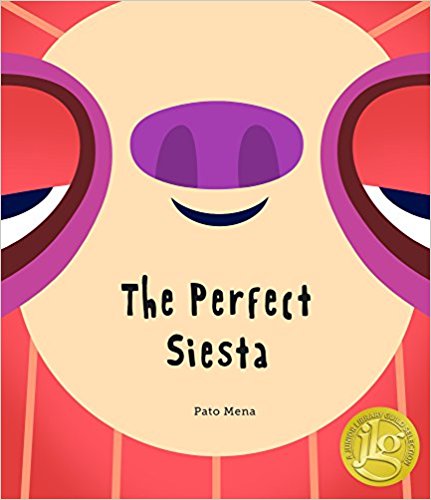
The Perfect Siesta, by Pato Mena, (June 2017, NubeOCHO), $15.95, ISBN: 978-84-945415-3-7

Recommended for readers 3-7

It’s a hot day in the jungle, so when a lovely, cool breeze blows through, a jaguar seizes the moment to take a nap. He has things to do, though, so he asks a coati to wake him in 10 minutes. The coati doesn’t want to say no to a jaguar, out of a healthy sense of self-preservation, but that breeze is just sooo nice… so he asks a cockatiel to wake him up in 10 minutes, who then goes on to ask a sloth. The poor sloth feels the pressure to stay awake, but can’t fight it anymore and lets out a giant SNORE that keeps everyone’s promise!

The Perfect Siesta has entered regular storytime reading at home, and I’m planning a great nap-centric read-aloud to debut this one at my library. It’s hilarious and I love the art, especially the giant, sleepy sloth’s eyes (shown on the cover). Snoring is up there with farts in terms of read-aloud humor, so let your loudest snore rip when you’re reading – the text will support you!

The collage-style artwork will catch readers’ attention and makes for a great read-aloud to large groups as well as small groups. The animals are native to South America, so this also makes for a good rainforest storytime, with extra fun if you have plush or flannels to add to the atmosphere.

Originally published in Spanish, The Perfect Siesta translates hilariously into English and makes for a fun bedtime, naptime, anytime read. The Perfect Siesta is a Junior Library Guild selection.

Posted in Early Reader, Preschool Reads

A mirror unites a boy’s homes in The Mirror in Mommy’s House/The Mirror in Daddy’s House

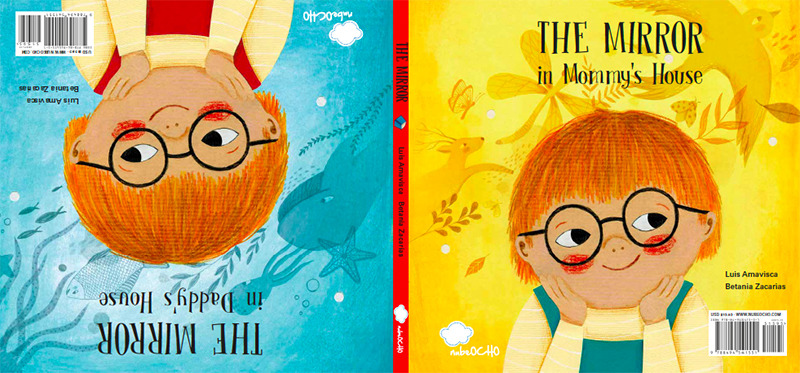
The Mirror in Mommy’s House/The Mirror in Daddy’s House, by Luis Amavisca/Illustrated by Betanía Zacarías, (Apr 2016, nubeOCHO), $15.95, ISBN: 978-84-945415-5-1

Recommended for readers 4-8

A child talks about growing up in a home in the midst of a marital breakup, and how a mirror provided an escape into a wonderful land with no arguing parents. Now that the child lives in two houses, things are much better. Mom and Dad are happier, and so is the child. There are pictures of the entire family at both houses, and a very special mirror at each house; plus, Mom and Dad each share something very special: their child!

We don’t need to talk about the 51% divorce rate to illustrate the need for books like The Mirror. This is a positive book for families going through divorce for a number of reasons: it illustrates the stress on kids living with parents who argue constantly; it’s not singling out either gender – the child can easily be male or female; and the parents care enough about their child to make sure that photos of the entire family – rather than a single parent with the child – have real estate in the child’s room, along with the special mirror that’s become a touchstone. The book is a two-in-one, giving kids a chance to read about each parent’s home and what makes it special. When you finish reading about the mirror in Mommy’s house, just flip it over to read about the mirror at Daddy’s house.

The art appears to be mixed media, with some artwork appearing to be drawn in crayon; it gives the book a comfortable feeling, as if the child created these books himself or herself.

Originally published in Spanish in 2016, nubeOCHO published The Mirror book(s) in English this year and still makes the Spanish language edition available (978-84-945415-6-8). Additional books for families going through divorce to read with young children include Dinosaurs Divorce, by Laurie Krasny Brown and Marc Brown, Nancy Coffelt’s Fred Stays with Me, and Karen Stanton’s Monday, Wednesday, and Every Other Weekend.

Posted in Animal Fiction, Early Reader, Fiction, Preschool Reads

Sugar and Spice and everything… Candy Pink?

candy-pink-coverCandy Pink, by Adela Turin/Illustrated by Nella Bosnia, (Nov. 2016, NubeOcho), $15.95, ISBN: 978-84-944446-7-8

Recommended for ages 5-8

A classic written 40 years ago with the goal to promote equality between boys and girls arrives in the United States for the first time. Candy Pink is written in the style of a folk tale, explaining how elephant all became gray. You see, male elephants were always gray, but female elephants were candy pink. To get that color, they ate only peonies and anemones, wore bibs and shoes, and stayed together in a little walled garden, while the boy elephants playing in the mud, eating yummy grass, and sleeping beneath trees. When one little elephant named Daisy doesn’t turn pink, her father is harsh and cruel, her mother, sad. They pressure her to eat more pink food and threaten her by telling her no one will want to marry her. When they finally give up, the girl elephant embraces her freedom, sheds her bib and shoes, and enjoys life – something that doesn’t go unnoticed by the other female elephants. And, well… you can’t tell the difference between boy and girl elephants anymore, can you?

I was taken aback the first time I read Candy Pink, because it seems harsh on a young girl: the emphasis on appearance and girlish pursuits, Daisy’s parents’ terrible reaction to her inability to fit their mold for her. A second reading put more in perspective for me – the little elephant embraced her uniqueness and wasn’t ostracized for it – the other female elephants flocked to her, and made a huge change that exists to this day. It’s a powerful little story for school-age kids that lends itself to some pretty big ideas. Originally published in Italian in 1976 with the title Rosaconfetto, Adela Turin tackled gender identity and the pressure society puts on appearances by using a parable that everyone could understand and that young girls could relate to. Forty years later, Candy Pink is just as relevant.

Award-winning illustrator Nella Bosnia’s artwork is beautiful. She uses shades of gray and pink against muted background colors for the world of the story; primarily greens, blues, and yellows for the assorted flora and fauna. The bibs, shoes, and bows on the elephants tails are frilly and exaggerated, even pinker than the pale pink elephants; against Daisy’s natural gray, it’s a true contrast.

An interesting and still-timely look at gender, society, and the expectations parents put on their own children. A good addition to bookshelves. Booktalk and display with self-esteem boosters like Karen Beaumont’s I Like Myself!, Peter Reynolds’ Ish, and Todd Parr’s It’s Okay to Be Different. Want another elephant fairy tale? Emma Dodd’s Cinderelephant is a light-hearted, fun take on the classic fairy tale.

Posted in Early Reader, Fiction, Preschool Reads

My Dad is a Clown heals bodies and souls

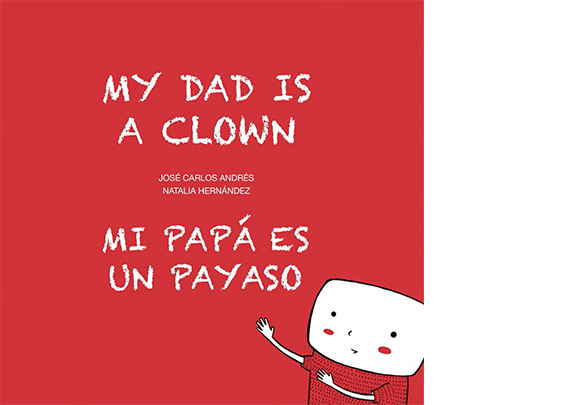
my-dad-is-a-clown-coverMy Dad is a Clown/Mi papá es un paysaso, by José Carlos Andrés/Illustrated by Natalia Hernández, (Jan. 2017, NubeOcho), $14.95, ISBN: 978-84-944137-6-6

Recommended for ages 4-8

A boy with two dads is proud of what they do for a living, and wants to be like them both when he grows up. Both of the boy’s dads are healers: one dad, Pascual, is a doctor and heals his patients’ bodies; his other dad, whom he refers to as simply “Dad”, is a clown, and heals people’s souls. Pascual and the boy sneak into Dad’s rehearsal one day, where the boy realizes the hard work that goes into being a performer, and decides that he will combine the best of his fathers’ professions when he grows up.

This is a sweet story about a boy who loves and is proud of his parents. We also see a loving relationship between the boy’s parents, who happen to both be men. The cartoony two-color art, primarily black and white with reds added for visual interest and emphasis, is both sweet and dramatic. The family is tender with one another, unafraid to show affection. It’s a gratifying, emotional read, particularly when the family reunites after Dad’s rehearsal and they share happy tears.

This third edition of the story is a bilingual edition, translated into English and includes the Spanish text directly beneath the English text, both featured in a highlighted typewriter font that makes for easy independent and cuddle time reading. It’s good for English and Spanish language learners, and is a sweet story about family love to add to your bilingual collections and your storytime rotation. Put this 0ne on your shelves: there are families out there who need and deserve to have their stories told.