Posted in Fiction, Preschool Reads, Toddler Reads

Hervé Tullet says, “Let’s Play!”

If there’s a new Hervé Tullet book, I need it. After bringing Press Here to my preschoolers and having laugh-out loud fun with my toddlers, I knew I was onto something good. Then, I brought Mix It Up! into a storytime, and the crowd went wild. These books are the height of interactive storytelling for a mid-size storytime group, especially for little ones that may have trouble sitting still. Now, we have the next book in this brilliant and fun series: Let’s Play!
let's play

Let’s Play, by Hervé Tullet, (March 2016, Chronicle Books), $15.99, ISBN: 9781452154770

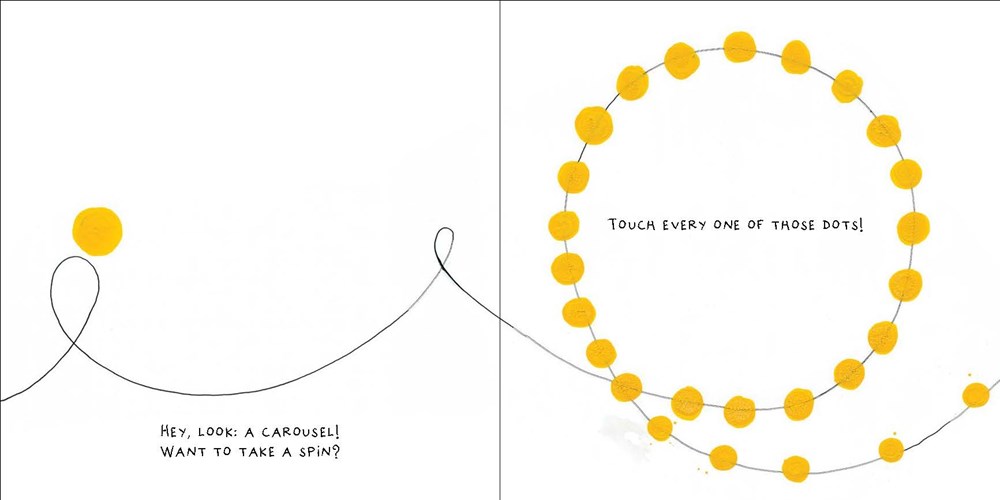
The yellow dot is back, and he’s a little bored. He wants you to play with him, and all you need to do it press the top corner of the book to get started. From there, the reader and the dot are partners, wandering all around the book’s available space – up, down, in loops and twists, playing hide and seek and exploring new, possibly spooky, spaces!
I’m always thrilled and amazed by what Tullet comes up with for his books. Whether it’s using your fingers to travel the world in The Finger Travel Game or using dots to keep readers engaged and, even more, enchanted, he always manages to break the fourth wall and grab your attention. His books are funny, interesting, and perfect for any age – they tap into a creativity that adults may not expect and that kids will embrace. I love his books, and your kids will, too. Feeling extra creative? Have a craft after storytime where kids can make their own dot(s) and ask them to make up their own adventure!
let's play_2
Posted in Preschool Reads

Book Review: What Will Fat Cat Sit On? by Jan Thomas (Harcourt, 2007)

what will fat cat sit onRecommended for ages 2-5

“What will Fat Cat sit on?” is the inquiry that kicks off this story as the Fat Cat in question looks for a seat, terrifying animals – a cow, a chicken, a pig, and a dog – as they imagine him sitting on them. When the mouse offers an alternative seat – a chair – the next question is, “What will Fat Cat have for lunch?” Toddlers and preschoolers can join in the fun, repeating the opening question throughout the story and identifying the animals who try to avoid being sat on. The cartoon illustrations are bright, set against vivid backgrounds. The animals’ facial expressions are exaggerated and simple, easily conveying the emotions of panic and relief. Characters are boldly outlined, allowing them to pop off of the page, and lettering is big and brightly colored, with simple sight words that beginning readers will easily recognize.

This could be part of a “silly animal books” read-aloud. Mo Willems’ Pigeon books are similar in tone and illustration, as is Katie Davis’ Who Hops?; these books offer similar participation opportunities. There are many silly songs and fingerplays about animals that could work well with a silly storytime, including Six Silly Spiders. Jan Thomas’ author website provides printable mask and finger puppets for the Fat Cat and each of the animals that work well for a coloring craft or, as the website suggests, a Fat Cat play, where readers can wear their masks and call out the sounds for their chosen animal.

Posted in Toddler Reads

Book Review: Who Hops, by Katie Davis (Harcourt, 2001)

who hopsRecommended for ages 0-4

Who Hops takes a funny look at animals who hop, swim, fly or crawl – and which animals do not.  Asking the opening question, “Who hops?”, the book teaches children about the animal world. We learn that frogs hop, as do rabbits, kangaroos and cows – wait, cows? Even the cow appears distressed! The author quickly corrects herself, noting that “Cows moo and give milk, but they don’t hop!”

The questions continue, asking who flies, who slithers, who swims and who crawls, with similar groupings of animals that do and one animal that doesn’t, with hilarious responses. The exaggerated facial expressions on the odd animals out are laugh-out-loud funny, and the day-glo artwork, outlined in bold black outlines, assures that all readers will be able to see and enjoy the book. The artwork is simple – line drawings, filled in with fluorescent colors – and the text is in bold, black font.

The book is a good companion to Jan Thomas’ What Will Fat Cat Sit On? and can be read as part of a silly animal read-aloud. Readers can participate by calling out when the story reaches the animal that doesn’t hop, fly, slither, swim or crawl. The author’s website features a printable matching game, where readers can match the animal to his activity. There are also songs and fingerplays about animals and how they move that would make for a fun read-aloud.

The book has received the Oppenheim Toy Portfolio Platinum Award, National Parenting Publications Honors, and designation as a Book Sense 76 Pick.