Posted in Preschool Reads

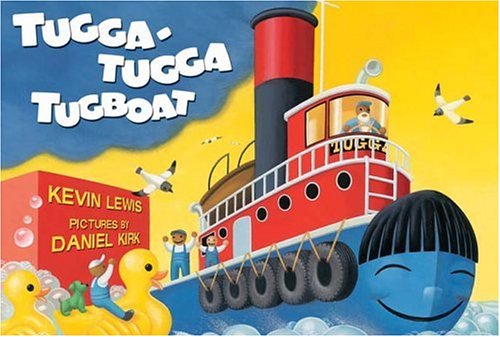
Book Review: Tugga Tugga Tugboat, by Kevin Lewis/illus. by Daniel Kirk (Hyperion Books for Children, 2006)

tugga tuggaRecommended for ages 2-5

A child’s bath time comes to life as Tugga Tugga Tugboat takes readers on a busy tugboat’s day, navigating busy waters to help move tankers and put out fires. As the story progresses, the artwork gives some hints about the tugboat’s whereabouts away: there are bars of soap and blocks being piled up on the harbor, and there is a rubber ducky in the water. The story is told in rhyme with the refrain, “toot, toot” and “scoot, scoot”, repeated often enough that toddlers and preschool readers will be able to quickly pick up the phrases and participate. Illustrations appear to be bright acrylics and are more realistic than cartoony. Story text is bold and black with differing sizes on the refrains, further prompting young readers to participate.

The book lends itself to a participatory reading, with young readers prompted to call out “toot, toot!” and “scoot, scoot!” There are many bath-related fingerplays and songs, including “Splish Splash” and “Rubber Ducky”, that add to the program and make for a fun, bath-related story time. Oriental Trading sells transportation rubber duckies – rubber duckies in cars and boats – in bulk for a low price, budget permitting.
Posted in Preschool Reads, Toddler Reads

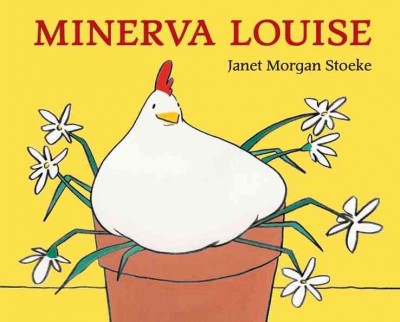
Book Review: Minerva Louise, by Janet Morgan Stoeke (Puffin, 2012 edition)

minerva louiseRecommended for ages 2-5

First published in 1988, Minerva Louise is the story of an inquisitive hen who goes exploring and finds a house with all sorts of interesting things to see. The book speaks to toddlers’ and preschoolers’ natural curiosity about the world around them; they can follow her as she wanders into new situations and sees things from her own unique point of view. In this first Minerva Louise adventure, she explores a farmhouse and sees a perfect nest for her (a fireplace), a comfortable chair (a flowerpot), friendly cows (a sleeping cat), a tractor (a tricycle), and more. She encounters a rubber duck in a bathtub, which she sees as a new friend inviting her to play in a pool, but decides to go play in the yard with her friends instead. The artwork is uncluttered; simple but eye-catching: Ms. Stoeke uses a crayon-like line, drawn onto heavy vellum paper and traced onto watercolor paper, filled in with gouache paints and occasional watercolor washes. She uses large, simple shapes and bold, flat colors inside soft black outlines, against a white background. The plain, black font makes for a good read-aloud book that will keep audiences interested in the pictures.

This would be part of a fun animal read-aloud. For a slightly older audience, I would also suggest an Amelia Bedelia companion story, as Minerva Louise tends to see things with her own unique point of view, similar to Amelia Bedelia. There are many farm animal printables that children can color, and there are many farm animal songs and fingerplays.

The author’s website offers links to more of Ms. Stoeke’s books, her art, and information about school visits. The Minerva Louise series includes A Hat for Minerva Louise; Minerva Louise on Halloween; Minerva Louise on Christmas Eve; A Friend for Minerva Louise; Minerva Louise at the Fair; Minerva Louise and the Red Truck. Minerva Louise won the Dutton Picture Book Contest (1988).

Posted in Toddler Reads

Book Review: Not a Box, by Antoinette Portis (HarperCollins, 2006)

not a boxRecommended for ages 2-5

A young bunny uses his imagination to make an ordinary cardboard box into a spaceship, a mountain, a robot, and more.

Not a Box illustrates the importance of childhood imagination. The rabbit insists that his toy is “not a box” in answer to the repeated question stated in the title. Using bold, black line drawings on white backgrounds, each page presents readers with the inner working of the rabbit’s imagination; what he imagines his toy is rather than what it isn’t: a race car; a burning building that his fireman can put out; a robot; a mountain. The questions are featured in bright white text against a brown background – the color of a cardboard box. Even the cover and endpapers have the color and texture of a cardboard box. The simple art and design of the book add to the importance of imagination contained within.

This book provides the opportunity for an imagination read-aloud, where children can participate by repeating, “It’s not a box!” in answer to the questions asked on each spread. A printable activity at TeacherVision encourages children to illustrate their vision of “not a box”, and offers coloring sheets and instructions on making their own “not a box”. An episode of Spongebob Squarepants features Spongebob and Patrick the Starfish play with a box, using their imaginations; this would be fun companion viewing to the reading.  For those lapsit readers who may not grasp the concept of the box being 3-dimensional, incorporating a cardboard box into storytime can further spark the imagination and get them thinking about what the box can be.

The book has received designation as an ALA Notable Children’s Books (2007), and received Theodore Seuss Geisel Honors (2007).

The author’s website offers information about the author and her books. She continues the story in Not a Stick.


notabox robot