Posted in Early Reader, Fiction, Preschool Reads

Maggie McGillicuddy’s got an eye for trouble… do you?

maggie mcgillicuddyMaggie McGillicuddy’s Eye for Trouble, by Susan Hughes/Illustrated by Brooke Kerrigan, (Oct. 2016, Kids Can Press), $16.95, ISBN: 9781771382915

Recommended for ages 4-8

This fun look at imagination appeals to a kid’s sense of play, but also teaches them to be aware of their surroundings. Maggie McGillicuddy sits on her porch, knitting away, and sees things a little differently. When she sees a shadow on the wall, she just knows it’s a hungry tiger! She clacks her knitting needles and scares that wildcat away. That’s no tree branch behind the pizza delivery girl’s bike, it’s a snake! She whacks her walking stick and scares that slippery snake right off. But when Charlie, her next door neighbor, is about to run into the street while chasing a ball, Maggie springs into action – this is no figment of her imagination!

This is such a great story about imagination and playing little games with yourself, but it makes a point about being aware, too. When Maggie sees that Charlie’s in danger, there’s no clacking of knitting needles or whacking a walking stick, she yells and gets Charlie’s attention – she makes him very aware of his surroundings! And playing games with your imagination is a fun way of being aware of what’s around you, too. Charlie and Maggie bond over their active imaginations, and invite the reader in, with repeated wink and nudge phrases like, “you see it there, don’t you?”

The artwork is rendered in watercolor, pencil crayon, gouache and collage, all coming together to give a light, fun tone to the book. Kids will recognize the places where Maggie’s and Charlie’s imaginations take root: tree roots that become snakes, shadows that become wild animals, herds of elephants out on the horizon and a dinosaur lurking behind a bush. I love the movement in illustrator Brooke Kerrigan’s work, too; Maggie’s scarf sways gently until she jumps to action: then, it swings outward, almost at attention. When all is well, the scarf gently relaxes at Maggie’s feet. Throughout the book, the scarf gets longer until both Maggie and Charlie are wearing it, looped around their necks.

Read this and talk to kids about being safe: from looking both ways before crossing a street to knowing street signs and where you are. Maybe even link this story to a book on community helpers, so kids know who to turn to if they need assistance. Have kids draw pictures of what they see in their imaginations when they look outside and make up a story of their own about what’s in the hallway!

Very good for Pre-K and elementary collections. The fun of imagination is contagious.
Posted in Early Reader, Fiction, Preschool Reads, Realistic Fiction

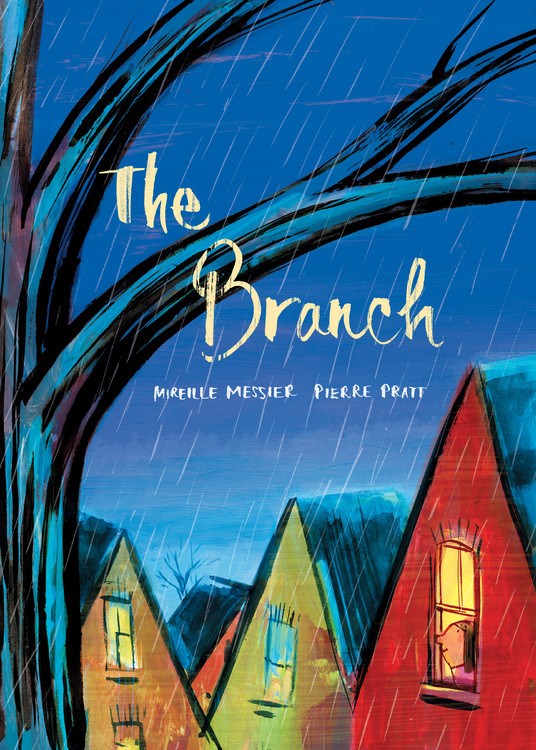
The Branch gets a new lease on life after a storm

thebranchThe Branch, by Mireille Messier/Illustrated by Pierre Pratt (Sept. 2016, Kids Can Press), $16.95, ISBN: 9781771385640

Recommended for ages 3-7

A little girl’s favorite tree branch comes clattering down during an ice storm. A neighbor teaches her how to repurpose the branch, to create new memories.

What a great book to communicate so many ideas! First, we have the imagination of the tree branch. As the little girl says, the branch,”was my castle, my spy base, my ship…”, and she experiences the grief of losing the branch when she spies it on the sidewalk. She doesn’t want to part with it right away, so her mother allows her to hold onto it for a little while – long enough for the girl to encounter her neighbor, who tells her that the branch is “full of potential! …it means it’s worth keeping”, and we learn that he builds things from salvaged wood, and encourages the little girl to think about what the branch could become. When she uses her imagination and reaches into herself to reimagine the branch, she and the neighbor work together to give the branch new life.

In addition to imagination, we’ve got reusing/recycling, which is great for the environment; showing a child unwilling to discard a tree branch as a casualty of the storm, and finding ways to recreate it will get kids thinking about what they could create with objects in the world around them: cereal boxes could become robots or cities for superheroes to protect; old cans can become pencil holders; soda bottles can become terrariums. There are thousands of ideas on the Internet, so there’s no need to wait for Earth Day to come around again to make kids aware of the fun things they can make when they reduce/reuse/recycle.

Finally, we’ve got making: the whole creative process is here: sketching out plans, sawing, planing, drying the wood, waiting, waiting, waiting. It’s a great book to feature with The Most Magnificent Thing, HowToons, and fun nonfiction books, like those in the Make series. Encourage kids and parents to work together on anything from paper airplanes (great use of catalog paper) to repurposing a tree branch – large or small – of your own.

Mireille Messier is a Toronto-based author who’s had over a dozen books published in French. She’s also one of the French reviewers for the National Reading Campaign. Her website is available in English or French and offers information about her books, school visits, and her blog. Pierre Pratt is an award-winning illustrator of over 50 books for children. He lives and works in Montreal, Quebec, and in Lisbon, Portugal.


Posted in Early Reader, Fiction, Fiction, Preschool Reads

A little boy learns to tell A Squiggly Story

squigglyA Squiggly Story, by Andrew Larsen/Illustrated by Mike Lowery (Sept. 2016, Kids Can Press), $16.95, ISBN: 9781771380164

Recommended for ages 3-6

A little boy wants to write a story, just like his big sister, but he’s got one problem: he doesn’t know that many words! Big sister knows just what to tell him: start with what you know. Every word starts with a single letter, after all! When he writes the letter “I”, he’s on his way; with his sister to help guide his thought process, he’s on his way to creating an exciting adventure!

What a great way to encourage new learners to create their own stories! The little boy is unsure about himself at first, but his sister quickly allays his fears by empowering him to just go with what he knows, guiding him through the stages of writing a story: the beginning, the middle, and the end. When he proudly brings his finished story to school, his teacher encourages him to think even more deeply, and turns the story into a class project. It’s a great storytime concept and a great way to introduce creative writing and art to new learners.

Mike Lowery’s cartoony art is filled with interesting styles to capture a young readers’ attention. There are word bubbles, emphasis on words like BIG and small, comic-style panels, and callout sketches that invite readers into the characters’ imaginations. The children are multiethnic, making the story accessible for all.

This is a good addition to creative picture book collections. Pair A Squiggly Story with Written and Drawn by Henrietta for a creative storytime and crafternoon.

Posted in Early Reader, Fiction, Preschool Reads

Imagination steers one boy past The Storm

stormThe Storm, by Akiko Miyakoshi (Apr. 2016, Kids Can Press), $16.95, ISBN: 9781771385596

Recommended for ages 3-7

A young boy is planning on a weekend trip to the beach with his parents, but a storm threatens otherwise. When the storm arrives, the boy tries not to be scared, imagining himself on a ship that’s strong enough to drive the storm away. When he wakes up the next day, will his dream of smooth sailing come true?

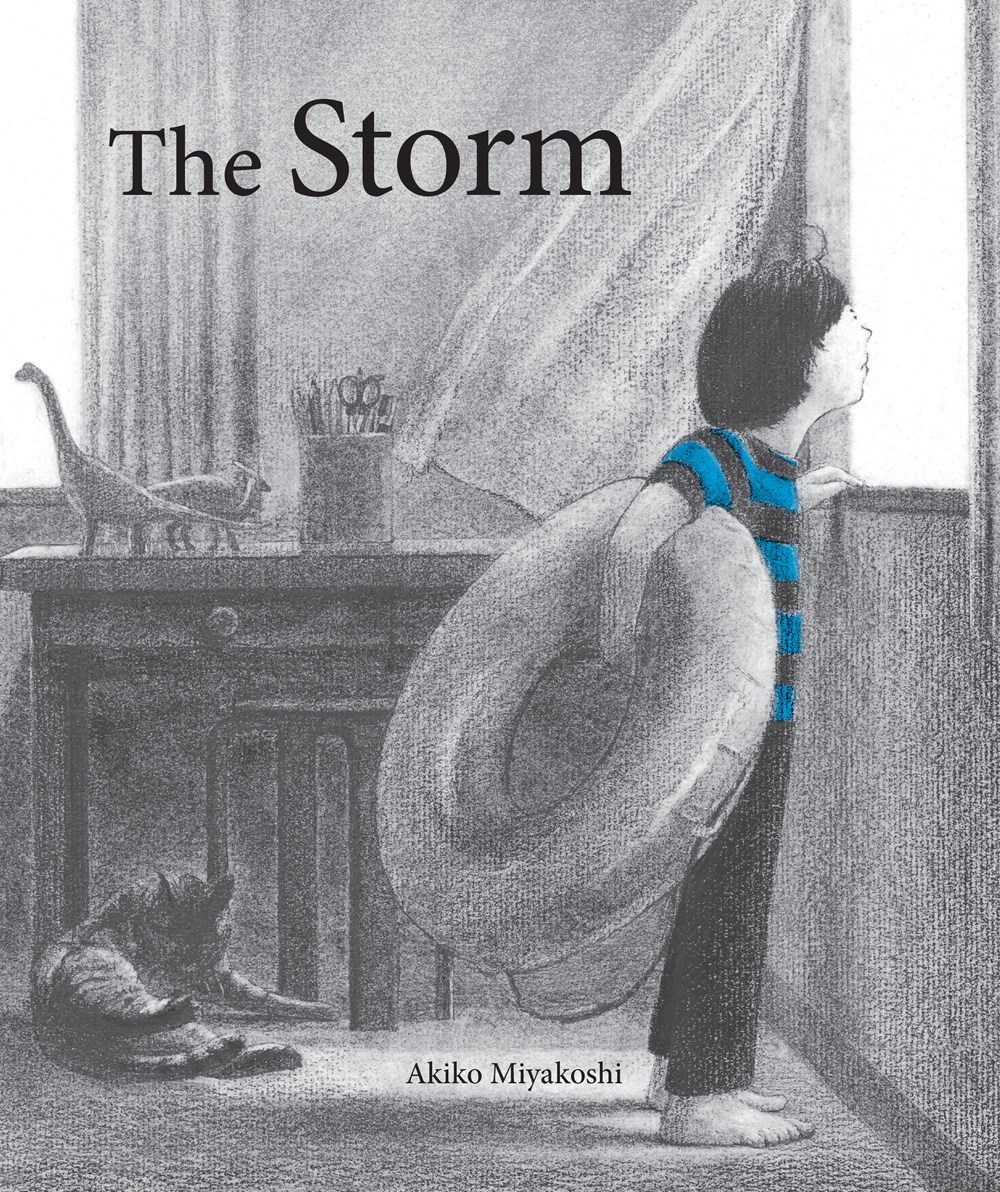
This is a perfect rainy day read. The gray charcoal illustrations with bright spots of blue (the boy’s shirt, the rain puddles) communicate the overall mood of the coming storm and the hope that it will pass in time to enjoy a trip to the beach. When the storm arrives in all its fury, the boy finds a safe place for himself: curled up in his bed, covers over his head, so he can’t hear the rain. He waits out the storm by imagining himself on a ship with propellers powerful enough to blow the storm away. He faces his fears by finding a safe place and through visualization.

The book provides a great opportunity to talk to young readers about overcoming fear and using positive imagery to steer them past any storms – negative thoughts or fears – in their own lives.

Read this one with Mercer Mayer’s There’s a Nightmare in My Closet or Lemony Snicket’s The Dark to talk about overcoming fear. Or just curl up on a rainy day with The Storm and a copy of Taro Yashima’s Caldecott Honor book, Umbrella, for a rainy day read.

The Storm has received a starred review from Kirkus. The Storm is writer and illustrator Akiko Miyakoshi’s first picture book, and won the Nissan Children’s Storybook and Picture Book Grand Prix. Her book, The Tea Party in the Woods, was published by Kids Can Press in 2015.

Posted in Early Reader, Fiction, Preschool Reads

Do Not Open the Box: A Picture Book Guessing Game!

box_coverDo Not Open the Box, by Timothy Young (Dec. 2015, Schiffer Books), $16.99, ISBN: 9780764350436

Recommended for ages 3-6

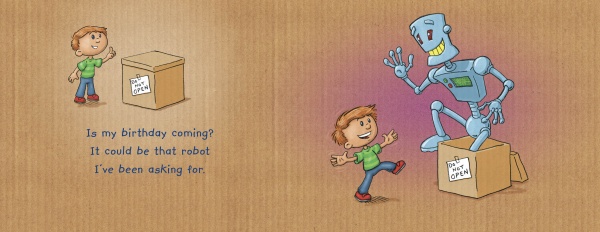
A little boy named Benny sees a box with a sign taped to it that says, “DO NOT OPEN”. Well, that just sends Benny’s imagination into overdrive: what could be in the box? Could it be something cool, like the robot he’s wanted? Or could it be something scary, like a monster? Maybe his sister put something in there to scare him!

The cartoony artwork is printed against a background made to look like corrugated cardboard, making the story look like it’s been written and drawn on a cardboard box. Sentences are simple and short, written in a rounded font and in blue to stand out against the brown cardboard background. Each spread has Benny wondering what could be in the box, and a rendering of his imagination. Kids will have loads of fun with this book: especially with the end reveal.

Bring out your own box for storytime, and have kids guess what could be in it! They can draw what they think, or they can call it out, but it’ll get their minds working and they’ll learn more about how guessing can lead us to the answers, if you provide hints and information as you go along. I could hide a teddy bear in a box and tell the kids that something furry is in the box; using trial and error, they can figure it out.

I read this book with my 3 year-old, and he loved it. He had a fun time guessing what was really going to be in the box, because nothing was too outlandish for us! “Could there be an OCTOPUS in the box? How about a REAL DINOSAUR?” Have fun with a read-aloud!


box_2


Timothy Young also wrote The Angry Little Puffin, which is an adorable book that G-man (my little guy) LOVES. Now that I’m remembering that, I need to order that for my library, too; that’s a great storytime book, and so is Do Not Open the Box. Give your readers’ imaginations a workout and add this one to your collection.

Posted in Animal Fiction, Preschool Reads

Buddy and Earl Go Exploring – A buddy tale of imagination!

Two friends – a hedgehog and a dog – settle down for the night. When the house is asleep, Earl, the hedgehog, announces that he’s leaving – much to his best friend, Buddy’s, chagrin. But wait! After running and running on his exercise wheel, Earl arrives at his destination and discovers that Buddy is there after all! Buddy’s confused, but goes with the flow, and the two go on an adventure that will have parents and kids alike laughing and wondering what their own pets get up to when everyone’s asleep.


buddy and earl

Buddy and Earl Go Exploring, by Maureen Fergus/Illustrated by Carey Sookocheff (March 2016, Groundwood Books), $16.95, ISBN: 9781554987146. Recommended for ages 4-8

The second book in the Buddy and Earl series is just as much fun as the first book, and loaded with imagination. Earl sees things differently, through fantastic eyes – Buddy’s water dish becomes a lake; Dad’s referred to as a “hideous ogre”; Mom’s hairbrush is a lovely lady hedgehog – and Buddy is drawn into this wonderful world of adventure. We know that poor Buddy is the fall guy – he’s the Pinky to Earl’s Brain, the dopey friend that blunders along – but we love it. The friends care for each other and watch out for each other, with Buddy providing the muscle and Earl bringing the fantastic.

The art is sweet and appealing, done in acryl gouache on watercolor paper, then assembled in Photoshop, to bring it all together. The story begins with the endpapers, gently drawing readers into the story and giving them one final giggle at the story’s end. Plain black font is unintrusive and makes for an easy read-aloud, and this is a great book for read-alouds. I’d add this to a bedtime story read-aloud or a pet storytime and let the kids tell me what they think their pets do at night!

Buddy and Earl Go Exploring is out in March, but you can pick up the first book in the series, Buddy and Earl, to keep the kids entertained while you wait.


buddy and earl_3

Posted in Fiction, Preschool Reads, Toddler Reads

Hervé Tullet says, “Let’s Play!”

If there’s a new Hervé Tullet book, I need it. After bringing Press Here to my preschoolers and having laugh-out loud fun with my toddlers, I knew I was onto something good. Then, I brought Mix It Up! into a storytime, and the crowd went wild. These books are the height of interactive storytelling for a mid-size storytime group, especially for little ones that may have trouble sitting still. Now, we have the next book in this brilliant and fun series: Let’s Play!
let's play

Let’s Play, by Hervé Tullet, (March 2016, Chronicle Books), $15.99, ISBN: 9781452154770

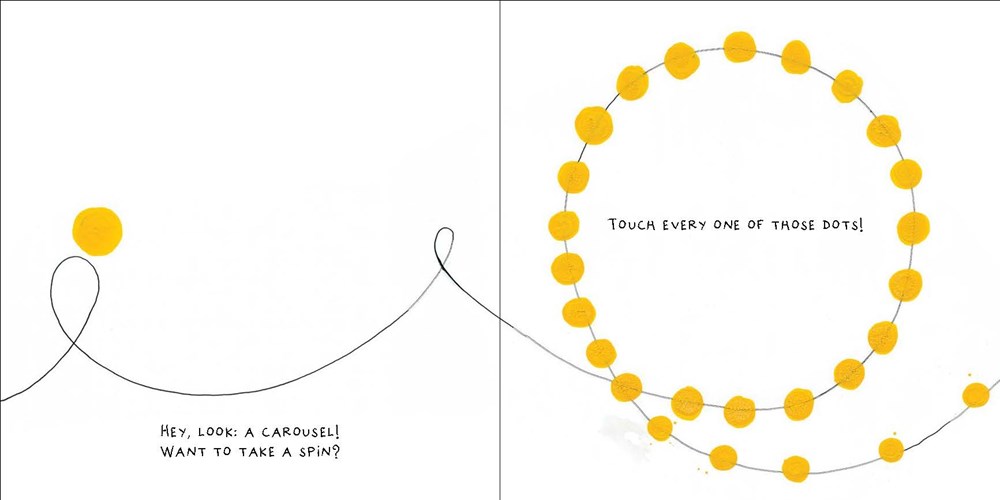
The yellow dot is back, and he’s a little bored. He wants you to play with him, and all you need to do it press the top corner of the book to get started. From there, the reader and the dot are partners, wandering all around the book’s available space – up, down, in loops and twists, playing hide and seek and exploring new, possibly spooky, spaces!
I’m always thrilled and amazed by what Tullet comes up with for his books. Whether it’s using your fingers to travel the world in The Finger Travel Game or using dots to keep readers engaged and, even more, enchanted, he always manages to break the fourth wall and grab your attention. His books are funny, interesting, and perfect for any age – they tap into a creativity that adults may not expect and that kids will embrace. I love his books, and your kids will, too. Feeling extra creative? Have a craft after storytime where kids can make their own dot(s) and ask them to make up their own adventure!
let's play_2
Posted in Early Reader

Do You Hear What I Hear? Vintage Art helps create a symphony!

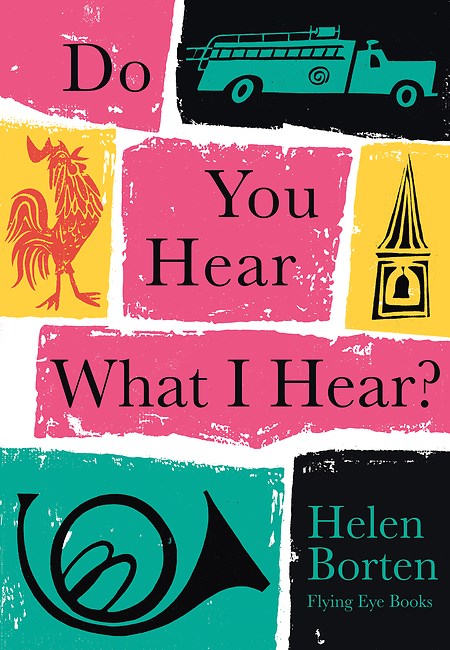
9781909263857_e3d21Do You Hear What I Hear?, by Helen Borten (May 2016, Flying Eye Books/Nobrow), $17.95, ISBN: 9781909263857

Recommended for ages 4-8

A companion to Ms. Borten’s Do You See What I See?, Do You Hear What I Hear?, also published in 1959, introduces children to the effects different sounds can have on them.

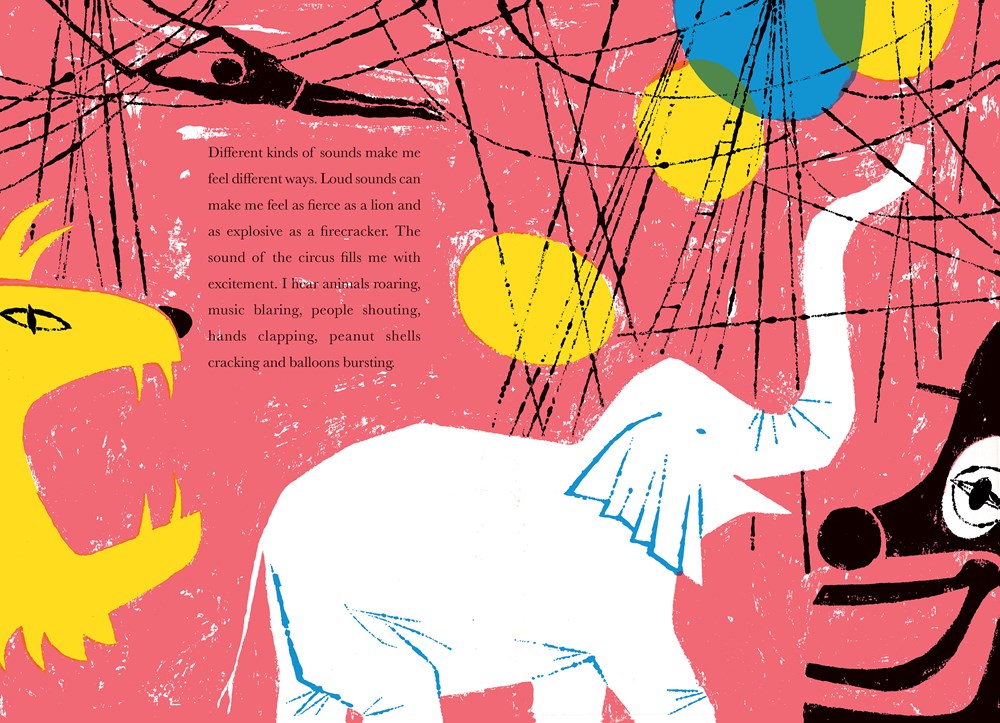
“Loud sounds make can me feel fierce as a lion and as explosive as a firecracker. The sound of the circus fills me with excitement. I hear animals roaring, music blaring, people shouting, hands clapping, peanut shells cracking, and balloons bursting.”

Accompanied by her beautiful artwork, these images have texture that help kids unpack the sensations described in the text. The frenetic atmosphere of the circus is captured in the many lines stabbing the spread; the cords holding up the big top and the trapeze wires; the motion of the swinging trapeze artist and the balloons, and the animals walking across the pages.

9781909263857_1_d7840


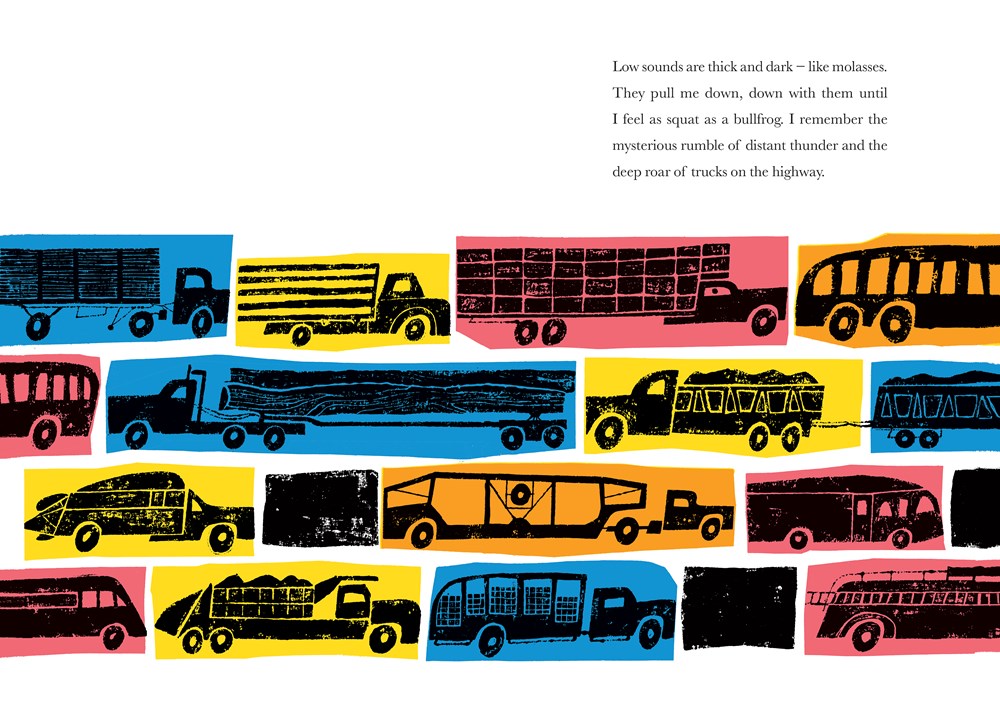
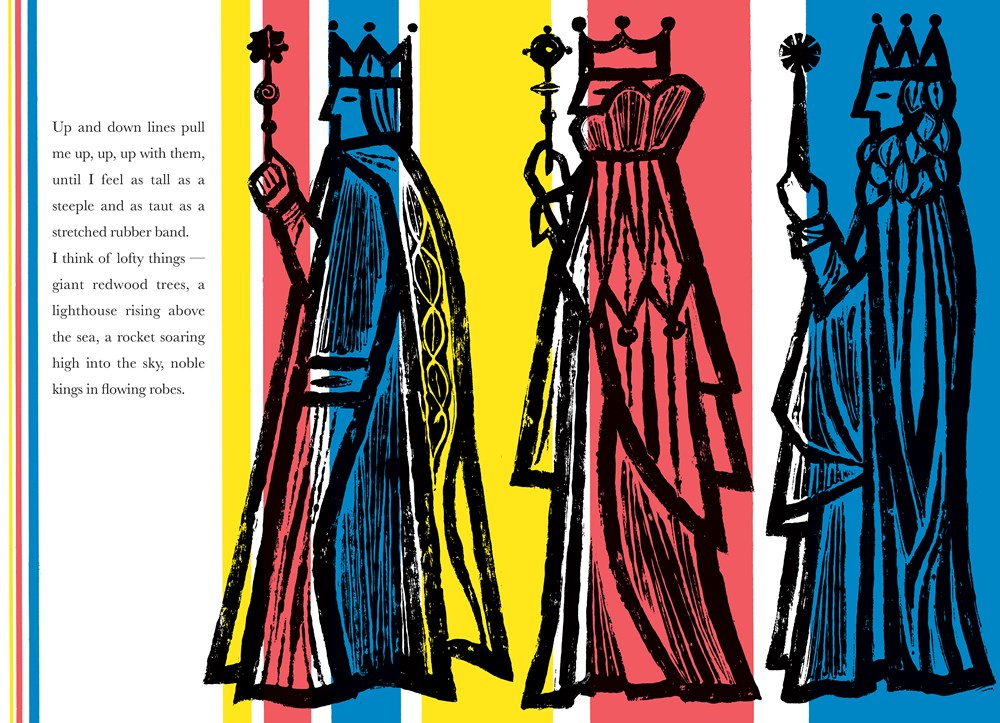
Originally published in 1959, Mr. Borten’s beautiful, vintage artwork adds texture to the basics: lines, color, and shape, whether it’s by adding swirls to an ocean full of fish or wispy, thin spider webs above the thick bars of a lion’s cage. Ms. Borten artwork and evocative text inspires children to see the world around them “as a great big painting, full of lines and shapes and colors, to look at and enjoy”.

This is a great book to read out loud, then talk about the different sounds and feelings kids associate with them. I know the sizzle of a grill makes me think of summer, and I can feel the warmth on my skin and taste the tart lemonade just thinking about it, and the scent of a box of crayons makes me feel excited, like I’m ready for the first day of school all over again. Have kids draw what different sounds make them think of, or describe them. I’ll be adding this book to  my family storytime rotation for sure.

Do You Hear What I Hear? isn’t out until May, but take a look at some more of the beautiful art from the book, and pre-order from Amazon. Check out the publisher’s website for more picture books, and take a look at some of the outstanding artwork from Do You Hear What I Hear, below.

9781909263857_2_494bd

9781909263857_4_92af3

Posted in Preschool Reads

Do You See What I See? Vintage art meets children’s concepts

9781909263840_def1bDo You See What I See?, by Helen Borten (May 2016, Flying Eye Books), $17.95, ISBN: 9781909263840

Recommended for ages 4-8

One step up from basic concepts, Helen Borten’s Do You See What I See? takes children one step further, unpacking what feelings and ideas these fundamental concepts evoke in young readers:

“Lines that bend in a zigzag way seem to crackle with excitement. They make me think of thunderstorms and jagged mountain peaks. I see the huge jaws of a crocodile, wide open and bristling with teeth, ready to snap shut.”

Originally published in 1959, Mr. Borten’s beautiful, vintage artwork adds texture to the basics: lines, color, and shape, whether it’s by adding swirls to an ocean full of fish or wispy, thin spider webs above the thick bars of a lion’s cage. Ms. Borten artwork and evocative text inspires children to see the world around them “as a great big painting, full of lines and shapes and colors, to look at and enjoy”.

I’m thrilled to see this book back in print and can’t wait to introduce it to my family storytime. We can have a great discussion about what different pictures and colors make kids feel, and how changing one thing in a picture – a shape, a color, adding or taking something away – affects the whole picture. A must-have for collections where kids are ready to take the next step beyond Mouse Paint and Mouse Count.

Do You See What I See? isn’t out until May, but take a look at some more of the beautiful art from the book, and you can pre-order from Amazon. Check out the publisher’s website for some more books – they have books with amazing artwork.


Posted in Preschool

This is Sadie gives us a little girl with a big imagination

this is sadieThis is Sadie, by Sara O’Leary/illus. by Julie Morstad (May 2015, Tundra Books), $17.99, ISBN: 9781770495326

Recommended for ages 4-8

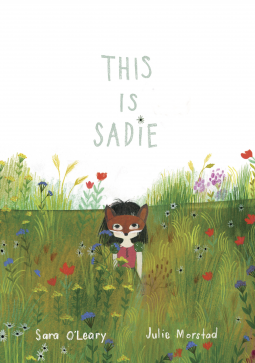
Sadie is a little girl whose friends sometimes live in the pages of books. She makes worlds and kingdoms out of cushions and boxes and anything around her. She has wings that bring her wherever she wants to go, and get her home safely. She can do anything, be anything, with her imagination. She’s Alice in Wonderland, she’s Mowgli, she’s anyone she wants to be.

The whole book is an invitation to all readers to get lost in their imaginations. Sadie is the focal point for the story, but boys and girls alike will recognize their own adventures, whether it’s sailing in a cardboard box boat or talking to birds and trees. Sadie’s creativity will spark children to create their own adventures – storytime and a pillow fort building activity would go great together for this book!

The art itself is dreamlike, with soft, bright yet relaxed colors on the pages. The simple black font is unintrusive and is perfect for storytime reading.

Kids will love this book, and grown-ups will love reading it. Read together, and go on an adventure.