Posted in Fantasy, Humor, Tween Reads

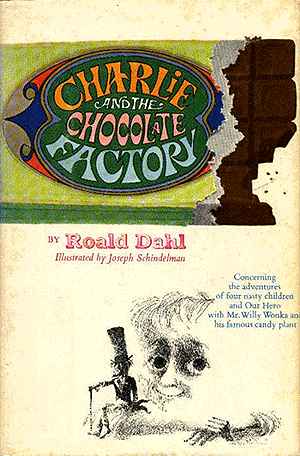
Book Review: Charlie and the Chocolate Factory, by Roald Dahl (Bantam, 1977)

Recommended for ages 8-12 (and ageless)

This was one of my favorite books growing up, and reading it again all these years later, I find that I love it as much now as I did when I was 8. Having spent the last few years watching multiple viewings of Willy Wonka and the Chocolate Factory (Gene Wilder is Willy Wonka), I ended up surprised on a few occasions when I realized that scenes from the movie – such as the Fizzy Lifting Drinks scene when Charlie and Grandpa have to belch their way down from certain doom – were not in the book after all! While the movie retained much of Roald Dahl’s dark comic humor, nothing beats the book, and Dahl’s wry observations on rude children and the parents who indulge them, and how the meek inherit… well, if not the earth, at least a lifetime’s supply of chocolate.

Charlie Bucket is starving – no, really, he is. He lives with his mother, father, and four sickly grandparents, who are so old and sick that they never get out of bed. Father has a menial job screwing the caps onto toothpaste tubes, and they family is very poor. They are so poor, all they can eat is cabbage soup, and Charlie refuses to take more than his share. Every day he walks past the famous chocolatier Willy Wonka’s chocolate factory and lifts his nose, inhaling the delicious smells; the only time he gets to enjoy a Wonka bar is on his birthday.

It all changes when Willy Wonka announces a contest where five winners will be allowed to tour the chocolate factory – and Charlie is holding one of the Golden Tickets. Grandpa Joe, his elderly grandfather who retains the joy and wonder of youth, jumps out of bed and insists that he go with him, and they’re off. Charlie meets the four other winners – the gluttonous Augustus Gloop, spoiled brat Veruca Salt, TV addict Mike Teavee, and boorish Violet Beauregarde – and their overly indulgent parents at the gates of the factory, and when Willy Wonka’s gates open for the first time in years, the fun really begins. Who will make it through the factory tour?

Dahl’s writing weaves words into pictures that are enhanced by Joseph Schindelman’s black and white illustrations. From Willy Wonka’s mysterious origins to the Oompa Loompa’s cautionary songs, this book is Mr. Dahl’s morality play. It’s a great reminder of the golden rules as children enter into the middle grades: be polite. Don’t be a bully. Share. Don’t be a glutton or have bad manners. Modesty and a humble demeanor reap their own rewards. Reading Dahl is like Emily Post for kids, but with chocolate rivers and candy flowers.

Roald Dahl is a well-known classic children’s author. There is an inactive wiki that appeared to be the start of a comprehensive body of work  with 106 articles; there is a call to revive it on the home page. There is also a wonderful Roald Dahl website that is animated and features links to the Roald Dahl store, museum, and his children’s charity. The site features a “book chooser” that will match kids with a “splendiferous read” of his, a biography on the author, and a “Wonkalator” – a calculator game that asks kids to help Wonka with his latest magical formula.
Posted in Fiction, Humor, Tween Reads

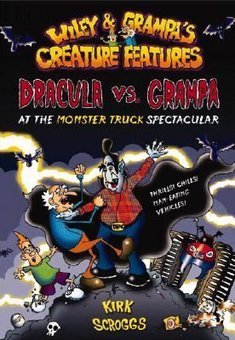
Book Review: Wiley & Grampa’s Creature Features, by Kirk Scroggs (Little, Brown, 2006)

Recommended for ages 8-12

The Wiley & Grampa books take the sting out of scary books for kids by making them hilarious and gross. They got in early on the ‘potty humor makes boys read’ trend that I have seen time and again, but author Kirk Scroggs gets it, and he writes well.

The stories revolve around young Wiley, a boy who lives with his grandmother and grandfather, in what appears to be “good ole boy country”. Wiley and his grandfather loves Pork Cracklins and monster trucks, and his grandmother is always after them to finish chores. Somehow, Wiley and Grampa always end up in trouble with the supernatural.

In the first book, Dracula vs. Grampa at the Monster Truck Spectacular, Wiley and Grampa sneak out to go to a monster truck show, despite Gramma’s telling them that with the storm coming, no one is going any where. They meet Dracula himself, and get the sneaking suspicion that Dracula’s very interested in Gramma, who just happens to resemble Drac’s dead wife. If that isn’t enough to entice readers, there are monster trucks. That run on blood.
In Grampa’s Zombie BBQ, Wiley, Grampa and Gramma are having barbecue and Gramma’s making her famous honey paprika barbecue sauce. When a horde of zombies shows up and shows an appetite for Gramma’s food, all is fine – until the food runs out, leaving Wiley and his grandparents to fend for themselves. But can the school lunch lady and her toxic beet borscht save the day?

The books are great for younger readers who are still getting into the swing of chapter books, for readers who want a good laugh, or readers who want their monsters a little less threatening. Wiley and his family are funny, and they are never really in any danger, giving more skittish readers reassurance. The books are illustrated with blackand white sketches on every page and the characters are drawn as exaggerated, caricature-like people.
There are ten Wiley & Grampa books available, the last of which came out in 2009. Kirk Scroggs’ website has a section dedicated to the series and links to more content.
Posted in Fantasy, Post-apocalyptic/Dystopian, Science Fiction, Tween Reads

Book Review: A Boy and His Bot, by Daniel H.Wilson (Bloomsbury, 2011)

Recommended for ages 9-12

On a class trip to a Mek Mound, an ancient Oklahoman Indian land mound reminiscent of the Egyptian pyramids, sixth grader Code Lightfall discovers Mekhos, a manufactured, experimental world inhabited by robots and long forgotten by humans. The world is under the grip of the evil tyrant Immortalis, bent on the world’s destruction; it falls to Code and Gary, an atomic slaughterbot brought to life by Code’s imagination and Mekhos technology, to find the Robonomicon and save the day.

A Boy and His Bot is a journey to Oz tale for a more modern age, complete with beautiful and deadly surroundings like the Toparian Wyldes, the beautiful forest maintained by a race of robots who trim and sculpt anything in their way, their upkeep programming overriding any other directive. Where Oz has a benevolent wizard, Boy  has Immortalis, the evil overlord who pushes all robots to the day of The Great Disassembly, when all of Mekhos will be undone. Code’s main objective, beyond stopping The Great Disassembly from taking place, is to get back home.

I have noticed that heroes in “boy books” often come from dysfunctional families, and Code is no exception. A shy boy, picked on by some classmates, ignored by others, Code is grieving the disappearance of his grandfather John a year prior. His parents are not in the picture. The only positive female force in the book is Peep, the little robotic probe that befriends him and leads him to the world of Mekhos. Gary the Slaughterbot plays the part of the all brawn, no brains protector with the heart of gold.

I wonder why it is that young male characters’ families are so flawed in YA literature. Is this an accurate reflection of the state of families today, or is this the newest hook to keep young boys reading? Is it a way to reach out to young boys that may be in crisis and refuse to speak?  The combination of robotic creatures, a manmade world on the brink of destruction, and an invention like the slaughterbot alone is enough to grab a boy’s attention on the surface, but Code’s background gives him a depth that should help boys and girls alike be interested enough in his journey to travel along with him.
Daniel H. Wilson, Ph.D. is the author of How to Survive a Robot Uprising, Where’s My Jetpack, and How to Build a Robot Army. A Boy and His Bot is his first YA novel, but he has also written Bro-Jitsu: The Martial Art of Sibling Smackdown, and his Robot books are popular with older tweens and teens. He maintains an author website.