Posted in gaming, geek, geek culture, Humor, Realistic Fiction, Teen, Young Adult/New Adult

Geek Mystery – The Unfortunate Decisions of Dahlia Moss

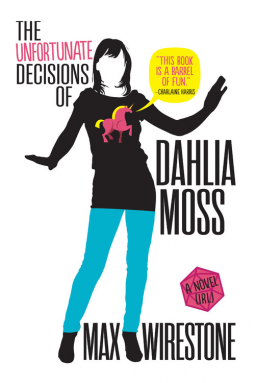
dahlia mossThe Unfortunate Decisions of Dahlia Moss, by Max Wirestone (Oct. 2015, Red Hook Books), $20, ISBN: 978-0316385978

Recommended for ages 14+

Geeks finally have a Jessica Fletcher to call their own (That’s the detective from the old TV show, Murder, She Wrote – ask your parents, kids)!  Meet Dahlia Moss – twenty-something geek girl who doesn’t make the best life decisions. She’s unemployed, unattached, and broke, living off her eccentric roommate for the time being. When Charice, her roommate, throws another one of her crazy parties, Dahlia finds herself being hired for private detective work by one of the guests, Jonah – it seems that someone stole a valuable artifact from him through his MMORPG (Massively Multiplayer Online Role Playing Game – think World of Warcraft, for any uninitiated reading this). Dahlia has zero detecting experience, but she does speak geek, and Jonah flashes a lot of money her way, so she takes the case. The plot only thickens when Jonah turns up dead shortly after. Now, Dahlia’s determined to find the artifact, the killer, and quite possibly, a new boyfriend. Let’s hope her decision-making abilities improve!

Told in the first person from Dahlia’s point of view, this is an often hilarious, readable, fun, whodunit. We’ve got a new heroine for the geek age in Dahlia Moss, who’s self-conscious, sarcastic, and fluent in fandom. If you love a good mystery – heck, even if you don’t, but love science fiction, gaming, fantasy, or any kind of fandom, this is a great book for you. Wirestone is a librarian, and if there’s one thing I know about our people, the Geek is strong with us. She humorously captures the strange bedfellows that online gaming makes of us all, and manages to weave together a smartly layered mystery and a love of all things quirky and geek. Dahlia Moss herself is wonderfully left of center and will appeal to anyone whose square peg just won’t fit into that round hole, no matter how hard we try.

Teens and college students will get a kick out of this book and likely try to figure out how their own social groups match up to Dahlia and her friends. Here’s hoping we get some more Dahlia adventures in the future!
Posted in Uncategorized

LI PopCon was a Blast!

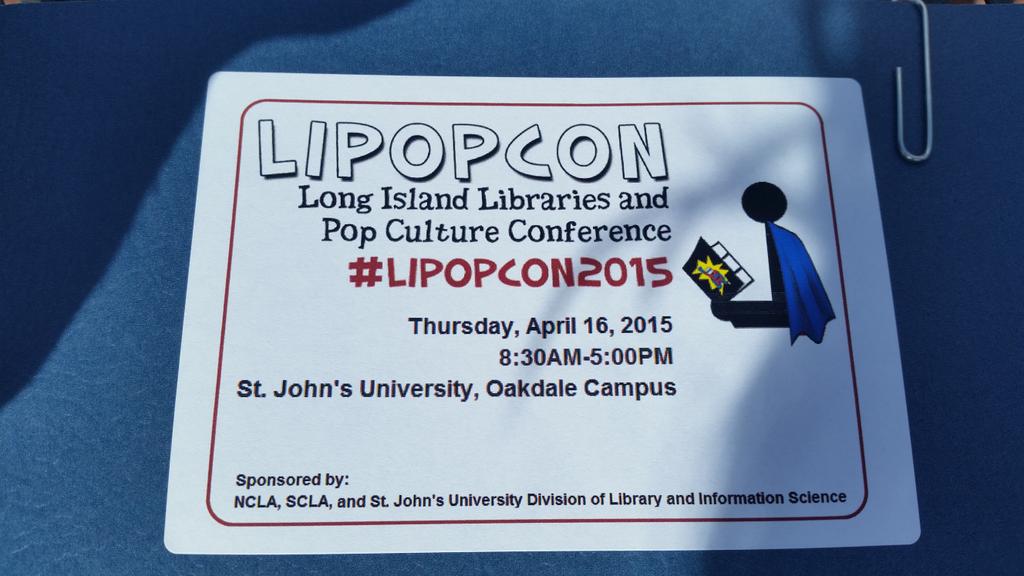
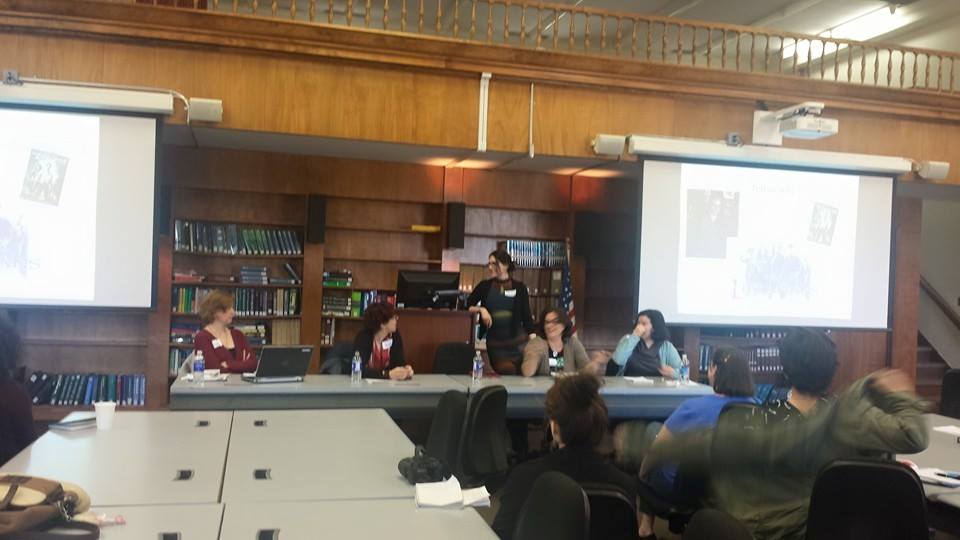
Whew! I’ve done it. I’ve spoken on my first panel. I was a guest at the first (hopefully annual) Long Island PopCon, a pop culture conference for librarians, educators, and students held at St. John’s Oakdale Campus. I got a nice nap on the LIRR in, and after a couple of coffees, was ready to go. I met some great exhibitors, got to hear Raina Telgemeier give a brilliant keynote at our lunch, and attended great panels – there were so many great panels lined up, I need to look into cloning technology for next year, so I don’t miss out on anything.

lipopcon


The anime/manga panel was a huge help for me. I tried to get an anime/manga club going at Pomonok Library for my tweens and teens earlier this year, but couldn’t sustain it past a few sessions. Now that I have resources recommended by both academic and public librarians, I feel more confident in offering this over the summer and seeing what I can get.

My panel, The Image of the Librarian and the Librarian’s Image, was filled with some great ladies, all of whom shared a love of pop culture and a firm tongue-in-cheek sense of humor when it comes to the classic image of the bunheaded librarian. We looked at our collective image from pop culture/media crit, sociological, and literary standpoints, and I hope that our audience learned from us as much as we learned from one another.

lipopcon_2

If you ever have a chance to go to St. John’s Oakdale campus, I highly recommend it. It’s gorgeous and green, and the Bourne Mansion is stunning. My fellow pop culture librarians and I are already talking about what panels we can put together for next year.

If you want to keep up to date with the Con, you can follow them on Facebook and their website, where you can also find a copy of yesterday’s program, complete with speaker information for your networking needs.

Posted in gaming, geek, geek culture

The Family That Geeks Together – TableTop Gaming

I wrote a piece on tabletop gaming for WhatchaReading recently, that’s received some great feedback. I thought I’d post the article here, too, especially with a lot of my readers being librarians and parents, and get some more input.

My 11 year-old son, Alex, and I hang out a lot together. I introduced him to Doctor Who, the Batman ’66 TV series, and Batman’s The Killing Joke; he introduced me to tabletop gaming. We’d played Clue, Monopoly, and Trouble until I thought I was going to weep, and even though we learned how to play Magic a few years ago at New York Comic Con, one game could get so bogged down that I kind of shied away from gaming. That changed last Christmas, when my brother-in-law gave Alex Munchkin, the card game where you loot the treasures, kill the monsters, and stab your buddy. He was immediately hooked. Next thing I knew, he was an authority in the making on tabletop gaming. He introduced me to Wil Wheaton’s TableTop web series. He collected different Munchkin games. We went to New York Comic Con together, and he showed me Fluxx, King of New York, and other tabletop games. We went home and played Munchkin with my 15 year-old, and we had a blast. I was hooked.

The Family That Geeks Together: Tabletop Gaming

Many Munchkin games later, we’ve expanded to include Cthulhu Fluxx, Machi Koro, Sushi Go, and We Didn’t Playtest This At All. We go at each other, talking smack and trying to trip each other up, laughing and talking about everything – school, books, crazy members of the family – as we go along. Tabletop gaming has given me a great way to tighten my relationship with my kid as he enters – shudder – puberty; it’s “our thing”: something that’s for us, we have together. Alex is a gamer, not really a talker, but if we’re playing Machi Koro, and something’s on his mind, it’ll come up as we’re stealing one another’s resources to build our city. If his brothers are driving him crazy, I’ll hear about it as he’s attacking a monster during a round of Munchkin. He’s relaxed. I’m relaxed. If we can defeat Cthulhu and find the Necronomicon, dealing with a 2 year-old who’s sticking fruit snacks in your hair is a piece of cake.

Cthulhu Fluxx munchkin cthulhu machi koro

Alex’s influence has spread to my library, where I just started a Tabletop Gaming club. Our first session, I had six kids and a parent show up to play another Fluxx game, Oz Fluxx. These kids had a BLAST. It exceeded my wildest hopes, because I haven’t had a lot of geekery catch fire with the kids at the library these days. When I finished the “learning round”, as I called the first game, they immediately asked for another round. I handed off the deck to the dad who sat in, who was more than happy to take over as game leader.

Fluxx Oz we didn't playtest      sushi-go

Gaming works. It gets kids thinking strategically, using numbers, words, reasoning. It helps them plan, it helps them understand cause and effect. Candyland and Chutes and Ladders, TiddlyWinks, Break the Ice – start playing with the little ones early. You can start when they’re about 3. But when they’re as young as 5, you can start teaching them Magic – it’s how Alex became more comfortable with numbers as a Kindergartener. I have a 6 year old in my Fluxx group at the library, and she was the kid who won the game. Her proud dad was the dad who joined my group, and he can’t wait until next week, when the group meets again. Gaming brings people together, so why wouldn’t it bring parents and kids together? It’s one of the few times they can oppose you without grief, right?

Now I’m scouring Kickstarter for new games to bring home, and to my library. I’ve got 3 in the hopper now: Gryphon Games’ 12 Days of Christmas and King’s Kilt, and Exploding Kittens, by Ellan Lee, Shane Small, and The Oatmeal’s Matthew Inman. Which also happens to be the most-backed Kickstarter EVER. Once I get these, I’ll make sure to report back.

12days kingskilt explodingkittens


In the meantime, what are YOU guys playing? I’d love to hear about it. Weigh in on Twitter, or in the comments below!

This article appeared on WhatchaReading on 2/21/15.

Posted in Fantasy, geek culture, Graphic Novels, roleplaying, Science Fiction, Teen, Tween Reads, Uncategorized

In Real Life: Where online worlds cross over to reality.

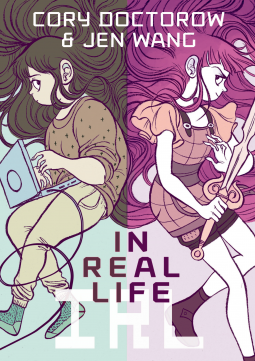
in real lifeIn Real Life, by Cory Doctorow/Illustrated by Jen Wang (:01 First Second, Oct. 2014). $17.99, ISBN: 9781596436589

Recommended for ages 13+

I’m a Cory Doctorow fan. I loved Little Brother, and I was fascinated by For the Win, which examines the lives of “gold farmers” – people whose job it is – in real life – to acquire gold and magic/rare items in games, and sell them to players for real-world currency. The gamers – which include children – are from poor families in third-world countries: India, China, and Singapore, working in deplorable conditions, and exploited by sweatshop bosses who pay pitiful wages.

In Real Life is a graphic novel about a girl named Anda, who loves playing a MMORPG (Massively Multiplayer Online Role-Playing Game) named Coarsegold. She makes friends in the gamespace, ultimately falling in with Lucy, a more experienced gamer who takes Anda under her wing. They stalk and “kill” the “gold farmers” they encounter, believing them to be cheating by selling gold and rare items to fellow gamers. The farmers look small, almost childlike, and Anda – despite doing this in the gamespace – feels guilty. She strikes up a friendship with one of the farmers, a Chinese teenager named Raymond, who tells her about his life and his job – laboring under sweatshop conditions to farm so that he can help support his family – and Anda decides that something needs to be done.

The story is similar to Doctorow’s plot in For the Win, but without delving into the global politics and economics involved in the novel. I loved this graphic novel, which could be an introduction or supplement to For the Win. We get to see positive representations of female gamers, teenagers, and we have a moral central character who is forced to understand that even morals don’t come solely in black and white. At the same time, In Real Life calls attention to a form of human rights violation taking place all over the world, yet located in our homes, our libraries, and anywhere we game.

Jen Wang’s art is perfect for Doctorow’s story. She’s got a manga style that works for me. Her use of color works to as a soft contrast to the tech storyline, and brings out the humanity at the tale’s core.

In Real Life publishes in October of this year, and I can’t wait to get it on my shelves. It’s going to be a great addition to any graphic novel collection, and a must-read for older tweens and teens, especially those who game. Social Studies courses could get some great discussions by adding this book to their curriculum.

Posted in Fantasy, Fiction, gaming, geek, geek culture, Humor, roleplaying, Science Fiction, Teen, Young Adult/New Adult

Attack the Geek: Geek Culture Gone Wild!

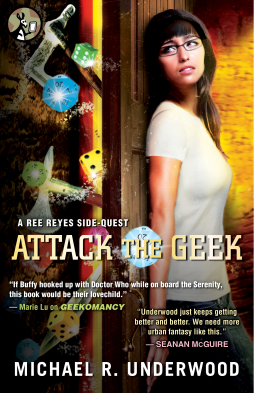
attackthegeekAttack the Geek, by Michael R. Underwood. Gallery, Threshold, Pocket Books (2014), $2.99, ISBN: 9781476757780

Recommended for 18+

Attack the Geek is more of a New Adult read than it is a YA read, but there are plenty of pop culture, gaming, and garden variety geek references in there that will appeal to younger audiences. There’s a content heads-up for language, but it’s nothing the kids aren’t screaming at each other these days.

Attack the Geek is a side adventure to a series created by Michael R. Underwood; his previous two books, Geekomancy and Celebromancy, are available via digital download on Amazon for a very reasonable price. I haven’t read the two previous books which could be a reason why I felt off-kilter with Attack the Geek.

For any gamers out there – did you ever have a roleplaying session where one bar fight or battle took up hours of your campaign? If you know what I’m talking about, that’s how I felt while reading Attack the Geek. It’s a single combat story, with barista Ree Reyes, the heroine and protagonist of the series, and her fellow geekomancers coming under attack at Grognards, the establishment owned by Ree’s boss, Grognard. The geekomancers have the ability to channel the power of geek culture by consuming it – Ree, for instance, keeps clips from her favorite movies, like X-Men or Spider-Man, to draw upon when she needs power – and she’ll be able to shoot webs or toss people with telekinesis. There are props aplenty, including working Star Trek phasers and Star Wars lightsabers, and collectible card game cards merely need to be torn to release their  magic in this world, if channeled by the geekomancer. So when they come under attack from a Strega witch named Lucretia, it’s a hairy battle, loaded with pop culture references and witty banter.

This being a side adventure is my own issue – I am unfamiliar with the geekomancy power and these characters, so in a sense, I was at a disadvantage. But I also thought the book was trying to be too witty, throw too many references in, for its own good. The references took over the plot, and after a while, I was just reading about a battle where there was Spider-Man web slinging, Star Trek phasers, and lots of collectible card game references. This just wasn’t my book. For anyone who’s a devoted sci-fi/fantasy/gaming/comic book fan, it’s worth a shot. It’s why I requested it from NetGalley, after all, and I may read Geekomancy now just to see if having more of a background will help me better grasp the book.