Posted in mythology, Preschool Reads

Book Review: Ganesha’s Sweet Tooth by Sanjay Patel & Emily Haynes/Illus. by Sanjay Patel (Chronicle, 2013)

Recommended for ages 4-8
ganeshas_sweet_tooth

This adorable story puts a new spin on the Hindu myth that tells the story of how Ganesha, the elephant-headed god, came to help write the epic poem, The Mahabharata. Young Ganesha has a sweet tooth and particularly loves laddoos – a kind of jawbreaker candy – until one day, he breaks a tusk on one! What’s a young godling to do? He meets the poet, Vyasa, who offers a surprising way to make the best of the situation.

I can’t say enough about this book. The art is stunning. Sanjay Patel is an animator at Pixar Studios, and the look and feel of the overall story definitely has a fun quality to it that Pixar fans will appreciate and everyone will enjoy. The colors and Indian-influenced artwork are breathtaking. This is artwork I would hang in my kids’ room, it’s so beautiful. It’s colorful and exciting, and introduces children to Indian-influenced art, which many will likely never have seen before.

ganeshas-sweet-tooth_Page_04

At the same time, the artwork is adorable. Children will adore Little Ganesha and his best friend Mouse and relate to them. What child wouldn’t want to sit and eat candy all day long? What child doesn’t believe he or she is invincible, as Ganesha does? When Ganesha breaks his tooth, he is worried about his appearance and becomes angry and frustrated, throwing his tusk at the moon. He loses his temper, like any other child would in a frustrating situation, and there is a friendly adult, in the person of Vyasa, to deflect Ganesha’s anger and channel it into something productive.

There are good lessons to be learned in this story, including making the best of a bad situation and how sharing is important, as illustrated between Ganesha, Mouse, and their other friends. I read the digital version of the book, but encourage adults to read the actual storybook, as the font is playful, round, and fun, attracting young readers’ eyes and directing them to the action and flow of the story. The artwork will keep little eyes busy – there is so much to see! – and the story lends itself to great post-storytime discussions about sharing, listening to your friends, and seeing the good in every situation.

Posted in Preschool Reads

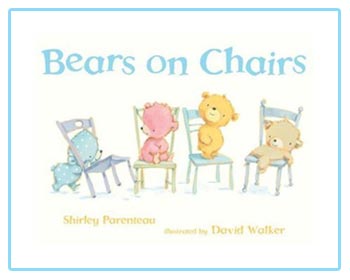
Book Review: Bears on Chairs, by Shirley Parentau/illus. by David Walker (Candlewick Press, 2009)

bears_coverRecommended for ages 2-5

In this story about sharing, compassion, and teamwork, four little bears sit comfortably on four little chairs until Big Brown Bear shows up and wants to sit down. The four little bears work together to find a seating arrangement that works for all five bears. The brief text offers a rhythm that makes it a good story time candidate, and David Walker’s acrylic illustrations use soothing pastel hues that allows readers to focus on the story.

There are many story time ideas here: we can create a teddy bear story time, with songs like Teddy Bear’s Picnic and Elvis Presley’s “Teddy Bear”, which will get children and adults alike up and moving. Children can bring their favorite teddy bear to cuddle during the story time, and we can incorporate fingerplays including Teddy Bear, Teddy Bear. Other story time ideas include a sharing and friendship-themed story times, with songs and fingerplays about sharing like “If You’re Friendly and You Know It” (to the tune of “If You’re Happy and You Know It”).

Posted in Preschool Reads, Toddler Reads, Uncategorized

Book Review: Thank You Bear, by Greg Foley (Viking, 2007)

thank-you-bearRecommended for ages 2-4

Bear finds a box that he cannot wait to share with his best friend, Mouse. On his way to Mouse, he meets other friends – a Monkey, an Owl, a Fox, an Elephant, a Squirrel and a Bunny – who criticize Bear’s gift as being too small, too ordinary, or even a better gift for someone else. Dejected, Bear is unsure whether or not his gift is worth giving, until Mouse shows him that friendship is all about gratitude. Preschoolers will appreciate this simple book on friendship and gratitude, and the joy that even the simplest gifts can bring to another. The font is a spare, typewriter-like print, and the pastel watercolor artwork, outlined with strong black lines, bring simplicity to a story that may diverge from more brightly colored books, but will stand out because of it.


This would be a great addition to a storytime on friendship and gratitude. There is the potential for a wonderful discussion about friends and giving – Shel Silverstein’s The Giving Tree would be a great companion story to this book – and the importance of saying “thank you”. Friendship is a popular storytime theme, with many songs available on children’s CDs. DLTK’s website has a friendship wreath craft made with traced handprints that can be prepared in advance and ready for attendees to assemble with help from their parents/guardians.

The author’s website has downloadable designs for Bear stationery and computer wallpaper, in addition to links to other books. Mr. Foley’s “Bear” series includes Make a Wish Bear; I Miss You Mouse; Good Luck Bear and Don’t Worry Bear, which also features his friend, Mouse.

The book received the Charlotte Zolotow Award in 2008 and was a nominee for Iowa’s Goldfinch Book Award (2011).

Posted in Toddler Reads

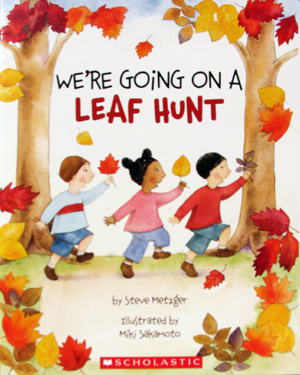
Book Review: We’re Going on a Leaf Hunt, by Steve Metzger/illus. by Miki Sakamoto (Scholastic, 2008)

leaf huntRecommended for ages 2-5

A group of friends goes on a leaf hunt, which leads them on adventures over a mountain, through a forest, around a waterfall, and across a lake.

I have a special place in my heart for this book; it was one of my son’s favorite books, because of its repetitive interactivity. The story follows a group of friends on a leaf hunt. They state their beginning intention – “We’re going on a leaf hunt. We’re going right away. Let’s find colorful leaves. It’s a wonderful day!”. The group’s arrival at each point – a mountain, a forest, a waterfall, and a lake – comes is accompanied by a repetitive phrase (“climb, climb, huff puff. We made it!”). They collect leaves from a different tree at each spot, and when they return, they revisit these areas, arriving home ready to jump and play. It makes for a fun read-aloud, where children can echo the repeated phrase and act out the group’s actions (climbing a mountain, crossing a lake).

The artwork appears to be watercolor, with lively reds, browns and yellows to create a beautiful fall day. The story font is mostly brown and bold, but words with emphasis receive a different treatment: the world “colorful” is spelled out with different fall colors; the names of the trees are bright orange, and water-related words are blue.

There are many websites available that offer printouts of different leaves that children can color for a fun, seasonal craft. There are also many seasonal and Fall-related songs and fingerplays.

The author’s website offers links to all of his books, with printables related to some of his books.

Posted in Fantasy, Tween Reads

Book Review; Breadcrumbs, by Anne Ursu (Erin McGuire, ill.) (Walden Pond Press, 2011)

Recommended for ages 9-12

Fifth graders Hazel and Jack are best friends until the day Jack decides he wants to be around boys more than a girl. Hazel is miserable at the loss of her friend, but when Jack disappears, she is the only one who ventures into the mysterious woods to find him, and get him back from the White Queen – whether or not he wants to come home.

Breadcrumbs is a trip through fairy tales and middle-grade stories that many readers will be familiar with, all surrounding a retelling of the classic tale of the Snow Queen. The characters are fifth graders who actually act their age; they are fully fleshed out with backgrounds that touch on issues that many readers will be familiar with – multiculturalism, adoption, divorce and remarriage, depression, and the pain of loss and how to move past it. There is a little bit of magic in every world, and Breadcrumbs brings that to life in the form of the main characters’ imaginations and in the more literal, magical forest sense. Erin McGuire’s black and white illustrations bring the chill of the cold forest, particularly the Snow Queen, to life and enhance the text. Compulsively readable, the book also provides numerous opportunities to enhance classroom discussions on topical issues or on a fairy tale unit.

Breadcrumbs is a 2011 Cybils award nominee for Middle Grade Science Fiction/Fantasy. Author Anne Ursu’s webpage offers information about Breadcrumbs and all of Ms. Ursu’s books, plus updated news and appearance information and links to social media.

Posted in Animal Fiction, Fantasy, Historical Fiction, Humor, Tween Reads

The Cheshire Cheese Cat: A Dickens of a Tale, by Carmen Agra Deedy & Randall Wright (Barry Moser, ill.) (Peachtree Publishers, 2011)

Recommended for ages 9-12

Skilley is a street cat who finds himself hired by Ye Olde Cheshire Cheese, a pub in Victorian London where writers like Charles Dickens find themselves inspired to write. Ye Olde Cheshire Cheese makes some of the best cheese in the kingdom, and they’ve got a bit of a mouse problem. It should be a dream job for Skilley, but he has a secret – he doesn’t like to eat mice. He prefers cheese, truth be told. Skilley and the mice of Ye Olde Cheshire Cheese, led by young Pip, work out an arrangement that should keep the staff at the Cheese fooled and Skilley’s belly fed until Pinch – a nasty street cat who’s had run-ins with Skilley before – shows up. Afraid that Pinch will discover his secret, Skilley finds his friendship with Pip at risk and Maldwyn, another guest of the Cheshire, in danger.

The Cheshire Cheese Cat is one of those stories that is just a fun, great read. The authors managed to create a morality tale and a story of friendship that has appeal to a huge age range. It would be a great read-aloud to younger grades, with anthropomorphic characters to keep them interested, and older readers will appreciate the dilemmas Skilley finds himself confronted with: unlikely friendships and looking “cool” in front of one’s peers among them. The characters, human and animal alike, are fleshed out and their interactions have depth. Inserting historical characters like Charles Dickens, who finds himself interested in the goings-on at the Cheese – goings-on that human patrons seem to miss – make the tale more fun, as does the visit from the “surprise guest” teased at the beginning of the book. Black and white illustations by Barry Moser add to the enjoyment and give the readers a little more grease for the imagination’s wheels.

The Cheshire Cheese Cat website offers information about Victorian London, Charles Dickens, The Cheshire Cheese, and more historical references found in the book. A fun page on Cheshire Cheese, thought to be the oldest cheese in England,  provides the history of the cheese and recipes and would be a fun addition to any classes reading the book. Author Carmen Agra Deedy maintains a blog where she also maintains a list of events and appearances, awards and nominations, and her other books.

Posted in Fiction, Humor, Middle School, Tween Reads

Darth Paper Strikes Back, by Tom Angelberger (Amulet, 2011)

Recommended for ages 9-12
After reading Angelberger’s first book in his “Origami” series, The Strange Case of Origami Yoda, I had to get the sequel. I am pleased to say that the sequel matches up to the original.

The McQuarrie Middle School gang is back, but the happy beginnings we saw at the end of Origami Yoda are nowhere to be found; to top it off, Harvey shows up at school with Darth Paper, his answer to Origami Yoda. In no time, Harvey’s managed to get Dwight suspended and under the threat of being sent to a special school for troubled children. Origami Yoda asks Tommy to put together another case file, this time, to show Dwight in a favorable light and get his suspension overturned. With Harvey threatening to throw a wrench in their work at every turn, can Tommy and his friends make everything right again – this time, without Origami Yoda’s advice?

If readers enjoyed Origami Yoda, they will enjoy Darth Paper Strikes Back. The book is written in the same fun, first-person style as the original, and the conflict with love-to-hate-him Harvey (and Darth Paper) adds a fun counterpoint to Origami Yoda’s sage advice while adding some unexpected depth to the book, particularly at the conclusion.
For more information about The Strange Case of Origami Yoda and author Tom Angleberger, you can see my original post.
 
 
Posted in Fantasy, Tween Reads

Book Review: The Summer of Moonlight Secrets, by Danette Haworth (Walker Books, 2010)

Recommended for ages 9-12

Eleven year-old Allie Jo lives with her mother and father at The Meriwether, a Florida hotel that they help manage. She doesn’t have many friends, and the mean girls at school call her a “hotel rat”. The summer of 1987 changes things for Allie Jo, though – she meets Chase, a fourteen year-old guest traveling with his journalist dad and who’s working through some issues of his own, and they both meet Tara, a mysterious girl who appears one day and says she’s run away. As Allie Jo and Chase learn more about Tara, they’re split as to what they believe – is she a troubled teen, or is her fantastic story true?

A fantasy substory taking place within a realistic fiction plot, The Summer of Moonlight Secrets is great fun with a few big issues going on – there is some minor bullying, the issue of an absentee mom, and a runaway whose stories all intertwine here. Ms. Haworth’s story is evenly paced with well-developed characters. Chapters are narrated in each of the three main characters’ voices, so the reader truly gets a glimpse into each character’s mind and point of view in addition to how each perceives the others. The big reveal is also a pleasant surprise, as Ms. Haworth almost leads to reader to one conclusion to reveal another, more interesting one. Overall, an enjoyable read about friendship that will make readers feel good when they’re done – and leave them with some interesting things to consider.

Danette Haworth’s website offers information about all of her books, her biography, and contact information.

Posted in Fiction, Realistic Fiction, Science Fiction, Tween Reads

Book Review: When You Reach Me, by Rebecca Stead (Yearling, 2010)

Recommended for ages 10-14When You Reach Me is a science-fiction novel set in a realistic fiction setting. It received the Newbery Award in 2010.

Miranda and Sal are best friends of the same age who live in the same building and both have single mothers. They spend all off their time together until the day when Sal is inexplicably punched in the stomach by a boy on the street. From then on, he shuts Miranda out of his life, leaving her hurt and confused. At about the same time, Miranda begins receiving strange notes from someone saying they are coming to save her friend’s life and his or her own, but that Miranda must write a detailed letter as the author will not be himself when he reaches her. She tries to figure out whether the notes or real or a joke as she navigates her situation with Sal, amkes new friends, and preps her mother to be a contestant on a game show, The $20,000 Pyramid. The notes continue to arrive, each with future predictions that come true, until the day Miranda witnesses an awful accident and brings the truth home: the notes are no joke.

The book is wonderfully addictive, with interesting characters and a realistic, New York in the 1970s setting. Ms. Stead layers plot upon plot, drawing the reader in and dropping little clues throughout the story to guide the reader along while never giving away the surprise until the climax of the story. Madeleine L’Engle’s A Wrinkle in Time figures heavily into the story both as Miranda’s favorite book and a device to further the plot and is woven beautifully into the fabric of the story. Older readers will be better able to sit down and spend some time with this complex book and have great discussions afterwards.

In addition to winning the Newbery, When You Reach Me has received numerous awards and honors including designation as a New York Times Notable Book and an American Library Association (ALA) Notable Children’s Book; it has also won School Library Journals’ Best Book of the Year (2009) and Publishers Weekly’s Best Children’s Book of the Year (2009).

The author’s website provides information and reviews on her books, a link to her blog, and contact information for libraries and schools that wish to host her.

Posted in Fiction, Middle School, Puberty, Tween Reads

Book Review: Are You There, God? It’s Me, Margaret, by Judy Blume (Yearling, 1970)

Recommended for ages 9-12

This Judy Blume classic follows sixth grader Margaret Simon, whose parents move her from their home in New York to the suburbs of New Jersey, and her search for an identity as she goes through puberty. The book has received numerous awards, including the New York Times Outstanding Book of the Year (1970). In 2005, the book made Time Magazine’s All-Time 100 Novels List.

Margaret meets new friends and they quickly form a secret club called the PTS’s – Pre-Teen Sensations. They have to wear bras to their meetings and they talk about boys, school, and most importantly, when they’re getting their periods. Nancy, the ringleader, makes Margaret uncomfortable with her superior attitude and concern over these things; she’s afraid she’ll be the last to get her period and be made fun of.

Raised without organized religion, Margaret has a very personal relationsihp with God and talks to him whenever she needs a comforting ear. She tells him her insecurities about puberty and her frustration with her family. With the other kids in her neighborhood identifying as either Christian or Jewish, Margaret struggles to know God in one of these faiths, but comes up empty; she asks him, after visiting both a synagogue and a church why she can’t “feel him” the way she does when she talks to him.

I loved this book when I was in sixth grade and re-reading it now, it holds up, mainly because the heart of the story still exists. Mean girls may appear bigger than life now, but Nancy was definitely a pioneering mean girl; Margaret is the Everygirl that we all identified with – insecure about ourselves, insecure about our place in school and our families, and just trying to figure it all out. Blume weaves all of Margaret’s insecurities together to create a solid, realistic character that girls can all identify with. Nobody does puberty like Judy Blume.

Judy Blume’s website features the usual author fare; there is a bio, interview questions, even autobiographical essays. She offers advice on writing and has a section on censorship – she is a very well-known advocate for the freedom to read – and her “Reference Desk” section provides interviews and an index of articles and information about Blume.