Posted in Fiction, Humor, Middle School, Tween Reads

Darth Paper Strikes Back, by Tom Angelberger (Amulet, 2011)

Recommended for ages 9-12
After reading Angelberger’s first book in his “Origami” series, The Strange Case of Origami Yoda, I had to get the sequel. I am pleased to say that the sequel matches up to the original.

The McQuarrie Middle School gang is back, but the happy beginnings we saw at the end of Origami Yoda are nowhere to be found; to top it off, Harvey shows up at school with Darth Paper, his answer to Origami Yoda. In no time, Harvey’s managed to get Dwight suspended and under the threat of being sent to a special school for troubled children. Origami Yoda asks Tommy to put together another case file, this time, to show Dwight in a favorable light and get his suspension overturned. With Harvey threatening to throw a wrench in their work at every turn, can Tommy and his friends make everything right again – this time, without Origami Yoda’s advice?

If readers enjoyed Origami Yoda, they will enjoy Darth Paper Strikes Back. The book is written in the same fun, first-person style as the original, and the conflict with love-to-hate-him Harvey (and Darth Paper) adds a fun counterpoint to Origami Yoda’s sage advice while adding some unexpected depth to the book, particularly at the conclusion.
For more information about The Strange Case of Origami Yoda and author Tom Angleberger, you can see my original post.
 
 
Posted in Fantasy, Tween Reads

Book Review: The Summer of Moonlight Secrets, by Danette Haworth (Walker Books, 2010)

Recommended for ages 9-12

Eleven year-old Allie Jo lives with her mother and father at The Meriwether, a Florida hotel that they help manage. She doesn’t have many friends, and the mean girls at school call her a “hotel rat”. The summer of 1987 changes things for Allie Jo, though – she meets Chase, a fourteen year-old guest traveling with his journalist dad and who’s working through some issues of his own, and they both meet Tara, a mysterious girl who appears one day and says she’s run away. As Allie Jo and Chase learn more about Tara, they’re split as to what they believe – is she a troubled teen, or is her fantastic story true?

A fantasy substory taking place within a realistic fiction plot, The Summer of Moonlight Secrets is great fun with a few big issues going on – there is some minor bullying, the issue of an absentee mom, and a runaway whose stories all intertwine here. Ms. Haworth’s story is evenly paced with well-developed characters. Chapters are narrated in each of the three main characters’ voices, so the reader truly gets a glimpse into each character’s mind and point of view in addition to how each perceives the others. The big reveal is also a pleasant surprise, as Ms. Haworth almost leads to reader to one conclusion to reveal another, more interesting one. Overall, an enjoyable read about friendship that will make readers feel good when they’re done – and leave them with some interesting things to consider.

Danette Haworth’s website offers information about all of her books, her biography, and contact information.

Posted in Fiction, Realistic Fiction, Science Fiction, Tween Reads

Book Review: When You Reach Me, by Rebecca Stead (Yearling, 2010)

Recommended for ages 10-14When You Reach Me is a science-fiction novel set in a realistic fiction setting. It received the Newbery Award in 2010.

Miranda and Sal are best friends of the same age who live in the same building and both have single mothers. They spend all off their time together until the day when Sal is inexplicably punched in the stomach by a boy on the street. From then on, he shuts Miranda out of his life, leaving her hurt and confused. At about the same time, Miranda begins receiving strange notes from someone saying they are coming to save her friend’s life and his or her own, but that Miranda must write a detailed letter as the author will not be himself when he reaches her. She tries to figure out whether the notes or real or a joke as she navigates her situation with Sal, amkes new friends, and preps her mother to be a contestant on a game show, The $20,000 Pyramid. The notes continue to arrive, each with future predictions that come true, until the day Miranda witnesses an awful accident and brings the truth home: the notes are no joke.

The book is wonderfully addictive, with interesting characters and a realistic, New York in the 1970s setting. Ms. Stead layers plot upon plot, drawing the reader in and dropping little clues throughout the story to guide the reader along while never giving away the surprise until the climax of the story. Madeleine L’Engle’s A Wrinkle in Time figures heavily into the story both as Miranda’s favorite book and a device to further the plot and is woven beautifully into the fabric of the story. Older readers will be better able to sit down and spend some time with this complex book and have great discussions afterwards.

In addition to winning the Newbery, When You Reach Me has received numerous awards and honors including designation as a New York Times Notable Book and an American Library Association (ALA) Notable Children’s Book; it has also won School Library Journals’ Best Book of the Year (2009) and Publishers Weekly’s Best Children’s Book of the Year (2009).

The author’s website provides information and reviews on her books, a link to her blog, and contact information for libraries and schools that wish to host her.

Posted in Fiction, Middle School, Puberty, Tween Reads

Book Review: Are You There, God? It’s Me, Margaret, by Judy Blume (Yearling, 1970)

Recommended for ages 9-12

This Judy Blume classic follows sixth grader Margaret Simon, whose parents move her from their home in New York to the suburbs of New Jersey, and her search for an identity as she goes through puberty. The book has received numerous awards, including the New York Times Outstanding Book of the Year (1970). In 2005, the book made Time Magazine’s All-Time 100 Novels List.

Margaret meets new friends and they quickly form a secret club called the PTS’s – Pre-Teen Sensations. They have to wear bras to their meetings and they talk about boys, school, and most importantly, when they’re getting their periods. Nancy, the ringleader, makes Margaret uncomfortable with her superior attitude and concern over these things; she’s afraid she’ll be the last to get her period and be made fun of.

Raised without organized religion, Margaret has a very personal relationsihp with God and talks to him whenever she needs a comforting ear. She tells him her insecurities about puberty and her frustration with her family. With the other kids in her neighborhood identifying as either Christian or Jewish, Margaret struggles to know God in one of these faiths, but comes up empty; she asks him, after visiting both a synagogue and a church why she can’t “feel him” the way she does when she talks to him.

I loved this book when I was in sixth grade and re-reading it now, it holds up, mainly because the heart of the story still exists. Mean girls may appear bigger than life now, but Nancy was definitely a pioneering mean girl; Margaret is the Everygirl that we all identified with – insecure about ourselves, insecure about our place in school and our families, and just trying to figure it all out. Blume weaves all of Margaret’s insecurities together to create a solid, realistic character that girls can all identify with. Nobody does puberty like Judy Blume.

Judy Blume’s website features the usual author fare; there is a bio, interview questions, even autobiographical essays. She offers advice on writing and has a section on censorship – she is a very well-known advocate for the freedom to read – and her “Reference Desk” section provides interviews and an index of articles and information about Blume.

Posted in Fiction, Middle School, Tween Reads

Book Review: How to Rock Braces and Glasses, by Meg Haston (Little, Brown, 2011)

Recommended for ages 10-13

Eighth grader Kacey Simon doesn’t think she’s a mean girl, she’s just brutally honest like a good journalist should be. Life is pretty good for Kacey until the tables are turned when a series of accidents leave her stuck with glasses and braces. Within a day, she goes from A-list to D-list as her cool girl friends pretend she doesn’t exist, she’s dropped from her school news segment and the lead in the school play. Her best friend seizes the opportunity to wrest the cool reins and goes on the attack, and a cruel YouTube video makes the rounds in school.

Alone for the first time, Kacey ends up teaming up with a former friend, Paige and emo musician Zander (aka Skinny Jeans) to get her popularity back. Along the way, Kacey learns that she may have been a mean girl after all – or just misunderstood.

The book is shallow, with an unlikeable heroine written to be likeable. Haston’s message of being real gets garbled; it’s as if the author herself is unsure of whether Kacey’s behavior pre-braces is reprehensible or defensible. I did not come away with the true feeling that she learned her lesson at the end of the day; rather, she just learned to find loopholes and how to use people to get her way. It sends out mixed messages.

Tween marketing powerhouse Alloy Entertainment packaged this title and the book has already been optioned to be a new Nickelodeon show, How to Rock, to air in 2012. Author Meg Haston’s website links to her blog and information about the book; she also has a Twitter feed. There is also an iTunes app that lets users take photos of themselves or friends and try on different braces and glasses combinations.

Posted in Fiction, Humor, Middle School, Tween Reads

Book Review: Diary of a Wimpy Kid, by Jeff Kinney (Amulet, 2007)

Recommended for ages 9-12

I am an unabashed fan of the Wimpy Kid series – I’ve read them all am waiting, with my kids, for Cabin Fever, the next book in the series (39 days from today!). My older son had the pleasure of meeting Jeff Kinney at ComicCon a few years ago and he was a very nice guy, autographing his book, mentioning that his son shared the same name as mine, my son and his son shared the same name, and really listening to what my son enjoyed about his book. 

Greg Heffley is a middle school ne’er do well – he’s lazy, he’s selfish, and he can’t figure out what everyone else’s problem is. Despite these qualities, he’s wildly funny, and he does try to do the right thing (he just tends to get a little lost on the way to doing it). He’s a middle schooler, he’s just trying to navigate life and make things easier on himself. Can you blame him?

Diary of a Wimpy Kid is a good book for several reasons, aside from it’s compulsive readability: the characters are well-written and funny, Greg has a clear voice, and this book shows boys and girls alike that keeping a diary – or a journal, whatever you choose to call it – is a good thing. Writing, even to a slacker kid like Greg, can be something fun to do. The book even resembles a diary on the inside and out, with lined pages, handwriting font, and hand-drawn pictures that look like Greg had drawn them filling the book.

Jeff Kinney’s Wimpy Kid series is one of the most popular middle-grade series out today, with five book currently out and the sixth coming in November. The Wimpy Kid website offers information about all of the books (and a countdown clock for Cabin Fever)  and offers news and information about the author, a link to “Wimp Yourself” where kids can create their own Wimpy Kid using preselected templates, links to merchandise.

Posted in Fantasy, Fiction, Tween Reads

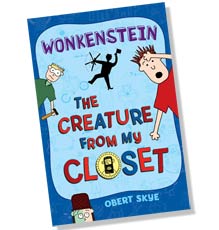
Book Revew: Wonkenstein: The Creature from my Closet, by Obert Skye (Henry Holt, 2011)

Recommended for ages 9-12

Rob is a 12-year old boy whose main use for books is to throw them into his closet. He has better things to do, after all, than read. Plus, Rob’s closet is just strange. It’s not because it’s got a second-hand door with a pony sticker on it that says, “Smile”. For starters, the doorknob is big, gold, and has a bearded man’s face engraved on it – and his expression seems to change. For another, the closet is where Wonkenstein – a creature that seems to be a mashup of Willy Wonka and Frankenstein – comes from one day, and now Rob’s closet will not open so he can send him back.

Rob tries to keep Wonkenstein a secret while trying to get him back to his world, but he ends up getting into more trouble, whether at home or school, the harder he tries. Poor Rob just wants life to go back to normal, but at the same time, he finds himself getting attached to the little guy.

Wonkenstein is a cute book for younger readers and older readers that may have drifted from reading and just need something fun and familiar to pull them back. The book has fun black and white illustrations that look like a child’s drawings and helps, along with the first-person voice of the book, add to the fantasy that Rob is narrating his own true story.

Obert Skye’s website has information about all of his books, plus author and tour information, and the publisher’s website has a book detail page with much of the same information, plus links to the book’s pages on social networking sites incluing Shelfari and LibraryThing.

Posted in Fantasy, Humor, Tween Reads

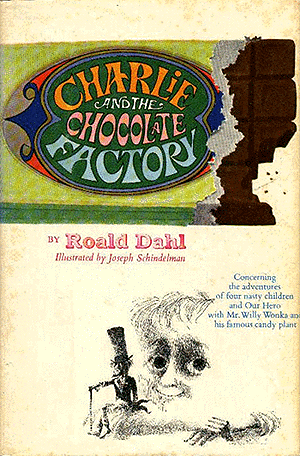
Book Review: Charlie and the Chocolate Factory, by Roald Dahl (Bantam, 1977)

Recommended for ages 8-12 (and ageless)

This was one of my favorite books growing up, and reading it again all these years later, I find that I love it as much now as I did when I was 8. Having spent the last few years watching multiple viewings of Willy Wonka and the Chocolate Factory (Gene Wilder is Willy Wonka), I ended up surprised on a few occasions when I realized that scenes from the movie – such as the Fizzy Lifting Drinks scene when Charlie and Grandpa have to belch their way down from certain doom – were not in the book after all! While the movie retained much of Roald Dahl’s dark comic humor, nothing beats the book, and Dahl’s wry observations on rude children and the parents who indulge them, and how the meek inherit… well, if not the earth, at least a lifetime’s supply of chocolate.

Charlie Bucket is starving – no, really, he is. He lives with his mother, father, and four sickly grandparents, who are so old and sick that they never get out of bed. Father has a menial job screwing the caps onto toothpaste tubes, and they family is very poor. They are so poor, all they can eat is cabbage soup, and Charlie refuses to take more than his share. Every day he walks past the famous chocolatier Willy Wonka’s chocolate factory and lifts his nose, inhaling the delicious smells; the only time he gets to enjoy a Wonka bar is on his birthday.

It all changes when Willy Wonka announces a contest where five winners will be allowed to tour the chocolate factory – and Charlie is holding one of the Golden Tickets. Grandpa Joe, his elderly grandfather who retains the joy and wonder of youth, jumps out of bed and insists that he go with him, and they’re off. Charlie meets the four other winners – the gluttonous Augustus Gloop, spoiled brat Veruca Salt, TV addict Mike Teavee, and boorish Violet Beauregarde – and their overly indulgent parents at the gates of the factory, and when Willy Wonka’s gates open for the first time in years, the fun really begins. Who will make it through the factory tour?

Dahl’s writing weaves words into pictures that are enhanced by Joseph Schindelman’s black and white illustrations. From Willy Wonka’s mysterious origins to the Oompa Loompa’s cautionary songs, this book is Mr. Dahl’s morality play. It’s a great reminder of the golden rules as children enter into the middle grades: be polite. Don’t be a bully. Share. Don’t be a glutton or have bad manners. Modesty and a humble demeanor reap their own rewards. Reading Dahl is like Emily Post for kids, but with chocolate rivers and candy flowers.

Roald Dahl is a well-known classic children’s author. There is an inactive wiki that appeared to be the start of a comprehensive body of work  with 106 articles; there is a call to revive it on the home page. There is also a wonderful Roald Dahl website that is animated and features links to the Roald Dahl store, museum, and his children’s charity. The site features a “book chooser” that will match kids with a “splendiferous read” of his, a biography on the author, and a “Wonkalator” – a calculator game that asks kids to help Wonka with his latest magical formula.

Posted in Fiction, Humor, Middle School, Tween Reads

Book Review: Dork Diaries: Tales from a Not-So Popular Party Girl by Rachel Renee Russell (Aladdin, 2010)

Recommended for ages 9-12

Dork Diaries: Tales from a Not-So-Popular Party Girl has been hailed as “Wimpy Kid for girls”, and I’m inclined to agree. The book is writtten in similar format – a middle-schooler’s journal – and is complete with illustrations and “OMG!” moments in a pre-teen’s life. Nikki, the protagonist, is not the slacker that Wimpy Kid Greg is, but is definitely not in the cool crowd. She and her friends Chloe and Zoey wish they could be in the CCP (Cute, Cool and Popular) crowd, but Nikki’s nemesis, Mackenzie – a spoiled, rich, mean girl – will do anything and everything to ruin Nikki’s life – including canceling the school Halloween dance just to make Nikki look bad. Nikki and her friends need to pull together to make it happen, and Nikki hopes to get the attention of her crush, Brandon Roberts. The only trouble is, Mackenzie has her sights set on Brandon, too.

The book is fun. Nikki is a vibrant narrator, who speaks fluent middle-school – girls will love her. She writes from a very female point of view, as opposed to the more gender-friendly Wimpy Kid, so I don’t know if boys will get on board with the series (especially as this book has a purple cover). The black and white drawings make you believe you are looking at a ‘tween girl’s diary, as do the script and handwriting fonts. All around, a fun book with a spunky heroine that girls will enjoy – and grown-up girls will laugh along with the more cringe-worthy memories of their own middle school years.

The Dork Diaries website features information on the Dork Diaries books and has a countdown clock for the next book’s release. There is a link to the music inspired by the book, and the Nikki has a blog where she recaps memories (from the books), links fan videos, and features fun contests and printables.

Posted in Humor, Science Fiction, Tween Reads

Book Review: Aliens Ate My Homework, by Bruce Coville (Aladdin, 1993)

     Recommended for ages 9-12

Sixth-grader Rod Albright, better known as Rod the Clod among his classmates, is a target for the two bullies at school and the go-to babysitter for his toddler twin brother and sister at home. One day, while working on a science project for school, a miniature alien spaceship crashes into his window, and Rod is commandeered into helping the alien crew in their search for BKR, an intergalactic criminal infamous for his cruelty – and who just happens to be hiding out in Rod’s neighborhood. Can Rod, who is incapable of lying, keep his alien visitors a secret and help them succeed in their mission while getting his science project done on time?

Told from Rod’s point of view, Aliens Ate My Homework is a fun read for kids ages 9-12. As the first book in a four-book series, Coville sets up the story line and introduces the reader to a full cast of characters: Rod, Thing One and Thing Two, the toddler twins, their mother, the crew of the Ferkel, and BKR, the intergalactic villian. The crew of the Ferkel is a diverse group of aliens, illustrating that diversity is welcome in all parts of the universe; Grakker, the Ferkel’s captain, is a borderline hostile military man, but the crew and Rod all learn how to work with him – and vice versa. BKR, the criminal wanted across the galaxy, is guilty of cruelty. Says Ferkel ambassadaor Madame Pong of BKR’s crimes,  “Millions have wept.” There are lessons to be learned within Coville’s bright narrative – different personalities and people and capable of working together; cruelty is wrong; and every being, no matter how powerful or how small, needs help.

Aliens Ate My Homework is the first in Bruce Coville’s 4-book series, Rod Albright’s Alien Adventures; the other books in the series are I Left My Sneakers in Dimension X; The Search for Snout; and Aliens Stole My Body. Coville’s website also offers printable door hangers and bookmarks, crossword puzzles, and information about all of Coville’s books.