Posted in Fantasy, Fiction, Post-apocalyptic/Dystopian, Science Fiction, Teen, Tween Reads, Young Adult/New Adult

Meritropolis: Question the System.

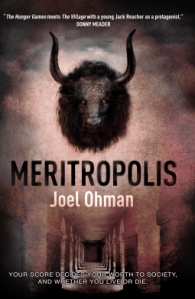
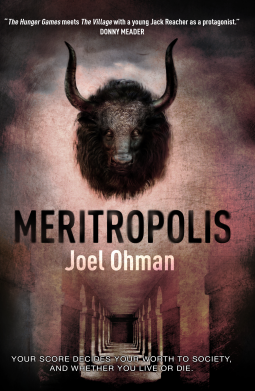
meritropolisMeritropolis, by Joel Ohman, (2014), $9.99, ISBN: 9781500189600

Recommended for 14+

In a post-apocalyptic society, the community known as Meritropolis thrives, thanks to the System. Citizens, from infants to the elderly, are evaluated, their numbers marked on their forearms. Anyone below a 50 is sent out of the city gates to fend for themselves.

Time is measured post-event (AE3 for 3 years after The Event), which is never named, merely known as “The Event”; we can assume it had something to do with nuclear war or nature collapse. Animal hybrids, created in pre-Event labs, hunt outside the gates. No one is heard from after being put outside the city’s walls.

Charley, a high-score 17 year-old, hates The System. It took his beloved older brother away from him, and he wants revenge on the System and the man responsible for it. Charley questions the System, the existence of a God who support this way of life, and free will. As he moves within Meritropolis society and gets closer to the people responsible for the System, he plots his revenge, joining forces with other residents. Together, they discover that what they know about the city and the System is only the surface of a very deep well of secrets.

This is an independently published book that makes me wonder why a major house hasn’t snapped it up yet. It’s a fast-paced read with a male protagonist who questions everything and has tremendous anger issues, but at the same time, works to contain his outbursts with common sense and planning. He’s got a plan, and he’s not allowing himself to be swept along, as many dystopian protagonists tend to in YA lit. Charley’s motivation is brutal and heartbreaking, but things he discovers as he works to undo the system from the inside are downright terrifying.

Outside the city walls, we find more craziness. The animal hybrids, and what they’re capable of, are the stuff of nightmares. There are illustrations at the beginning of each chapter – feast on the bion, imaginations! – that help you comprehend exactly what the citizen of Meritropolis are surrounded by, and being left to, once they’re outside city gates.

The book should appeal to both teen boys and girls. In Charley, boys have their Katniss – a male role model they can look up to and relate to, who understands anger, aggression, and most importantly, self-control. Girls will appreciate Charley’s back story and they’ll love Sandy, Charley’s counterpart. There are additional male and female characters, all relatable, that will give kids a reason to keep turning pages.

I’m interested in reading more about the world Joel Ohman has created here. Maybe we’ll get another story about a different post-Event society if enough people read this book. So what are you waiting for? It’s available as an ebook or a paperback, so you have no reason for not checking it out.

Posted in Science Fiction, Teen, Uncategorized, Young Adult/New Adult

Caragh M. O’Brien’s The Vault of Dreamers is an unsettling YA thriller

cover46937-mediumThe Vault of Dreamers, by Caragh M. O’Brien, (Roaring Brook Press, Sept. 2014). $17.99, ISBN: 9781596439382

Recommended for ages 14+

In a not-too distant future, environmental upheaval and economic collapse have left many Americans in poverty. For creative teens who want a way out, the Forge School is the answer. A school for the most creative minds, and a reality show all at once, The Forge School/The Forge Show accepts students and keeps 50 out of 100 based on their “blip rate” – how many viewers watch their feed. After making it past the first cut, students’ popularity allows them banner ad income that they can receive, upon graduation, along with opportunities for success. Rosie Sinclair, aspiring filmmaker, is a student at the Forge School, and has discovered that the school has some big secrets. What is going on while the students sleep?

Vault of Dreamers is one of those books that takes a few chapters to build as O’Brien builds a solid story. We learn about Rosie’s background and the backgrounds of other students; we see family dynamics come into play, and we understand the motivation for many of these students to take part in a reality show that not only films you everywhere but the bathroom and shower, but a school that distributes sleeping pills to the student body on a nightly basis to assure that they will have a full 12 hours of sleep for maximum creativity. By the time the story kicks into high gear, we see what Rosie risks in order to learn Forge’s secrets: she’s putting her future and the future of her family on the line.

By the time we understand all of this, the story goes white-knuckle, non-stop. Is Rosie an unreliable narrator? Who can we trust? The reader is just as thrown off as Rosie is, and the need to know what was going on consumed me. The reality show setting will click with teens who have grown up with reality TV and popularity based on “likes” and approval ratings.

The ending nicely sets up a sequel, and even as a standalone work, offers a conclusion that will fuel some great discussions. You may howl in frustration, but you’ll be waiting for the next installment of this series.

The Vault of Dreamers will be published on September 16, but you can pre-order it from Amazon now.

Posted in Graphic Novels, Horror, Science Fiction, Young Adult/New Adult

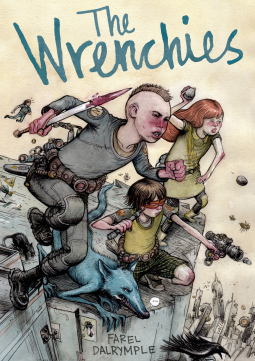
The Wrenchies – adolescence is terrifying.

wrenchiesThe Wrenchies, by Farel Dalrymple (:01 First Second, Sept. 2014). $19.99, ISBN: 9781596434219

Recommended for ages 14+

In a dystopian future, adolescence is terrifying. Only the kids are safe – adults live in fear of the Shadowsmen, a group of mindless monsters who hunt down teenagers and attack them with horrifying, tentacular fingers that penetrate their minds and leave them changed – walking nightmares. The Wrenchies, a gang of kids who band together against the Shadowmen, meet Hollis, a sad, lonely boy who has a charm of sorts that allows him access to the Wrenchies’ world, a parallel universe from his. The story also includes a subplot with a man named Sherwood, who is somehow tied to both of these universes and to the Shadowmen.

I didn’t love the Wrenchies – more often than not, I was lost as to what was going on. It took me a good part of the book to realize that there was a parallel universe, and I never really felt that I “got” the entire story. I just didn’t connect with it, nor did I connect with Dalrymple’s style of art. This would be a great read for a teen/YA post-apocalyptic fan who prefers a less linear storyline. There’s violence and language aplenty, which may give some parents pause – it wasn’t an issue for me, but my younger ones don’t usually seek these types of books out.


Posted in Post-apocalyptic/Dystopian, Science Fiction, Teen

Ann Brashares The Here and Now gives us time travel and dystopia.

cover35542-mediumThere Here and Now, by Ann Brashares. Random House Children’s (2014), $18.99, ISBN: 9780385736800

Recommended for ages 14+

Ann Brashares, author of the Sisterhood of the Traveling Pants series, gives us a well-constructed story with dypstopian elements, time travel, and a race through the past, present and future to stop a terrifying future.

Prenna is a 17 year-old Traveler – she, her mother, and a group of her people came to our present time to escape a future where a blood plague ravaged the population. The Travelers live under a restrictive list of rules that appear to exist more for their power-hungry leaders rather than the actual good of the people (or the Natives – people in the right timeline – that the rules are supposed to protect). When Prenna finds herself growing closer to her friend Ethan, she starts questioning not only the rules, but the entire structure their society was built on – and she and Ethan find themselves drawn into a race against time to put a stop to the dismal future from which Prenna came, all the while pursued by the leaders who want to silence Prenna, possibly for good.

The Here and Now has elements of The Giver – the post-apocalyptic society governed by rules really spoke to me – and is one of those books that I couldn’t put down. I needed to know what was going to happen next; Ms. Brashares constructed a compelling narrative with enough mystery to keep me going for that famous “one page more”. Within the overall story structure, there are mini-mysteries that the two teens have to unravel to get the next piece of the puzzle; add to that the internal conflict Prenna feels at duty to her family and the love she and Ethan feel for one another, and you have a great read for teens that can spawn interesting conversations about the implications of time travel: what would happen if you went back in time and changed things, even if they were for the better? What kind of society would develop if a blood-borne plague spiraled out of control? More than a teen romance, The Here and Now offers the opportunity to draw teens into complex conversations about the world around them.

Posted in Post-apocalyptic/Dystopian, Science Fiction, Tween Reads

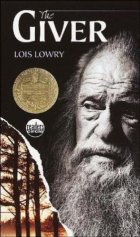
Book Review: The Giver, by Lois Lowry (Houghton Mifflin, 1993)

Recommended for ages 11-14

In the dystopian future, there is no more war, disease, or poverty. There are no choices, either – in 12-year old Jonas’s community, spouses are assigned to one another, children are assigned to families, and children’s milestones are pre-selected and celebrated once a year. At age seven, they receive jackets that button in the front. At the age of nine, they receive bicycles. At the age of 12, they attend the Ceremony of Twelve, where they are assigned their careers. Jonas, who has been experiencing feelings that has made him feel different from his peers, is assigned to be the Receiver of Memory – the sole repository for the collective memories of the community. He begins to work with the outgoing Receiver, now called The Giver, to receive the memories and learns disturbing truths through both the memories and the truths he begins to see in his daily life in the village.

The Giver is one of those books that sticks with you, changing the way you think about things. What price is a group willing to pay to live in a perfect, ordered society? Jonas, in receiving memories, plays the part of Adam in the Garden of Eden – he receives knowledge, and with knowledge comes confusion. Is his community right because they don’t know better? He begins to question everything around him and everything he’s ever known; when he sees his father commit an act in the course of his daily work that he finds unspeakable, the last vestiges of what he believes in are thrown into chaos.
 
The Giver is one of the most challenged books books in middle schools across America, usually for its portrayal of euthanasia (but also for what has been considered a sexual reference). Regardless of its challenges, it remains a popular and important middle-school book that speaks to the power of free will and choice. There are many lesson plans for this book on the Web, including this comprehensive one from the Mountain City Elementary School District in Tennessee. The book won the 1994 Newbery Medal and the 1996 William Allen White Children’s Book Award and has been designated an American Library Association (ALA) Best Book for Young Adults and an ALA Notable Children’s Book. The Giver is the first in a 3-book series that includes Gathering Blue and Messenger.
 
Lois Lowry is an award-winning YA author; she has received numerous awards, including two Newbery medals (for The Giver and Number the Stars). Her website lists all of the awards she’s won in addition to offering book information, a biography, her blog, her photos, and copies of her speeches.
Posted in Post-apocalyptic/Dystopian, Science Fiction, Tween Reads

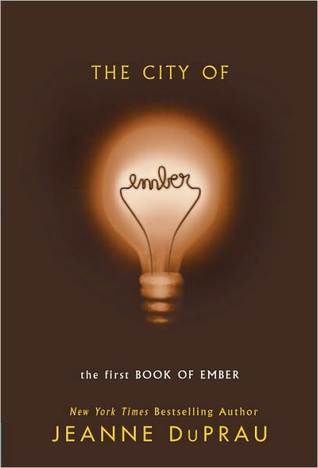
Book Review: The City of Ember, by Jeanne DuPrau (Yearling, 2004)

Recommended for ages 9-12
A post-apocalyptic novel, The City of Ember begins with The Builders, who created an underground city that would save humankind from an assumed environmental catastrophe. The city was to last for 220 years, at which time they hoped it would be okay to return to the surface. They created Instructions to leave Ember, which they gave to the Mayor, to be passed down to every Mayor until it was time; the box containing the Instructions would then open.

The box was lost after the seventh Mayor tried to force the box open.

In the year 241, the City of Ember is failing. They are running out of food and supplies and there are rolling blackouts that last for longer stretches each time. There are whispers that the generator is failing. Because the population of Ember does not know their above-ground origins, they do not know that there is another choice. Lina and Doon, two 12-year old residents of Ember, learn about some of Ember’s secrets, like the stores of food available to those who know the “right people”. Lina also happens upon a document long hidden in her grandmother’s closet; torn into shreds by her baby sister, she tries to unravel the mystery and thinks she has happened upon a way to leave Ember. Will anyone other than Doon believe her, or will the Mayor and the police try to keep them quiet?

The book tells an intelligent story with fairly well-drawn characters. Ms. DuPrau does not speak down to her audience, but I do wish she had fleshed out the characters a bit more; the Mayor, for instance, is the typical bloated, corrupt politician; Lina’s grandmother’s memory is slipping away, but she remembers that there is something lost that she must find before she dies; the police are one-dimensional, just-following-orders good/bad guys. The overall story, however, is solid and compelling – what happens to a society if their lights go out for good?

The City of Ember is the first in the Books of Ember series and was made into a movie in 2008. Designated as an American Library Association (ALA) Notable book, the book has received Kirkus Editors Choice status and was awarded the 2006 Mark Twain Readers Award. The author’s website offers information on all of Ms. DuPrau’s books, a biography, and an FAQ. The site also offers the chance for visitors to solve a puzzle similar to the document in City of Ember.

Posted in Fantasy, Post-apocalyptic/Dystopian, Science Fiction, Tween Reads

Book Review: A Boy and His Bot, by Daniel H.Wilson (Bloomsbury, 2011)

Recommended for ages 9-12

On a class trip to a Mek Mound, an ancient Oklahoman Indian land mound reminiscent of the Egyptian pyramids, sixth grader Code Lightfall discovers Mekhos, a manufactured, experimental world inhabited by robots and long forgotten by humans. The world is under the grip of the evil tyrant Immortalis, bent on the world’s destruction; it falls to Code and Gary, an atomic slaughterbot brought to life by Code’s imagination and Mekhos technology, to find the Robonomicon and save the day.

A Boy and His Bot is a journey to Oz tale for a more modern age, complete with beautiful and deadly surroundings like the Toparian Wyldes, the beautiful forest maintained by a race of robots who trim and sculpt anything in their way, their upkeep programming overriding any other directive. Where Oz has a benevolent wizard, Boy  has Immortalis, the evil overlord who pushes all robots to the day of The Great Disassembly, when all of Mekhos will be undone. Code’s main objective, beyond stopping The Great Disassembly from taking place, is to get back home.

I have noticed that heroes in “boy books” often come from dysfunctional families, and Code is no exception. A shy boy, picked on by some classmates, ignored by others, Code is grieving the disappearance of his grandfather John a year prior. His parents are not in the picture. The only positive female force in the book is Peep, the little robotic probe that befriends him and leads him to the world of Mekhos. Gary the Slaughterbot plays the part of the all brawn, no brains protector with the heart of gold.

I wonder why it is that young male characters’ families are so flawed in YA literature. Is this an accurate reflection of the state of families today, or is this the newest hook to keep young boys reading? Is it a way to reach out to young boys that may be in crisis and refuse to speak?  The combination of robotic creatures, a manmade world on the brink of destruction, and an invention like the slaughterbot alone is enough to grab a boy’s attention on the surface, but Code’s background gives him a depth that should help boys and girls alike be interested enough in his journey to travel along with him.
Daniel H. Wilson, Ph.D. is the author of How to Survive a Robot Uprising, Where’s My Jetpack, and How to Build a Robot Army. A Boy and His Bot is his first YA novel, but he has also written Bro-Jitsu: The Martial Art of Sibling Smackdown, and his Robot books are popular with older tweens and teens. He maintains an author website.
Posted in Middle School, Post-apocalyptic/Dystopian, Science Fiction, Tween Reads

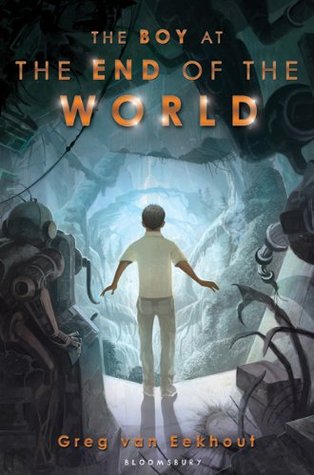
Book Review: The Boy at the End of the World, by Greg Van Eekhout (Bloomsbury Children’s Books, 2011)

Recommended for ages 9-12

A preteen boy (we are led to guess), wakes up in a pod in a devastated shelter. Destruction lies all around him; he sees being similar to himself lying dead in pods similar to his. The only other functional being is a robot, who calls out to him. The boy runs, but the robot catches up to him and reveals the boy’s name, Fisher, to him. Fisher learns that he is the only survivor of the human race.

It’s the usual post-apocalyptic story: Humans ruined the earth and nature took back her planet. Humans genetically engineered animals and more humans, putting them in gel-filled pods, with robots to oversee their care, until the time when conditions allowed for them to awake and rebuild society. The humans were individually programmed with specific survival skills to help create communities. Fisher is programmed to be a fisherman. Click, the name he gives his robot companion, tells Fisher that he has been tasked with helping Fisher “continue existing”, and the two set off to search for more humans in another Ark – the facilities were humans and animals were engineered and kept in hibernation.

Born a blank slate, Fisher learns and adapts through the story’s progression, developing not only intelligence outside of his initial programming but emotional depth. The characters they meet are not cute and cuddly woodland creatures: they’re often chilling. There are groundhogs who blame humanity for the planet’s destruction and hold a grudge; there is a robot who takes his task of preserving the human race  permanently – these characters bring a new dimension to the story of a boy and his robot. This is a survivalist tale.

It is difficult to write a postapocalyptic tale without sounding like hundreds of similar books on the market, and the “humans and technology bad, nature good” call to action beats the reader over the head throughout the book. Humans bring the planet to the brink of environmental collapse, so they leave the rest of the planet to deal with it while they go into hiding until the coast is clear. The technology that humans created to save them ultimately turns on them and brings the race to the point of near-extinction, further painting us as hapless ne’er do wells.

That said, the YA market in post-apocalyptic fiction isn’t as saturated as the adult market is yet, so perhaps a younger audience will read this story through different eyes. That said, this is a generation that has been fed this storyline since they were babies: think of Happy Feet, a movie that deceptively sold us a cute story about a penguin who didn’t fit in, and gave us a Greenpeace horror movie halfway through the picture. Think of Wall-E, where we were drowning our society in junk, so we had to go into space to get away from it.

I don’t want it to sound like I didn’t like this book, because I did. I think older middle grade readers, starting with 10-11 year olds, will see Fisher as a hero they can identify with as a young boy who needs to learn to survive, and whose robot companion acts as a friend and parent. Kids can also relate to the marriage of technology and environmental awareness contained in the book’s message.

Greg Van Eekhout knows how to write for kids – he has a Masters in Education and spent ten years developing online curricula for K-12 and college students. He is kid- and teacher-accessible, offering teachers tips on having author events at schools (and libraries), and providing his e-mail address to be contacted about school visits. He offers two presentations that he follows in his appearances. His website is geared toward grownups who are interested in reading his reviews, about his books, and where he’ll be next.