Posted in Adventure, Espionage, Fiction, Middle Grade, Tween Reads

New NatGeo Explorer Academy: The Falcon’s Feather

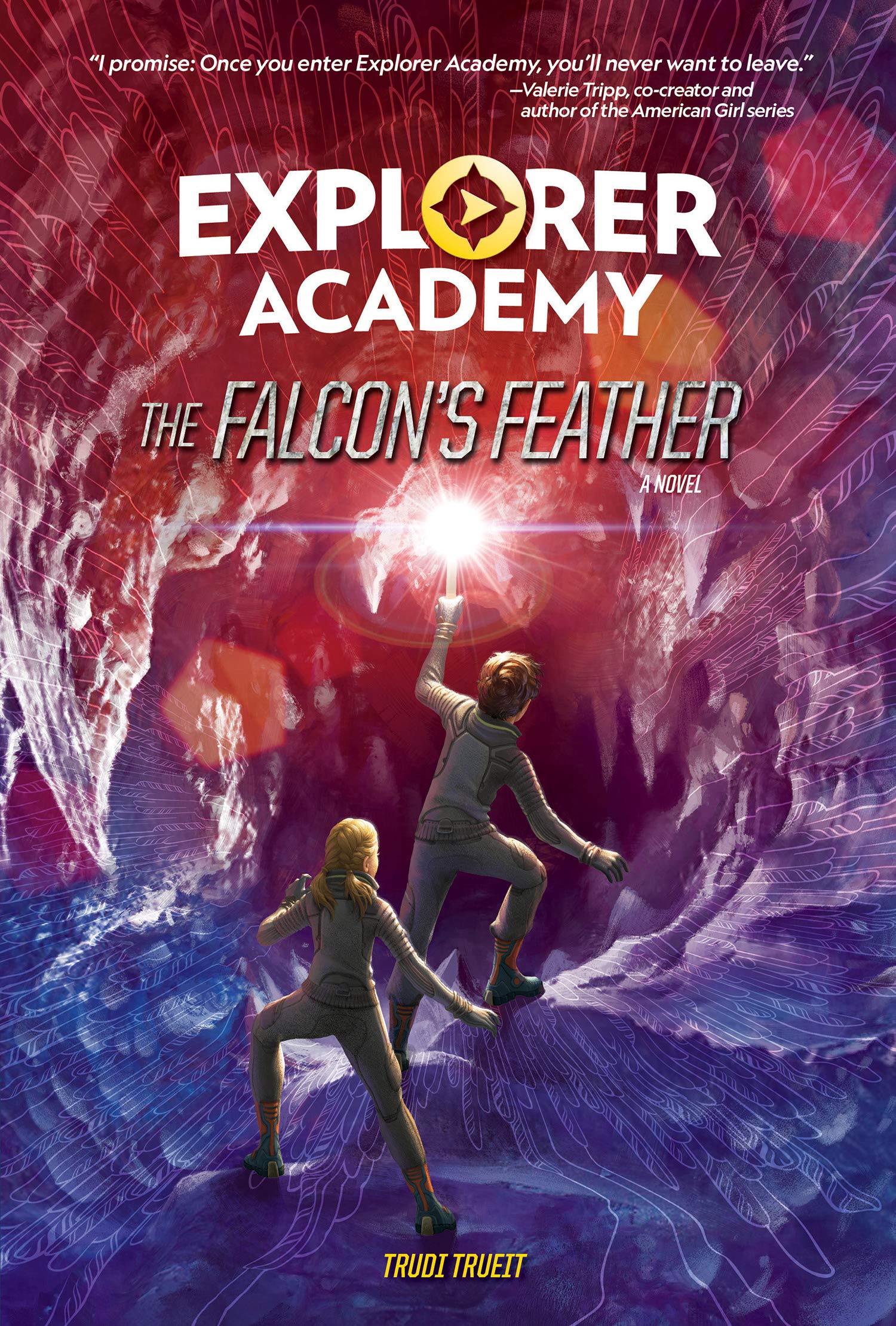
Explorer Academy: The Falcon’s Feather, by Trudi Treueit/Illustrated by Scott Plumbe (interior) and Antonio Javier Caparo (cover), (March 2019, National Geographic), $16.99, ISBN: 9781426333040

Ages 9-13

The second Explorer Academy adventure picks up shortly after the first adventure, The Nebula Secret, concludes, and the action kicks in pretty quickly. Cruz Coronado is back, and he’s on a mission to get the remaining ciphers that his mother hid around the world before her untimely death. His best friends, Emmett and Sailor, are right in the thick of it with him, and his Aunt Marisol is, too. The evil Nebula group is still trying to get Cruz out of the way, and now, there’s something new afoot; something only hinted at: they want Cruz done away with before his 13th birthday. Could it be something to do with that unusual DNA-shaped birthmark on his arm? We’ll have to keep reading to find out, because that’s all you’re going to get here.

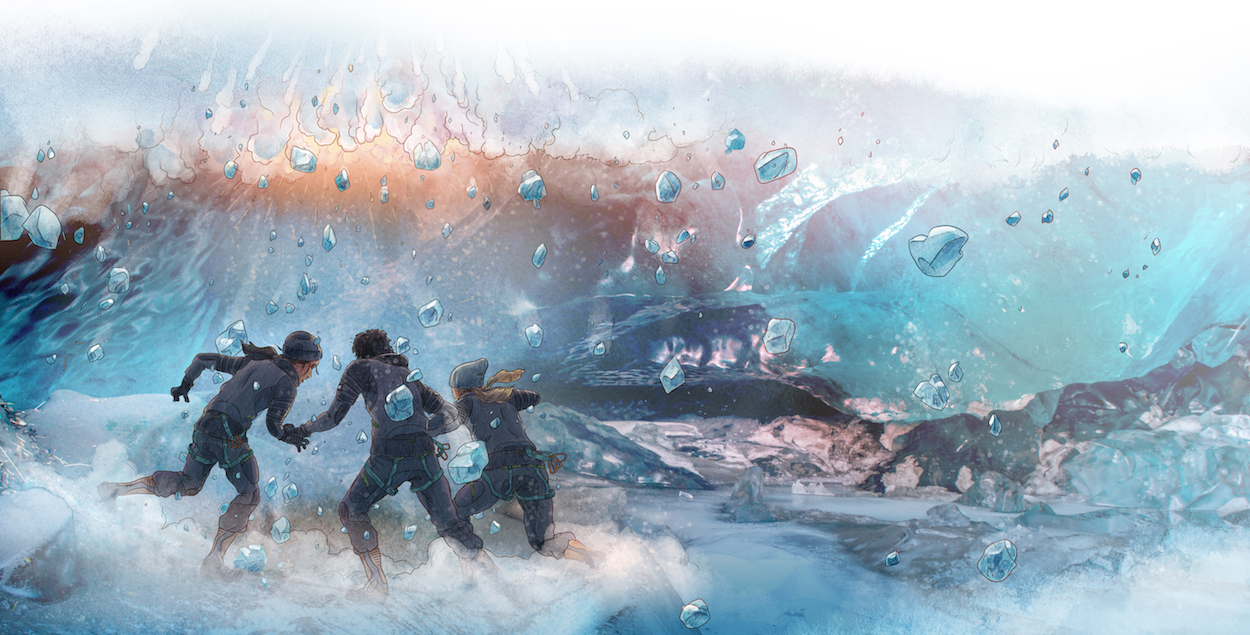
In addition to the globe-hopping mystery, The Falcon’s Feather also talks conservation and preservation; this time, Cruz and his friends save a pod of whales entangled in nets, and, while visiting the Svalbard Global Seed Vault in Norway, have a discussion about biodiversity. NatGeo is committed to educating readers about world issues, and this is a great way to do it: put kids in the middle of an adventure and let them experience it! There are all sorts of new gadgets and gizmos in this volume, and Mell, our favorite robot bee, is back. One scientist creates a communication device that allows Cruz to communicate with the endangered whales, and it’s an outstanding moment in the book; Cruz’s world opens up when he not only hears the whales’ songs, but connects them to human understanding. This installment ends on a tense note, assuring that readers (like me!) will be waiting for the next book. The Truth Behind the Fiction section introduces us to the real-life scientists who inspire some of the book’s characters, including a deep-sea submersible pilot, an explorer studying ecosystems and biodiversity, and a geoscientist researching climate change. Color illustrations throughout the book are just gorgeous and will keep readers turning pages. Maps at the beginning of some chapters help place readers when the characters find themselves in a new location.

This series is a no-brainer. Get it on your shelves for your burgeoning explorers/conservationists/secret agents, or just readers who love a good, tight suspense read.


Posted in Intermediate, Non-Fiction

Explore our natural world with Wilderness: Earth’s Amazing Habitats

Wilderness: Earth’s Amazing Habitats, by Mia Cassany/Illustrated by Marcos Navarro, (Apr. 2019, Prestel Publishing), $19.95, ISBN: 9783791373720

Ages 6-12

There are incredible wildernesses all over the world. Wilderness: Earth’s Amazing Habitats is an introduction to 16 rare plant and animal habitats across the world, from the Amazon Rainforest in South America to the Tropical Rainforest of New Guinea. It’s also a call to action, reminding readers that these wildernesses require protection to keep them safe; Mia Cassany cites deforestation and human intervention as having a disastrous impact on the habitats and the species that live within. So let’s take a look at, as author Mia Cassany says, “the most stunning nature show on earth”!

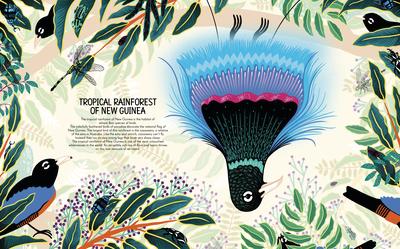
Beautifully illustrated endpapers bring you into the book with large, colorful tropical leaves – and eyes peeking out of the darkness – drawing you into the wildnerness from the beginning. An opening spread contains an author note on the importance of conservation and preservation, and a world map includes illustrated points where habitat is located. Two-page spreads feature stunning, full-bleed illustrations of every habitats; a brief description gives readers an idea of location and species inhabiting each spot, but it’s the art that’s front-and-center here. Bright, colorful, and lush, we see lowland gorillas peering out of the brush in Kahuzi-Biéga National Park in the Congo; a colorful, day-glo spread starring a panda, wild golden monkeys, and golden pheasants in China’s Qinling Mountains, and a stunning gecko camouflaged against leaves in the tropical rainforest in Madagascar. Back matter provides animal names, locates them on the page (they can be hard to spot!), and a brief, informative paragraph on each.

This is a beautiful coffee table book, and a nice addition to your natural history collections. It’s not a standalone book, but a gorgeous companion book to any unit on habitats and nature studies.


Posted in Intermediate, Non-Fiction, picture books

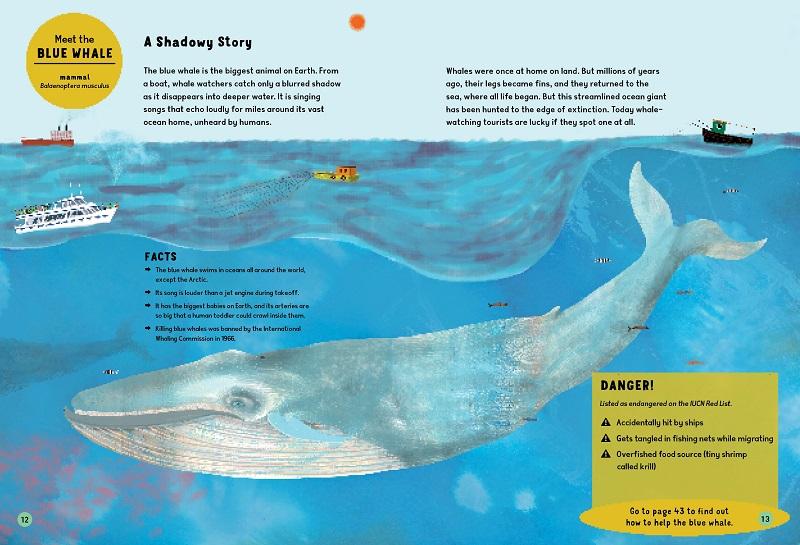
Jenni Desmond talks elephants in her latest nonfiction work

The Elephant, by Jenni Desmond, (Nov. 2018, Enchanted Lion Books), $18.95, ISBN: 9781592702640

Ages 5-8

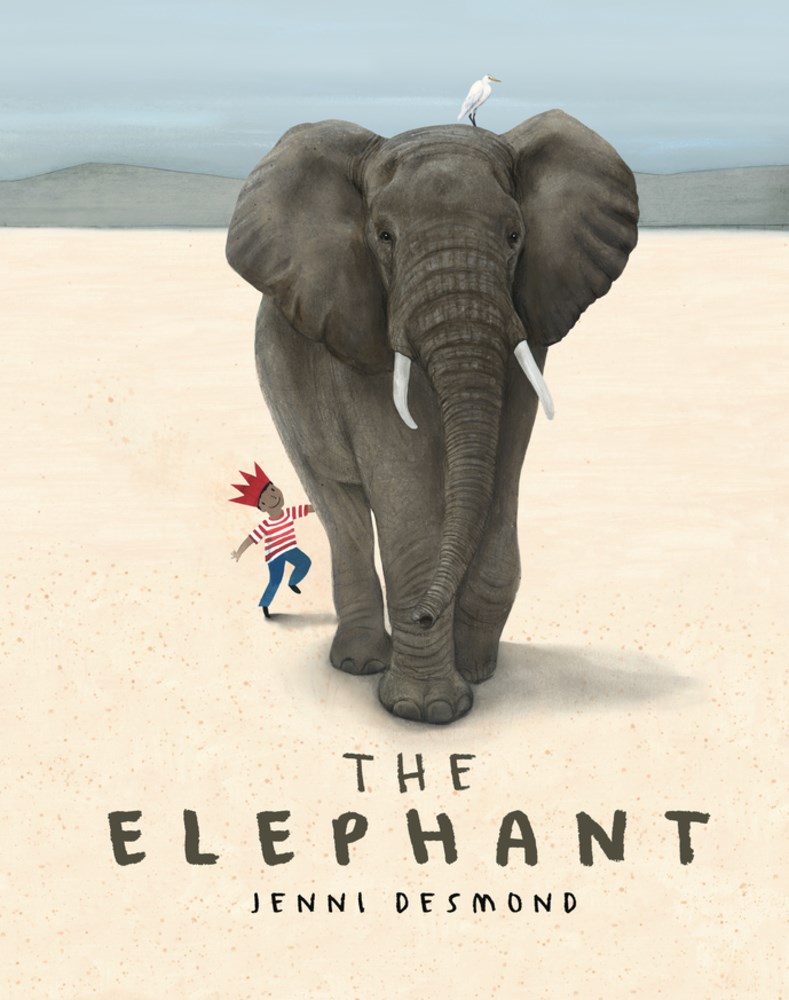
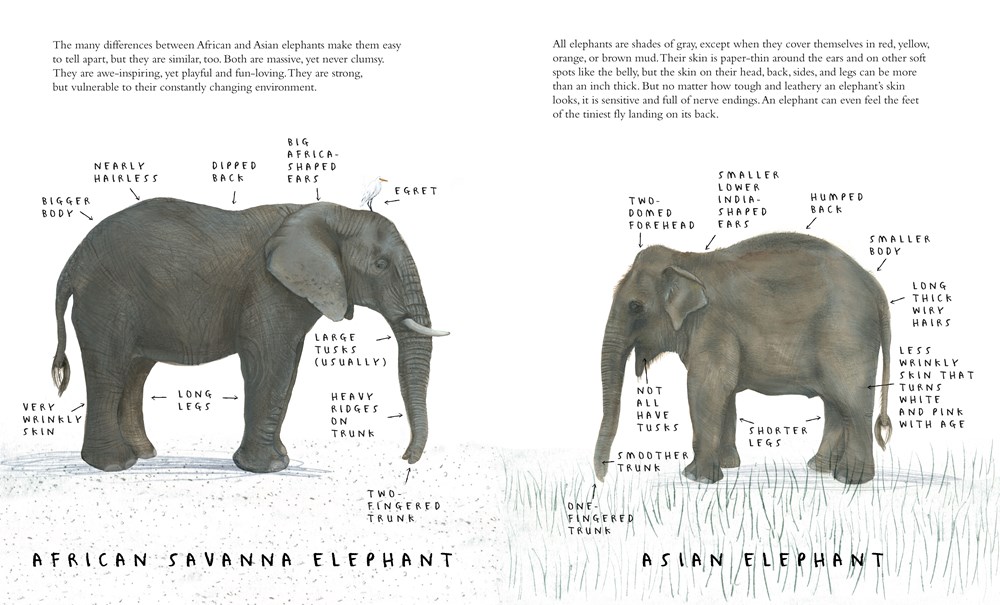
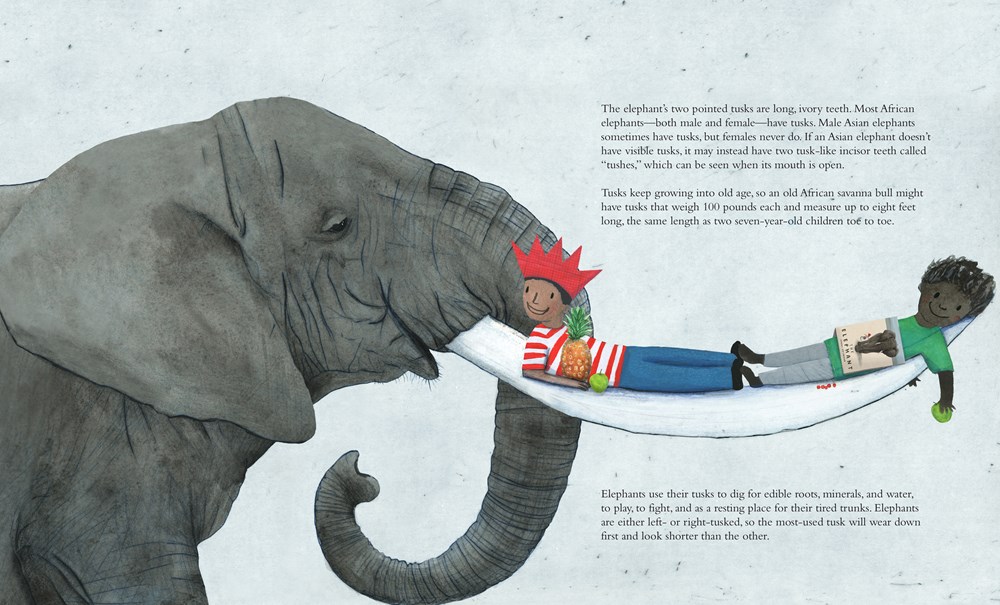
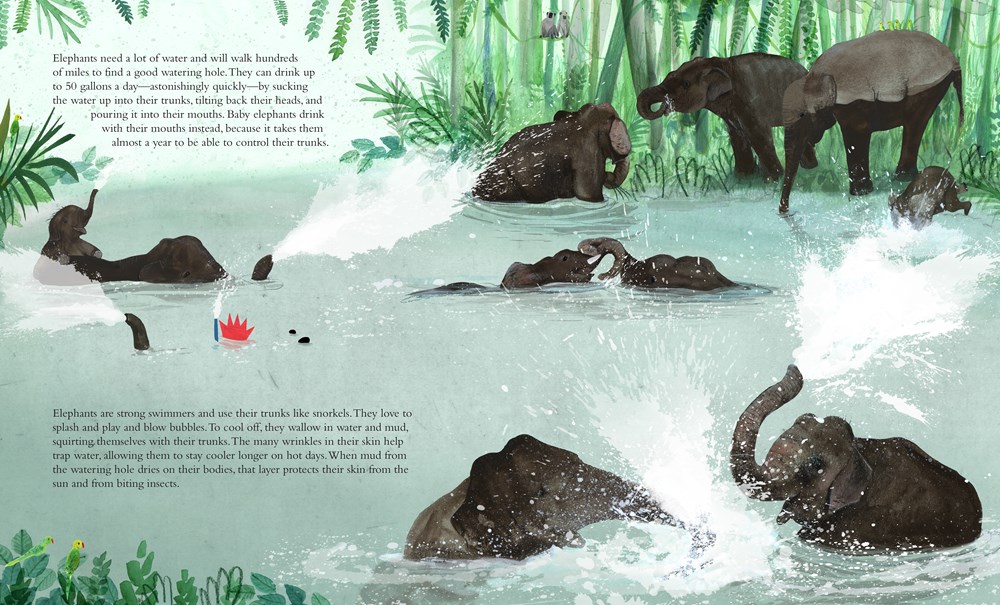
Jenni Desmond’s latest nonfiction book takes a look at one of our world’s largest animals: the elephant. Using a young boy’s exploration as a vehicle, we see him pick a book and be drawn into an elephant’s world through breathtaking, realistic color artwork. Informative facts throughout include the difference species and subspecies of elephants and the fact that they appear light on their feet because they mainly walk on tiptoe; they have sensitive skin and detect a fly landing on a leg or the rumbling of other elephants from as much as six miles away! Elephants can favor a tusk, much like humans have a preferred hand to write with. The author notes factors endangering elephants, including poachers who seek elephants’ ivory tusks.

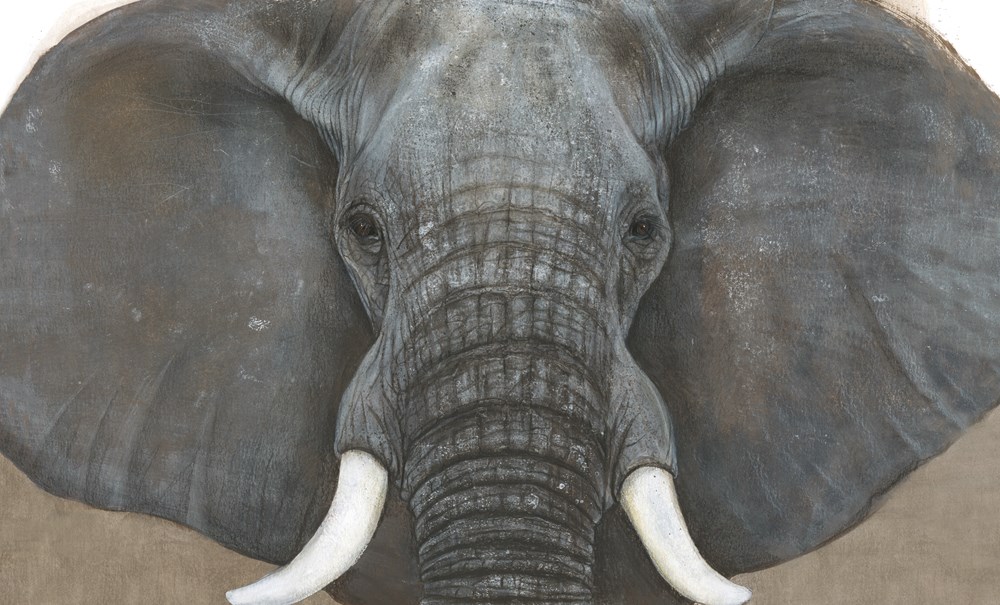
The collage, paint, and colored pencil artwork is stunning, rendering detailed, realistic elephants on every page, while keeping readers aware that this is a child’s journey; the boy shows up, cartoon-like, in spreads, sporting a red crown and, sometimes, a friend.

This superb volume is a wonderful way to connect reading, imagination, and nonfiction – nonfiction is great for dreamers, too, after all! Jenni Desmond received the 2016 New York Times Best Illustrated award for The Polar Bear. This is her third book on endangered animals, joining The Polar Bear and The Blue Whale (2015). The Elephant has starred reviews from Publisher’s Weekly, Kirkus, and Booklist, and is a Publisher’s Weekly Best Book of 2018. Add this one to your wildlife nonfiction collections.

Posted in Intermediate, Non-Fiction, picture books, Preschool Reads

How islands raised an activist: Galápagos Girl/Galapagueña, by Marsha Diane Arnold

Galápagos Girl/Galapagueña, by Marsha Diane Arnold/Illustrated by Angela Domínguez, translated by Adriana Dominguez, (Sept. 2018, Lee & Low Books), $18.95, ISBN: 9780892394135

Ages 4-8

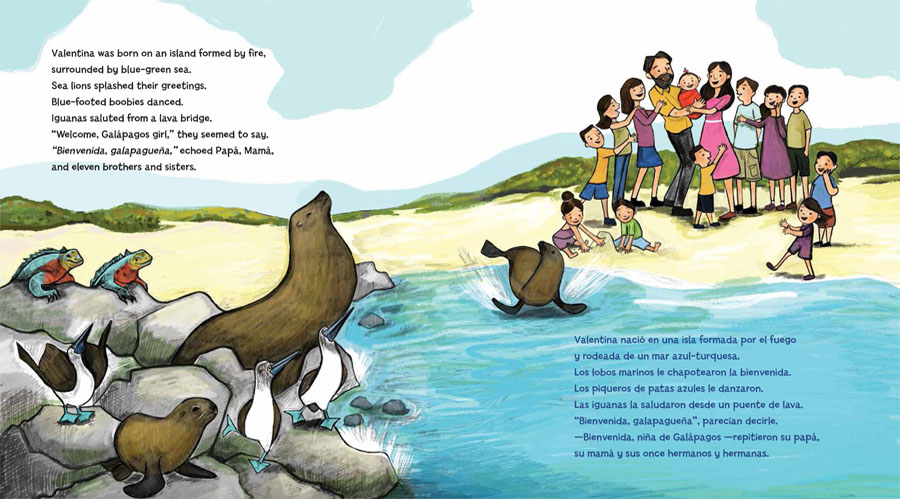
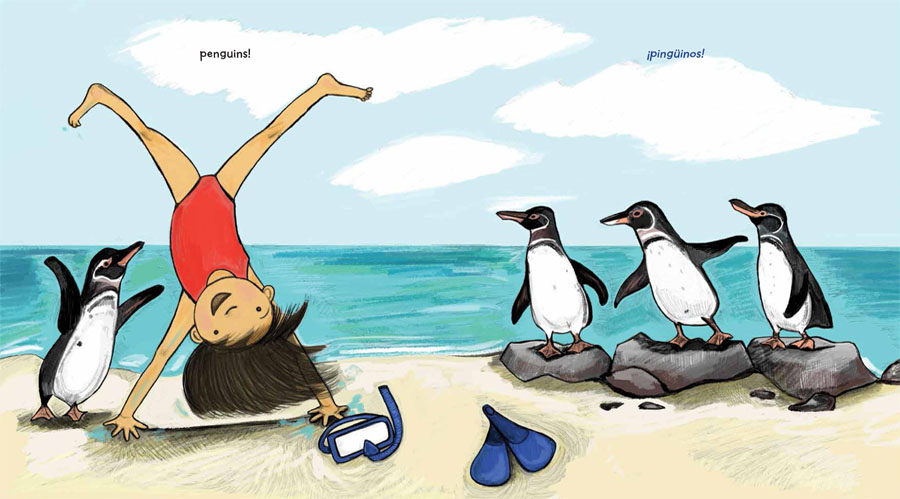
This bilingual English/Spanish story is based on the life of Galápagos Islands conservationist Valentina Cruz. Raised on the island, Valentina grew up surrounded by beauty: the blue-green sea, the playful penguins and sea lions, the sounds of the waves crashing against the rocks, and her father’s two tortoises, Carlitos and Isabela. Valentina goes away to school, but promises the animals and her islands that “I will not forget you… And I will help to keep you safe.” It’s a promise she keeps, returning to the islands on school holidays, camping out on remote islands to live and learn among the different flora and fauna, eventually becoming a biologist who returns to the islands to teach visitors to love her home as she does, and about the importance of preservation and conservation.

Author Marsha Diane Arnold met Valentina on a 2007 trip to the Galápagos and was inspired to write Galápagos Girl in the hope that readers would learn, as Valentina did, to help keep nature safe. Under threat from invasive species, active tourism, and encroaching humans, plant and animal life on the Galápagos is increasingly vulnerable. With bright, tropical colors and bold illustration, Pura Belpré Honoree Angela Dominguez transports readers to the magical islands; she communicates the feeling that we’re seeing something truly special as Valentina moves among unique plants and animals that aren’t found anywhere else on Earth. We’re given a special, secret pass to paradise as we turn each page of Galápagos Girl, and reading it with an unabashed sense of wonder will inspire that spark in a storytime group. An author’s note and a note about the Islands explains Marsha Diane Arnold’s first meeting with Valentina and provides background on the Islands. Five pages of information about the animals introduced in the story adds nice background information to the story, as does a solid bibliography. The bilingual text makes it accessible to Spanish and English-speaking readers.

The storytelling gives readers a glimpse at Valentina’s passion for conservation and illustrates how growing up with a respect for nature creates a better world for everyone. Galápagos Girl is a worthwhile add to storytime collections, bilingual collections, and natural history collections. There’s a free Animals of the Galápagos matchup download available at the Lee & Low website.

Marsha Diane Arnold is an award-winning picture-book author. Her past titles include the Smithsonian Notable Book The Pumpkin Runner and Lost. Found., which received three starred reviews. Marsha was inspired to write this story after traveling to the Galápagos Islands, where she met Valentina Cruz and had the opportunity to swim with sea lions and dolphins. She lives with her family in Alva, Florida. You can find her online at marshadianearnold.com.

Angela Domínguez is the author and illustrator of several books for children, including the Children’s Book Press title Let Me Help! / Quiero ayudar!Marta Big and Small, and Maria Had a Little Llama, which received the Pura Belpré Illustration Honor. In 2016, she received her second Pura Belpré Honor for her illustrations in Mango, Abuela, and Me by Meg Medina. When Angela is not in her studio, she teaches at the Academy of Art University, which honored her with their Distinguished Alumni Award. She lives in Virginia. Visit her online at angeladominguezstudio.com.

Posted in Intermediate, Middle Grade, Middle School, Non-Fiction, Non-fiction, Non-Fiction, Tween Reads

BIG Summer Nonfiction Reads Roundup!

From sharks, to space, to stories of survival in the wild, I’ve got books for all sorts of nonfiction tastes! Let’s start with the oogie stuff and go from there.

They Lost Their Heads! What Happened to Washington’s Teeth, Einstein’s Brain, and Other Famous Body Parts, by Carlyn Beccia, (Apr. 2018, Bloomsbury), $18.99, ISBN: 9780802737458

Recommended for readers 10+

If you have readers who loved Georgia Bragg and Kevin O’Malley’s books, How They Croaked: Awful Ends of the Awfully Famous, and How They Choked: Failures, Flops, and Flaws of the Awfully Famous, this is a home run! Learn what happened to the famous body parts of 17 famous folks, and pick up some knowledge about other body parts and how they influenced science medicine. If you’ve ever ever wanted to know what happened to Thomas Edison’s last breath or Van Gogh’s missing ear, this is the place to go. You also learn cool stuff like what rots first after you die (psst… it’s the intestines). Loaded with black and white drawings, funny footnotes, sources, an index, and a bibliography. This one’s a hit for upper elementary readers, all the way through high school. They Lost Their Heads! has a starred review from Booklist.

StarTalk with Neil DeGrasse Tyson (Young Readers Edition), by National Geographic, (March 2018, National Geographic), $17.99, ISBN: 9781426330872

Recommended for readers 10+

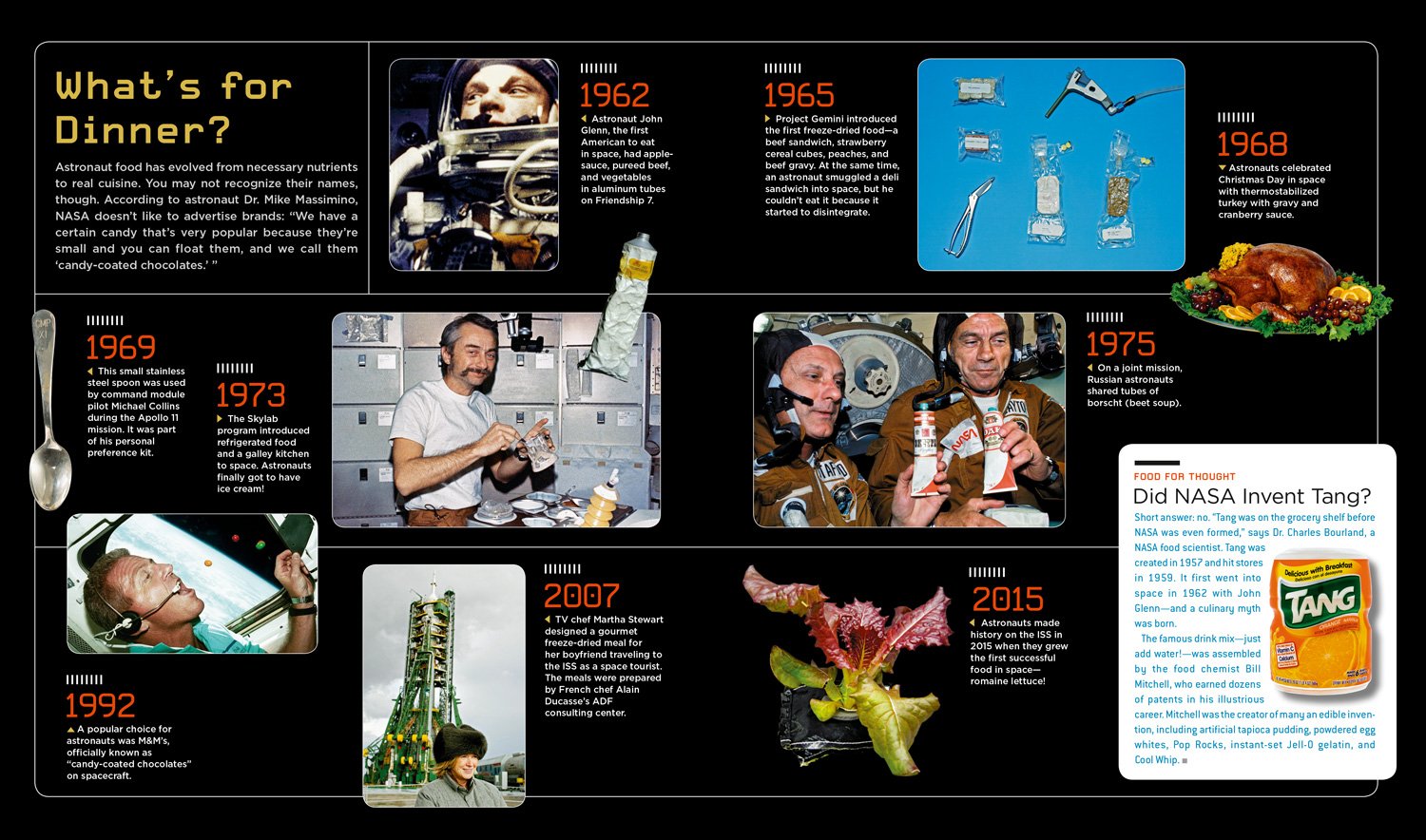
I LOVE Neil DeGrasse Tyson and evangelize his StarTalk Radio podcast any chance I get. (Seriously, it’s great stuff.) NatGeo’s Young Readers edition of the StarTalk book is must-booktalk summer reading. Get your Summer Reading budget and buy some astronaut ice cream; while you and the kids feast, read the section on why you can’t get a pulled pork sandwich in space; find out what the Vomit Comet is; and read mini-bios on scientists like Carl Sagan. Not so much with the food? There are also sections on zombies and superheroes. Debate the eternal question: Could the Death Star really blow up a planet? There’s so much to discover in this book that every kid is darn near guaranteed to find something to interest him or her. (Psst… get an extra copy for yourself. You’ll thank me.)


Survivors: Extraordinary tales from the Wild and Beyond, by David Long/Illustrated by Kerry Hyndman, (Sept. 2017, Faber & Faber), $19.95, ISBN: 9780571316014

Recommended for readers 9-13

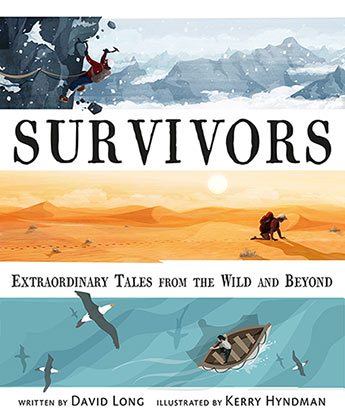
Do you know fans of Lauren Tarshis’ I Survived series? I’ve never been able to keep those books on the shelves, no matter which library I’ve been at. Middle graders go berserk for that series, and they’ll LOVE this oversized, illustrated anthology of true survival tales. There are 23 stories in here; the most famous being explorer Ernest Shackleton, who saved his crew when a 1914 Antarctic expedition put their lives in danger. There’s also the story of Hugh Glass, a “fur trapper and adventurer” who made the critical error of surprising a mother bear and her cubs by the Missouri River in 1823, or Mauro Prosperi, a runner competing in the 1994 Marathon of the Sands through the Sahara Desert, found himself in the middle of a sandstorm. Not crazy enough for your readers? There’s also a Hollywood pilot who crashed INSIDE a Hawaiian volcano in 1992. The stories are fast-paced, beautifully illustrated in color, and are perfect for adventure fans. Best part? All the stories are TRUE.


The Ultimate Book of Sharks, by Brian Skerry, Elizabeth Carney, & Sarah Wassner Flynn, (May 2018, National Geographic Kids), $19.99, ISBN: 9781426330711

Recommended for readers 7-13

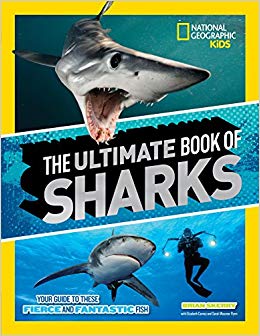
Kids love sharks. This is a fact. The Ultimate Book of Sharks has all the info and pictures your shark-loving fans crave, just in time for Shark Week, which kicks off on July 22 (get your printables and programs lined up – I’ll do a separate post about Shark Week as it gets closer). The NatGeo folks bust myths about sharks, give us a look at shark anatomy, and – as always – provide loads of information about conservation and preservation, and how we can all help keep sharks, and our waters, safe and clean. This volume is chock full of fast facts and lists, with Up-Close Encounters, where marine wildlife photojournalist and author Brian Skerry shares some of his stories with readers. There’s an index at the end. This volume is an absolute must-add to your science and nature collections.


Red Alert! Endangered Animals Around the World, by Catherin Barr/Illustrated by Anne Wilson, (July 2018, Charlesbridge), $17.99, ISBN: 9781580898393

Recommended for readers 7-11

This is such a fun book. Think of a Choose Your Own Adventure about endangered animals, and you’ve got Red Alert! Red Alert! profiles 15 animals on the International Union for Conservation of Nature’s (IUCN) list. A beginning note explains the organization’s “Red List”: a list of endangered plants, animals, and fungi, and lists some of the categories mentioned in the book. Colorful endpapers start the fun: the first, a map of the world, with the 15 profiled animals drawn into their world regions; final endpapers highlight a plethora of endangered animals. From here, readers can pick a place to explore: deserts, forests, mountains, grasslands, rivers, or oceans; pick a creature from each of these regions, and go to its page to read further. You can also read the book straight through. Spreads include the animals’ scientific names, facts, endangered category, and factors contributing to the endangerment of the species. A section at the end provides resources for more information on taking conservation action. A solid introduction to environmental action for younger readers.


National Geographic Kids Almanac (2019 Edition), (May 2018, National Geographic Kids), $14.99, ISBN: 9781426330131

Recommended for readers 8-13

Another guaranteed must-have from NatGeo Kids, this latest edition of their Kids Almanac shows readers a baby animal “tweet-off” between several zoos and aquariums (it’s from 2017, but who doesn’t want to revisit that simpler, lovelier time?), talks about updates in robotics and technology, dwarf planets, and has a Special Gross Edition of their Just Joking feature. Facts, quizzes, updated maps and stats, and homework help ideas all in one volume? This is one desk reference every kid should have – put one on your shelves, and keep one in your reference area, to be on the safe side.


How’s that for a start? Next time a kid comes in, stressed about needing a nonfiction book, consider yourself ready.

Posted in Adventure, Animal Fiction, Fantasy, Fiction, Middle Grade, Teen, Tween Reads

Paranormals address conservation in Earning My Spots

earning-spotsEarning My Spots, by Mark Eastburn, (Nov. 2016, Sky Pony Press), $15.99, ISBN: 9781510707788

Recommended for ages 10+

Sam isn’t having the easiest time in his rural Vermont school. He’s bullied, he’s not terribly popular, and he’s tired of eating roadkill for dinner. Before you call the authorities: he’s also a were-hyena. Looked upon as the scavengers of the animal world (that Lion King movie did his kind no favors, either), the werewolves at school are jerks that constantly gang up on him. The day a new kid, Manny, shows up and sets off Sam’s “shape-shifter sense”, he defends Manny from the wolves and discovers that Manny and his  mom are were-jaguars, and that she’s brought them to Vermont in search of a great hunter. That night, Sam’s family is attacked by were-harpies who take his family, sending Sam and Manny on a quest that will take them to Louisiana and South America, where Sam will meet more hyenas and learn about his true heritage, and discover a plot to overthrow the no-tails – that’s you and me, folks – that are destroying their planet and encroaching on their lands.

Earning My Spots is an interesting and unexpected take on human impact on wildlife and the environment. It’s a paranormal middle grade story that carries a deeper message; using shifter were-animals, we get the a side of the story we don’t usually hear, because shifters can speak for animals and humans alike.

There were ups and downs for me while reading this one. I really liked learning about the hyena heritage – the whole time spent in Louisiana was the highlight of the story for me. Other facets of the narrative, like Sam’s seeming obsession with his and other animals’ bite force (pressure behind their bite) and detailed descriptions of marking his territory, dragged down the flow of the story for me.

If you’ve got paranormal fiction readers, this may draw them in and give them an awareness of environmental conservation. For me, it’s an additional purchase for when my current paranormal collection needs refreshing.


Posted in Early Reader, Fiction, Fiction, Intermediate

A boy and his friend must act fast to save The Last Tree

last-treeThe Last Tree, by Ingrid Chabbert/Illustrated by Guridi, (April 2017, Kids Can Press), $17.95, ISBN: 9781771387286

Recommended for ages 4-7

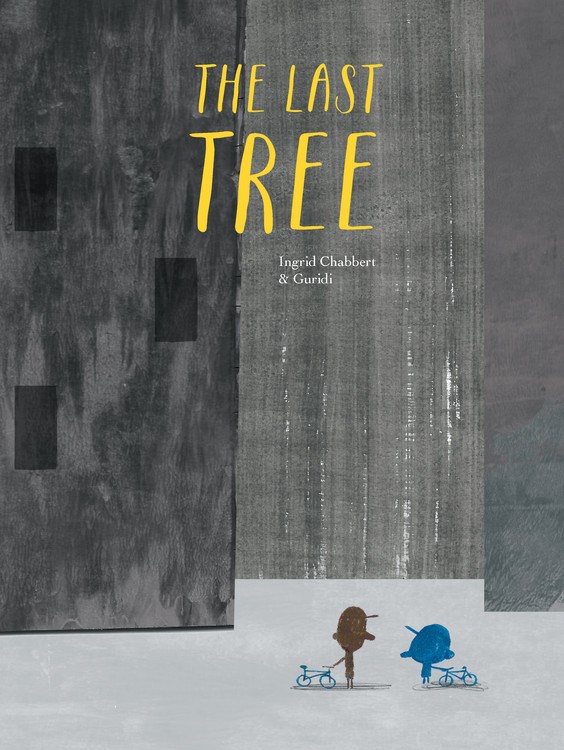
A boy listens to his father describe running and playing in the grass as a child, but has only a concrete playing area with a diminishing patch of grass available to him. One day, the boy and his friend discover a baby tree – a sapling, really – hidden behind a wall and are amazed: it’s the first tree they’ve ever seen up close. The boy goes home and discovers, to his horror, that a luxury condo complex is scheduled to begin construction right in the very spot where the tree is growing, and the boys spring into action to save the last tree.

This is a powerful look at how lack of green spaces affects children. Ingrid Chabbert’s narrator is an adult, looking back on his childhood, and how important saving that tree was to him and his friend. It sends a message about the importance of conservation and preservation today, and offers some hope for tomorrow. Artist Guridi communicates this message using charcoal, gravure ink, gouache, pencil, and digital art to create a spark of hope in the grey, bleak future that faces us as we see more green spaces disappear under development.

A strong addition to collections for Earth Day, conservation units, and to empower kids who may not understand that they can have a long-lasting impact on the world with the smallest and kindest of acts. The Last Tree invites a discussion on empathy by examining the boys’ actions and asking children to contribute by sharing a time when they took action to help someone or something that needed it.


Posted in Intermediate, Middle Grade, Non-Fiction, Non-fiction, Non-Fiction, Tween Reads

Holiday Shopping: Nature

First tech, now nature. This latest round of holiday gift ideas looks at science and nature books. These are perfect for the kid who loves to be outdoors and wants to know more about our world and the animals he or she shares it with.

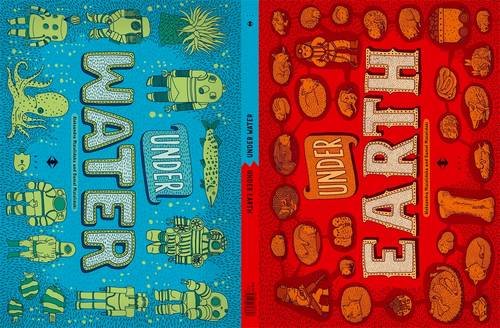
underwater_2Under Earth, Under Water, by Aleksandra Mizielinska and Daniel Mizielinski, (Oct. 2016, Candlewick Press), $35.00, ISBN: 978-0-7636-8922-3

Recommended for ages 7-12

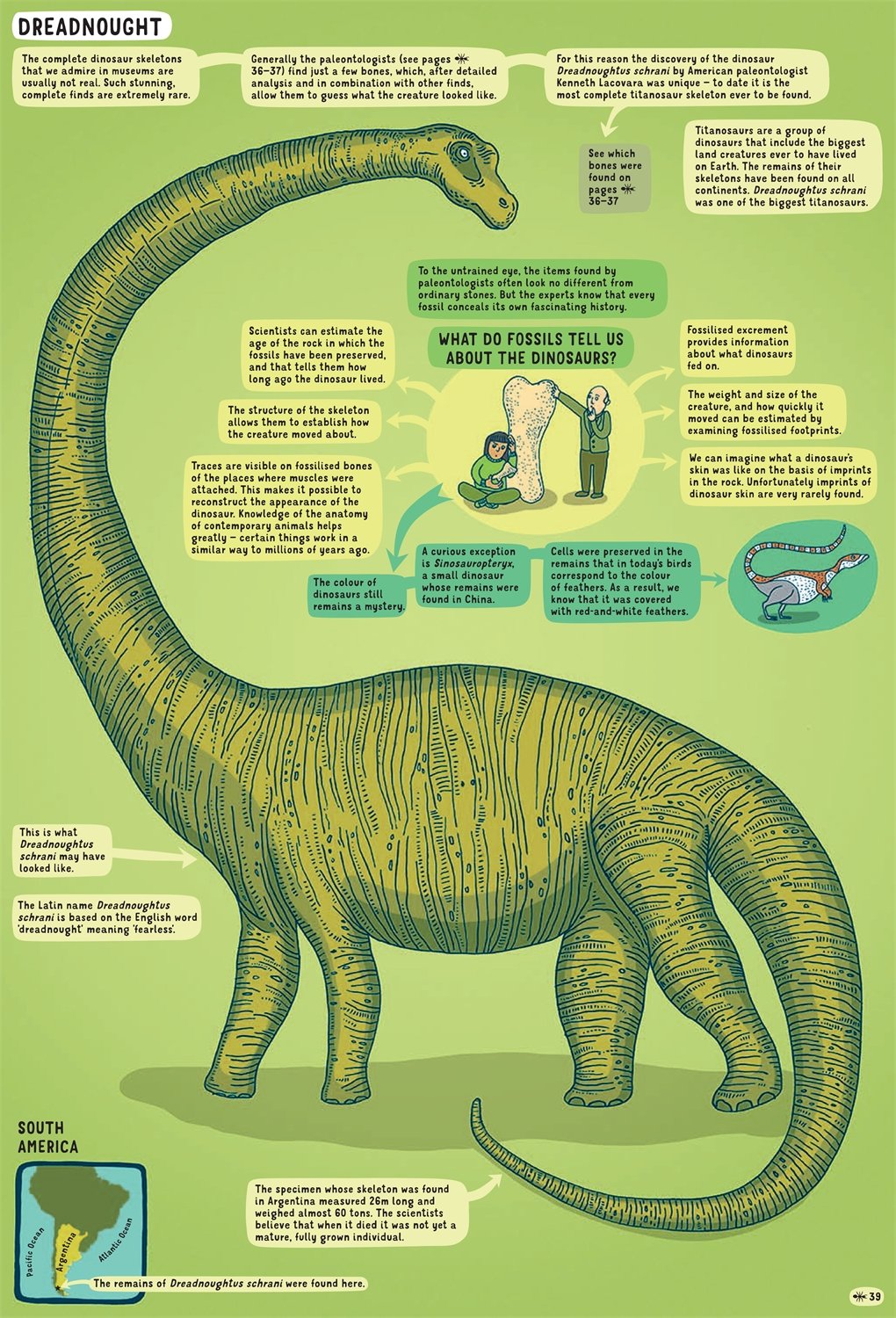
This book is stunning. It’s two books in one, each examining our worlds just below the surface: water and earth. The illustrations are amazing, and kids will flip as they see the inside of an anthill, take a look at an archaeological dig, check out a history of submarines, or tag along for a tour of the Mariana Trench. I can’t get enough of this book, and kids who love natural science won’t, either. Check out this spread on a Dreadnoughtus schrani!

underwater_5


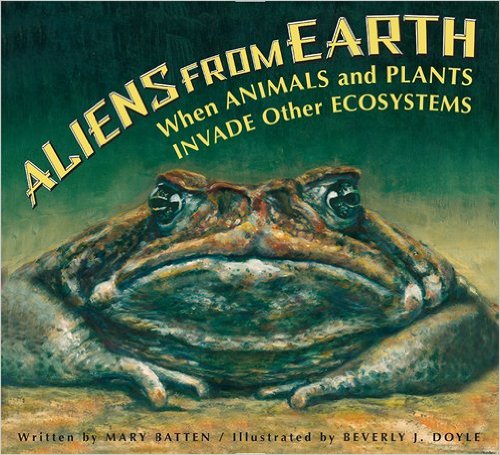
aliens-from-earthAliens From Earth: When Animals and Plants Invade Other Ecosystems, by Mary Batten/Illustrated by Beverly J. Doyle, (March 2016, Peachtree Publishers), $16.95, ISBN: 978-1-56145-900-1

Recommended for ages 9-12

Aliens From Earth takes a fascinating look at what happens when animals or plants invade a new habitat, upsetting an ecosystem’s balance. Fire ants, gypsy moths, even the cute little starlings that I see every morning when I head to work are all in here. Introducing an invasive species into an ecosystem unprepared for it can be responsible for the spread of disease, loss of habitat for current inhabitants, and reduction of natural resources for an area. This volume is beautifully illustrated by artist Beverly J. Doyle, whose acrylic paintings make me feel like I’m walking through a museum exhibit as I read. Previously published in 2006, Aliens from Earth is an Izaak Walton League of American Conservation Book of the Year. Give this to kids who are interested in environmentalism, preservation, and conservation.


oceanpediaUltimate Oceanpedia, by Christina Wilsdon, (Nov. 2016, National Geographic Children’s Books), $24.99, ISBN: 978-1426325502

Recommended for ages 7-13

Know a kid who would live in the aquarium if she or he could? Fascinated by fish, crazy for sea turtles, smart about sharks? The Ultimate Oceanpedia is the book for them. Stunning photos accompany entries on earth’s oceans, sea life, exploration, weather, the coast, and conservation of our underwater habitats and saving sea life. There are fast facts, stats, food webs, and maps galore. Sections on climate change and offshore drilling take on today’s big issues and present the facts without bias, letting readers form their own opinions. A call to action provides simple ways kids can help make the world a better, cleaner, healthier place to live. A glossary and in-depth resources encourage kids to keep learning and changing the world around them for the better.

These books are all available right now and are dying to go home with you! Shop your local bookseller, or click on over to Amazon, Barnes & Noble, Books-a-Million, or Indie Bound to buy.

Posted in Animal Fiction, Fiction, Middle School, Realistic Fiction, Tween Reads

When activism goes too far? Flip the Bird, by Kym Brunner

flip-the-birdFlip the Bird, by Kym Brunner, (Noc. 2016, HMH Books for Young Readers), $17.99, ISBN: 9780544800854

Recommended for ages 11+

Issues with hunting, falconry, and animal rights activism all come together in Kym Brunner’s Flip the Bird. Fourteen year-old Mercer Buddie wants two things out of life right now: he wants a girlfriend, and he wants to be a falconer, like his father and brother. He’s training as an apprentice to his father, a master falconer, but feels like his dad favors his jock of an older brother and is too critical of him. He captures a red-tailed hawk that he names Flip – to show his dad that falconry doesn’t always have to be a Very Serious Business – and has a few short weeks to train him for the big falconry meet; he’s got his eye on the Best Apprentice Award. Then he meets Lucy, who’s gorgeous and has a great personality and seems to be just as interested in him; the only problem is that she and her family are part of a fanatical animal rights organization called HALT. Mercer tries to play both sides to stay in Lucy’s and his family’s good graces, but sooner or later, the two halves of his life are going to converge. His mother is a scientist at a university lab doing medical research, and his father has a raptor rehabilitation center in addition to being a falconer – which means, a hunter. There are a lot of difficult choices in Mercer’s immediate future.

Flip the Bird brings together a lot of hot button topics to create a moving story about family and going with the crowd. Told in the first person by Mercer, the narrative is humorous while discussing the frustrations of being the little brother; the struggle to be treated like a responsible young adult, and the difficulty in making decisions that may be unpopular with the people you want to impress the most. To impress Lucy, Mercer joins the HALT collective she forms at school, but this puts him at direct odds with his family, and they let him know it. There are consequences to his actions, and we see Mercer grow as he faces those consequences. There’s interesting information about falconry and raptor rescue here, which will appeal to fans of animal fiction and birds. While the author gives a shout-out to some of her research sources in her acknowledgements, and does emphasize the extreme commitment that falconry requires, I’d have liked to see links to information about raptor rescue at the end of the book. I did some quick searching and came up with a quick list for anyone interested: The Raptor Trust, Wild Bird Fund, and A Place Called Hope. PBS’ Falconer’s Memoir page offers a map of states permitting falconry and links to classroom activities for using “A Falconer’s Memoir” in the classroom. The World Wildlife Fund is an organization that works with wildlife conservation and endangered species, and most large zoological preserves pioneer conservation and rehabilitation practices for animals in the wild. Kym Brunner is also a seventh grade teacher, and her author website offers presentations that you can use in the classroom.

I enjoyed the book and the characters. I’ll be adding this to my shelf; if you’ve know realistic fiction, animal fiction, or middle schoolers looking for something new and different to read, add this one to your shelves and shopping lists.

Posted in Middle Grade, Middle School, Non-Fiction, Non-fiction, Teen, Tween Reads

Bridge to the Wild: Zoos connect people and animals

bridge-to-the-wildBridge to the Wild, by Dr. Caitlin O’Connell/Photographs by Timothy Rodwell, (Aug. 2016, HMH Books for Young Readers), $18,99, ISBN: 9780544277397

Recommended for ages 10 and up

I’m about to gush here. If you read my reviews often enough, you probably have guessed that I love any nonfiction book about animals, conservation and preservation, and even better when the ideas are combined. In Bridge to the Wild, Dr. Caitlin O’Connell begins by recalling a childhood visit to the zoo – back when animals were still largely kept in cages (I remember it well), and saw a gorilla, seemingly in deep despair over living in a cage not much bigger than he was.

Thankfully, those days are (mostly) over. Zoos are more like natural preserves now, offering many animals larger spaces to roam; conservation and preservation is the order of the day, with zoo staff rescuing and caring for animals all over the world. As more animals face extinction at the hands of poachers, habitat devastation, and pollutants that contaminate their environment, zoos are playing a bigger part in keeping our wildlife alive, and conducting valuable research on improving their conditions and our world. Bridge to the Wild is Dr. O’Connell’s manifesto, where she lays out the valuable ways zoos are a bridge for humans, to the wild outside our doors.

Dr. O’Connell spent a week working with the staff at Zoo Atlanta –  a private, nonprofit wildlife park and zoo – to observe the relationships between animals and caretakers, to help strengthen this bridge. After all, what we see as observers is only the tip of the iceberg; many, many loving and brilliant people are behind the scenes, learning about and learning from the animals, caring for them, loving them. From the Dawn Chorus – the morning symphony conducted by the tenants as the day begins, to the Dusk Chorus, when they start winding down for the night, Dr. O’Connell and Tim Rodwell introduce us to the inhabitants of Zoo Atlanta, from the pandas, to the hornbills, meerkats, gorillas, tigers and more.

There are anecdotes and beautiful photographs, a “Keeper Feature” that profiles the different keepers at Zoo Atlanta, and a fantastic note on ignorance and extinction, which is a real call to action to end senseless poaching of animal parts for talismans and “remedies” that simply don’t work. A full bibliography and sources are available and provide more research opportunities, and data sheets encourage budding zoologists to do some research on their own, guided by Dr. O’Connell, who lays out simple experiments to observe and record behaviors.

Animal books are hugely popular with my Corona Kids, and I’ve been stacking my collection with plenty of rescue, preservation, and conservation titles for them, to drive home the point that this planet doesn’t only belong to us. Bridge to the Wild is going to be one of those books I talk endlessly about, especially since my library is about a stone’s throw away from the Queens Zoo. I may even slip copies of this book into teachers’ hands during class visits, with a “hint, hint” nudge for a class trip activity (sorry, kids!). That’s how important this book is to me.

Bridge to the Wild has received a starred review from School Library Journal. Learn more about Dr. O’Connell’s work and books at her author website.

Take a peek at a chapter excerpt on meerkats, then go order this book for your animal lovers!
meerkat_1