Posted in picture books, Preschool Reads

Happy Pride! And Tango Makes Three!

And Tango Makes Three, by Justin Richardson & Peter Parnell/Illustrated by Henry Cole, (April 2005, Simon & Schuster), $17.99, ISBN: 9780689878459

Recommended for readers 4-8

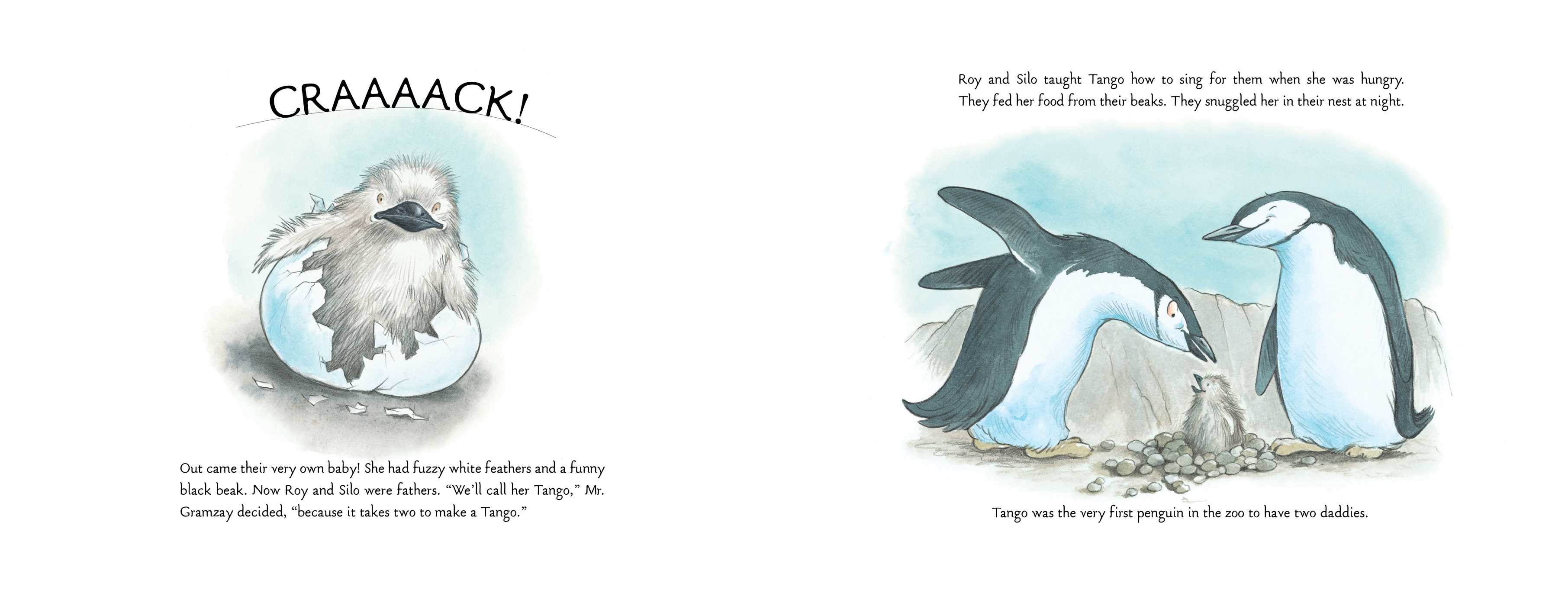
And Tango Makes Three is a classic in children’s and LGBT literature. It’s based on the true story of two penguins at the Central Park Zoo, Roy and Silo, and the little penguin they hatched together. Roy and Silo were (are?) are pair of penguins that discovered each other in 1998; they walked together; bowed to each other, swam together, even built a nest together. But no egg was forthcoming until their keeper, a nice man named Mr. Gramzay, put a fertile egg in their nest. The two penguins cared for the egg until it hatched, and Mr. Gramzay named him Tango, because “it takes two to make a Tango”. Could you squeal from the adorableness? So Tango made three; a happy little penguin family.

This sweet story about family caused an uproar you wouldn’t believe, because – GASP – two male penguins were depicted in a loving relationship AND as parents! Could you even? (It’s like… adoption never existed, amirite?) Poor little Tango and his dads made a lot of people nervous, and as a result, And Tango Makes Three has topped the 10 Most Challenged Books List between 2006 and 2010, and still gets people riled up 13 years later. That said, And Tango Makes Three also received a lot of awards, including designation as an American Library Association Notable Children’s Book (2006); the ASPCA’s Henry Bergh Award (2005); The Gustavus Myer Outstanding Book Award (2006); Nick Jr. Family Magazine’s Best Book of the Year (2006); Bank Street College’s Best Book of the Year (2006); the Cooperative Children’s Book Council choice, and Notable Social Studies Trade Book (2006); and it was a Lambda Literary Award finalist (2006). Not too shabby!

And Tango Makes Three is a story about love, family, and community. No one at the zoo gives a second thought to Roy and Silo’s relationship, and seriously, do you think kids who come to see the animals do? It’s a story of family and how, for one couple, a baby made them complete. Henry Cole captures the spirit of New York’s Central Park with his soft watercolors, and make Roy and Silo come to life with expressive facial and body expressions. If this isn’t on your shelves or in your storytimes – Father’s Day is coming! – please add it. And hug your dad(s).
Posted in Fiction, Middle Grade, Realistic Fiction

Join the resistance: BAN THIS BOOK

Ban this Book, by Alan Gratz, Sept. 2017, Starscape), $15.99, ISBN: 9780765385567

Recommended for readers 8-12

Fourth grader Amy Anne Ollinger isn’t one to speak up. When her parents tell her to let her sisters get their own way, she listens. All she wants to do is read her books and stay off anyone’s radar, but that all changes when her favorite book, From the Mixed-Up Files of Mrs. Basil E. Frankweiler, is pulled from the library shelves after a classmate’s mother finds it inappropriate. Amy Anne is shocked when the school board carries the motion, but it gets worse when her classmate’s mom returns to the library with a list of MORE books. And the administration refuses to call it banning! Amy Anne launches into action: she starts her own banned book library, run out of her locker. As the battle of the books escalates, Amy calls some friends in for backup. They’re going to challenge every book in the library. The dictionary? You can find bad words, like “stupid”, in there. Goodnight Moon? That cute little mouse is a health violation! Math textbooks? Imaginary numbers don’t exist!

Ban This Book is wonderful, first and foremost, because it gives kids a voice. Amy Anne finds hers as the novel progresses, and defending her beloved books gives her the power to assert herself in other areas of her life. Alan Gratz gives us a protagonist of color who goes on her own hero’s journey in the course of this novel; from mouse (as drawn by her classmate) to advocate – and assistant librarian! Mr. Gratz also shows a valuable part of librarianship that most people don’t always associate with our little profession: defenders of the right to read. Ms. Jones, Amy’s school librarian, is portrayed as a knowledgable, dedicated professional – and one who notably does not “shush” her library kids – who fights for her books and her readers, challenging the school board over their decision to take her – the professional – out of the review and reconsideration process.

Amy Anne and her friends learn how to assemble as a group and use their strengths to form their own library, to organize their own challenge to the status quo, and to make decisions for themselves. Every character is a winner here, and extra kudos to the author for not making the board and PTA mom classic mustache-twirling villains here: Amy recognizes that they are good people who want to believe they are doing what’s best for their kids.

Every single book that the PTA mom challenges in Ban This Book can be found on the American Library Association’s list of frequently banned and challenged books.

An absolute must-add to reading lists and collections. Make this one the center of your Banned Book Week Display!

Posted in Fiction, Middle School, Puberty, Tween Reads

Book Review: Are You There, God? It’s Me, Margaret, by Judy Blume (Yearling, 1970)

Recommended for ages 9-12

This Judy Blume classic follows sixth grader Margaret Simon, whose parents move her from their home in New York to the suburbs of New Jersey, and her search for an identity as she goes through puberty. The book has received numerous awards, including the New York Times Outstanding Book of the Year (1970). In 2005, the book made Time Magazine’s All-Time 100 Novels List.

Margaret meets new friends and they quickly form a secret club called the PTS’s – Pre-Teen Sensations. They have to wear bras to their meetings and they talk about boys, school, and most importantly, when they’re getting their periods. Nancy, the ringleader, makes Margaret uncomfortable with her superior attitude and concern over these things; she’s afraid she’ll be the last to get her period and be made fun of.

Raised without organized religion, Margaret has a very personal relationsihp with God and talks to him whenever she needs a comforting ear. She tells him her insecurities about puberty and her frustration with her family. With the other kids in her neighborhood identifying as either Christian or Jewish, Margaret struggles to know God in one of these faiths, but comes up empty; she asks him, after visiting both a synagogue and a church why she can’t “feel him” the way she does when she talks to him.

I loved this book when I was in sixth grade and re-reading it now, it holds up, mainly because the heart of the story still exists. Mean girls may appear bigger than life now, but Nancy was definitely a pioneering mean girl; Margaret is the Everygirl that we all identified with – insecure about ourselves, insecure about our place in school and our families, and just trying to figure it all out. Blume weaves all of Margaret’s insecurities together to create a solid, realistic character that girls can all identify with. Nobody does puberty like Judy Blume.

Judy Blume’s website features the usual author fare; there is a bio, interview questions, even autobiographical essays. She offers advice on writing and has a section on censorship – she is a very well-known advocate for the freedom to read – and her “Reference Desk” section provides interviews and an index of articles and information about Blume.