Posted in Tween Reads

Blog Tour: TILTERSMITH by Amy Herrick

Welcome to The Tiltersmith Blog Tour!

Follow along as we celebrate the release of The Tiltersmith with behind-the-scenes looks from author Amy Herrick, plus 10 chances to win a copy!

Old Books that Bump into Magic
by Amy Herrick

In yesterday’s blog I talked about my early reading habits, how I particularly loved the kind of fantasies where magical encounters came to ordinary children much like myself as they moved through their ordinary worlds.

Several of these books I go back to again and again looking for the same sensation they gave me the first time I read them, of sitting in my bedroom on a dull and rainy afternoon and noticing a slightly open door in the wall of my bedroom. A door that had never been there before. A door with some light coming through it or maybe a little music or laughter or maybe a scent I’d never scented before. A World in Back of the World.

I’ll mention here a few of the books from my childhood that still do this for me. Books that are still in print, but possibly you have missed.

Five Children and It by Edith Nesbitt

This book was first published in 1902. Although it takes place in England and is over one hundred years old, you will find the children in it perfectly recognizable and ordinary. They have been brought on a summer vacation to a house in the country. One day they find a big sand pit and decide to try to dig a hole to Australia. They don’t manage to get that far, but along the way they accidentally dig up a Psammead, “which in plain English” is a Sand-fairy. It is round and fat and furry with eyes at the end of long horns, like a snail’s eyes.  It has been sleeping in the sand pit for the last few thousand years and, as it turns out, is able to grant wishes. This, it proceeds to do, giving them one wish each day. Although the children attempt to be careful, knowing from fairytales how easy it is for things to go wrong in such matters, each wish brings on more trouble than the one before. The book is funny, charming and cleverly suspenseful. It was pretty much a ground-breaker in its time.
Bedknob and Broomstick by Mary Norton

This one was originally published as two books, the first in 1943 (Bedknob), the second (Broomsticks) in 1945. They were later combined in an edited version in 1957.  In this story, three siblings are sent away from London to stay with a relative in a countryside town. There, early one morning, they accidently observe their very proper and upright next-door neighbor flying by their window on a wobbling broomstick. When they confront Miss Price with their discovery that she is a witch in training, she devises a clever means of keeping their mouths shut and her secret safe. She gifts them with an enchanted bedknob which will turn their bed into a magical vehicle. When they twist the knob, the bed will carry them anywhere they wish in time or place. The catch is that she will take the spell away if any of them divulge her secret.

In the beginning, it appears that the adventures will be of the tangled, light-hearted variety. For their first wish, longing to see their mother, they give the bed their home address. The bed plops them down in the middle of a foggy London street, dressed only in their pajamas. Unfortunately, their mother is not at home and they are soon carted off to a nearby police station by an annoyed policeman. By guile and quick wits, they manage to get out of this one, but as the book moves on and they are taken across the world* and then thrown into the distant English past, the stakes grow higher and it becomes the sort of book you are reading under the covers with a flashlight.

*It should be noted that in one of these later chapters there is a “cannibal island” scene in which the children meet up with a fictional primitive culture. Nowadays, Norton’s descriptions of the tribe the children encounter might be considered stereotypical and inaccurate.

Half Magic by Edward Eager

Half Magic was the first written of Edward Eager’s seven books about ordinary children who happen to bump into magic right in the middle of their ordinary United States of America childhoods. It takes place at the time of Eager’s own childhood in 1920’s United States and was first published in 1954. The story opens at the beginning of summer. The four protagonists, one brother and three sisters, are bored and hoping they might encounter some magic like the children do in the books of Edith Nesbit. Although, as Mark, the brother, says: “Magic never happens, not really.”

Then Jane finds what she believes to be a nickel stuck in a crack in a sidewalk and puts it in her pocket. She doesn’t really look at it and doesn’t begin to realize the peculiar power of the coin until she innocently wishes out loud that a house would catch on fire somewhere nearby, so they could have some excitement. In the next moment several fire trucks go racing down the street and the children go running after them. They soon stop in front of a yard where a very fancy play house is burning to the ground in a great conflagration of smoke and flames.

In the next instance, their mother, without asking for permission, borrows the coin (also mistaking it for a nickel) off Jane’s dresser. She goes out for a boring evening with relatives, wishes she could be at home without needing to take the long bus ride, and suddenly and inexplicably finds herself on a dark and lonely road, halfway to where she has wished to be.

It soon becomes apparent to the children (although not to their mother), that the coin can grant wishes, but only half a wish at a time.

As the book unfolds, the foursome must experiment as they try to figure out how to cajole the coin into giving them an entire wish.

You might say, that by the end, they are half successful.

The process, however, is a fully satisfying joy ride for the reader.

If you’ve missed any of the above, I envy you. What a first-time treat you have in store for yourself.


About the Book

Amazon | BookshopGoodreads

Myths and monsters collide with climate chaos in a thrilling fantasy adventure.

Spring has arrived in Brooklyn, New York, but winter refuses to let go. Sleet, snow, and even a tornado batter the city. Mr. Ross, the science teacher, believes climate change is the cause, but classmates Edward, Feenix, Danton, and Brigit suspect older, magical forces are at work. When a peculiar character calling himself Superintendent Tiltersmith appears with a keen interest in the foursome, their suspicions are confirmed, and they’re swept up in a battle of wits and courage.

The friends must protect a set of mysterious tools belonging to the Lady of Spring. If they can free her from her underground prison, winter will end. But if the Tiltersmith steals the tools, he will keep the Lady in his power and upset the balance of nature forever.

Perfect for readers of Madeleine L’Engle and Susan Cooper, The Tiltersmith returns to the world of Amy Herrick’s acclaimed Time Fetch in a timely, exciting stand-alone adventure.

Praise:

“Herrick combines vivid descriptions of climate events, school-set science lessons, and weather-related stories from various cultures around the globe . . . resonates with current events and fits tonally alongside children’s fantasy classics.”
Publishers Weekly

“Vacillating between scientific reasoning and lore from worldwide cultures, the descriptions of beautiful legends of seasons and the sobering study of climate change are so rich.”
Kirkus Reviews

“Despite the contemporary setting, a diversified cast, and topical themes, events take on ritualistic elements that readers up on their Greek mythology will recognize. American fans of Susan Cooper’s The Dark Is Rising sequence will find themselves on familiar footing, albeit a bit closer to home.”
Booklist

“The author proves to have a keen eye for developing wonderfully dastardly villains. Tiltersmith is a fantastic bad guy who oozes disarming charm while also being deeply unsettling … cleverly handled … a compelling tale.”
Bulletin of the Center for Children’s Books  

“It’s a great combination of the mystical and the scientific! A bit of gentle romance shouldn’t deter younger readers . . . The writing style is craftily literary, with warm incisive forays into each character’s inner life.”
Youth Services Book Review   

About the Author

Website | Facebook | Twitter

Amy Herrick grew up in Queens, New York, and attended SUNY Binghamton and the University of Iowa. She lives in Brooklyn, where she has raised two sons, taught pre-K and grade school, written books, and kept company with her husband and numerous pets. A retired teacher, she loves traveling, learning Spanish, and above all reducing her carbon footprint.


GIVEAWAY

  • Ten (10) winners will receive a hardcover of The Tiltersmith
  • US/Canada only
  • Ends 11/6 at 11:59pm ET
  • Enter via the Rafflecopter below
  • Visit the other stops on the tour for more chances to win!

a Rafflecopter giveaway
https://widget-prime.rafflecopter.com/launch.js


Blog Tour Schedule:

October 17th Mama Likes This
October 18th A Dream Within a Dream
October 19th Always in the Middle
October 20th BookHounds
October 21st Mrs. Book Dragon

October 24th Good Choice Reading
October 25th Mom Read It
October 26th YA Books Central
October 27th Satisfaction for Insatiable Readers
October 28th Randomly Reading

Posted in Animal Fiction, Fiction, Middle Grade

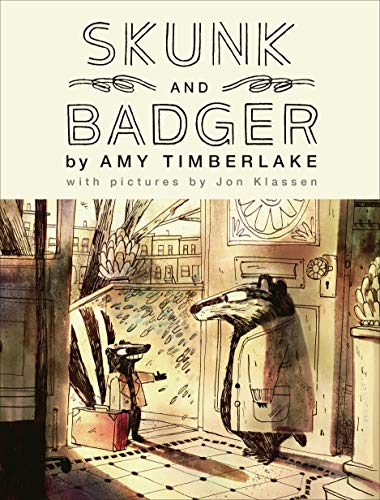
Skunk & Badger are an odd couple you’ll love

Skunk and Badger (Skunk and Badger #1), by Amy Timberlake/Illustrated by Jon Klassen,, (Sept. 2020, Algonquin), $18.95, ISBN: 9781643750057

Ages 8-12

This is an utterly adorable, amusing story of two unlikely friends. Badger, a rock scientist, lives on his own in his aunt’s house, doing very important rock science; when Skunk shows up at his door, he’s a little taken aback – he clearly hasn’t been reading his aunt’s letters, telling him he’ll be getting a roommate! – and he reluctantly lets Skunk into his home, and, slowly but surely, his life. You see, Skunk is much more of a free spirit than Badger: he cooks delicious meals, zings potatoes across the room while he’s cooking, and makes friends with chickens! Badger, who lives a functional and regimented life, is not sure about this whole Skunk business. After a big sleep over with the chickens leads to an incident where Skunk accidentally sprays Badger, the two have a falling and Skunk leaves; as he’s sadly said before, “No one wants a skunk”. Skunk’s departure gets Badger thinking about what makes a good friend – and is determined to find Skunk and makes amends.

Newbery Honor author Amy Timberlake and Caldecott Medal Winner Jon Klassen create an enduring story of compassion, embracing differences, and friendship. Badger is a lovable curmudgeon, paired with idealist, extroverted Skunk – but Skunk knows all too well how he’s perceived by others. When Badger loses his temper and calls him “vermin”, Skunk draws the line between endearing grouchiness and unacceptable treatment. Jon Klassen’s artwork fits perfectly with this sedate, sweet story; he gives memorable scenes life and makes this a book about friendship that kids will turn to again and again. You know what I’m going to say: Frog and Toad fans, this is the book for you. I can’t wait to see what Skunk and Badger get up to next.

Skunk and Badger has starred reviews from Kirkus, Publishers Weekly, and Booklist.


Posted in Non-Fiction, Teen, Tween Reads, Women's History

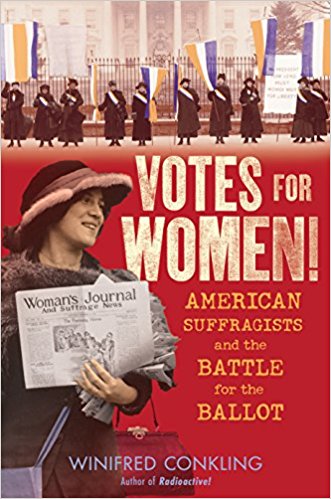
Votes for Women! Suffrage was a fight every inch of the way.

Votes for Women! American Suffragists and the Battle for the Ballot, by Winifred Conkling, (Feb. 2018, Algonquin Young Readers), $19.95, ISBN: 9781616207342

Recommended for readers 12+

Winifred Conkling is emerging as a definitive chronicler of women’s history. Passenger on the Pearl told the story of Emily Edmondson, who escaped slavery and dedicated her life to education young African-American women; Radioactive! gave long-overdue props to Irène Curie & Lise Meitner, whose work on radioactivity was often overlooked in a male-dominated field; now, Votes for Women gives us a comprehensive history of the fight for American suffrage, long before women finally won the right to vote in 1920. For readers who may only be familiar with Susan B. Anthony, this volume is indispensable, introducing readers to Elizabeth Cady Stanton; Susan B. Anthony’s counterpart and founder of the suffrage movement, and Alice Paul, who took her cue from the more action-oriented British suffrage movement, and went to jail for the cause, where she and fellow protestors suffered deplorable conditions and were force-fed. We meet Victoria Woodhull, the first female Presidential candidate, and revisit Sojourner Truth’s famous speech, “Ain’t I A Woman?” Most importantly, we learn about the beginnings of intersectional feminism; when abolitionists and suffragists found common ground – and then diverged under political fire.

This is a comprehensive book, complete with photos, primary sources, and writing that never turns away from the more difficult moments in the battle for the vote: from racism to violence, it’s all here. It’s a good book for your nonfiction collections and women’s history collections for middle school and high school, with extensive primary source references, a timeline of American women’s suffrage, a bibliography, notes, and an index. Booktalk this with the graphic novel, Sally Heathcote: Suffragette by Mary M. and Bryan Talbot, which features a fictional character from the British movement, and is a great hook to get teens interested. A Mighty Girl has a strong list of additional reading, filtered by age, on suffrage.


Posted in Fantasy, Fiction, Middle Grade, Tween Reads

What is the Secret of Dreadwillow Carse?

dreadwillowThe Secret of Dreadwillow Carse, by Brian Farrey (Apr. 2016, Algonquin Young Readers), $16.95, ISBN: 9781616205058

Recommended for ages 8-12

In a fantasy kingdom where all the subjects are deliriously happy, two girls bond over their mutual feelings of sorrow, helplessness, and ultimately, determination. Princess Jeniah is a 12 year-old Queen Ascendant; her mother is dying and she’s got very little time left to learn to be a queen, let alone to process the grief she’s feeling. Her mother’s cryptic message about the mysterious bog, Dreadwillow Carse, fires up her curiosity: “If you enter the Carse, the monarchy will fall.”

At the same time, a village girl, Aon, loses her father when the Crimson Hoods come and take him away, ostensibly to become the next advisor to the monarchy. The villagers barely recognize that he’s gone, and Aon – who’s already lost her mother to the Carse – is bereft. Aon is not like the other villagers. She feels a sadness she can’t explain. All the time.

When the two girls encounter one another, Jeniah asks Aon for a favor: explore the Carse. The monarchy can ask someone else to enter the Carse, after all, can’t they? In return, Aon asks Jeniah to send her father home. This meeting sets each girl off on her own personal voyage of discovery, where they’ll uncover long-kept secrets of the Carse, the monarchy, and most importantly, about themselves.

On the face of it, this is an interesting middle grade fantasy tale, with multicultural characters and a Big Secret to be uncovered. Read a little deeper, and you discover that this is an interesting portrayal of pre-adolesence set in a high fantasy setting. A villager and a monarch bond over their mutual sadness, that they feel they can never show to others. The people around them are either keeping secrets from them, as with Jeniah, or are wandering through life in a false delirium, refusing to see what’s going on around them, as with Aon. Aon feels a sadness no other villager can grasp, and she feels frustrated and ignored. The Carse’s presence holds so many answers, but they’re discouraged from venturing in. They have to work together to find answers, and those answers will reveal terrible truths about those around them.

Tweens will identify with the girls and their feelings of frustration; many will understand the undercurrent of seemingly inexplicable sadness and the pressure to put on a smiling face. They’ll share Jeniah’s frustration with her tutor, who answers all of her questions with questions – she has to learn not only to question everything, but to weigh the answers in front of her before she acts. The character development is built steadily through the book, with small plot reveals throughout leading readers further and further, until they reach the conclusion that hits hard and leaves a lot of questions in its wake. This is a great book to hold a discussion group with. I’ll be booktalking it for sure.

A good addition to middle grade collections and fantasy fans’ TBRs. Author insights and an excerpt are available on the Algonquin website. The Secret of Dreadwillow Carse has received a starred review from School Library Journal.

Posted in Non-Fiction, Teen, Tween Reads, Uncategorized, Women's History

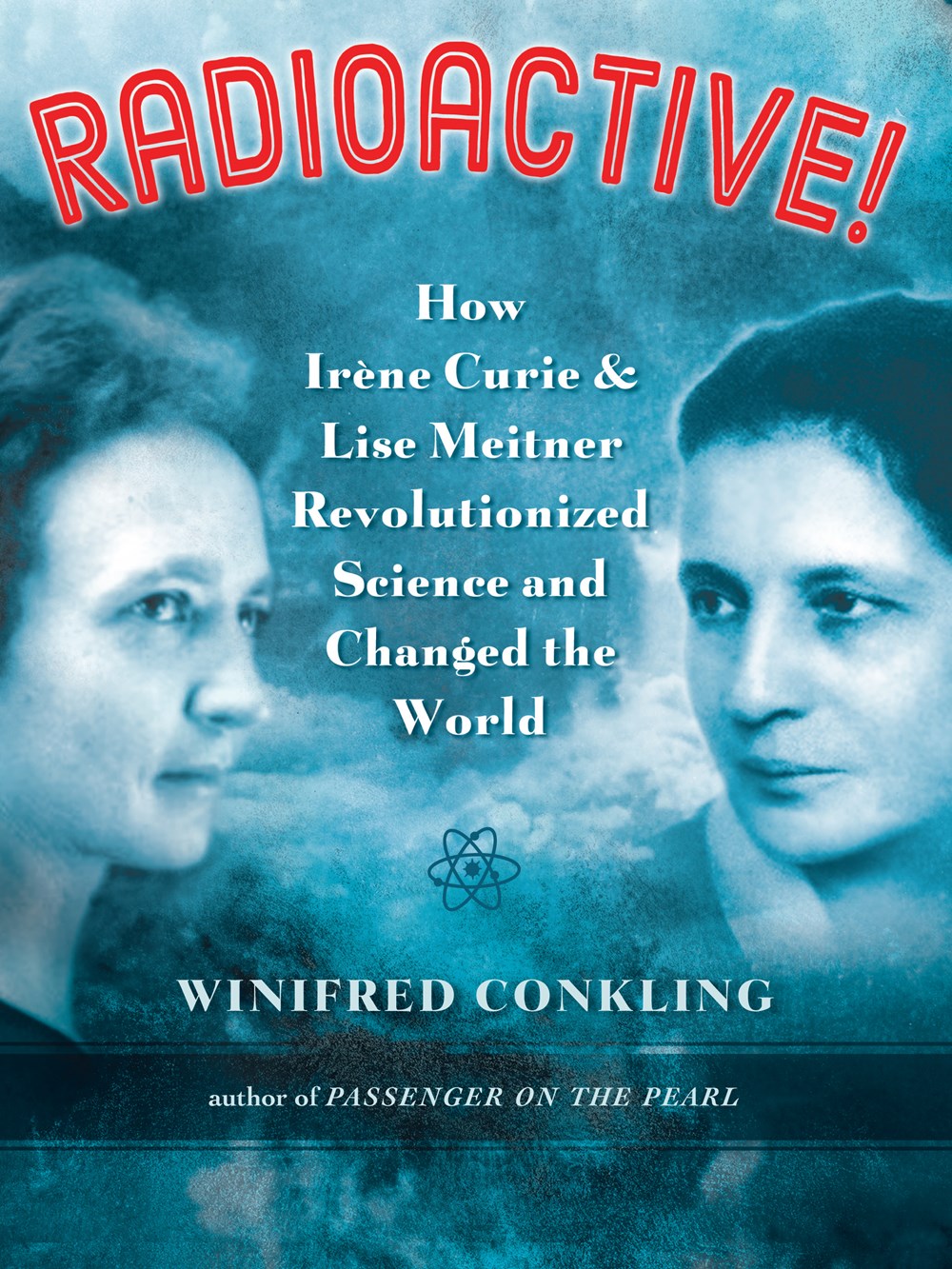
Radioactive! The story of two women scientists and how they changed the world.

radioactiveRadioactive!: How Irène Curie and Lise Meitner Revolutionized Science and Changed the World, by Winifred Conkling (Jan. 2016, Algonquin Young Readers), $17.95, ISBN: 9781616204150

Recommended for ages 12+

Most of us know who Marie Curie was: the scientist who pioneered the study of radioactivity. But how many know that her daughter, Irène, was an accomplished scientist in her own right, whose studies on radioactivity, physics, and the transmutation of elements earned her a Nobel prize, shared with her husband? Have you heard of Lise Meitner, the physicist whose work in physics – often published in conjunction with her friend and research partner, Otto Hahn – led to the discovery of nuclear fission? She was passed over for a Nobel for several reasons, not the least of which involved her being straight-up robbed by a partner who took credit for much of her work during the World War II years, when she was exiled in Sweden.

Radioactive! tells the stories of these two very important women and their historical research. We learn Irène’s story from the beginning, as the daughter of celebrated scientist, Marie Curie. She worked by her mother’s side, operating an x-ray machine on World War I battlefields, eventually going on to further her mother’s work in radioactivity along with her chemist husband, Pierre Joliot. We learn about Lise Meitner, whose work put her in competition with Curie many times, but experienced more sexism and prejudice than Curie ever did. When Hitler rose to power in the 1930s, her Jewish heritage created problems at her research position, where former colleagues turned against her and demanded she resign; she was eventually forced her to flee Austria for Sweden or end up in a concentration camp. Although she continued to consult with Hahn on their nuclear fission research, he took credit for her work and took home the Nobel Prize for Chemistry in 1944.

I’ve been looking for biographies on women in science for my tweens and teens, and this certainly fits the bill. There are photographs throughout the book, and Ms. Conkling provides strong backgrounds on both Curie and Mietner, making them live again, making the reader care about them, and explaining physics, fission, and radioactive science in terms that we can all wrap our heads around. A valuable addition to libraries and classrooms, and a great book for anyone who wants to inspire the next generation of scientists – female OR male.

Winifred Conkling is an award-winning author of fiction and nonfiction for young readers, including Passenger on the Pearl: The True Story of Emily Edmonson’s Flight from Slavery and the middle-grade novel Sylvia and Aki, winner of the Jane Addams Children’s Literature Award and the Tomás Rivera Award. Her author website provides teacher guides for her books. There is no guide up for Radioactive yet, but I’m sure there will be one closer to the book’s publication date.