Posted in Humor, Science Fiction, Tween Reads

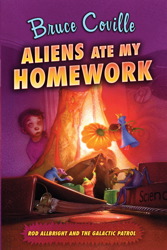
Book Review: Aliens Ate My Homework, by Bruce Coville (Aladdin, 1993)

     Recommended for ages 9-12

Sixth-grader Rod Albright, better known as Rod the Clod among his classmates, is a target for the two bullies at school and the go-to babysitter for his toddler twin brother and sister at home. One day, while working on a science project for school, a miniature alien spaceship crashes into his window, and Rod is commandeered into helping the alien crew in their search for BKR, an intergalactic criminal infamous for his cruelty – and who just happens to be hiding out in Rod’s neighborhood. Can Rod, who is incapable of lying, keep his alien visitors a secret and help them succeed in their mission while getting his science project done on time?

Told from Rod’s point of view, Aliens Ate My Homework is a fun read for kids ages 9-12. As the first book in a four-book series, Coville sets up the story line and introduces the reader to a full cast of characters: Rod, Thing One and Thing Two, the toddler twins, their mother, the crew of the Ferkel, and BKR, the intergalactic villian. The crew of the Ferkel is a diverse group of aliens, illustrating that diversity is welcome in all parts of the universe; Grakker, the Ferkel’s captain, is a borderline hostile military man, but the crew and Rod all learn how to work with him – and vice versa. BKR, the criminal wanted across the galaxy, is guilty of cruelty. Says Ferkel ambassadaor Madame Pong of BKR’s crimes,  “Millions have wept.” There are lessons to be learned within Coville’s bright narrative – different personalities and people and capable of working together; cruelty is wrong; and every being, no matter how powerful or how small, needs help.

Aliens Ate My Homework is the first in Bruce Coville’s 4-book series, Rod Albright’s Alien Adventures; the other books in the series are I Left My Sneakers in Dimension X; The Search for Snout; and Aliens Stole My Body. Coville’s website also offers printable door hangers and bookmarks, crossword puzzles, and information about all of Coville’s books.

Posted in Fiction, Humor, Tween Reads

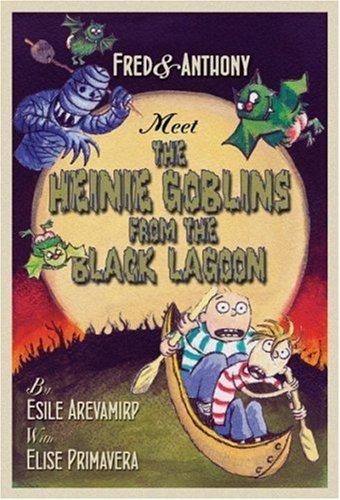
Book Review: Fred & Anthony Escape from the Netherworld and Fred & Anthony Meet the Heine Goblins from the Black Lagoon, by Elise Primavera (Hyperion, 2007 & 2008)

Recommended for ages 9-12

I am writing one review for both of these books as they are by the same author and from the same series.

Fred and Anthony are two kids with one big wish: find someone to do their homework for them so they can relax, eat Chex Mix and Pez, and watch horror movies. In their first adventure, Escape from the Netherworld, they decide to make money so that they can afford to pay someone; because they already have a reputation for botched and unfinished jobs im their own neighborhood, they strike out for a new neighborhood and end up discovering The Netherworld when Anthony falls through a bathroom portal. Luckily, Fred has the foresight to grab a Guide to the Netherworld to help them navigate their way past evil dentists, deceptively dressed werewolves, and Count Dracula himself. They make their way back home only to discover that a ghost has followed them – so they hire him as a ghost writer (get it?) to write about their adventures. Their get rich quick plan is under way!
 
Their third adventure, Fred & Anthony Meet the Heinie Goblins from the Black Lagoon, catches readers up on the first two books, so readers can come in on any book in the series and not feel lost. Fred and Anthony are sent off to Camp Plenty Wampum summer camp in Heinie Goblins; naturally, the camp brochure is a ruse and the camp, run by two Wise Guys named Carmine and Vinnie, is a dump serving cold Hot Pockets with warm water, forcing recreation time in leaky canoes on the questionable Lake Gitchie Lagoonie, and haunting them by dressing up as The Burnt Marshmallow Mummy and The Lone Short-Sheeting Stranger. While out on Lake Gitchie Lagoonie, the boys’ canoe capsizes and they end up back in The Netherworld for a brief time, until their escape from the Creature from the Black Lagoon leads them back up to the Camp.
 
Deciding that they can make money by charging kids for trips to The Netherworld, the boys launch their next career venture. In The Netherworld, they meet the Heinie Goblins – cute, purple-feathered little batlike creatures with bare backsides. Despite the Guide to the Netherworld’s warning about the goblins being “a pain in the butt”, the boys allow a goblin to accompany them back to the camp, but the goblin brings friends along, who menace the other campers. When Carmine and Vinnie show up dressed as the Lone Short-Sheeting Stranger and the Burnt Marshmallow Mummy, the goblins become jealous of losing the audience’s attention – the book is, after all, named for them – and attack, leaving the boys to figure out a way to make things right.
 
The books are written with the lower end of the age range or the reluctant reader in mind, with black and white illustrations on every page and a mixture of graphic novel and chapter book format. Gross humor will appeal to boys (or girls!) who giggle at a good bathroom joke. The books are slightly more than 100 pages in length, making them easy and quick reads for younger children.
 
The author and illustrator, Elise Primavera, “ghost wrote” these books under the name Esile Arevamirp. There are four Fred & Anthony titles, but was surprised that the author’s website had no mention of them; I even attempted to find a website for her alter ego but found nothing. Turning to YouTube, discovered Rat Chat Reviews, an animated video review site for children’s books; the rats posted an interview with Fred and Anthony on the cancellation of their series. Regardless of whether or not there are any more Fred & Anthony books in the future, the series is still a fun set of books for a younger or reluctant reader.
Posted in Fantasy, Post-apocalyptic/Dystopian, Science Fiction, Tween Reads

Book Review: A Boy and His Bot, by Daniel H.Wilson (Bloomsbury, 2011)

Recommended for ages 9-12

On a class trip to a Mek Mound, an ancient Oklahoman Indian land mound reminiscent of the Egyptian pyramids, sixth grader Code Lightfall discovers Mekhos, a manufactured, experimental world inhabited by robots and long forgotten by humans. The world is under the grip of the evil tyrant Immortalis, bent on the world’s destruction; it falls to Code and Gary, an atomic slaughterbot brought to life by Code’s imagination and Mekhos technology, to find the Robonomicon and save the day.

A Boy and His Bot is a journey to Oz tale for a more modern age, complete with beautiful and deadly surroundings like the Toparian Wyldes, the beautiful forest maintained by a race of robots who trim and sculpt anything in their way, their upkeep programming overriding any other directive. Where Oz has a benevolent wizard, Boy  has Immortalis, the evil overlord who pushes all robots to the day of The Great Disassembly, when all of Mekhos will be undone. Code’s main objective, beyond stopping The Great Disassembly from taking place, is to get back home.

I have noticed that heroes in “boy books” often come from dysfunctional families, and Code is no exception. A shy boy, picked on by some classmates, ignored by others, Code is grieving the disappearance of his grandfather John a year prior. His parents are not in the picture. The only positive female force in the book is Peep, the little robotic probe that befriends him and leads him to the world of Mekhos. Gary the Slaughterbot plays the part of the all brawn, no brains protector with the heart of gold.

I wonder why it is that young male characters’ families are so flawed in YA literature. Is this an accurate reflection of the state of families today, or is this the newest hook to keep young boys reading? Is it a way to reach out to young boys that may be in crisis and refuse to speak?  The combination of robotic creatures, a manmade world on the brink of destruction, and an invention like the slaughterbot alone is enough to grab a boy’s attention on the surface, but Code’s background gives him a depth that should help boys and girls alike be interested enough in his journey to travel along with him.
Daniel H. Wilson, Ph.D. is the author of How to Survive a Robot Uprising, Where’s My Jetpack, and How to Build a Robot Army. A Boy and His Bot is his first YA novel, but he has also written Bro-Jitsu: The Martial Art of Sibling Smackdown, and his Robot books are popular with older tweens and teens. He maintains an author website.
Posted in Fiction, Humor, Middle School, Tween Reads

Book Review: Middle School – The Worst Years of My Life, by James Patterson and Chris Tebbetts (Little, Brown, 2011)

Recommended for ages 10-14
 

Rafe Katchadorian is having a tough year: his mom is working double shifts at her diner job in order to support him, his sister, and her lazy, unemployed fiance, and he’s already attracted the attention of the school bully during his first week of middle school. What’s a kid to do? Make a name for himself, of course!

With some prodding by his best friend, Leonardo the Silent, Rafe decides that he’s going to break every single rule in the middle school code of conduct. There are guidelines to follow, though – he’s got to have witnesses every time he breaks a rule; he’s got three “lives” – he loses one if he passes up an opportunity to break a rule – and finally, he can’t hurt anyone in his quest to break the rules. How bad can a good kid get, and how far is Rafe willing to go to break all the rules, and will he break his own in the process?
 
I started this book expecting a light, humorous tale and was amazed at the punch Patterson and Tibbett packed into this middle school story. Rafe’s family issues aside, there are a multitude of issues in his life. In reality, he would be considered an at-risk tween with a need for a solid support system. Two major plot developments may suprise readers, but these are important stories for tweens and young teens to be exposed to – children with similar life stories may appreciate a literary figure they can relate to, and other readers will glimpse into another kid’s world, possibly starting a dialogue or creating a new sensitivity among them.
 
 Chris Tebbetts is a YA author whose love of books and libraries began as a child. His website suggests links for writerw and readers, and provides a list of Good Reads for young readers and teens.
 

James Patterson is best known for his Alex Cross mystery series, but he is a Children’s Choice Award-winning author, receiving the award in 2010 for his book Max, one of the books in his popular Maximum Ride series. His Daniel X series has been praised by Good Morning America as being some of the best books for boys, and the first book in his Witch & Wizard series spent five weeks on the New York Times bestseller list. Patterson’s website, ReadKiddoRead, is dedicated to getting kids reading and suggests titles for all ages and interests.

Posted in Guide, Humor, Tween Reads

The Young Person’s Guide to Grown-Ups, by Monte Montgomery, illustrated by Patricia Storms (Bloomsbury, 2012)

Recommended for ages 9-12
Being a kid is tough. What if there were some sort of guide to figuring out the grown-ups in their lives? Monte Montgomery and Patricia Storms have created a field guide to the average grown-up to help children navigate these strange people who seem to hold so much sway over them.
The book examines grown-ups as seen through a child’s eyes and includes basic similarities and differences between grown-ups and kids: adults, for instance, have stopped growing taller and started growing wider, but have never stopped feeling like the kid they used to be, providing the reader with an entry point with which to relate.
Set up like a Grown-Ups for Dummies book, complete with callout Tactics boxes spotlighting tools for dealing with different situations and line drawings throughout, Young Person’s Guide takes kids through everything they need to know about grown-ups at home, at school, and “in the wild”. Descriptions of various adults in each of these settings and an FAQ flesh out each section. Montgomery imparts Three Universal Truths that kids and adults alike should know and includes an in-depth, illustrated guide to various classes of adults, like atheletes, dentists, police officers and millionaires (complete with Donald Trump-like caricature).
Young Person’s Guide is a fun book that will help younger children feel like they have some handle on why grown-ups say and do the things they do, while helping them understand that adults and kids have much more in common than they may think. It is a fun book that can start conversations both at home and in the classroom.
Patricia Storms’ webpage are as much fun as her illustrations. Infused with bright graphics and personal information, the reader can see that the illustrator takes the message of Young Person’s Guide to heart and keep in touch with the kid that used to look back from the mirror.
Posted in Fantasy, Fiction, Humor, Tween Reads

Book Review: Villain School: Good Curses Evil, by Stephanie Sanders (Bloomsbury, 2011)

Recommended for ages 9-12

What do you do when your parents are some of the baddest bad guys in history, and you just don’t match up? You get sent to Master Dreadthorn’s School for Wayward Villains. Dracula’s daughter, Jezebel, is there – she prefers hot chocolate to blood. The Big Bad Wolf’s son, Wolf, is in there, too – he saved a human child from drowning. The Green Giant’s son was expelled when they realized that his dad was just some green guy trying to get kids to eat their vegetables.

Rune Drexler, Master Dreadthorn’s 12-year old son, is at villain school, too, but he’s not getting any preferred treatment – quite the opposite; he can’t seem to do anything right in his father’s eyes. When his father calls him to his office and gives him a Plot – a dangerous and evil test to achieve his next EVil (Educational Villain Levels) level, Rune sees his chance to be the villain his father wants him to be. But can he and his two friends carry out the Plot without ending up being heroes?
The story takes a little bit of time to get started; Sanders concentrates on exposition early on in the story. Once the Plot is under way, though, the story becomes a fun read with just enough of a twist to take the reader by surprise. I did not feel cheated by the book’s end – I wanted to know what Rune was going to do next. Middle grade readers will enjoy the good-natured jabs that the characters throw at one another, and the idea of being good while you’re trying to be evil will show younger readers that there is something good in even the baddest of villains.
Posted in History, Non-Fiction, Tween Reads

How They Croaked: The Awful Deaths of the Awfully Famous, by Georgia Bragg; illustrated by Kevin O’Malley (Walker Books for Young Readers, 2011)

Recommended for ages 10-13
 
Most school-aged kids know who King Tut, George Washington, and Napoleon were, but what they may not know is how they died. How They Croaked delivers the full-on details of how these historic figures and 16 others met their makers in gloriously gory detail.
 
Along the way, Bragg dispels famous myths – Cleopatra did not meet her doom at the fangs of an asp – and provides insight on how modern medicine may have saved a few of these famous lives. George Washington, for instance, could have survived if only he had access to antibiotics.
 
Bragg provides morality in her profiles. We learn that Pocahontas was exploited from the minute she saved Captain John Smith from the axe, and that Robert Carter, the “explorer” who discovered King Tut’s tomb, wasn’t much more than a grave robber on a grander scale. We also learn some amusing details along the way, including famous last words, what cupping was all about, and some gross information about Marie Antoinette’s three-foot hairdo.
 
Kevin O’Malley, writer and illustrator of children’s books such as Animal Crackers Fly the Coop! and Mount Olympus Basketball, gives the reader his macabre best while still keeping it on a level that younger readers won’t shy away from, including a a distended Henry VIII and a shrieking Julius Caesar.
 
For reluctant readers and kids (or grownups!) who just want a fun read that makes you squeal with squeamish delight, How They Croaked is a perfect addition to your history library.
 
Posted in Fiction, Humor, Middle School, Tween Reads

Book Review: Ellie McDoodle: New Kid in School by Ruth McNally Barshaw (Bloomsbury, 2008)

 
Recommended for ages 8-12
 
Ellie McDoodle is the nickname for sixth grader Eleanor McDougal, who fills her notebooks with doodles, journaling the people around her, her family, and her own daily happenings.

When Ellie’s parents announce that they’re moving, Ellie is crushed. She doesn’t want to leave her friends, her school, or her home. She creates a journal to document the move, insisting that “there won’t be much to keep track of… because this is the END of everything good.”

Or is it? Despite some rough patches, like discovering the “New Kid Bingo” card some of her classmates circulate at school or teachers not remembering her name, Ellie learns that being the new kid may not be so bad. Through her own actions, she makes friends, convinces her parents to give her a room of her own in the attic, and organizes her fellow classmates in a peaceful against long lunch lines in the cafeteria. Being the new kid may end up being sort of fun after all.

Ruth McNally Barshaw’s Ellie McDoodle series has been described by Student Library Journal as “reminiscent of Jeff Kinney’s Diary of a Wimpy Kid“, and it is to some degree: both stories have a vibrant narrator who tells his tale in the first person, accompanied by line drawings. To dismiss Ellie McDoodle as merely a feminine Wimpy Kid is selling the book short. Ellie McDoodle is not a Wimpy Kid clone; it is a smart, sensitive book featuring a character to whom both boys and girls can relate.
 
Ellie’s family is as realistic and provides a positive family model. The family eats meals together at the same table; they play friendly pranks on one another, like hiding a spooky-looking Mrs. Santa Claus figure all around the house to take family members off guard; even Ellie’s cranky older sister Risa is never outright abusive, but is more of an angsty teen. Her older brother Jonathan is a friendly clown who makes punny jokes, and her toddler brother, Ben-Ben, is a happy baby who gets into everything. 
Readers will see Ellie as a positive role model who affects her own change rather than waiting for it to come to her. Rather than succumb to her sadness, Ellie seeks ways to make the best of her situation. She befriends a librarian at the local library; meets neighborhood children and accepts their invitiations to play, a move that helps her cope with insensitive schoolmates. Using her talent in art to help make a difference in her school, her peaceful protest gets not only the notice of the principal, but of the local television station.
 
Ruth McNally Barshaw’s website offers information on all of the Ellie McDoodle books and links to more of McNally Barshaw’s art. Readers can find out where she’ll be appearing and read her blog, and create Ellie mini-books and stationery. She offers teens advice on writing their own graphic novels, and has teaching guides available for educators.
 
The Ilsley Public Library in Vermont created a book trailer for New Kid in School, viewable below.
Posted in Graphic Novels, Humor, Middle School, Tween Reads

Book Review: Amelia Rules! The Whole World’s Crazy, by by Jimmy Gownley (Renaissance Press, 2006)

Recommended for ages 9-12
 
Jimmy Gownley’s graphic novels about Amelia McBride and her group of friends remind me of Bugs Bunny cartoons – when you’re a child, they entertain you; when you’re a little older, you get the jokes.
 
In this first volume, we meet Amelia, age nine. Her parents have just divorced and she and her mom have moved from Manhattan to “the middle of nowhere, Pennsylvania”, where they live with her retired pop rock star Aunt Tanner. Tanner provides a ready ear and sometimes, shoulder, for Amelia when she needs to vent.
 
Amelia’s a wise-cracking tomboy, but she isn’t skin deep. We see the effect of her parents’ divorce on her, be it through the frustration and anger with her father for canceling plans for their weekend together because he has a last-minute work commitment or her discomfort in overhearing her mother berating her dad on the phone. She shakes it off, adapts her hard-as-nails persona, and moves on. We all know kids like Amelia;  maybe we have even been in Amelia’s place at one point, and this is what makes her so accessible to kids and grownups alike.
 
Speaking of grown-ups, there are plenty of in-jokes for mom and dad to catch. Amelia and her friends go to Joseph McCarthy Middle School (motto: “Weeding out the wrong element since 1952”). Ann Coulter garners a mention on one of Santa’s lists (hint: it ain’t the “nice” list). There are pop culture references aplenty. The dialogue is funny and smart; Gownley doesn’t talk down to his audience, nor does he shy away from sensitive topics.
 
Amelia’s friends are a mixed bag of personalities. Amelia’s friend Reggie is obsessed with being a superhero, to the point of starting his own league of heroes called GASP (Gathering of Awesome Super Pals). Pajamaman is the most popular kid in school, but never speaks, wears footie pajamas, and comes from a poor family. Rhonda, Amelia’s nemesis (and grudgingly, good friend), has a crush on Reggie and puts herself in competition with Amelia for his attention. The group deals with bullies and crazy teachers, unrequited love and poverty. It’s a group of kids that readers will see themselves reflected in.
 
The Amelia Rules! website offers even more to Amelia fans. There are book trailers, podcasts, a blog, and links to fan art and fan fiction. Visitors can listen to music in Tanner’s Garage and play games in the Ninja Lair.
Posted in Fantasy, Fiction, Tween Reads

Book Review: The Miraculous Journey of Edward Tulane, by Kate DiCamillo (Candlewick Press, 2009)

Recommended for ages 9-12
 
I normally try to stay away from reading multiple books by the same author in a row, but after coming off of The Tale of Desperaux, I really wanted more, so I picked up The Miraculous Journey of Edward Tulane.

Edward Tulane is a stunning china rabbit with real fur ears and wires enabling movement in his arms and legs, and a fashionable silk wardrobe. He is the apple of his owner’s eye, 10-year old Abilene. Abilene changes his outfits daily annd dotes on him. He lives a comfortable life and knows it, but he’s cold and keeps Abilene at a distance, never allowing himself to love her as she loves him; her purpose in his life is to take care of him and coddle him.

Abilene and her family go on a cruise where Edward, as a cruel prank by two boys on the ship, is tossed overboard; thus begins a journey where he finds himself in the company of an old woman, a homeless man, and a dying little girl and her older brother. Each of these people teaches Edward a little more about love, loss and longing.
 
The reader journeys with Edward, experiencing his growth and heartache through each subsequent companion’s story. Despite the affection – even love – he feels with each new owner, his thoughts always stray back to Abilene, finally understanding what love is and he regrets not reciprocating her affection.
 
The them of second chances is a dominant theme in the book, leaving the reader with the message that there’s always a chance for redemption – it just make take some time. It is a powerful and relevant theme for middle grade children, who need to understand at this delicate age that their actions can and do have consequences, but that almost nothing is unforgiveable, and reconciliation is always down the road.