Posted in Middle Grade, Non-Fiction, Non-fiction, Tween Reads

Shannon Hale Talks Cool Kids, Crybabies, and Real Friends

Real Friends, by Shannon Hale/Illustrated by LeUyen Pham, (May 2017, :01 First Second), $12.99, ISBN: 978-1-62672-785-4

Recommended for readers 8-13

How do I even start my gushing over Shannon Hale’s memoir about family, friendship, and growing pains? I’m a Shannon Hale fan and a LeUyen Pham fan; their collaborations – like on one of my favorite chapter book series, Princess in Black – work so well, visually and literally, it’s a treat for the eyes, the imagination, the whole reader is satisfied.

Here, we see young Shannon’s life from Kindergarten through fifth grade in terms of her relationships; with her mother, a series of friends, her troubled and sometimes abusive sister, and with God. Primarily, this is a story of how Shannon struggled with The Group. We all know The Group. Mean Girls was a story about The Group; just about every high school or middle school movie or TV show has a Group. It’s the in-crowd, the girls who make lives miserable for everyone that isn’t part of their group – and sometimes, even for the people in the group. Shannon desperately wants friends, but with friends comes the stress of being part of The Group and putting up with the mind games and backstabbing that is aimed at her by another jealous group member. At home, she tries to navigate relationships with her large family, trying to give her temperamental sister, Wendy, a wide berth.
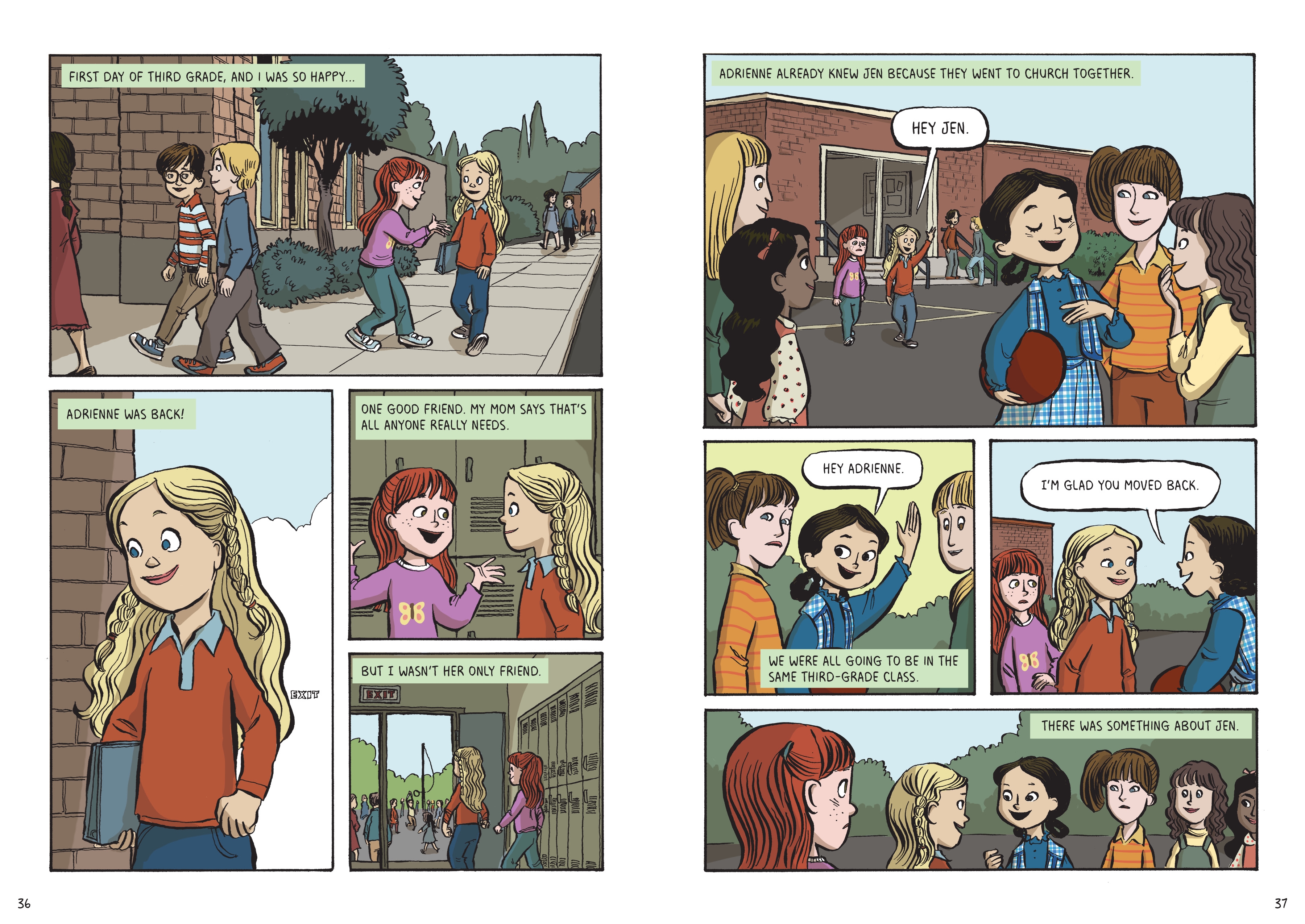
We see the effects of stress on Shannon, who develops OCD-type behavior and manifests physical ailments often associated with anxiety. We also see how Shannon copes by creating her imaginary worlds – she’s a Wonder Woman, a Charlie’s Angel, a secret agent, and she brings her friends along for the ride. This book is powerful for a girl who, like Shannon, grew up in the ’70s, disappeared into my own imagination, and struggled for years with Groups and backstabbing. I’m an only child, but Shannon could have been writing about me – and that’s how readers will feel reading this book, just like readers do when they read literally anything by Raina Telgemeier.

Readers will know this is their story, whether they’re an 8 year old kid or a 46 year old librarian and book blogger; maybe there’s a boy out there who, like Shannon or Kayla, another character, hides in the bushes so no one will see them crying and make fun of them. Real Friends is painful, real, and beautiful.

Real Friends received a starred review from School Library Journal, and Kirkus offers an interview with Shannon and Dean Hale. Wander over to Shannon Hale’s author page for information on her other books, games and quizzes, and more; LeUyen Pham’s webpage is loaded with neat things to see, including a free, downloadable Love: Pass It On poster, and links to her illustration, Facebook, and book pages.

This one is a no-brainer for collections. Display with Victoria Jamieson’s Roller Girl, Raina Telgemeier’s Smile, and Sisters, and novels like Jennifer L. Holm’s Fourteenth Goldfish,  and Dana Alison Levy’s Family Fletcher books. If it’s a display or book talk on self-esteem and standing up to the crowd, make sure to include Kathryn Otoshi’s Zero, One, and Two.

Posted in Fiction, Fiction, Historical Fiction, Middle Grade

The Gray Twins reunite in The Whispers in the Walls

Scarlet and Ivy: The Whispers in the Walls, by Sophie Cleverly, (May 2017, Sourcebooks Jabberwocky), $7.99, ISBN: 9781492634065

Recommended for readers 8-12

When we left Ivy Gray at the dismal Rookwood School, she had just found her lost twin, Scarlet; hidden away in an asylum by the tyrannical headmistress, who told her family that Scarlet was dead. Masquerading as Scarlet, Ivy attended Rookwood and discovered the truth about a great many secrets. The Whispers in the Walls picks up just as Ivy reunites with Scarlet and they go home, only to have their spineless father and cruel stepmother send the two girls back. Back to the school that hid one daughter in an asylum and lie about her death. Their father drops them off with a “But it’s different now, it’s still a very good school with a new headmaster”, and has the nerve to tell them he loves them after that, securing a Father of the Year award sometime in the future, I’m sure.

Things aren’t wonderful back at Rookwood. Penny, Scarlet and Ivy’s tormenting nemesis, is still there, and she’s worse than ever. Violet, Penny’s best friend, and bullying accomplice, the girl who was also hidden away at the same asylum, is sent back to Rookwood, but is quiet, withdrawn, and now rooming with Ariadne. Scarlet is insufferable to such a degree, Ivy finds herself distancing from her twin. The headmaster, the sinister Mr. Bartholomew, is a fanatical disciplinarian whose punishments go beyond reason.

The girls are thrown back into this maelstrom, with most of the student body none the wiser. But there are new secrets discovered at Rookwood; secrets about Mr. Bartholomew himself; a secret group of students from the past that may include Scarlet and Ivy’s mother, and another girl rescued from the asylum, hiding in the school.

The Whispers in the Walls is a good follow-up to The Lost Twin, but Scarlet is nearly insufferable. She’s difficult for the mere sake of being difficult, and may put off readers as much as she does her twin sister. Ivy remains a strong character who continues developing through the story; I hope she rubs off on Scarlet for future adventures. The new headmaster, Mr. Bartholomew, continues the tradition of awful school management – Rookwood seems set to go through headmasters and headmistresses like Hogwarts goes through Defense of the Dark Arts professors. There are several story threads presented in The Whispers in the Walls, only a couple of which are resolved; I’m looking forward to seeing where the third book takes us.

Posted in Animal Fiction, Fiction, Middle Grade

Happy #Nocturnals Day!

It’s the Nocturnals, Book 3: The Fallen Star‘s book birthday today, and I’d like to shine a (soft) spotlight on my favorite Nocturnal, Tobin! Fabled Films put together a little writeup about pangolins that I thought I’d share with you. Enjoy!

In The Fallen Star, the third installment of the non-episodic middle grade series, The Nocturnals, all of the forest’s pomelos have been inexplicably poisoned. Iris, a mysterious aye-aye, claims that monsters from the moon are to blame. When Tobin the pangolin falls ill, the Nocturnal Brigade must race to find answers, and the cure, before this possibly unearthly predicament threatens to harm them all.

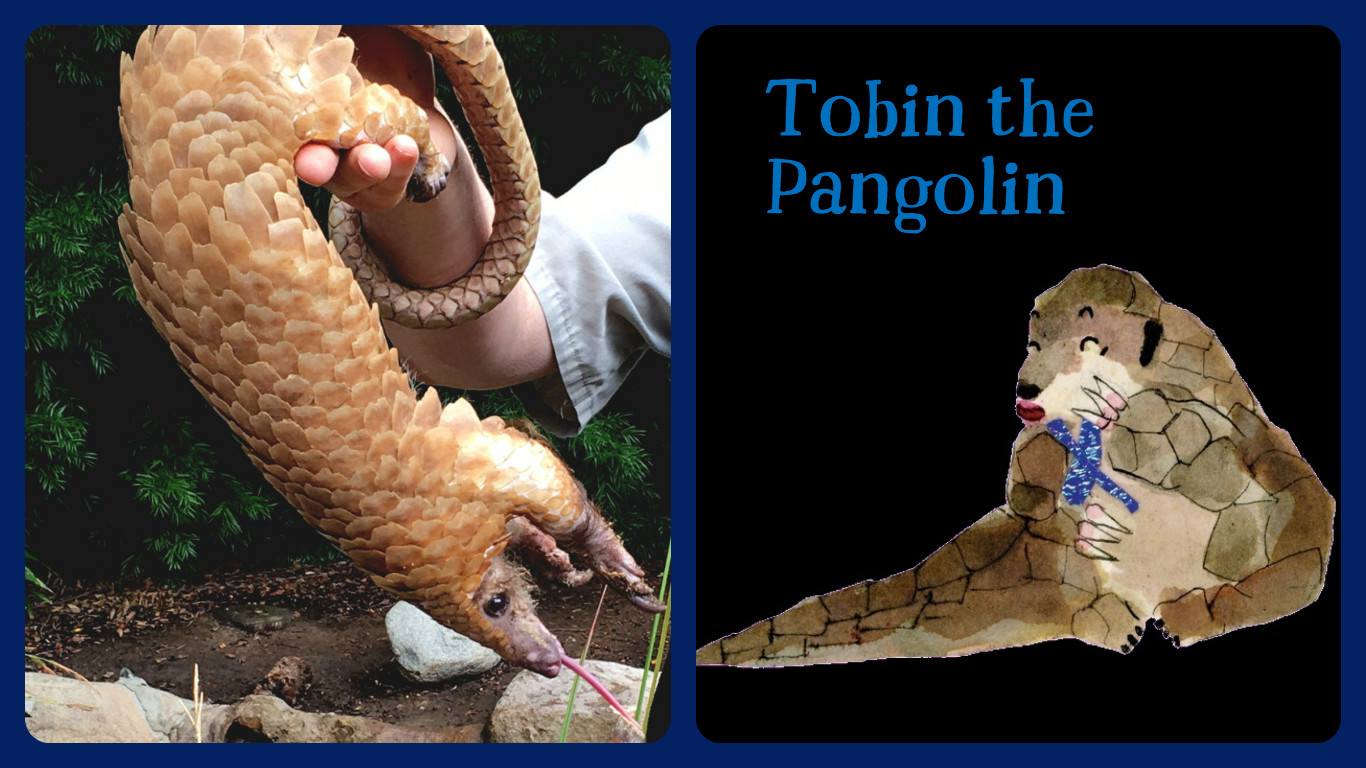
Tobin is one of the main characters of The Nocturnals series, and many of our readers write to us saying that they have never heard of the critically endangered pangolin before reading our books. Here are some interesting facts about pangolins that help inform and develop Tobin’s character.

Pangolins are funny-looking creatures, but everything about them is designed to help them survive and protect themselves. All of their physical features perform a specific job.

Pangolins look like they wear an armor, and that’s because they are covered in scales made of keratin, which is the same thing that our human fingernails are made of. Just like our fingernails, the keratin on a pangolin is hard and forms a protective shell. Whenever Tobin is scared, he curls up as a way of protecting himself.

Not only does Tobin curl himself up for protection with his scales when he’s scared, but he also sprays something smelly to ward off predators. This smell comes from the scent glands on his tail end. Remember when Bismark complained how stinky Tobin was when they first met? That was because Tobin sprayed something because Bismark had startled him. When Tobin is afraid, he sprays an unpleasant smell from his scent glands. This reaction also helps deter the thing that he’s afraid of. Tobin is sometimes embarrassed by this bad smell, but he shouldn’t be, because spraying that smell helps him survive (especially if the smell has been enhanced by a poisoned pomelo, like in The Fallen Star!).

Pangolins have very poor eyesight. When Tobin first meets the bats in The Mysterious Abductions, he thinks that they’re the same creatures as Bismark because he can’t see very well. But Tobin has other senses like smell and hearing that compensate for his poor eyesight. His very long snout makes his nose very sensitive. Instead of seeing something, he can detect its presence by smelling it.

To read more about pangolins and their special features, check out these resources:

“Mammals.” Animal Encyclopedia: 2,500 Animals with Photos, Maps, and More! Washington, D.C.: National Geographic, 2012. 47. Print.

(http://www.iucnredlist.org/ ;

(http://animaldiversity.org/)

(Macdonald, David W. “Pangolins.” The Princeton Encyclopedia of Mammals. Princeton, NJ: Princeton UP, 2009. 476-77. Print.)


Posted in Adventure, Animal Fiction, Fantasy, Fiction, Middle Grade

The Nocturnals Return in The Fallen Star

The Nocturnals (Book 3): The Fallen Star, by Tracey Hecht/Illustrated by Kate Liebman, (May 2017, Fabled Films Press), $15.99, ISBN: 9781944020057

Recommended for readers 8-12

The lovable group of Nocturnal sleuths is back in their third adventure, this time with high stakes: the forest’s pomelos have been poisoned, and the flowers that cure the sickness are disappearing! As the group watches a star fall one evening, they meet a mysterious aye-aye, Iris, who declares that the forest is being invaded and monsters from space have poisoned the pomelos! Dawn, ever the thoughtful and skeptical fox, is suspicious, and seeks a more down-to-earth reason, but things become more tense when they discover that animals in the forest are getting sick, including poor Tobin, who’ve all eaten pomelos. The blue flowers that help cure the sickness are disappearing, and a strange blue glow shows up right before the flowers start disappearing. This sounds like a job for the Nocturnals!

This third book in the animal friends series takes no prisoners: things are tense, with the friends racing against time to help their sick friends and find out the truth behind the poisoned fruit and disappearing cure. Bismark is in full narcissist with a heart of gold mode, proclaiming he speaks alien (and then slipping and admitting it was gibberish) and wooing Dawn every chance he gets. Dawn is still the most focused and perceptive member of the group, and sweet, gentle Tobin is the source of possibly the greatest fart joke in the history of children’s literature, giving readers much-needed comic relief throughout the white knuckle moments The Fallen Star is filled with.

We also meet some more animals in this book; most notably, an Aye-aye named Iris, and the woylies, a group of small marsupials who pitch in to help the Nocturnals. You can find more information about Aye-ayes at Zooborns.com, and Whiteman Park, a conservation center in Australia, has a downloadable fact sheet available on the endangered woylie.

This Aye-aye has its eyes on you! (source: Zooborns.com)
Woylie: Now say it with an Australian accent! (Source: whitemanpart.com.au)

Teamwork, friendship, and determination sees the friends through this latest adventure, and there’s a lovely message about tolerance that is especially important reading.

Things have started taking off for Nocturnals since the first book published last year!  The Nocturnals World website offers Boredom Busters, face painting tips, and a wealth of educational resources for classrooms and libraries, and the New York Public Library, in conjunction with Fabled Films, launched a read-aloud writing program in New York City public schools.

Posted in Fiction, Realistic Fiction, Teen, Young Adult/New Adult

Everything can change in One Moment

One Moment, by Kristina McBride, (Jan. 2017, Sky Pony Press), $9.99, ISBN: 9781510714557

Recommended for ages 14-18

Maggie is looking at the best summer of her life. She and her group of best friends are heading into their senior year of high school, and she’s made a big decision about her relationship with her boyfriend of almost two years, Joey. But things change in an instant when the friends head out to the gorge to kick off their summer; Joey, the charismatic daredevil of the group, dives off a cliff, and the next thing Maggie remembers is her friend Adam coming to get her and seeing Joey, unmoving, on the ground. As Maggie and her friends mourn Joey’s death, she also discovers that Joey kept so man secrets – secrets that Adam and her friend, Shannon, seem to be privy to. As Maggie struggles to regain her memory of that fateful day, she learns that Joey may not have been everything she thought he was.

Part mystery, part coming of age heartbreaker, One Moment looks at the hole left when a loved one dies, and the confusion and anger that step in when they leave behind secrets. Maggie is at times sympathetic and at times frustrating; the author leads readers to figure things out long before Maggie does, and more often than not, she falls into a classic victim role. She finds her strength by ultimately letting Joey go in her own way, but getting there can be a battle. The story does speak to the

Teen romance and realistic fiction fans will enjoy this one. Booktalk this with Julie Anne Peters’ Lies My Girlfriend Told Me; it’s a strong readalike from an LGBTQ perspective.


Posted in Preschool Reads, Toddler Reads

Blog Tour: Share, Big Bear, Share! And Giveaway!

Big Bear has a big pail of yummy blueberries! His friends would like some, too, but Big Bear seems to be a bit clueless. The old oak tree tells him to SHARE, BIG BEAR, SHARE!, but Bear is so enamored of his blueberries, he’s not really listening – and hears something different each time! Will he finally realize that a good friend shares, and invite his pals to have some berries?

Share, Big Bear, Share!, by Maureen Wright/Illustrated by Will Hillenbrand, (Apr. 2017, Two Lions), $17.99, ISBN: 978-1503951006. Recommended for readers 3-7

Share, Big Bear, Share! is a great story for preschoolers and kindergarteners, who are developing social skills and learning to share and work together. Big Bear is a nice bear, he’s just a little unaware; when the Old Oak Tree tells him – multiple times – to share, Big Bear – who’s not really listening; he’s got an entire bucket of blueberries! – half-hears the message, with hilarious results. The message for readers is twofold: sharing is important, but so is paying attention! I think a round of the old game, Telephone is a perfect accompaniment to this story: a teacher, parent, or educator whispers something into one child’s ear and has the message go around the group, until the last player states what he or she heard, which is usually something very different from the original statement!

The story makes it point in a sweet, funny way that appeals to young readers. Will Hillenbrand’s graphite pencil artwork, fleshed out with digital media, gives Bear and his woodland friends a cuddly quality that kids will love. Old Oak Tree looks wonderfully wise and his facial expressions are perfect and accurate. Kids will have seen that face on their caregivers many times!

Share, Big Bear, Share! is the third Big Bear book by Maureen Wright and Will Hillenbrand (Sleep, Big Bear, Sleep! and Sneeze, Big Bear, Sneeze!) Display this one with books like Anna Dewdney’s Llama Llama, Time to Share and Leo Lionni’s It’s Mine! for readalikes; build a social skills library by adding Beth Ferry’s Stick and Stone, Rowboat Watkins’ Rude Cakes, and Julie Gassman’s You Get What You Get.

There’s a Help Big Bear SHARE Game, available through illustrator Will Hillenbrand’s website, for you to download, print, and hand out.

GIVEAWAY! Want a chance to win your own copy of Share, Big Bear, Share? Enter here!

WILL HILLENBRAND has written and/or illustrated over 60 books for young readers including Down by the Barn, Mother Goose Picture Puzzles and the Bear and Mole series. He has lived almost all of his life in Cincinnati, Ohio, where he grew up as the youngest of four boys. He now lives in Terrace Park and was recently honored as Author/Illustrator in Residence at Kent State University.

Information about his books, selected readings, art process videos and activity ideas can be viewed at www.willhillenbrand.com. Connect with Will at www.facebook.com/willhillenbrandbooks.


Posted in Fiction, Fiction, Intermediate, Realistic Fiction

Meet The Kelly Twins!

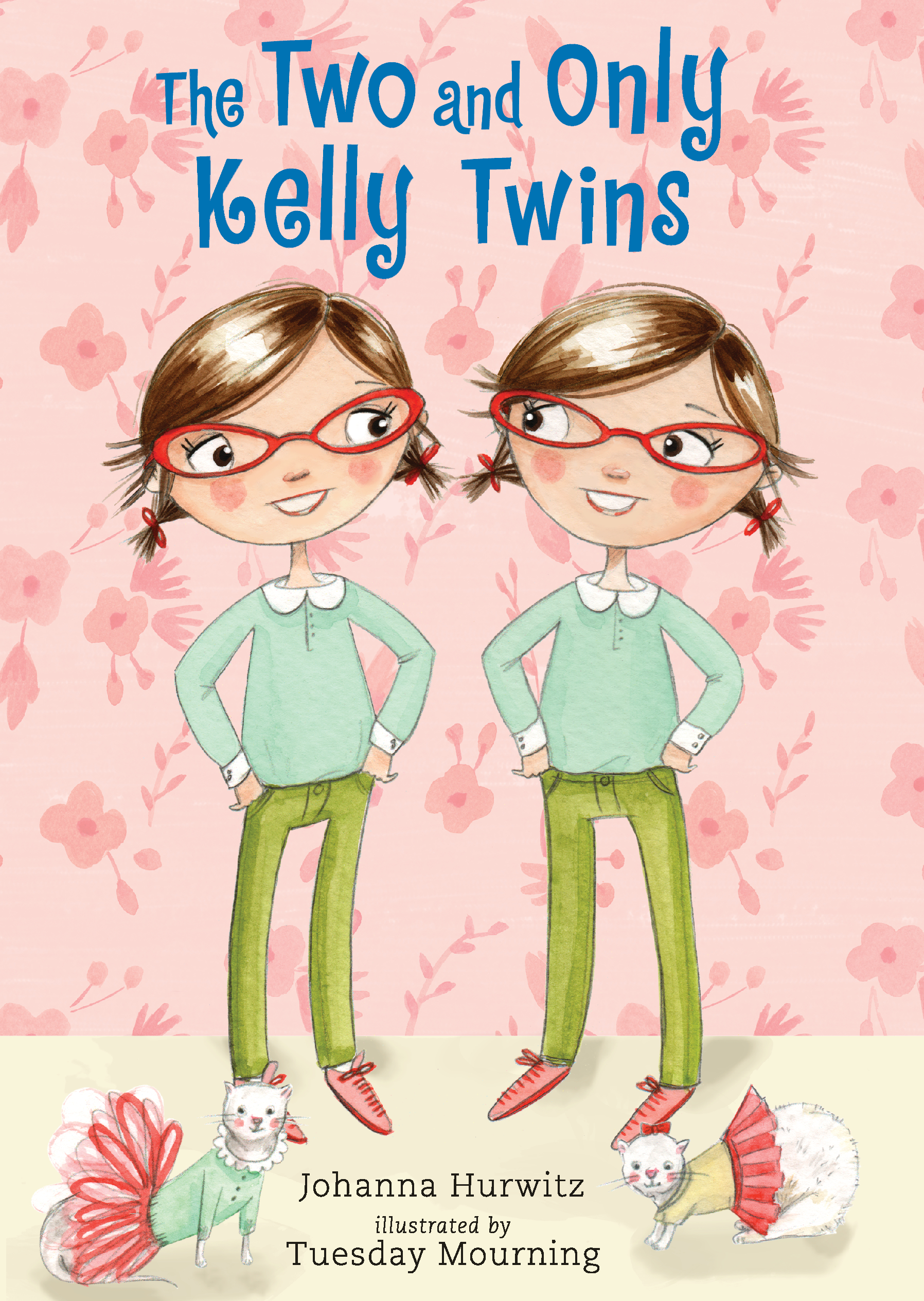
Second graders Arlene and Ilene are The Kelly Twins: twins with two different birthdays! (One was born at 11:55 pm on July 17th, the other at 12:03 am on July 18th.) They look alike and they dress alike; they even share a bedroom. They’re in two separate classes at school, but otherwise, they’re always together.

In Arlene and Ilene’s first book, The Two and Only Kelly Twins, the twins get matching identical pet ferrets, which they dress alike (naturally), get a little jealous when a set of triplets arrives at their school, and learn that being an identical twin, wearing an identical Halloween costume, isn’t the greatest thing for trick-or-treating. They also learn what it’s like to be separated, when Arlene has to be hospitalized with appendicitis – and that makes them not exactly alike anymore!

Double or Nothing With the Two and Only Kelly Twins is the newest Kelly Twins story. In Double or Nothing, the twins continue exploring what makes them different, from getting a haircut to learning that friends with siblings look forward to time on their own, away from their sisters and brothers.

Fans of Johanna Hurwitz’s Monty series will be happy to see that he shows up in the Kelly Twins books. The Kelly Twins books are perfect for fans of Ivy and Bean, Judy Moody, Anna Branford’s Violet Mackerel books, and Cherise Mericle Harper’s Just Grace. I’d include some diverse chapter books, like Hilary McKay’s Lulu series, the Katie Woo and Ruby Lu books, Monica Brown’s Lola Levine series, and Karen English’s Nikki and Deja books. There are so many great chapter books that boys and girls love that you can feature here, this is just a smattering! (I may have to do a longer book list on this…) Parents and educators can download a curriculum guide here!


Tuesday Mourning’s black and white illustration are adorable and really give each twin her own personality, highlighting subtle differences between the two. She also puts ferrets in sweaters and skirts: who wouldn’t love that?

The Two and Only Kelly Twins, by Johanna Hurwitz, (Sept. 2013, Candlewick Press), $14.99, ISBN: 978-0763656027

Double or Nothing with the Two and Only Kelly Twins, (Apr. 2017, Candlewick Press), $14.99, ISBN: 978-0763688080

Recommended for readers 6-9

Double Fun Giveaway!
One lucky winner has a chance to receive both books featuring the Kelly twins–The Two and Only Kelly Twins AND Double or Nothing With the Two and Only Kelly Twins! (U.S. addresses only, please). Check out this Rafflecopter giveaway to enter!

Johanna Hurwitz is a former children’s librarian and the award-winning author of more than seventy books for children, including The Two and Only Kelly Twins and four books about Arlene and Ilene’s friend Monty, who lives on their street. Ms. Hurwitz divides her time between Great Neck, New York, and Wilmington, Vermont. To learn more, visit her website: johannahurwitz.com.


Posted in Fantasy, Fiction, Humor, Intermediate

Hazy Bloom and the Tomorrow Power – what will she see next?

Hazy Bloom and the Tomorrow Power, by Jennifer Hamburg/Illustrated by Jenn Harney, (Feb. 2017, Farrar Straus Giroux), $15.99, ISBN: 978-0-374-30494-2

Recommended for readers 7-10

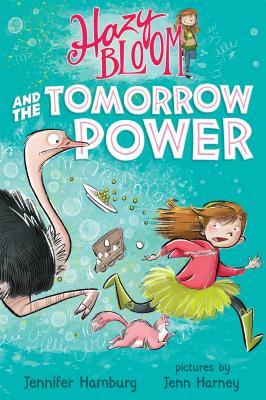
Third grader Hazel Bloom (call her Hazy, please) is having visions – peas flying in the air, eggs crashing to the ground – that come true in the craziest of ways, the day after she gets her visions. Her best friend calls it her “tomorrow power”. Hazy tries to head off any catastrophes at the pass, but she always manages to make the wrong move, causing chaos instead of preventing it. If she can find her focus, maybe she can use her “tomorrow power” to save the day when she’s needed most!

The Tomorrow Power is the first in a new intermediate chapter book series about a girl who finds herself with a touch of precognition, with humorous results. Most of the fun comes from Hazel trying to figure out where the vision will take place, and trying to prevent it, while trying to function like a normal kid. There are black and while illustrations throughout, outrageous situations, and a likable group of characters. Pair with the Heidi Heckelbeck series by Wanda Coven for some fun intermediate magical reading.

Posted in Fiction, Fiction, Middle Grade, Realistic Fiction, Tween Reads

A young girl finds One Good Thing About America every day

One Good Thing About America, by Ruth Freeman, (March 2017, Holiday House), $16.95, ISBN: 9780823436958

Recommended for readers 8-12

At home in the Congo, nine year-old Anaïs is the best English student in her class. She loves spending time at her grandmother’s home. She loves her family: her father, her older brother, Olivier, and younger brother, Jean-Claude, and her mother. But now, her father is in hiding, her older brother, stayed in Africa with their grandmother, and Anaïs, Jean-Claude, and their mother are living in a shelter in Crazy America. Nothing about the people or the language makes sense to her – why would anyone eat chicken fingers? Why do vowels change sounds with every word? – and she misses her home, her life before.

Written in the form of letters from Anaïs to her grandmother, One Good Thing About America, by Ruth Freeman, a teacher who works with English Language Learners. Motivated by her students’ determination and their stories, this is her tribute to them as much as it is a chance to create an understanding of the immigrant experience in America. Anaïs, her family, and her classmates and neighbors develop through the course of the story; experiencing sleepovers, mac and cheese dinners, Halloween, and even a frightening emergency room trip. We never get the full story behind Anaïs’ father’s trouble with the mining company, but readers understand the urgency of the situation: her father is in hiding, on the run, and no one that associates with him is safe. While Anaïs longs for her family to be whole again, she has the added challenge of learning a new language and making a new life in a strange country where nothing makes sense. She has good days and bad days; goes from hopeful to frustrated, and every reader will appreciate and understand where she’s coming from. Little doodles throughout the book illustrate new things Anaïs encounters, from the crunchy fall leaves that “make the sound of eating toast” to ice cream and pizza.

A list of English words Anaïs struggles with – what she hears, as opposed to what she learns – also helps readers understand the challenges our language and colloquialisms present to English language learners. Words in French, Anaïs’ native tongue, introduce readers to some new vocabulary.

One Good Thing About America is a good book for all communities. In our current socio-political climate, I daresay it should be a summer reading selection for middle graders (and their families). I suggest booktalking with Andrea Davis Pinkney’s The Red Pencil and Thanhha Lai’s Inside Out & Back Again for excellent discussions about the differences within the refugee experience.

Posted in Animal Fiction, Preschool Reads

Bow-Wow-Meow takes a sensitive look at identity

Bow-Wow-Meow, by Blanca Lacasa/Illustrated by Gómez, (May 2017, nubeOCHO), $16.95, ISBN: 978-84-94515-7-5

Recommended for readers 4-8

Fabio’s a dog that really isn’t into doggish things. He doesn’t play fetch, he doesn’t roll over to have his belly tickled, he doesn’t wag his tail, and he doesn’t bark. His family tries to teach him how to act like a dog: they throw sticks, they roll around on the floor, and they bark at him. Fabio is uninterested. One night, Max, a little boy in the family, discovers that Fabio is going out at night, and follows him: right into a group of cats engaging in very catlike behavior, from coughing up hairballs to playing cards (hey, are you with your cat 24/7?). Max can’t believe how happy Fabio is as he sharpens his claws, climbs drainpipes, chases mice, and bow-wow-meows along with his feline friends. The next morning, when Max’s parents try to get Fabio to act like a dog, Max quietly acknowledges Fabio, making him the happiest member of his family.

Recognition and visibility are important. When Max acknowledges Fabio, when he sees Fabio for who he really is, Fabio’s whole world changes; Max’s world widens that much more. Bow-Wow-Meow sensitively handles identity and diversity for young readers. By telling Fabio’s story using dogs and cats, kids are entertained and enlightened in a sweet, fun way that leaves the pathways open for discussion again and again. Gómez’s bold artwork is fun and expressive and will appeal to storytime audiences. Younger readers may struggle with some pages, where the black text is superimposed over a dark background.

I’d love to read this with Jules Feiffer’s Bark, George, for a good storytime on diversity and animals. You can also display and pair this with books like Morris Micklewhite and the Tangerine Dress, by Christine Baldacchino, or Jacob’s New Dress, by Sarah and Ian Hoffman. Mothering.com has a good article with recommendations for kids’ books that defy gender.