Posted in Fiction, Uncategorized

The Most Magnificent Thing teaches kids perspective

the most magnificent thingThe Most Magnificent Thing, by Ashley Spires. Kids Can Press (2014), $16.95, ISBN: 9781554537044

Recommended for ages 4-8

One day, a girl and her dog set out to make the “most magnificent thing” – the girl draws up schematics (her dog is the assistant), gets materials, and sets up on the street, getting to work. When she’s finished, she takes a look at it – it’s not really what she had in mind. She tries again. And again. And again. She just can’t make her vision come to life, and she gets MAD. At this point, her assistant suggests a walk, where she starts to feel better; she finds she has regained self-control and even more, perspective, allowing her to go back and look at her previous creations with a refreshed eye.

Ashley Spires, who some may know from her Binky the Space Cat series, looks at the frustrating process of working on something and not having it turn out the way you envision it. It is something everyone can relate to, from a LEGO structure to a Science Fair project to a PowerPoint presentation for the big client meeting. Children, who are still learning the delicate art of self-control, will recognize themselves in these pages, as the girl becomes increasingly frustrated with her work, and once she injures herself, loses her temper. Her dog/assistant serves as comic relief and ends up saving the day by having her walk away and clear her head. The book teaches a valuable lesson to kids and grownups alike; walking away and returning when you’re calmer often allows the ability to see things are not so bad after all, and maybe, you can even find things you liked in the project you were about to crumple up and throw out.

The digital art is adorable. The characters have large, expressive faces, and are set against a mostly line-art, blue and black or white and black background, so they really stand out. There are some beautiful spreads and the font itself is a curvy font with a quirky personality and fits perfectly with the story. The endpapers display the row of brownstones where the story takes place, leading the reader into the story.

This is a good book to use for a storytime on patience or feelings. Perhaps a small LEGO craft afterward, or a construction paper assembly craft will help young minds create their own most magnificent things.

Posted in Fiction, Tween Reads, Uncategorized

Minerva Mint: The Order of the Owls

minervamintMinerva Mint: The Order of the Owls, by Elisa Puricelli Guerra/illus. by Gabo Leon Bernstein, Capstone Young Readers Group (2014), $9.95, ISBN: 9781623700386

Recommended for ages 8-10

Minerva Mint: The Order of the Owls is the first book in a new middle-grade series about an eccentric young girl named Minerva Mint, her two friends, Thomasina Crowley and Ravi Kapoor, and the mysteries that the group solves together; the most important being to find Minerva’s parents.

Minerva was found, as an infant, in a bag in Victoria Station. She lives in Lizard Manor -a large, ramshackle mansion that has seen better days – with Mrs. Flopps, the station custodian who discovered Minerva. Minerva meets Ravi and Thomasina, and the three become fast friends. Thomasina shares Minerva’s adventurous spirit and Ravi, a bit more level-headed and fearful, comes along for the ride at first because of his crush on Thomasina. He grows into himself during the group’s first adventures, but I’m pretty sure we’ll still see him as the voice of reason in the group.

This first book establishes the characters and the underlying mystery that will permeate the series – who are Minerva’s parents, and why did they leave her as an infant? There are some clues in the bag Minerva was found in, and she tries to put the pieces together. Thomasina and Ravi are sworn to help her, but Minerva is no damsel in distress; she can handle after years of fending off various long lost “parents” who come to the home in search of the valuable real estate and imagined riches in Lizard Manor.

The story is fast-paced and light, perfect for a middle-grade read about friendship with some mystery thrown in. Minerva is a quirky, fun character that will appeal to girls who want to step outside the “girly” model. Thomasina – pretty, blonde, wealthy Thomasina – is an adventurous spirit and a friendly, outgoing girl, which is a relief if you’re tired of the seemingly obligatory mean girls popping up as dramatic foils. Ravi is a shy, fearful boy who allows himself to be drawn out by the two girls. The group’s valued friendship sends a good message to younger readers about sticking together.

Gabo Leon Bernstein’s black and white illustrations are adorable and add to the story, giving us characters to bond with and creepy, fun landscapes. His illustrations advance the plot and fire up the imagination.

I look forward to more Minerva Mint books, and luckily, there are a two in progress: Merlin’s Island and The Legend of Black Bart. The publishers website offers extras, including character profiles, a book trailer, and downloadable clues sheet and a secret club contract that readers can use for their own secret societies!

Posted in Science Fiction, Teen, Uncategorized

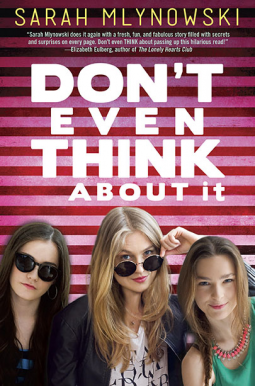
Don’t Even Think About It – Talk About Your Strange Side Effects!

Don’t Even Think About It, by Sarah Mlynowski, Random House Children’s (2014), 9780385737388, $17.99

dontthinkaboutitRecommended for ages 16+

I was lucky enough to be chosen by Random House to review an advanced copy of this book, by Sarah Mlynowski, who I fondly remember from her Red Dress Ink chick lit days. I thoroughly enjoyed her book Milkrun, so I was excited to see that she was writing YA. The plot is certainly different: a group of New York teens, attending Bloomberg Public High school down in Tribeca, develop ESP after receiving a tainted batch of flu shot at school.

Ms. Mlynowski has her ensemble cast: Cooper and Mackenzie the young lovers, one of whom has a secret; Pi, the overachiver; Olivia, the shy girl; BJ, the pervert; Tess, the one with the unrequited love for her best friend – these personalities and more are all here, which gives a feeling of familiarity to those reading the book. You know these kids – we’ve been these kids, in many cases. The characters aren’t soul-searching, and don’t require that depth of character for this quick read. It’s a situational piece of fiction.

What interested me was not the superficial teens, because they mostly are – even “the brain”, Pi, who uses her powers to try and get ahead of the number one student in the school so she can get the vaunted Harvard acceptance letter – it was how they dealt, on their own levels, with their newfound abilities. They didn’t take to Twitter, Instagram, or Facebook to discuss it with the world. They kept it quiet. They didn’t want anyone to know, because they live in a day and age where they know they’d be poked and prodded like test animals, or even worse, have their ability – something to give them an edge, to make them special – taken away from them. At the same time, Mlynowski creates an interesting portrait of what these abilities do to their bearers. It’s not always predictable, and it was enjoyable to see things play out.

The book is suggested for 16 and over for some language and situations. For a quick, light read between tests and papers, Don’t Even Think About It will fit nicely in your backpack.

Posted in Graphic Novels, Tween Reads, Uncategorized

Guest Post from WhatchaReading: Preview! NFL RUSH ZONE: GUARDIANS OF THE CORE SUPER BOWL™ EDITION TPB


From Chuck at WhatchaReading:


I haven’t read NFL Rush Zone yet, the series on Nicktoons looks great and I’ve come to expect nothing less than excellence from our pals over at Action Lab. Maybe it’s time to give this one a try?

NFL rush zone


Read more and get order details at WhatchaReading!

Posted in Fantasy, Preschool Reads, Uncategorized

When You Wish Upon the Moon… Randy DuBurke’s Moon Ring Takes You on a Trip

Book Review: The Moon Ring, by Randy DuBurke, Chronicle Books 2002
Recommended for ages- 4-8

the moon ring

Maxine, a young girl, sits on the porch, with her grandmother, seeking relief from the summer heat, when a magic ring seemingly falls from the blue moon. Maxine is swept away on a magic ride around the world – to the South Pole, a wild savannah, and New York City, accompanied by some new friends. But what happens when she runs out of wishes?

The book is a fun fantasy tale about magic and the moon. We always hear about wishing on a star, but the moon is the star of the show here (no pun intended). Randy DuBurke gives readers a classic fairy tale elements – granting wishes, being transported to exciting adventures and locales, and the temporary scare – the wishes have run out!

Young readers will enjoy the close relationship Maxine and her wise grandma who knows that magic is out there. Maxine is drawn with a wonderfully expressive face – it makes for fun reading, with prompts to children learning about facial expressions and emotions. The exciting, changing landscapes are beautifully rendered in pen, ink, and acrylics on cold waterpress paper. The story uses its space well, alternating between full-bleed spreads and framed panels. I read the digital version of this book, so I can’t speak to the fonts, but I’m sure a read-aloud with the actual book will work better with a young group.

The Moon Ring is a playful, fun book that makes for a good read-aloud session. This would be a great addition to a read-aloud about magic, imagination, or the moon. There are many rhymes and fingerplays about the moon that would be good companions to this book – Hey Diddle Diddle would be a fun start!

Posted in Uncategorized

Book Review: Baby Shoes, by Dashka Slater/illus. by Hiroe Nakata (Bloomsbury, 2006)

baby shoesRecommended for ages 2-5

A toddler’s new white shoes with a blue stripe turn into multicolored shoes after an eventful day in the park with his mother.

Mama buys Baby gets a new pair of white shoes with a blue stripe and then head to the park, where Baby proceeds to get those new white shoes covered in chalk, grass, plum juice, and yellow paint as he barrels through his day. With every new “decoration” on his shoes, Baby and Mama exchange an “Uh-oh!” and an “Oh, no!”, but those shoes just go, go, go! The repetitive, rhyming text invites young audiences to jump in and participate, and the watercolor illustrations provide inviting images the draw readers into Baby and Mama’s eventful day. There is a great deal of action in the book, with dotted lines tracing Baby’s path and Mama in a perpetual runner’s crouch, hands extended, to catch the active Baby. The endpapers invite the reader into the story, showing Baby’s shoes in a variety of situations that arise in the book: getting caught in the path of a red chalk line, running through grass, and negotiating a yellow line of paint. The plain black font is bold enough to stand out from its sedate but colorful background, and curves around the text to continue the feeling of action.

This is a great story to bring into a lapsit read-aloud, especially as the book is targeted at active toddlers and young preschoolers. The repetitive text engages young listeners and offers them the opportunity to chime in with Mama, Baby, or both as baby collects a new color on his shoes. Rhymes and fingerplays will get the active toddlers playing and moving. A Raffi CD would add enjoyable music, allowing a dance time to bring a successful storytime to a close.


Posted in Preschool Reads, Uncategorized

Book Review: Rain Romp, by Jane Kurtz/Illus. by Diana Wolcott (Greenwillow Books, 2002)

RainRompRecommended for ages 3-6

Preschoolers often deal with moods that they don’t know how to control; many will associate with this young girl who wakes up in a bad mood on a rainy day. Her parents try to boost her mood, but she wants none of it, until she decides to stomp her bad mood away in the rain. Her parents join her, and the bad mood goes away. The watercolor and gouache art is perfect to convey the both the weather and the girl’s moods, going from angry and gray, like the rain, to happy and content, as the sun peeks through the clouds. The text curves around the art and gets larger for emphasis when the girl vents her anger.  As she and her family hug, mood lifted, the text curves underneath them, allowing the reader to join in the hug.

This would be a good addition to a read-aloud on moods. There could be a discussion on what preschoolers do when they are angry, or sad, or happy. If they feel sad or mad, what makes them feel better? A good storytime craft would allow the children to draw a picture of how they deal with a bad mood, and they could receive a smiley face handstamp at the end of the storytime.

Posted in Uncategorized

Book Review: I Stink! by Kate McMullan/illus. by Jim McMullan (HarperCollins Children’s Books, 2002)

i stinkRecommended for ages 2-5

While the rest of the city sleeps, a garbage truck wakes up to start his work day. The smiling truck is proud of his powerful engine and the noises and smells that are part of his job – he roars and burps his way through an “alphabet soup” of trash, from apple cores to zipped-up ziti with zucchini-and brags about how much he stinks, telling the reader, “No skunk has ever stunk this bad!” He heads to the river to eject the trash onto a barge, and heads back to the garage to gas up and sleep until the next night. The watercolor-and-ink illustrations use a palette of darker colors to communicate the sleepy city and the colors of the garbage itself. The text is bold and appears in assorted sizes and colors, fitting the garbage truck’s friendly and big personality.

The voice of the truck provides for a fun read-aloud, where children can chime in and make truck noises: burping, roaring, saying ahh. There are many truck crafts, songs and fingerplays to create a truck-related storytime. Children can create their own trucks using construction paper shapes and popsicle sticks; several websites offer printable truck pictures to color.

Posted in Preschool Reads, Toddler Reads, Uncategorized

Book Review: Baby in Car, by Monica Wellington (Dutton Books, 1995)

baby in a carRecommended for ages 0-4

Monica Wellington’s Baby in a Car begins with the question, “What does baby see?” and answers by taking a toddler on a road trip filled with fun things to see from the car. This brightly colored board book is filled with bold, bright illustrations that toddlers will easily recognize, from traffic lights and taxis to flags and umbrellas.  The cartoon style illustration uses gouache collage to provide texture, including the blades on a helicopter, leaves on an apple tree, and the moon’s shading. Young readers will be attracted to the bright pictures of easily identifiable objects, and the childlike lettering further communicates a young, happy tone. Parents and guardians can use the book on car rides, whether to the grocery store or a longer family trip, to keep children happy and begin conversations about their surroundings.

Baby in a Car is part of a series by Wellington that includes Baby in a Buggy, Baby at Home, and Baby Goes Shopping.

Story time activities could include traveling rhymes and fingerplays including Wheels on the Bus and Over the Mountain. The book can be used in a participatory fashion, with the reader asking, “What does baby see?” and allowing parents and children to respond with each picture. 

Posted in Uncategorized

Book Review: My People, by Langston Hughes/illus. by Charles R. Smith Jr. (Ginee Seo books/Atheneum Books for Young Readers, 2009)

my peopleRecommended for ages 3-8

Langston Hughes’ 1923 poem is brought to life with images by illustrator Charles R. Smith in this 2010 Coretta Scott King Illustrator Award-winning book. The book brings together the 33 words of Hughes’ beautiful ode to beauty and sepia-toned photographs of African-Americans of all ages. The photos are close-up, happy, expressive faces against a black background, with additional photos of faces running down the margins of the pages; these are lighter sepia so as not to distract from the main photos and words on the page. The faces appear to emerge from the shadows, and Smith often juxtaposes young and old together, creating a perfect harmony on each spread. The font is large and bold, alternating white and sepia. The endpapers offer a collage of faces in the overexposed, faded sepia we see on the page margins inside.

This is an excellent story time choice for young audiences. The faces will appeal to babies, toddlers and preschoolers alike, and at 33 words, the reader can take his or her time, allowing listeners to enjoy the faces and allow the words to sink in. This would make an excellent Black History Month reading, but can be a reading done at any time. It would be a good addition to a multicultural story time in diverse neighborhoods, which could include fingerplays and songs from other cultures. Participants can be invited to contribute their own nursery rhymes, songs and fingerplays.