Posted in Post-apocalyptic/Dystopian, Science Fiction, Tween Reads

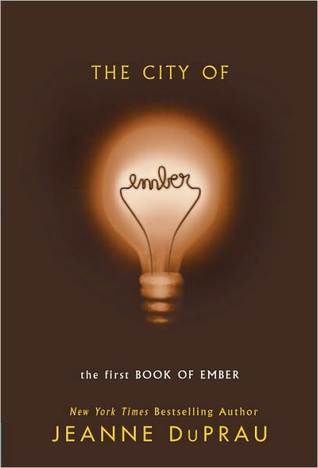
Book Review: The City of Ember, by Jeanne DuPrau (Yearling, 2004)

Recommended for ages 9-12
A post-apocalyptic novel, The City of Ember begins with The Builders, who created an underground city that would save humankind from an assumed environmental catastrophe. The city was to last for 220 years, at which time they hoped it would be okay to return to the surface. They created Instructions to leave Ember, which they gave to the Mayor, to be passed down to every Mayor until it was time; the box containing the Instructions would then open.

The box was lost after the seventh Mayor tried to force the box open.

In the year 241, the City of Ember is failing. They are running out of food and supplies and there are rolling blackouts that last for longer stretches each time. There are whispers that the generator is failing. Because the population of Ember does not know their above-ground origins, they do not know that there is another choice. Lina and Doon, two 12-year old residents of Ember, learn about some of Ember’s secrets, like the stores of food available to those who know the “right people”. Lina also happens upon a document long hidden in her grandmother’s closet; torn into shreds by her baby sister, she tries to unravel the mystery and thinks she has happened upon a way to leave Ember. Will anyone other than Doon believe her, or will the Mayor and the police try to keep them quiet?

The book tells an intelligent story with fairly well-drawn characters. Ms. DuPrau does not speak down to her audience, but I do wish she had fleshed out the characters a bit more; the Mayor, for instance, is the typical bloated, corrupt politician; Lina’s grandmother’s memory is slipping away, but she remembers that there is something lost that she must find before she dies; the police are one-dimensional, just-following-orders good/bad guys. The overall story, however, is solid and compelling – what happens to a society if their lights go out for good?

The City of Ember is the first in the Books of Ember series and was made into a movie in 2008. Designated as an American Library Association (ALA) Notable book, the book has received Kirkus Editors Choice status and was awarded the 2006 Mark Twain Readers Award. The author’s website offers information on all of Ms. DuPrau’s books, a biography, and an FAQ. The site also offers the chance for visitors to solve a puzzle similar to the document in City of Ember.

Posted in Humor, Science Fiction, Tween Reads

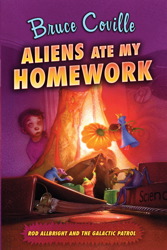
Book Review: Aliens Ate My Homework, by Bruce Coville (Aladdin, 1993)

     Recommended for ages 9-12

Sixth-grader Rod Albright, better known as Rod the Clod among his classmates, is a target for the two bullies at school and the go-to babysitter for his toddler twin brother and sister at home. One day, while working on a science project for school, a miniature alien spaceship crashes into his window, and Rod is commandeered into helping the alien crew in their search for BKR, an intergalactic criminal infamous for his cruelty – and who just happens to be hiding out in Rod’s neighborhood. Can Rod, who is incapable of lying, keep his alien visitors a secret and help them succeed in their mission while getting his science project done on time?

Told from Rod’s point of view, Aliens Ate My Homework is a fun read for kids ages 9-12. As the first book in a four-book series, Coville sets up the story line and introduces the reader to a full cast of characters: Rod, Thing One and Thing Two, the toddler twins, their mother, the crew of the Ferkel, and BKR, the intergalactic villian. The crew of the Ferkel is a diverse group of aliens, illustrating that diversity is welcome in all parts of the universe; Grakker, the Ferkel’s captain, is a borderline hostile military man, but the crew and Rod all learn how to work with him – and vice versa. BKR, the criminal wanted across the galaxy, is guilty of cruelty. Says Ferkel ambassadaor Madame Pong of BKR’s crimes,  “Millions have wept.” There are lessons to be learned within Coville’s bright narrative – different personalities and people and capable of working together; cruelty is wrong; and every being, no matter how powerful or how small, needs help.

Aliens Ate My Homework is the first in Bruce Coville’s 4-book series, Rod Albright’s Alien Adventures; the other books in the series are I Left My Sneakers in Dimension X; The Search for Snout; and Aliens Stole My Body. Coville’s website also offers printable door hangers and bookmarks, crossword puzzles, and information about all of Coville’s books.

Posted in Fantasy, Post-apocalyptic/Dystopian, Science Fiction, Tween Reads

Book Review: A Boy and His Bot, by Daniel H.Wilson (Bloomsbury, 2011)

Recommended for ages 9-12

On a class trip to a Mek Mound, an ancient Oklahoman Indian land mound reminiscent of the Egyptian pyramids, sixth grader Code Lightfall discovers Mekhos, a manufactured, experimental world inhabited by robots and long forgotten by humans. The world is under the grip of the evil tyrant Immortalis, bent on the world’s destruction; it falls to Code and Gary, an atomic slaughterbot brought to life by Code’s imagination and Mekhos technology, to find the Robonomicon and save the day.

A Boy and His Bot is a journey to Oz tale for a more modern age, complete with beautiful and deadly surroundings like the Toparian Wyldes, the beautiful forest maintained by a race of robots who trim and sculpt anything in their way, their upkeep programming overriding any other directive. Where Oz has a benevolent wizard, Boy  has Immortalis, the evil overlord who pushes all robots to the day of The Great Disassembly, when all of Mekhos will be undone. Code’s main objective, beyond stopping The Great Disassembly from taking place, is to get back home.

I have noticed that heroes in “boy books” often come from dysfunctional families, and Code is no exception. A shy boy, picked on by some classmates, ignored by others, Code is grieving the disappearance of his grandfather John a year prior. His parents are not in the picture. The only positive female force in the book is Peep, the little robotic probe that befriends him and leads him to the world of Mekhos. Gary the Slaughterbot plays the part of the all brawn, no brains protector with the heart of gold.

I wonder why it is that young male characters’ families are so flawed in YA literature. Is this an accurate reflection of the state of families today, or is this the newest hook to keep young boys reading? Is it a way to reach out to young boys that may be in crisis and refuse to speak?  The combination of robotic creatures, a manmade world on the brink of destruction, and an invention like the slaughterbot alone is enough to grab a boy’s attention on the surface, but Code’s background gives him a depth that should help boys and girls alike be interested enough in his journey to travel along with him.
Daniel H. Wilson, Ph.D. is the author of How to Survive a Robot Uprising, Where’s My Jetpack, and How to Build a Robot Army. A Boy and His Bot is his first YA novel, but he has also written Bro-Jitsu: The Martial Art of Sibling Smackdown, and his Robot books are popular with older tweens and teens. He maintains an author website.
Posted in Fantasy, Science Fiction, Steampunk, Tween Reads

Book Review: Larklight: A Rousing Tale of Dauntless Pluck in the Farthest Reaches of Space, by Philip Reeve (Bloomsbury, 2007)

Recommended for ages 9-12
Larklight is the first in a ‘tween steampunk trilogy by Philip Reeve, and I was really looking forward to sinking my teeth into this book. Steampunk? Pirates? Pass that book over!
I was not disappointed. A great read for both boys and girls interested in science fiction and fantasy, Larklight offers a little something for everyone. The main character, Arthur Mumby, is a boy of about 11 or 12 who lives with his 14-year old sister, Myrtle (who is a very big part of the storyline – no wallflower female characters in this book!) and their widowed father upon Larklight, a floating home in space. The story takes place during the Victorian era, and the British Empire has colonized space. Aetherships cruise the skies much as Blackbeard’s Queen Anne’s Revenge hunted ships in the waters on earth.
Mr. Mumby, a xenobiologist, agrees to a meeting with a correspondent who refers to himself as “Mr. Webster” – when he arrives, we discover that Webster is an evil space spider with whose spidery army traps Larklight and Mr. Mumby in their webs. Art and Myrtle escape, ultimately ending up with a band of space pirates led by Jack Havoc, a teenager with his own troubled past, and his band of alien misfits. Running from the British Empire, Jack joins Art and Myrtle on their quest to save their father and learn what made them Webster’s target.
In addition to the nonstop action and wonderfully Victorian narrative, there is mech and steam aplenty for steampunk fans. Giant, mechanized spiders, steam-driven aetherships propelled by alchemic reactions, and an assault on Queen Victoria – what more could a kid possibly ask for?

I appreciated Reeve’s strong male and female characters. At first glance , Myrtle appears solely as Art’s antagonist for Art but emerges as a strong, clever character – it’s interesting to see her character evolve. Ssil, one of Jack Havoc’s alien crew, has no idea where her origins lie, providing a sense of mystery and pathos. She has only the family she creates around her, but longs to know who she is. While scientific men are assumed to be the only ones capable of performing the “chemical wedding” that propels aetherships into space, Ssil performs it with ease – indeed, she is the only member of Jack’s crew who can do it.

There are two sequels to Larklight, also by Reeve: Starcross and Mothstorm, that I expect I shall be picking up shortly. The film rights for Larklight have been bought and a film is due out in 2013.

Posted in Middle School, Post-apocalyptic/Dystopian, Science Fiction, Tween Reads

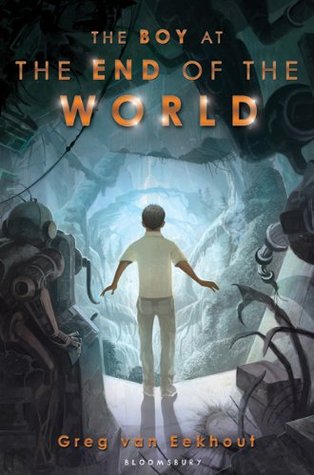
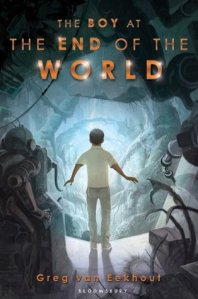
Book Review: The Boy at the End of the World, by Greg Van Eekhout (Bloomsbury Children’s Books, 2011)

Recommended for ages 9-12

A preteen boy (we are led to guess), wakes up in a pod in a devastated shelter. Destruction lies all around him; he sees being similar to himself lying dead in pods similar to his. The only other functional being is a robot, who calls out to him. The boy runs, but the robot catches up to him and reveals the boy’s name, Fisher, to him. Fisher learns that he is the only survivor of the human race.

It’s the usual post-apocalyptic story: Humans ruined the earth and nature took back her planet. Humans genetically engineered animals and more humans, putting them in gel-filled pods, with robots to oversee their care, until the time when conditions allowed for them to awake and rebuild society. The humans were individually programmed with specific survival skills to help create communities. Fisher is programmed to be a fisherman. Click, the name he gives his robot companion, tells Fisher that he has been tasked with helping Fisher “continue existing”, and the two set off to search for more humans in another Ark – the facilities were humans and animals were engineered and kept in hibernation.

Born a blank slate, Fisher learns and adapts through the story’s progression, developing not only intelligence outside of his initial programming but emotional depth. The characters they meet are not cute and cuddly woodland creatures: they’re often chilling. There are groundhogs who blame humanity for the planet’s destruction and hold a grudge; there is a robot who takes his task of preserving the human race  permanently – these characters bring a new dimension to the story of a boy and his robot. This is a survivalist tale.

It is difficult to write a postapocalyptic tale without sounding like hundreds of similar books on the market, and the “humans and technology bad, nature good” call to action beats the reader over the head throughout the book. Humans bring the planet to the brink of environmental collapse, so they leave the rest of the planet to deal with it while they go into hiding until the coast is clear. The technology that humans created to save them ultimately turns on them and brings the race to the point of near-extinction, further painting us as hapless ne’er do wells.

That said, the YA market in post-apocalyptic fiction isn’t as saturated as the adult market is yet, so perhaps a younger audience will read this story through different eyes. That said, this is a generation that has been fed this storyline since they were babies: think of Happy Feet, a movie that deceptively sold us a cute story about a penguin who didn’t fit in, and gave us a Greenpeace horror movie halfway through the picture. Think of Wall-E, where we were drowning our society in junk, so we had to go into space to get away from it.

I don’t want it to sound like I didn’t like this book, because I did. I think older middle grade readers, starting with 10-11 year olds, will see Fisher as a hero they can identify with as a young boy who needs to learn to survive, and whose robot companion acts as a friend and parent. Kids can also relate to the marriage of technology and environmental awareness contained in the book’s message.

Greg Van Eekhout knows how to write for kids – he has a Masters in Education and spent ten years developing online curricula for K-12 and college students. He is kid- and teacher-accessible, offering teachers tips on having author events at schools (and libraries), and providing his e-mail address to be contacted about school visits. He offers two presentations that he follows in his appearances. His website is geared toward grownups who are interested in reading his reviews, about his books, and where he’ll be next.