Posted in Fiction, Graphic Novels, Middle Grade, Science Fiction

Star Wars: Jedi Academy, Return of the Padawan, is essential reading for all aspiring Jedi Masters

jedi academyStar Wars: Jedi Academy, Return of the Padawan (Book 2), by Jeffrey Brown (July 2014), $12.99, ISBN: 9780545621250

Recommended for ages 8+

With Star Wars Reads Day coming up in October, I’ve been boning up on my Star Wars reads for my patrons (and because I enjoy them). Yesterday, I read Jeffrey Brown’s latest chapter in his graphic Jedi Academy saga, Return of the Padawan. Jeffrey Brown has been all over the Star Wars Universe lately, with his Darth Vader parenting books, Darth Vader & Son and Vader’s Little Princess (and soon, Good Night, Darth Vader), and Jedi Academy, his graphic novel series for younger readers. The first book introduced us to Roan Novachez, an aspiring Jedi from Tatooine, who attends a Jedi Academy middle school, where he meets all sorts of new beings from across the galaxies, and gets to enjoy Head Master Yoda’s teachings.

Return of the Padawan pick up the story as Roan returns to Jedi Academy for a new school year. This time around, Roan has to deal with cyberbullying over Holobook, a teacher who seemingly has it in for him, shifting friendships, and a constant struggle against the insidious dark side, in the form of two classmates who make it a little too easy.

Roan feels awkward and out of place, and thinks his friends are drifting away from him. When the two class bullies show an interest in him, he thinks they’re the ones loosening up – until he realizes that maybe, he’s heading down a slippery path. The book is a great mix of all things middle school, including issues that kids have to deal with today, like online bullying and the confusion often present in middle school friendships. The story is told through sequential panels, but also through “Holobook” (the Jedi Academy version of Facebook) entries, report cards, and school newsletters.

This book is a no-brainer for anyone who loves Star Wars. It’s a great introduction to the Star Wars universe for younger readers, who will enjoy the cartoon art and depiction of day-to-day school life, with fun enhancements that link their lives to the Star Wars universe.

I can’t wait to get this one on my shelves at the library. It’s on sale tomorrow, so make sure you get your copy!


Posted in Fantasy, geek culture, Graphic Novels, roleplaying, Science Fiction, Teen, Tween Reads, Uncategorized

In Real Life: Where online worlds cross over to reality.

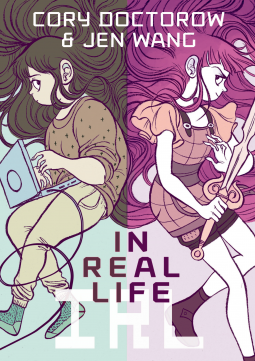
in real lifeIn Real Life, by Cory Doctorow/Illustrated by Jen Wang (:01 First Second, Oct. 2014). $17.99, ISBN: 9781596436589

Recommended for ages 13+

I’m a Cory Doctorow fan. I loved Little Brother, and I was fascinated by For the Win, which examines the lives of “gold farmers” – people whose job it is – in real life – to acquire gold and magic/rare items in games, and sell them to players for real-world currency. The gamers – which include children – are from poor families in third-world countries: India, China, and Singapore, working in deplorable conditions, and exploited by sweatshop bosses who pay pitiful wages.

In Real Life is a graphic novel about a girl named Anda, who loves playing a MMORPG (Massively Multiplayer Online Role-Playing Game) named Coarsegold. She makes friends in the gamespace, ultimately falling in with Lucy, a more experienced gamer who takes Anda under her wing. They stalk and “kill” the “gold farmers” they encounter, believing them to be cheating by selling gold and rare items to fellow gamers. The farmers look small, almost childlike, and Anda – despite doing this in the gamespace – feels guilty. She strikes up a friendship with one of the farmers, a Chinese teenager named Raymond, who tells her about his life and his job – laboring under sweatshop conditions to farm so that he can help support his family – and Anda decides that something needs to be done.

The story is similar to Doctorow’s plot in For the Win, but without delving into the global politics and economics involved in the novel. I loved this graphic novel, which could be an introduction or supplement to For the Win. We get to see positive representations of female gamers, teenagers, and we have a moral central character who is forced to understand that even morals don’t come solely in black and white. At the same time, In Real Life calls attention to a form of human rights violation taking place all over the world, yet located in our homes, our libraries, and anywhere we game.

Jen Wang’s art is perfect for Doctorow’s story. She’s got a manga style that works for me. Her use of color works to as a soft contrast to the tech storyline, and brings out the humanity at the tale’s core.

In Real Life publishes in October of this year, and I can’t wait to get it on my shelves. It’s going to be a great addition to any graphic novel collection, and a must-read for older tweens and teens, especially those who game. Social Studies courses could get some great discussions by adding this book to their curriculum.

Posted in Graphic Novels, Horror, Science Fiction, Young Adult/New Adult

The Wrenchies – adolescence is terrifying.

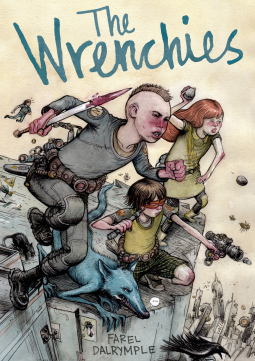
wrenchiesThe Wrenchies, by Farel Dalrymple (:01 First Second, Sept. 2014). $19.99, ISBN: 9781596434219

Recommended for ages 14+

In a dystopian future, adolescence is terrifying. Only the kids are safe – adults live in fear of the Shadowsmen, a group of mindless monsters who hunt down teenagers and attack them with horrifying, tentacular fingers that penetrate their minds and leave them changed – walking nightmares. The Wrenchies, a gang of kids who band together against the Shadowmen, meet Hollis, a sad, lonely boy who has a charm of sorts that allows him access to the Wrenchies’ world, a parallel universe from his. The story also includes a subplot with a man named Sherwood, who is somehow tied to both of these universes and to the Shadowmen.

I didn’t love the Wrenchies – more often than not, I was lost as to what was going on. It took me a good part of the book to realize that there was a parallel universe, and I never really felt that I “got” the entire story. I just didn’t connect with it, nor did I connect with Dalrymple’s style of art. This would be a great read for a teen/YA post-apocalyptic fan who prefers a less linear storyline. There’s violence and language aplenty, which may give some parents pause – it wasn’t an issue for me, but my younger ones don’t usually seek these types of books out.


Posted in Fiction, Post-apocalyptic/Dystopian, Science Fiction, Teen, Young Adult/New Adult

Alena Graedon’s The Word Exchange: an all-too plausible dystopia.

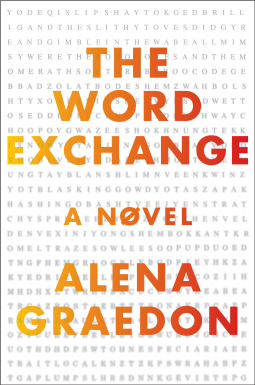
word exchangeThe Word Exchange, by Alena Graedon. Doubleday Books (2014), $13.99, ISBN: 9780385537667

Recommended for 18+

While Alena Graedon’s The Word Exchange isn’t written for YA/New Adult audiences, I wholeheartedly believe that these readers should read it, much in the way that they should read (if they haven’t already) Ernest Cline’s Ready Player One. Alex Awards, are you listening?

The Word Exchange takes place in an entirely believable, very near future. Society is too plugged in – smartphones appear to have morphed into devices called Memes, which think for you. Well, not really – but kind of. They anticipate what you want to do – hail a cab? Order a coffee? – and even offer you words when you can’t think of the word you’re looking for. Ana, a young woman who works with her father, Doug Johnson, at the North American Dictionary of the English Language (NADEL, for short), uses her meme – something Doug has no patience for; he feels like books and language are a disappearing art. He has no idea how right he is.

There’s a virus – WordFlu – that’s erasing language, stealing it from the populace. They start by bungling words here and there, eventually devolving into gibberish, silence, and ultimately, death. When Doug goes missing, Ana goes on the search for her father and finds herself in the middle of something far greater than she, Doug, or the Dicionary could ever be – could there really be a plot in place to erase language?

Told in the form of journal entries by Ana and her friend, Doug’s associate Bartleby (also known as Horace), The Word Exchange examines what would happen in a society that leaves entirely too much to technology. It’s very unsettling, because it’s only a step or two from where we are now. Imagine if someone were to create an app that let you think of the word that was on the tip of your tongue, but you couldn’t remember, for pennies a download? Now imagine if you had a Seamless or taxi service available to you without even picking up your phone or pulling up your app? Those bothersome clicks and pokes to the touchscreen would go away, because your Meme would do all the work for you. Would society really hand over the reins so easily?

The book starts slowly, laying groundwork – the mystery of Doug’s disappearance happens fairly soon in the book, but Ana’s search builds until about halfway through the book, when the action just explodes. Layered and tautly paced, this book was unputdownable for the second half. She’s got complex, three-dimensional characters, and a plot that chilled me to the bone just thinking about it – because it could happen. Very easily.

Teens and young adults should be reading this book, because they’re the next generation – they’ll appreciate the setting and hopefully, the message that Ms. Graedon delivers. It’s a fantastic book discussion group title that explores technology, morality, and the politics of doing business in an increasingly online world. I loved this book and can’t wait to see some of the discussions that evolve around it.

Posted in Science Fiction

Star Wars Reads Day is Back!

I am so excited about this for a number of reasons, not the least being, Star Wars Reads Day is back! Now that I’m a librarian attached to an actual library, I’m planning bulletin boards, events, and displays. I’ll post progress and pictures as it comes together.

star-wars-reads-day-3-logo


From StarWars.com:

Bookstores and libraries will once again feel the power of the Force.

Disney Publishing Worldwide and its publishing partners announced today the third annual Star Wars Reads Day, to be held October 11, 2014. Last year, Star Wars authors and costumed volunteers participated in over 2,000 Star Wars Reads Day events across North America and, for the first time, around the world. On October 11 of this year, Star Wars fans, authors, and artists will again come together in this multi-publisher initiative that celebrates reading and Star Wars. Participating publishing partners include Abrams, Chronicle Books, Dark Horse, Del Rey, Disney Book Group, DK, Klutz, Quirk Books, Random House Audio, Scholastic, and Workman Publishing.

“With the debut of our new animated series Star Wars Rebels launching on Disney XD this Fall, and the upcoming theatrical release of Episode VII in 2015, our third Star Wars Reads Day comes at an exciting time,” says Carol Roeder, Director of Lucasfilm Franchise Publishing, Disney Publishing Worldwide.

The following authors are confirmed to participate in official Star Wars Reads Day events: Chris Alexander (Star Wars Origami), Tom Angleberger (Origami Yoda series), Jeffrey Brown (Goodnight Darth VaderStar Wars: Jedi Academy), Troy Denning (Star Wars: Crucible), Ian Doescher (William Shakespeare’s Star Wars, William Shakespeare’s Empire Striketh Back, William Shakespeare’s The Jedi Doth Return), Jason Fry (LEGO Star Wars: The Visual Dictionary: Updated and Expanded, Star Wars in 100 Scenes), Daniel Lipkowitz (LEGO Star Wars: The Yoda Chronicles), John Jackson Miller (Star Wars: Kenobi), Chris Reiff and Chris Trevas (Star Wars: Death Star Owner’s Technical Manual), Daniel Wallace (The Bounty Hunter Code, The Jedi Path), and Ryder Windham (Star Wars: The Ultimate Visual Guide, Star Wars Rebels Junior Novel).

For updates and more information, follow Star Wars Reads Day on Facebook.

For more information and an FAQ, check out StarWars.com’s Star Wars Reads Day page.

Posted in Fiction, Middle School, Science Fiction, Teen, Tween Reads

Henry and the Incredibly Incorrigible, Inconveniently Intelligent Smart Human makes humans the invention.

henry and the humanHenry and the Incredibly Incorrigble, Inconveniently Intelligent Smart Human, by L.A. Messina. Tater Tot Books (2014), eBook: $3.99 ISBN: 9780984901838

Recommended for ages 10-14

Henry is a young teen robot in his 13th upgrade. He’s not the popular kid at school, and he has a faulty processor that comes from a virus that attacked his system when he was younger. When his father’s boss shows up at their home one night with a new human model to test for the market, Henry is thrilled – his own human! But this human isn’t a slack-jawed, drooling blank slate like most humans are. This one makes up words, can do things without extensively detailed commands, and doesn’t want to sleep in his box because it’s not comfortable. At first, Henry is worried – what if this human goes berserk like the one that went on a rampage in his mother’s business? – but he comes to realize that the HueManTech ETC-420- GX-2, or “E”, as Henry calls him, is a very special model.

Unfortunately, Henry’s not the only one who thinks “E” is special, which leads to a taut race to unravel the truth about E, especially when the government begins showing an interest in E and Henry’s family.

The book starts out slow as Ms. Messina establishes the drudgery of Henry’s young teen life – mocked at school, boring job at his mother’s spa, Henry is the lonely kid who takes comfort in his comic books and video games, until something exciting – E’s arrival – sparks up his life. Even then, the narrative moves at a slower pace as Henry discovers how special E really is. But once the plot kicks into motion, involving the government and the origins for both E and Henry, the story moves at a great pace that kept me turning pages and wanting to know more.

The book, available via e-book format, is a good read for tweens and young teens. It provides a wealth of opportunities to discuss what would happen in a society where robots were on the top of things and humans were the creation; it also offers chances to discuss morality and the government. It would be a good discussion group story for educators to encourage among their students and patrons.

Lynn Messina’s website offers a book trailer for Henry, along with fun extras for readers.

Posted in Fantasy, Graphic Novels, Science Fiction, Tween Reads

Legends of Zita the Spacegirl is out of this world!

legends of zitaLegends of Zita the Spacegirl, by Ben Hatke. :01 First Second (2012), $18.99, ISBN: 978-1-59643-806-4

Recommended for ages 8-14

I just realized that while I’d reviewed both Zita the Spacegirl and the upcoming Return of Zita the Spacegirl, I never wrote a review for the second book in this great series – so I re-read it in order to remedy the situation.

When we rejoin Zita in the second book in her series, she has found intergalactic fame as The Girl Who Saved Scriptorious. Creatures from all over the galaxy are clamoring to meet her, and fame has become a bit overwhelming for Zita. When she encounters a robot that looks just like her, she decides to let the robot handle fame while she and Mouse take off to relax and be anonymous for a while. The only problem is, the robot is an Imprint-o-Tron, which eventually tries to replace their targets – and when two aliens seek “Zita”‘s help in saving their planet from the interstellar scavengers, the Star Hearts, Zita-bot is all too happy to lend a hand, stirring up trouble for Zita and her friends.

I am a big Zita fan, and this second book has every bit of the spirit of fun and adventure that the first book (and the upcoming third) do. We see a slightly different Zita here -she’s overwhelmed by fame, she wants to go home, and she ultimately learns about the power of sacrifice – she’s a more mature Zita who is still, at heart, a kid. The Imprint-o-Tron reminds me of Pinocchio, who wanted to be a real boy. The Imprint-o-Tron, or as I started calling her, the Zita-bot, isn’t bad – she’s following her programming, and she really seems to want to be Zita, to face the exciting adventures that Zita does. There are some great messages to be found in this second book.

There are some great resources on the Web for using Zita materials in the classroom. Comics Are Great has a downloadable lesson plan, along with an hour-long podcast dedicated to the book, where teachers, librarians, and cartoonists discussing the book.

The Zita trilogy is a great middle-grade graphic novel series. She stands as a good role model for any girl or boy who seizes the power of imagination and inner courage.

Posted in Fantasy, Graphic Novels, Humor, Science Fiction, Tween Reads

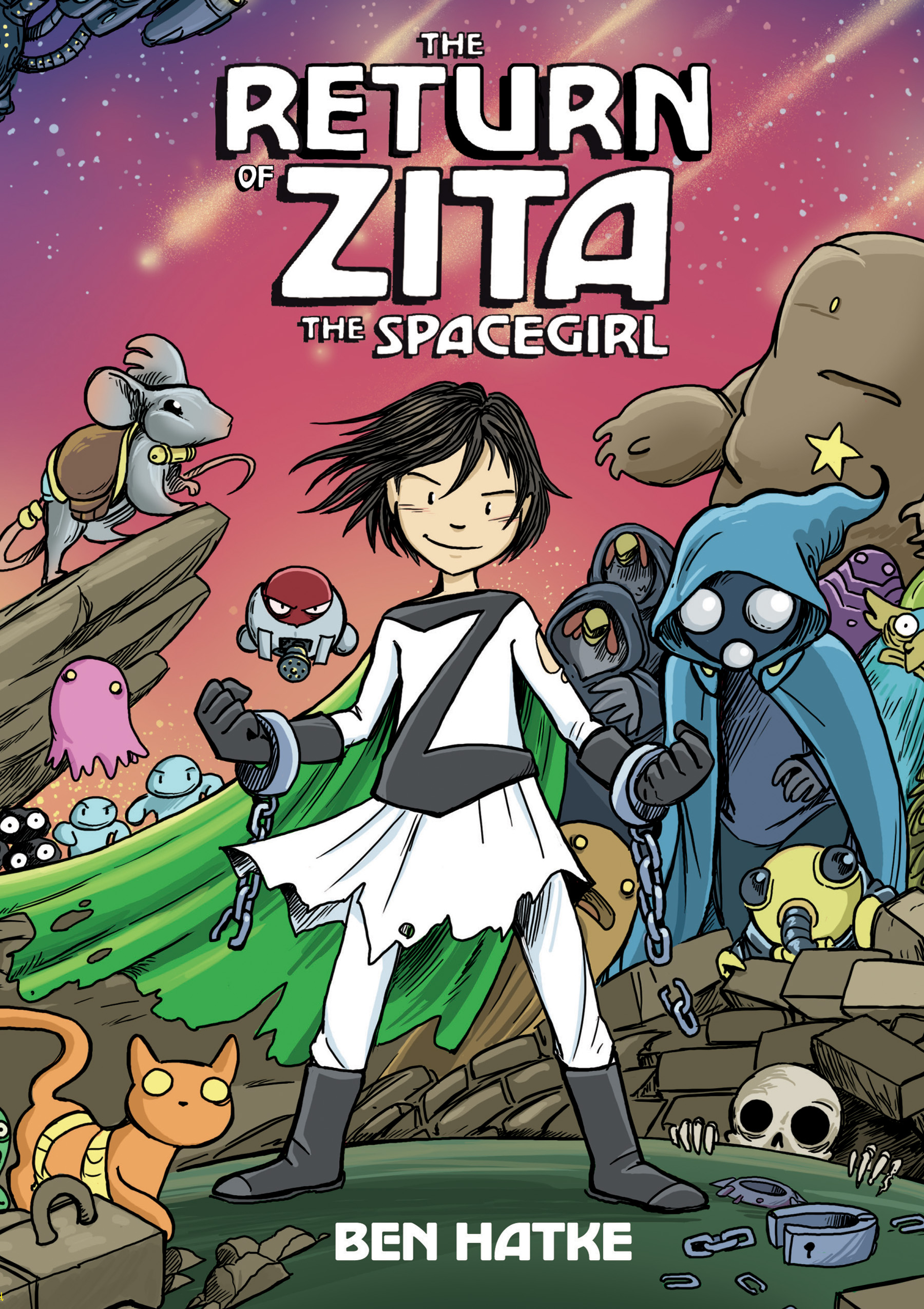
The Return of Zita the Spacegirl – A WhatchaReading Review!

Great sagas come to an end – maybe. But we’ll get to that. For anyone who hasn’t heard of Ben Hatke’s Zita the Spacegirl, I urge you to get to a library, a bookstore, or a friend with an enviable graphic novel collection and check her out, because she is fantastic. I first met her when Chuck, our editor monkey, handed me a copy of the first book and said, “You have to read this. It’s all you.” And it was. I quickly read Legends of Zita the Spacegirl, and was delighted when a review copy of Return of Zita the Spacegirl showed up on my doorstep a couple of weeks ago.

Check out my review on WhatchaReading!

zita3

Posted in Fantasy, Fiction, gaming, geek, geek culture, Humor, roleplaying, Science Fiction, Teen, Young Adult/New Adult

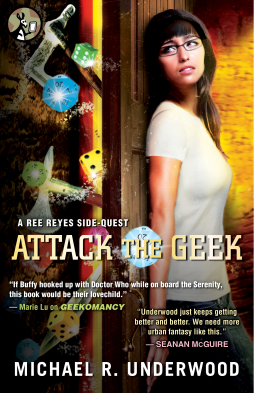
Attack the Geek: Geek Culture Gone Wild!

attackthegeekAttack the Geek, by Michael R. Underwood. Gallery, Threshold, Pocket Books (2014), $2.99, ISBN: 9781476757780

Recommended for 18+

Attack the Geek is more of a New Adult read than it is a YA read, but there are plenty of pop culture, gaming, and garden variety geek references in there that will appeal to younger audiences. There’s a content heads-up for language, but it’s nothing the kids aren’t screaming at each other these days.

Attack the Geek is a side adventure to a series created by Michael R. Underwood; his previous two books, Geekomancy and Celebromancy, are available via digital download on Amazon for a very reasonable price. I haven’t read the two previous books which could be a reason why I felt off-kilter with Attack the Geek.

For any gamers out there – did you ever have a roleplaying session where one bar fight or battle took up hours of your campaign? If you know what I’m talking about, that’s how I felt while reading Attack the Geek. It’s a single combat story, with barista Ree Reyes, the heroine and protagonist of the series, and her fellow geekomancers coming under attack at Grognards, the establishment owned by Ree’s boss, Grognard. The geekomancers have the ability to channel the power of geek culture by consuming it – Ree, for instance, keeps clips from her favorite movies, like X-Men or Spider-Man, to draw upon when she needs power – and she’ll be able to shoot webs or toss people with telekinesis. There are props aplenty, including working Star Trek phasers and Star Wars lightsabers, and collectible card game cards merely need to be torn to release their  magic in this world, if channeled by the geekomancer. So when they come under attack from a Strega witch named Lucretia, it’s a hairy battle, loaded with pop culture references and witty banter.

This being a side adventure is my own issue – I am unfamiliar with the geekomancy power and these characters, so in a sense, I was at a disadvantage. But I also thought the book was trying to be too witty, throw too many references in, for its own good. The references took over the plot, and after a while, I was just reading about a battle where there was Spider-Man web slinging, Star Trek phasers, and lots of collectible card game references. This just wasn’t my book. For anyone who’s a devoted sci-fi/fantasy/gaming/comic book fan, it’s worth a shot. It’s why I requested it from NetGalley, after all, and I may read Geekomancy now just to see if having more of a background will help me better grasp the book.

Posted in Fiction, Humor, Middle School, Science Fiction, Tween Reads

M.E. Castle’s The Clone Chronicles concludes with Game of Clones

gameofclones_3 Game of Clones: The Clone Chronicles, #3, by M.E. Castle. Egmont USA (2014), $15.99, ISBN: 9781606842348

Recommended for ages 8-12

In M.E. Castle’s third installment of the Clone Chronicles, seventh grader Fisher Bas and his clone, Fisher-2, put aside their differences to team up and fight Three, the Fisher clone created by the evil Dr. X. Three’s gone rogue, with plans for world domination on his mind, and he’s on track to make it happen – will Dr. X make an appearance? Is the enemy of Fisher’s enemy a friend?

The book is a fast-moving action-adventure series that should appeal to both middle grade boys and girls. Fisher and Fisher-2 have allies in their classmates, Amanda and Veronica, both of whom serve as the boys’ crushes and as intelligent, strong females in the series. Fisher tends to be an overthinker, and Alex struggles to define his own personality despite being a Fisher clone. This struggle runs throughout the book, and mirrors many a tween’s burgeoning identity and personality clashes and crises; where Fisher-2 is a clone, a tween pushes back against being merely “the son” or “the daughter”. Three wreaks havoc in Fisher’s neighborhood and school, forcing him to think of creative solutions and seek help outside of his gadgets; he realizes the power of friendship and of reaching out to ask for help, and it makes him a better person.

Overall, it’s a fun book in a popular series that tweens will enjoy. Game of Clones is part of The Clone Chronicles series; the first two books are Popular Clone and Cloneward Bound.