Posted in Fantasy, Graphic Novels, Science Fiction, Tween Reads

Legends of Zita the Spacegirl is out of this world!

legends of zitaLegends of Zita the Spacegirl, by Ben Hatke. :01 First Second (2012), $18.99, ISBN: 978-1-59643-806-4

Recommended for ages 8-14

I just realized that while I’d reviewed both Zita the Spacegirl and the upcoming Return of Zita the Spacegirl, I never wrote a review for the second book in this great series – so I re-read it in order to remedy the situation.

When we rejoin Zita in the second book in her series, she has found intergalactic fame as The Girl Who Saved Scriptorious. Creatures from all over the galaxy are clamoring to meet her, and fame has become a bit overwhelming for Zita. When she encounters a robot that looks just like her, she decides to let the robot handle fame while she and Mouse take off to relax and be anonymous for a while. The only problem is, the robot is an Imprint-o-Tron, which eventually tries to replace their targets – and when two aliens seek “Zita”‘s help in saving their planet from the interstellar scavengers, the Star Hearts, Zita-bot is all too happy to lend a hand, stirring up trouble for Zita and her friends.

I am a big Zita fan, and this second book has every bit of the spirit of fun and adventure that the first book (and the upcoming third) do. We see a slightly different Zita here -she’s overwhelmed by fame, she wants to go home, and she ultimately learns about the power of sacrifice – she’s a more mature Zita who is still, at heart, a kid. The Imprint-o-Tron reminds me of Pinocchio, who wanted to be a real boy. The Imprint-o-Tron, or as I started calling her, the Zita-bot, isn’t bad – she’s following her programming, and she really seems to want to be Zita, to face the exciting adventures that Zita does. There are some great messages to be found in this second book.

There are some great resources on the Web for using Zita materials in the classroom. Comics Are Great has a downloadable lesson plan, along with an hour-long podcast dedicated to the book, where teachers, librarians, and cartoonists discussing the book.

The Zita trilogy is a great middle-grade graphic novel series. She stands as a good role model for any girl or boy who seizes the power of imagination and inner courage.

Posted in Fiction, Humor, Middle School, Tween Reads

Desmond Pucket Makes Monster Magic and Get Laughs

desmond-pucket-makes-monster-magic_0Desmond Pucket Makes Monster Magic, by Mark Tatulli. Andrews McMeel Publishing (2013), $13.99, ISBN: 978-1-4494-3548-6

Recommended for ages 8-12

Desmond Pucket is a middle schooler who loves monster movies and special effects. He’s also a prankster who just can’t resist a good opportunity to use his special effects expertise to scare the daylights out of people, whether it’s his annoying older sister or one of the teachers. He’s been good at covering his tracks, but when he springs a prank on his older sister and her friends at a sleepover, he finds himself in hot water at school – one of his sister’s friends is the daughter of the disciplinary head at his school; he’s been waiting for Desmond to slip up, so he can transfer him to another school! Now Desmond has three chances left before he’s kicked out of school and misses the big field trip to Mountain Full of Monsters at Crab Shell Pier. Can he keep out of trouble for just a little longer?

The book is written in a similar style to Jeff Kinney’s Diary of a Wimpy Kid; it’s a first-person storyteller and illustrated, presumably by Desmond, with black and white sketches. There are even drawings that look like they’ve been sketched on torn bits of paper, to add to the realism of Desmond, and his friend Ricky’s, notes. The endpapers are green and have the appearance of crumpled paper, with more of Desmond’s drawings and notes to the reader.

I loved this book. It’s fun, light, and Desmond is – like Greg in Diary of a Wimpy Kid – a victim of his own making. He can’t stay out of trouble, but unlike Greg, he knows he’s his own worst enemy. He just can’t resist a good prank opportunity to cause mayhem. He even laments not being able to take credit for his brilliant pranks, because he knows it will get him into trouble. When he decides to pull a prank at  his sister’s sleepover, he has no idea of the trouble he’s getting himself into, and when the fallout hits, he has a major crisis on his hands – how can he stay out of trouble and still be himself?  He ultimately decides that being true to himself and owning who he is is more important than anything, including a long-awaited school trip.

Andrews McMeel has a wealth of Desmond activities and information online, especially since the second book in the series, Desmond Pucket and the Mountain Full of Monsters, will be released this August. You can read a sample chapter online at the Desmond Pucket site, follow him on Facebook, and download teacher and librarian resources on the Andrews McMeel site, including a guide to teaching with graphic resources and English/Language Arts and Science curriculum connections to work with, using the book. There are games and activities for readers both online and at the end of the book itself, where Desmond shares some notes on how to make fake blood, cool monster growl effects, a phantom knocker, a ghost, and a gelatin dessert.

I am looking forward to more Desmond books, as is my 10 year-old son, who read this book in about an hour and a half last night!

Posted in Non-Fiction, Tween Reads

How to Make a Planet makes astronomy accessible – and awesome – to middle graders

how to make a planetHow to Make a Planet, by Scott Forbes/Illustrated by Jean Camden. Kids Can Press (2012), $17.95, ISBN: 9781894786881

Recommended for ages 8-12

How to Make a Planet takes the best part of an astronomy textbook and makes it accessible to middle grade students. Written as a how-to-guide to making your own planet, Scott Forbes breaks down the entire process of Earth’s formation, from the Big Bang through to the arrival of… well, us. Mr. Forbes writes about quarks and neutrons, the periodic table of elements and continental drift, all in a way that neither speaks down to his audience nor bores them. Accompanied by Jean Camden’s fun illustrations, including kids working on their planetary masterpiece and bike riding across the solar system, with giant insects, dinosaurs and more, there is always something exciting to read and see. A running “Time Check” box contains information bullets describing what’s happening at different intervals in the Earth’s creation. There is an Amazing Facts page, glossary and index.

This book is a great resource for teachers and librarians to have available in classroom, school, and public libraries. It’s a great way increase science literacy and interest younger readers in the sciences.


HowToMakeAPlanet_2336_spr2 (1)

Posted in Fiction, Uncategorized

The Most Magnificent Thing teaches kids perspective

the most magnificent thingThe Most Magnificent Thing, by Ashley Spires. Kids Can Press (2014), $16.95, ISBN: 9781554537044

Recommended for ages 4-8

One day, a girl and her dog set out to make the “most magnificent thing” – the girl draws up schematics (her dog is the assistant), gets materials, and sets up on the street, getting to work. When she’s finished, she takes a look at it – it’s not really what she had in mind. She tries again. And again. And again. She just can’t make her vision come to life, and she gets MAD. At this point, her assistant suggests a walk, where she starts to feel better; she finds she has regained self-control and even more, perspective, allowing her to go back and look at her previous creations with a refreshed eye.

Ashley Spires, who some may know from her Binky the Space Cat series, looks at the frustrating process of working on something and not having it turn out the way you envision it. It is something everyone can relate to, from a LEGO structure to a Science Fair project to a PowerPoint presentation for the big client meeting. Children, who are still learning the delicate art of self-control, will recognize themselves in these pages, as the girl becomes increasingly frustrated with her work, and once she injures herself, loses her temper. Her dog/assistant serves as comic relief and ends up saving the day by having her walk away and clear her head. The book teaches a valuable lesson to kids and grownups alike; walking away and returning when you’re calmer often allows the ability to see things are not so bad after all, and maybe, you can even find things you liked in the project you were about to crumple up and throw out.

The digital art is adorable. The characters have large, expressive faces, and are set against a mostly line-art, blue and black or white and black background, so they really stand out. There are some beautiful spreads and the font itself is a curvy font with a quirky personality and fits perfectly with the story. The endpapers display the row of brownstones where the story takes place, leading the reader into the story.

This is a good book to use for a storytime on patience or feelings. Perhaps a small LEGO craft afterward, or a construction paper assembly craft will help young minds create their own most magnificent things.

Posted in Non-Fiction, Tween Reads

Helaine Becker’s Zoobots – The Future is Now, and there are robot snakes!

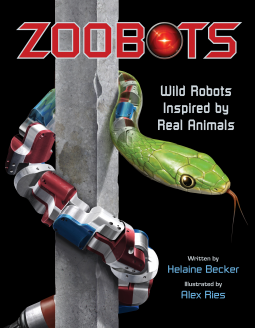
zoobotsZoobots: Wild Robots Inspired by Real Animals, by Helaine Becker/illustrated by Alex Ries. Kids Can Press (2014), $17.95, ISBN: 9781554539710

Recommended for ages 8-12

Robot Snakes. That’s the first thing that jumped out at me when I saw the cover of this book on NetGalley, and I knew that not only would my 10 year-old love this book, but so would every 10 year-old in the several library sites I oversee. That is the kind of book Zoobots is – it’s a win-win situation. You have robot animals, complete with facts about the functions and statistics on the robotic creatures, plus profiles on the animals influencing them; you also have the nonfiction aspect, which makes it compatible with Common Core focus on nonfiction texts, with the extra STEM (Science, Technology, Engineering, Mathematics) appeal that will hopefully inspire a reader or 3 to become a scientist and actually work with these robots.

Helaine Becker’s text is chunked into a dossier-type format, complete with futuristic fonts. We get the name of the robot – some include the Shrewbot, the Octobot, the Ghostbot, and the Nanobot – and what class of animal its influence belongs to (i.e., mammalia, reptilia). There are skills, specifications, and applications: the growing number of robotics dedicated to the medical industry alone is amazing, as is the idea of using pill bug-inspired robots to help prevent raging forest fires. Special Ops describes special talents these robots can use while in the field; my favorite is the Uncle Sam snake robot, who can actually assemble itself!

There is no science fiction here – all of the 12 robot animals profiled are in some sort of prototype stage, whether being developed or in existence. A section on the future wonders what further robots future minds will create, which I hope spurs some readers to start sketching and joining robotics teams. There is a glossary of terms and a full index.

I loved this book, and think it belongs in libraries and science classes throughout elementary and middle schools. The illustrations, by concept artist and illustrator Alex Ries, give life to the robotics, spotlighting their flexibility and their features. The book is only 36 pages, but the number of lesson plans and ideas that can come out of this? Boundless.

Posted in Animal Fiction, Fiction, Preschool Reads

Ten Birds Meet a Monster teaches us to count and describe things around us.

tenbirds meet amonsterTen Birds Meet a Monster, by Cybèle Young. Kids Can Press (2014), $18.95, ISBN: 9781554539550

Recommended for ages 4-8

Ten little birds discover a scary shadow outside their door – what can they do? One by one, the birds rally together to create different beasts using the clothes in the closet, each shape becoming more amorphous than the last, with increasingly wild names to accompany their shapes: we have Vicious Polka-dactyls, a Gnashing Grapplesaurus, a Frightening Vipper-Snapper, and more. Will the monster be more scared of them than they are of him and leave the birds alone?

Ten Birds is a concept book meant for a slightly older child, due to the more elevated language. We go beyond counting here, althoug counting from one to ten is certainly the basis for the story, and delve into adjectives and wordplay. Every bird is described with an adjective as he or she jumps in to help: “always resourceful”; “always diligent”; “always creative”. Each concoction the birds come up with is also defined with an adjective, allowing the opportunity for a good discussion about adjectives and describing words. This would be a fun enhancement to an English lesson in addition to a Math lesson.

The story is repetitive,which appeals to younger readers. The black and white ink and paper artwork is spare and beautiful, with beautiful detailing on the birds’ faces and bodies. The white background and framed pages make this an art book almost as much as it is a concept book for children. The font is a simple, black font on the white background, giving the sign that this is a read-aloud book – no fancy or fun fonts to distract the reader or the audience.

Ms. Young has written and illustrated an earlier Ten Birds book – Ten Birds – where the birds encounter a problem and have to solve it with their own wits, much like they do in Ten Birds Meet a Monster. Ten Birds received the 2011 Governor General’s Award for Illustration. The Birds series is a good one for young readers and I look forward to seeing what other predicaments Ms. Young can find for these birds. Maybe a board book for little hands and minds next?

Posted in Adventure, Fiction, Middle School, Tween Reads

Young Sherlock and Irene Adler Face Off in Sherlock, Lupin, and Me: The Dark Lady

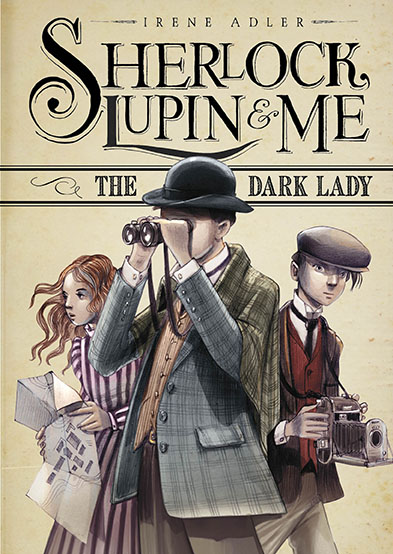
sherlock lupin meSherlock, Lupin and Me: The Dark Lady, by Irene Adler. Capstone Young Readers (2014), $12.95, ISBN: 9781623700409

Recommended for ages 9-14

Written by Irene Adler herself, this middle-grade novel details the first time Irene Adler, a young American girl living abroad and vacationing with her mother in a French coastal town, meets Sherlock Holmes and his friend, Lupin. The three become quick friends; when a dead body washes up on the beach one morning, they decide to solve the mysteries surrounding the dead man: who was he? Was this a suicide or a murder, and why?

Woven into the story’s fabric is background information on Holmes and Adler, offering glimpses into life events that led to the adults they become. Adler lives with her mother and her butler, Horatio Nelson, who seems to double as a chaperone/bodyguard. Young Irene is headstrong and willful, seemingly at endless odds with her mother. Sherlock is a quiet, somewhat surly, brilliant boy who’s reticent to discuss his home life; he has an older brother and a younger sister that annoy him. Arsene Lupin, the son of an acrobat, is a reckless young man who has an eye for Irene, but may eventually find himself at odds with the great Sherlock Holmes.

I really enjoyed this story. Middle graders who have already begun studying Sherlock Holmes will enjoy seeing the character development written into this young, teenage Sherlock, and those unfamiliar with Holmes will doubtless enjoy this introduction, easing them into the great sleuth’s world. The writing is fun and accessible to younger readers, and the sets itself up for a potentially exciting continuing series. For starters, will we find out more about Lupin, who ends up being one of the most famous thieves in literature? Will we meet a young Moriarty? A young Lestrade or Watson? And will we find out more about Irene Adler’s parents, who seem very secretive about something to do with Irene?

Jacopo Bruno’s Victorian-type illustrations add a Holmesian feel to each chapter, setting a mood for the reader.

I love the pairing of the world’s greatest detective with the world’s best gentleman thief as teenagers – I can’t wait to see where this series is going to go.

The Capstone Kids site should be getting a minisite up soon, but I didn’t see anything on Sherlock, Lupin and Me at the moment.

Posted in Fantasy, Graphic Novels, Humor, Science Fiction, Tween Reads

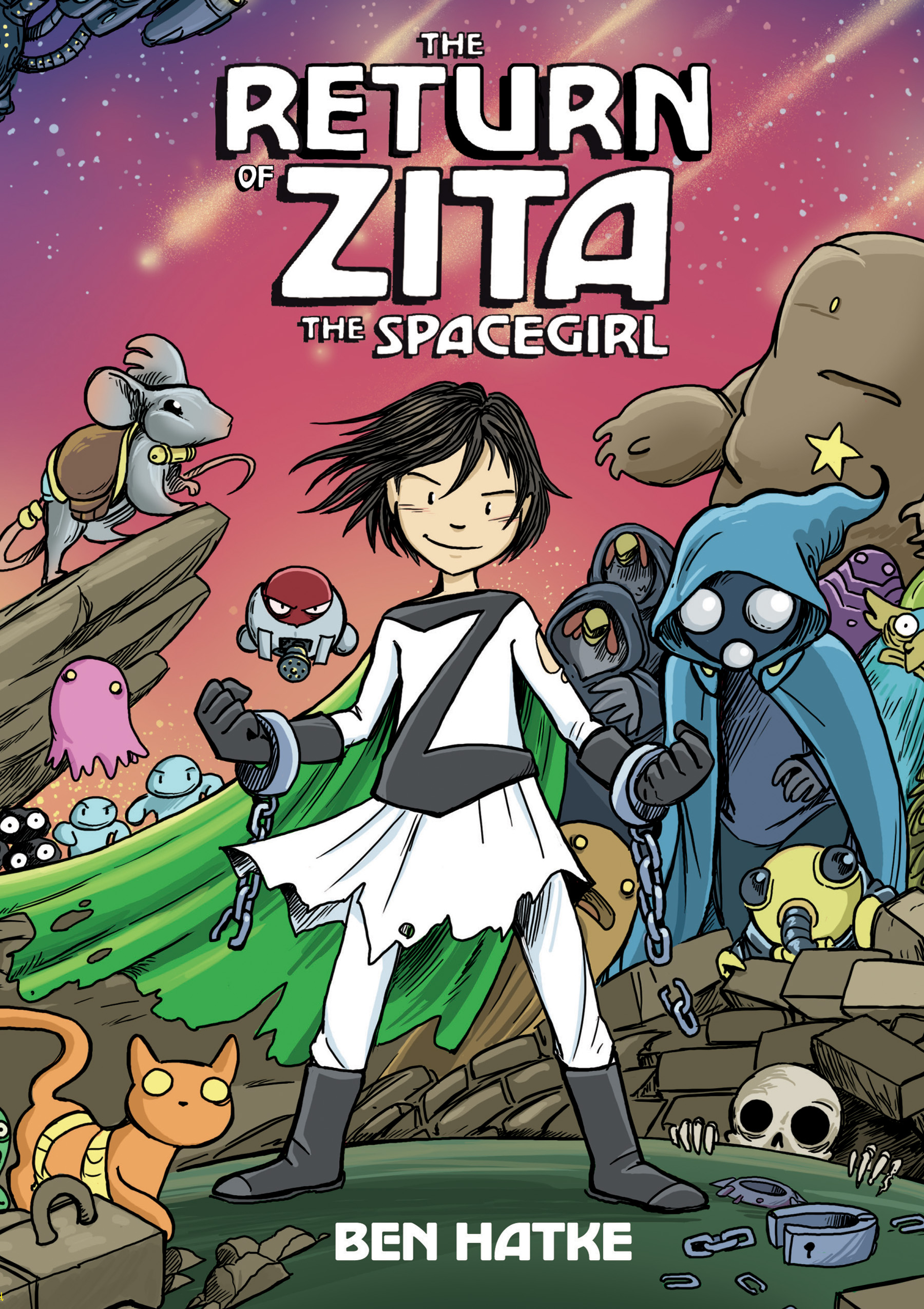
The Return of Zita the Spacegirl – A WhatchaReading Review!

Great sagas come to an end – maybe. But we’ll get to that. For anyone who hasn’t heard of Ben Hatke’s Zita the Spacegirl, I urge you to get to a library, a bookstore, or a friend with an enviable graphic novel collection and check her out, because she is fantastic. I first met her when Chuck, our editor monkey, handed me a copy of the first book and said, “You have to read this. It’s all you.” And it was. I quickly read Legends of Zita the Spacegirl, and was delighted when a review copy of Return of Zita the Spacegirl showed up on my doorstep a couple of weeks ago.

Check out my review on WhatchaReading!

zita3

Posted in Fiction, Tween Reads, Uncategorized

Minerva Mint: The Order of the Owls

minervamintMinerva Mint: The Order of the Owls, by Elisa Puricelli Guerra/illus. by Gabo Leon Bernstein, Capstone Young Readers Group (2014), $9.95, ISBN: 9781623700386

Recommended for ages 8-10

Minerva Mint: The Order of the Owls is the first book in a new middle-grade series about an eccentric young girl named Minerva Mint, her two friends, Thomasina Crowley and Ravi Kapoor, and the mysteries that the group solves together; the most important being to find Minerva’s parents.

Minerva was found, as an infant, in a bag in Victoria Station. She lives in Lizard Manor -a large, ramshackle mansion that has seen better days – with Mrs. Flopps, the station custodian who discovered Minerva. Minerva meets Ravi and Thomasina, and the three become fast friends. Thomasina shares Minerva’s adventurous spirit and Ravi, a bit more level-headed and fearful, comes along for the ride at first because of his crush on Thomasina. He grows into himself during the group’s first adventures, but I’m pretty sure we’ll still see him as the voice of reason in the group.

This first book establishes the characters and the underlying mystery that will permeate the series – who are Minerva’s parents, and why did they leave her as an infant? There are some clues in the bag Minerva was found in, and she tries to put the pieces together. Thomasina and Ravi are sworn to help her, but Minerva is no damsel in distress; she can handle after years of fending off various long lost “parents” who come to the home in search of the valuable real estate and imagined riches in Lizard Manor.

The story is fast-paced and light, perfect for a middle-grade read about friendship with some mystery thrown in. Minerva is a quirky, fun character that will appeal to girls who want to step outside the “girly” model. Thomasina – pretty, blonde, wealthy Thomasina – is an adventurous spirit and a friendly, outgoing girl, which is a relief if you’re tired of the seemingly obligatory mean girls popping up as dramatic foils. Ravi is a shy, fearful boy who allows himself to be drawn out by the two girls. The group’s valued friendship sends a good message to younger readers about sticking together.

Gabo Leon Bernstein’s black and white illustrations are adorable and add to the story, giving us characters to bond with and creepy, fun landscapes. His illustrations advance the plot and fire up the imagination.

I look forward to more Minerva Mint books, and luckily, there are a two in progress: Merlin’s Island and The Legend of Black Bart. The publishers website offers extras, including character profiles, a book trailer, and downloadable clues sheet and a secret club contract that readers can use for their own secret societies!

Posted in Fantasy, Fiction, gaming, geek, geek culture, Humor, roleplaying, Science Fiction, Teen, Young Adult/New Adult

Attack the Geek: Geek Culture Gone Wild!

attackthegeekAttack the Geek, by Michael R. Underwood. Gallery, Threshold, Pocket Books (2014), $2.99, ISBN: 9781476757780

Recommended for 18+

Attack the Geek is more of a New Adult read than it is a YA read, but there are plenty of pop culture, gaming, and garden variety geek references in there that will appeal to younger audiences. There’s a content heads-up for language, but it’s nothing the kids aren’t screaming at each other these days.

Attack the Geek is a side adventure to a series created by Michael R. Underwood; his previous two books, Geekomancy and Celebromancy, are available via digital download on Amazon for a very reasonable price. I haven’t read the two previous books which could be a reason why I felt off-kilter with Attack the Geek.

For any gamers out there – did you ever have a roleplaying session where one bar fight or battle took up hours of your campaign? If you know what I’m talking about, that’s how I felt while reading Attack the Geek. It’s a single combat story, with barista Ree Reyes, the heroine and protagonist of the series, and her fellow geekomancers coming under attack at Grognards, the establishment owned by Ree’s boss, Grognard. The geekomancers have the ability to channel the power of geek culture by consuming it – Ree, for instance, keeps clips from her favorite movies, like X-Men or Spider-Man, to draw upon when she needs power – and she’ll be able to shoot webs or toss people with telekinesis. There are props aplenty, including working Star Trek phasers and Star Wars lightsabers, and collectible card game cards merely need to be torn to release their  magic in this world, if channeled by the geekomancer. So when they come under attack from a Strega witch named Lucretia, it’s a hairy battle, loaded with pop culture references and witty banter.

This being a side adventure is my own issue – I am unfamiliar with the geekomancy power and these characters, so in a sense, I was at a disadvantage. But I also thought the book was trying to be too witty, throw too many references in, for its own good. The references took over the plot, and after a while, I was just reading about a battle where there was Spider-Man web slinging, Star Trek phasers, and lots of collectible card game references. This just wasn’t my book. For anyone who’s a devoted sci-fi/fantasy/gaming/comic book fan, it’s worth a shot. It’s why I requested it from NetGalley, after all, and I may read Geekomancy now just to see if having more of a background will help me better grasp the book.