Posted in Middle Grade, Non-Fiction, Non-fiction, Tween Reads

Give your brain a workout with NatGeo Kids’ MASTERMIND!

mastermindMastermind, by Stephanie Warren Drimmer/Puzzles by Julie K. Cohen, (May 2016, NatGeo Kids), $12.99, ISBN: 978-1-4263-2110-8

Recommended for ages 8-12

Loaded with over 100 games, tests, and puzzles designed to “unleash your inner genius,” Mastermind is huge fun – and you learn stuff, too.

Guided through the book by cartoon characters Ima Genius and her canine sidekick Astro, Mastermind is all about the brain: each section is devoted to a different part of our brains and features sections like How it Works, where readers are guided through a step by step process of each part of the brain makes operations like sight, muscle movement, smell, and memory happen; fun facts and wild photos help break it all down for readers. Time Trials challenge readers to solve puzzles while timing themselves, and a final quiz in each chapter, called Test Your S.M.A.R.T.S. (Superior Mental Acuity and Rationality Testing System), pop up in each section, so budding geniuses can witness themselves becoming smarter with each section. A fun Mastermind Meter lets you track the progression of your genius through the book.

I had a great time reading and playing the games in Mastermind. The facts and real-life stories are interesting and fun, and there’s a ton of information to be learned here. Each section of the book looks at a different part of the brain and how we use them, from our senses, to identifying sounds, to mental map making and memory. Beginning with a maze through a highlighted part of the brain (to get your brains ready, naturally), readers learn how animals use their brains for similar purposes, and Weird Science introduces us to people living with brain issues that make them see things differently; for instance, hemospatial neglect causes someone to ignore things on one side – imagine only shaving half your face?

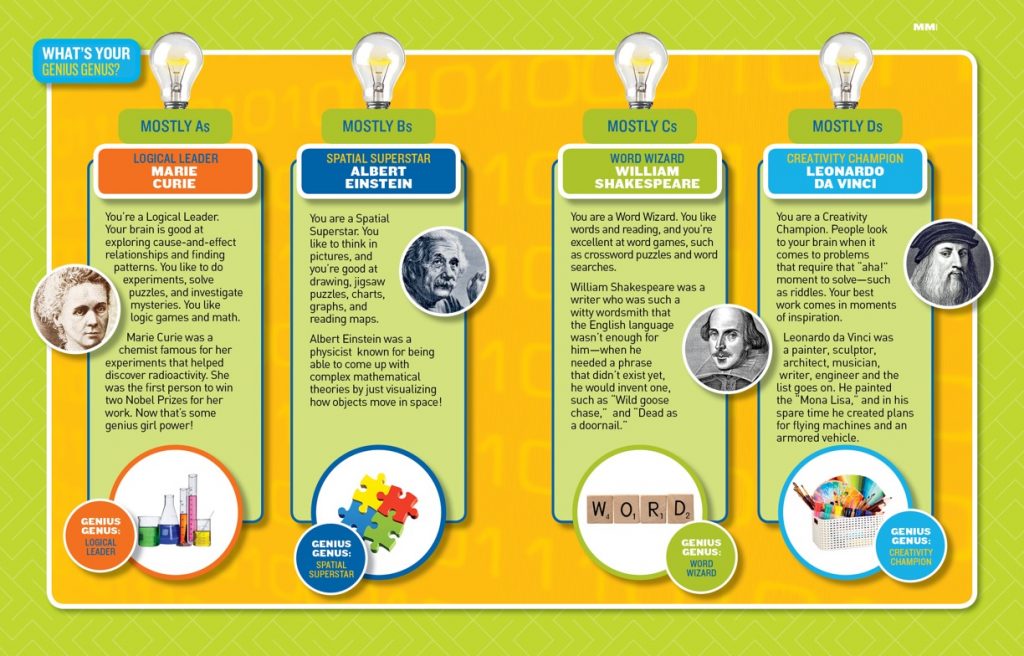
This will be destroyed in circ, because kids are meant to write in this book, but it won’t stop me from adding it as a great birthday or holiday gift to a few budding geniuses on my list. There are tons of ideas in this book for teachers and librarians, though; you can get the kids fired up with your own timed code challenges or have them figure out which genius they gel best with. The Mastermind website offers two downloadable puzzles, and a genius personality quiz kids can take online. All in all, Mastermind provides some fun and makes you think, which is really what learning should be all about.

mastermind_1

Posted in gaming, Graphic Novels, Non-Fiction, Teen, Tween Reads, Young Adult/New Adult

Box Brown gives us the real story of Tetris, the most addictive game EVER

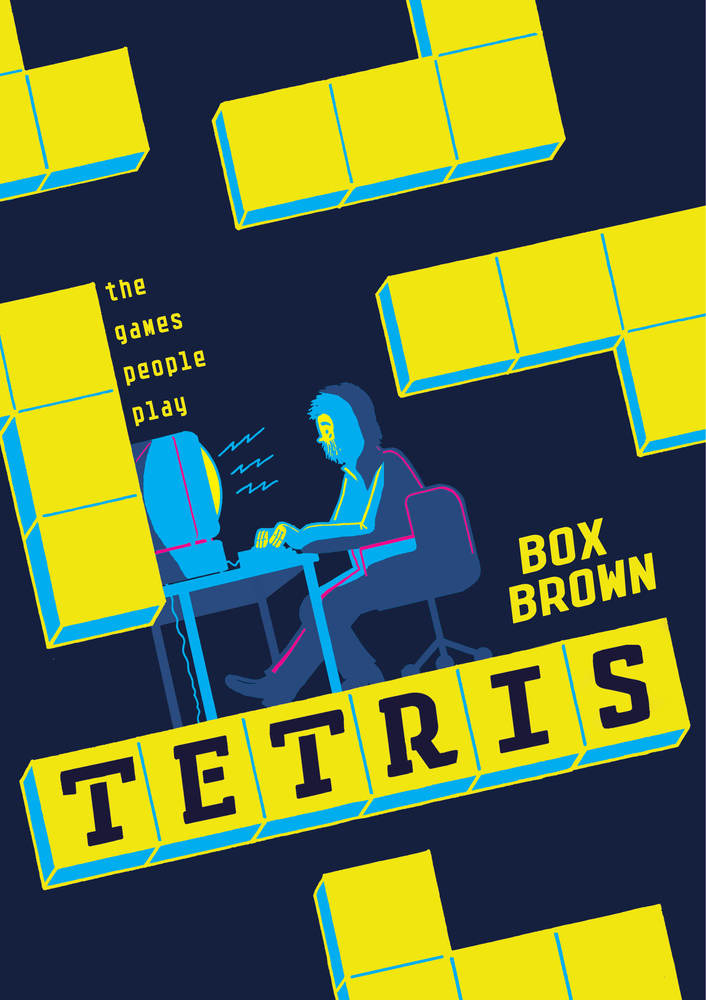
tetris_1Tetris: The Games People Play, by Box Brown (October 2016, First Second), $19.99, ISBN: 9781626723153

Recommended for ages 12+

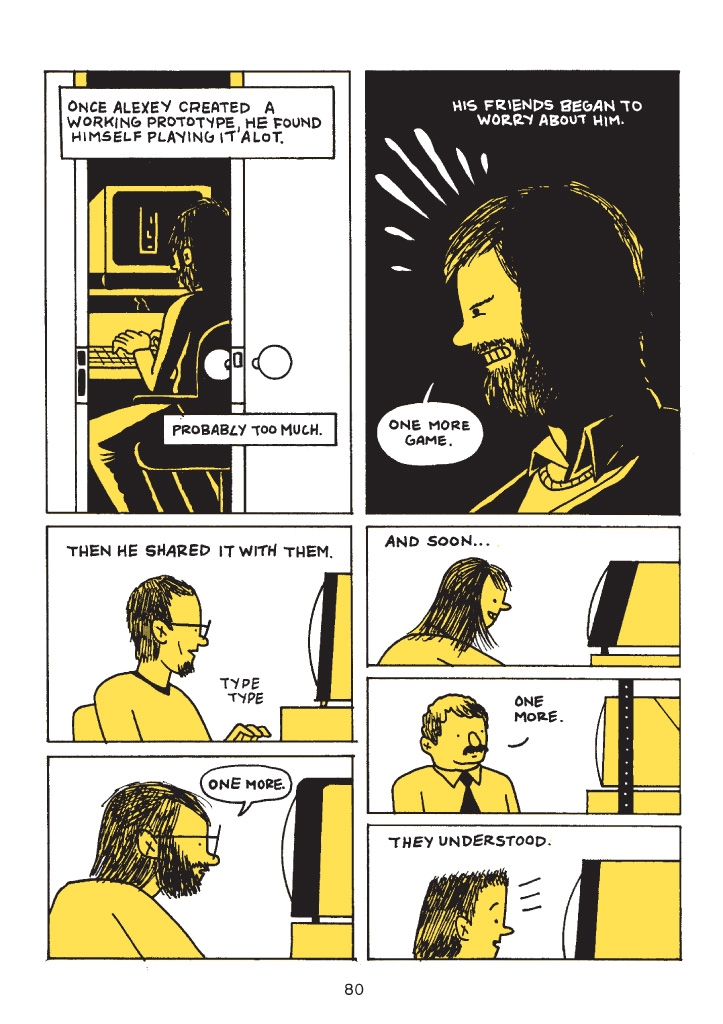
If you spent the better part of the early ’90s glued to your keyboard/gaming console/handheld, immersed in the video game Tetris, you’re not alone. I have logged many hours in front of my NES, rotating those little blocks to achieve the perfect fit. Box Brown’s graphic novel tells the story behind Tetris: the men who created it, and the game developers that almost went to war over bringing it to the masses.

We meet Alexey Pajitnov and his colleague, Vlad Pokhilko, computer scientists at the Moscow Academy of Science. In 1984, Alexey created Tetris in his spare time; it began life as freeware, being passed from friend to friend, coworker to coworker. This game was a phenomenon waiting to happen: it was addicting from the start; people were mesmerized. One story in the book illustrates a manager providing copies to his workplace colleagues, only to take the discs back and destroy them when office productivity declined.

We see the struggle between game developers and the tangled weave of rights for the game: Nintendo, Atari, and Sega all wanted it, and rights 0wnership was downright sketchy, with miscommunication and under the table deals leading to lawsuits. The story reads like an international thriller in parts, with all the trips to Moscow, international dealings, and theft and intrigue.

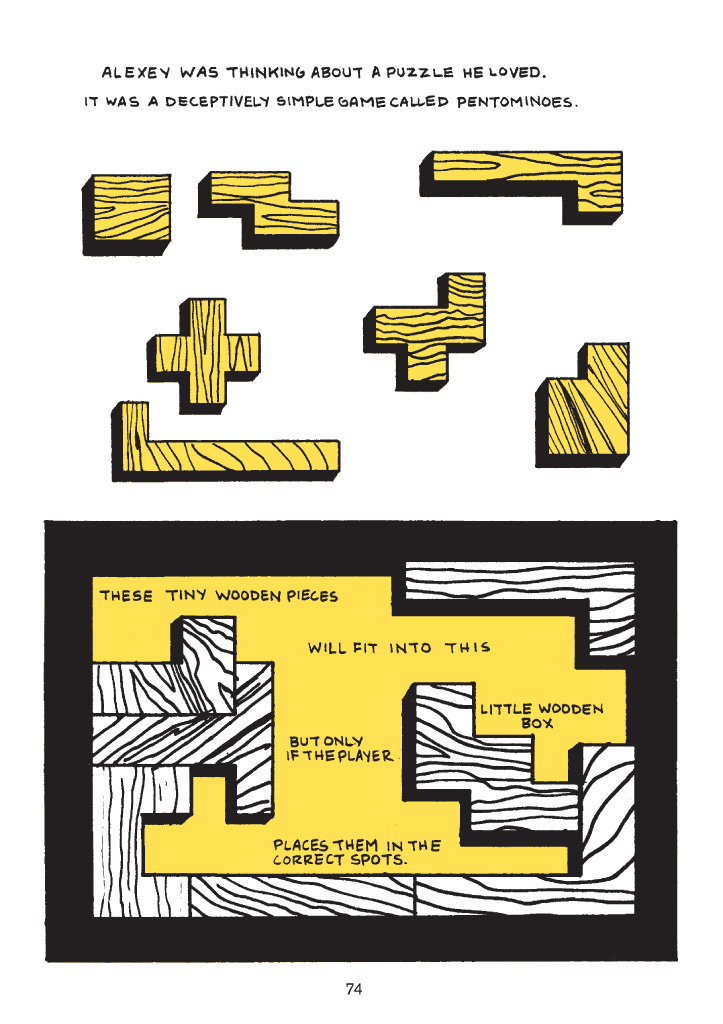
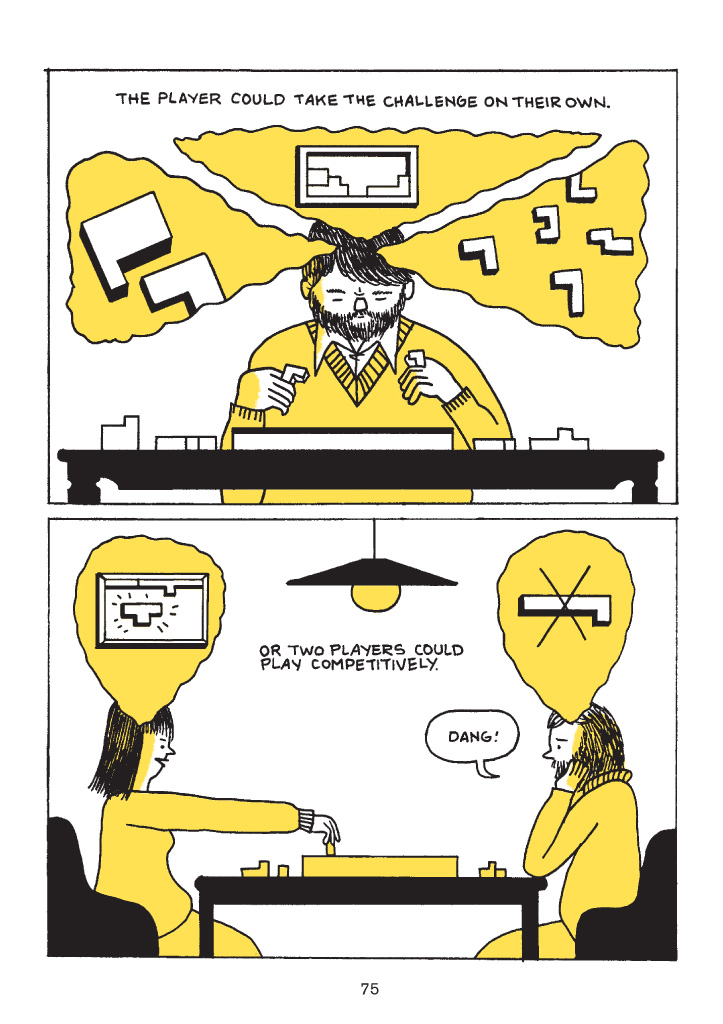
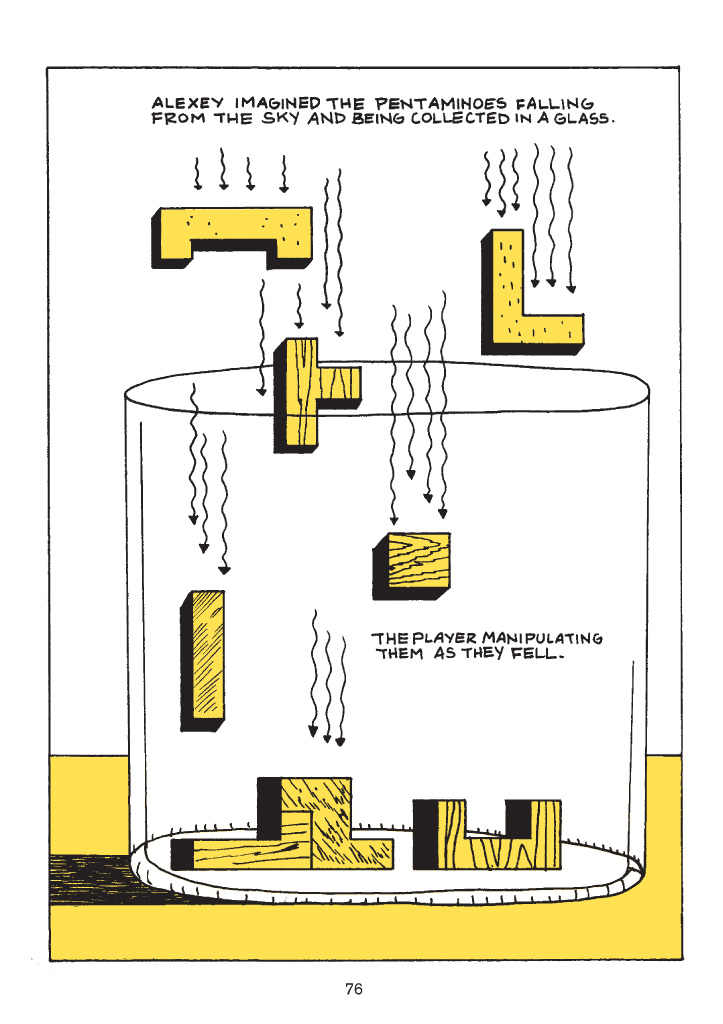
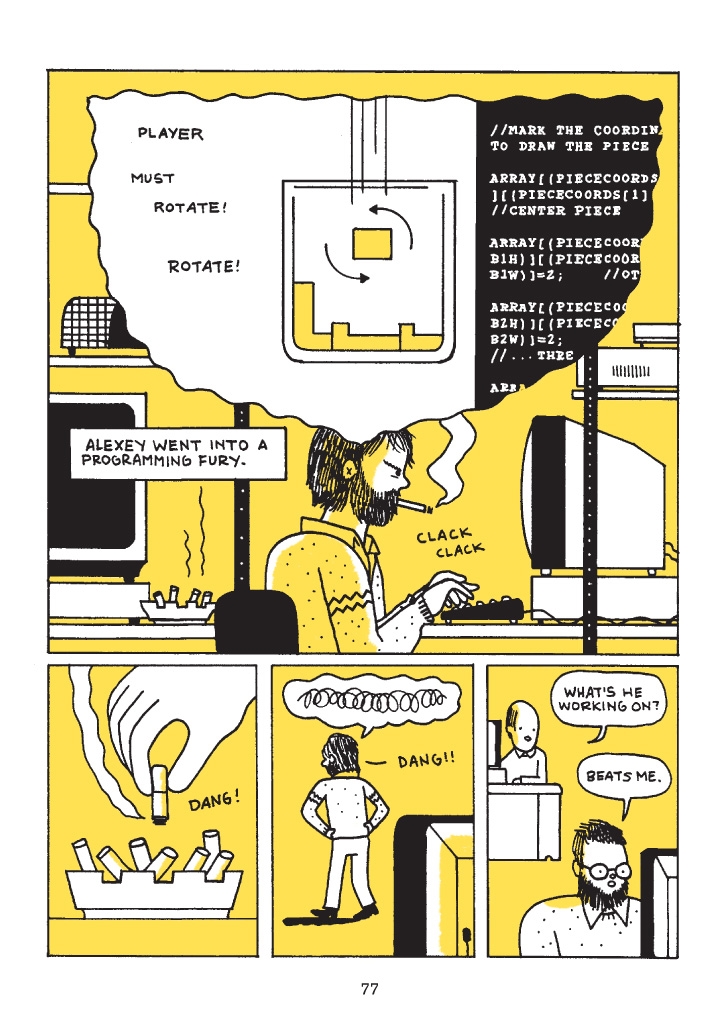
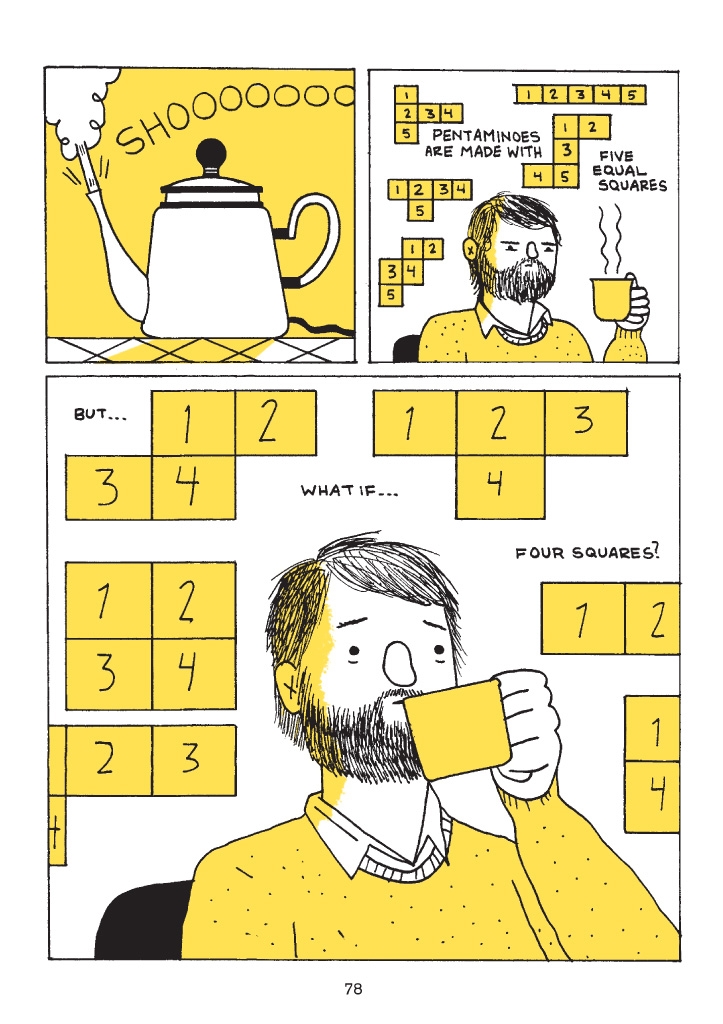
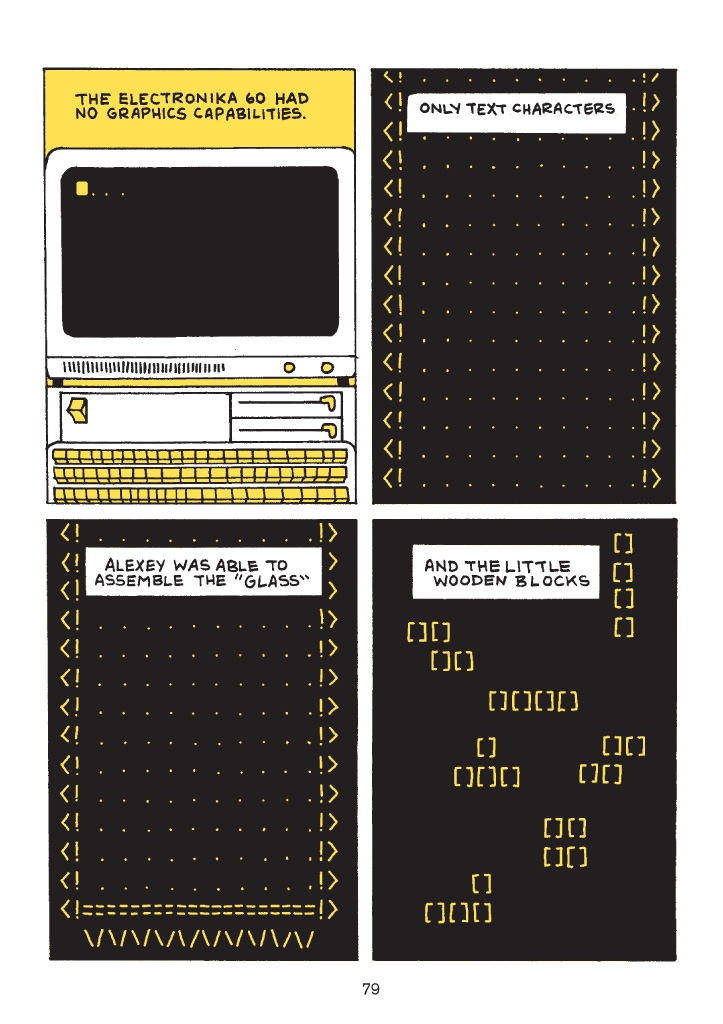
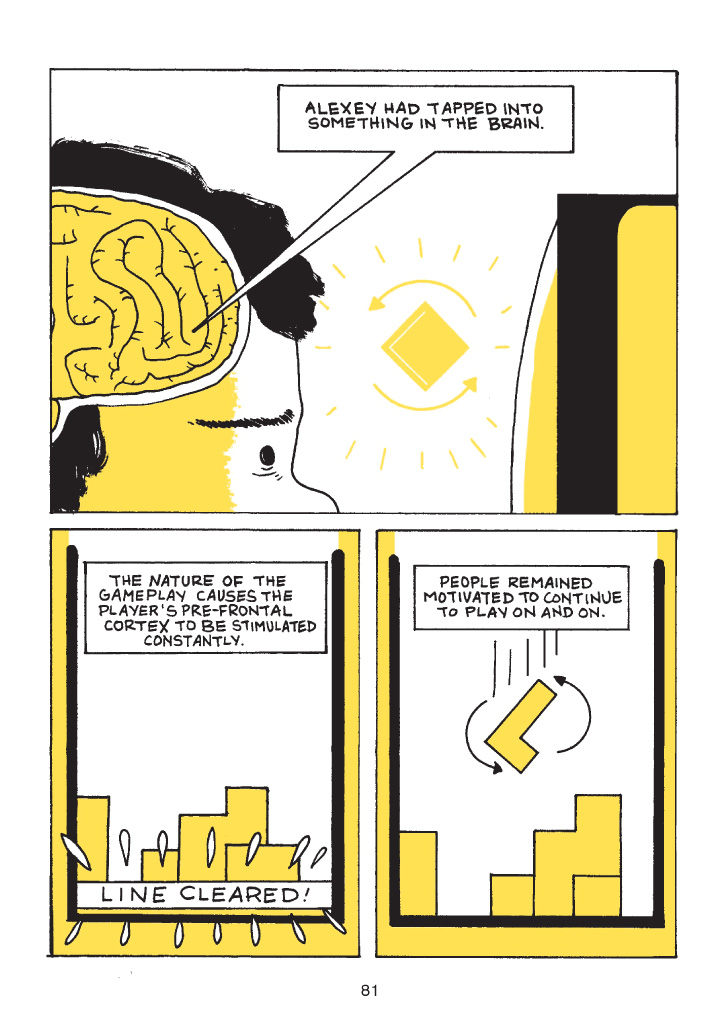
The story unfolds in two-color art, with game screen renderings and simple character drawings keeping readers focused on the story and the complexity of the game itself. In the story of Tetris, Box Brown also gives us the story of gaming: the pursuit of fun, and the role of gaming in art, culture, commerce, and intellect. From Lascaux cave paintings, which depict games, to artifacts of gaming pieces rendered in bone, to Senet, an Ancient Egyptian board game, to dice games, and finally, to smartphone gaming (where Tetris still lives on), the pursuit of fun, the joy of gaming, is part of human history.

This will go over well with gamers and history fans, graphic novel fans and anyone interested in business. There’s some good advice for businesses in the story of Tetris, especially for anyone interested in international licenses. Box Brown’s graphic novel is multilayered and well-rounded, with an abundance of information presented in an interesting and easy to digest format.

Box Brown is a New York Times–bestselling author. He wrote the best-selling graphic biography, Andre the Giant: Life and Legend. Take a look at some more of Tetris here, and head over to Box Brown’s author webpage and see more of his illustration work.

tetris_2 tetris_3 tetris_4


And now, you can’t get the Tetris music out of your head, either. You’re welcome.

Posted in Middle Grade, Middle School, Non-Fiction, Non-fiction, Teen, Tween Reads

Bridge to the Wild: Zoos connect people and animals

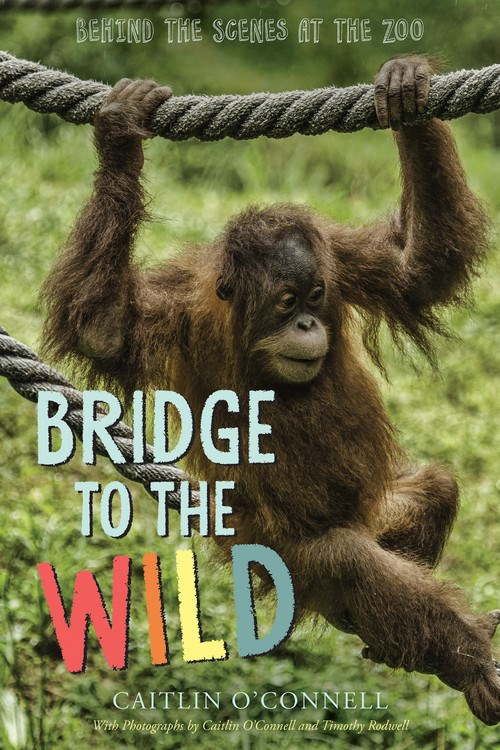
bridge-to-the-wildBridge to the Wild, by Dr. Caitlin O’Connell/Photographs by Timothy Rodwell, (Aug. 2016, HMH Books for Young Readers), $18,99, ISBN: 9780544277397

Recommended for ages 10 and up

I’m about to gush here. If you read my reviews often enough, you probably have guessed that I love any nonfiction book about animals, conservation and preservation, and even better when the ideas are combined. In Bridge to the Wild, Dr. Caitlin O’Connell begins by recalling a childhood visit to the zoo – back when animals were still largely kept in cages (I remember it well), and saw a gorilla, seemingly in deep despair over living in a cage not much bigger than he was.

Thankfully, those days are (mostly) over. Zoos are more like natural preserves now, offering many animals larger spaces to roam; conservation and preservation is the order of the day, with zoo staff rescuing and caring for animals all over the world. As more animals face extinction at the hands of poachers, habitat devastation, and pollutants that contaminate their environment, zoos are playing a bigger part in keeping our wildlife alive, and conducting valuable research on improving their conditions and our world. Bridge to the Wild is Dr. O’Connell’s manifesto, where she lays out the valuable ways zoos are a bridge for humans, to the wild outside our doors.

Dr. O’Connell spent a week working with the staff at Zoo Atlanta –  a private, nonprofit wildlife park and zoo – to observe the relationships between animals and caretakers, to help strengthen this bridge. After all, what we see as observers is only the tip of the iceberg; many, many loving and brilliant people are behind the scenes, learning about and learning from the animals, caring for them, loving them. From the Dawn Chorus – the morning symphony conducted by the tenants as the day begins, to the Dusk Chorus, when they start winding down for the night, Dr. O’Connell and Tim Rodwell introduce us to the inhabitants of Zoo Atlanta, from the pandas, to the hornbills, meerkats, gorillas, tigers and more.

There are anecdotes and beautiful photographs, a “Keeper Feature” that profiles the different keepers at Zoo Atlanta, and a fantastic note on ignorance and extinction, which is a real call to action to end senseless poaching of animal parts for talismans and “remedies” that simply don’t work. A full bibliography and sources are available and provide more research opportunities, and data sheets encourage budding zoologists to do some research on their own, guided by Dr. O’Connell, who lays out simple experiments to observe and record behaviors.

Animal books are hugely popular with my Corona Kids, and I’ve been stacking my collection with plenty of rescue, preservation, and conservation titles for them, to drive home the point that this planet doesn’t only belong to us. Bridge to the Wild is going to be one of those books I talk endlessly about, especially since my library is about a stone’s throw away from the Queens Zoo. I may even slip copies of this book into teachers’ hands during class visits, with a “hint, hint” nudge for a class trip activity (sorry, kids!). That’s how important this book is to me.

Bridge to the Wild has received a starred review from School Library Journal. Learn more about Dr. O’Connell’s work and books at her author website.

Take a peek at a chapter excerpt on meerkats, then go order this book for your animal lovers!
meerkat_1


Posted in Middle Grade, Non-Fiction, Non-fiction, Teen, Tween Reads

You want football stats? SI Kids has them! 1st and 10 is loaded with lists, stats, and photos!

sikidsfootballSports Illustrated Kids 1st and 10: Top 10 Lists of Everything in Football (Revised & Updated), by the Editors of Sports Illustrated for Kids, (July 2016, Sports Illustrated, $19.95, ISBN: 978-1-61893-173-3

Recommended for ages 8+

Do you love lists? Do you love stats? Do you love football? There’s something for everyone in this updated edition of Sports Illustrated for Kids’ book, 1st and 10: Top 10 Lists of Everything in Football. There are loads of Top 10 lists, sure: Top 10 Rivalries, Nicknames, Fantasy Performers, Stadiums, and more, but each of these lists is loaded with stats: dates, scores, major games, players, you name it. There are 36 lists in all, with some great career highlights for longtime football fans and new ones who want to learn some of the history behind the sport.

Since I’m not well-read or conversant in sports, I’ve been trying to beef up some of that knowledge so I can guide the kids at my library to books that will interest them; 1st and 10 is a great book for me to lead them to. I can easily booktalk it, because it’s quick bites of information. There are things I can focus on, like the Top 10 Artifacts (the first Super Bowl ring! A football from 1895! My inner archivist and history nerd is rejoicing!), Movies (The Replacements is a long guilty pleasure of mine), and Hairstyles (My hair on the most humid of days has nothing on Troy Polamalu).  Add in the stunning photography that you’d expect from Sports Illustrated, and you have a book that collectors of any age will enjoy.

1st and 10 is part of a series of Top 10 lists for each sport: you can also add Full Count: Top 10 Lists of Everything Baseball, Slam Dunk! Top 10 Lists of Everything Basketball, Face-Off! Top 10 Lists of Everything Hockey, and The Top 10 of Everything Sports. I’ll be putting these books on my shelves, now that I know about them. They’re great go-to resources for any library that has sports fans coming through the doors.

Posted in Early Reader, Non-Fiction, Non-Fiction, Preschool Reads

Gear Up! Sports Illustrated Kids Talks Hockey!

si_hockeyMy First Book of Hockey: Mostly Everything Explained About the Game (A Rookie Book), by the Editors of Sports Illustrated for Kids (Sept. 2016, Sports Illustrated), $11.95, ISBN: 978-1618931771

Recommended for ages 4-8

Sports Illustrated Kids’ Rookie Books series are great for burgeoning sports fans, big or small. Hey, I’m honest: whenever I’ve needed to learn something from the bare bones, I’ve gone to the children’s section. It’s how I learned to crochet more than a basic single stitch, it’s how I’m relearning all the high school Spanish I forgot, and it’s how I learned exactly what goes on during a hockey game.

An illustrated, cartoony “rookie” appears on the endpapers and throughout the book, acting as our guide. through Hockey 101. He gears up in the beginning, putting on all of his protective hockey equipment, and shows up on every spread, offering fun side commentary over the action photos.  There are photos of real NHL players from several teams (don’t ask me who they are, please, I just learned what a slap shot is), with comic book word bubbles, big, fun fonts, and simple explanations to give readers a good starting point on understanding and enjoying hockey. Digital numbers add to the sports feel as the book, divided into three “periods” like a hockey game, breaks down what happens during each period.

There are great photos – think Sports Illustrated photography, after all – a glossary of terms, and a friendly introduction to the sport. Other books in the Rookie series include My First Book of Baseball and My First Book of Football. If they ever decide to release a My First Book of Soccer, I can guarantee it will circulate like wildfire in my library!

If you have sports fans in your community, these are a must-have. I’ll be adding a few of these to my shelves, and suggesting that my colleagues, who have field hockey teams in their communities, add My First Book of Hockey to theirs.

Posted in Middle School, Non-Fiction, Teen, Young Adult/New Adult

Trying to Float: A New York Childhood

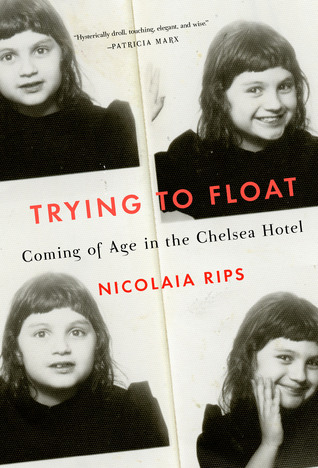
trying to floatTrying to Float: Coming of Age in the Chelsea Hotel, by Nicolaia Rips, (July 2016, Scribner), $25, ISBN: 978-1501132988

Recommended for ages 14+

New York City’s Chelsea Hotel is part muse, part myth. Home to countless artists, luminaries, and eccentric personalities over since it opened its doors in the late 19th century, the Chelsea  seemingly received as much inspiration as it gave. Art decorated the walls of the hotel, often put there by artists moved to add their voice to the hotel’s presence. Among the more recent Chelsea residents were the Rips family: lawyer, Michael, model-turned-artist, Sheila, and their daughter, Nicolaia. It’s Nicolaia’s story we get in Trying to Float: Coming of Age in the Chelsea Hotel.

Nicolaia wrote the memoir of her formative years at the Chelsea before she graduated high school. The project was inspired by her parents, who told her to journal her stories from school and life in general – so kids, take those journaling assignments seriously! Nicolaia’s story, told in a series of anecdotes and memories, alternates between laugh-out loud funny and painfully spot on. She was the lonely kid in the crowd, her parents often wrapped up in their own eccentricities, and she seemed to figure out a lot on her own, or with the help of some of the Chelsea residents.

Her self-deprecation and her wise-beyond-her-years insights make this book an unputdownable read. Teens will love this because they’ll identify with so many moments: mortification at a birthday party, mean girls spreading rumors about you right in front of you, a parent making you want to move away and start life over under the teenager’s version of a witness/parent protection program. New Yorkers and people who love New York will love it because it’s a slice of life in New York City.

Trying to Float received a starred review from Kirkus. Do not miss this one. Get a copy for yourself, get a copy for a teen in your life, and booktalk it with some more New York stories. There are tons out there, including the photo essay book, Living in the Chelsea Hotel by Linda Troeller.

Posted in Early Reader, Intermediate, Non-Fiction, Non-Fiction, Non-Fiction

Celebrate diversity with The Barefoot Book of Children!

barefoot_1The Barefoot Book of Children, by Tessa Strickland and Kate DePalma/Illustrated by David Dean, (Oct. 2016, Barefoot Books), $19.99, ISBN: 9781782852964

Recommended for ages 3-8

“Every morning, millions of children open their eyes and start another day.”

Using broad statements and insightful questions about how we live, love, and play,  The Barefoot Book of Children introduces readers to children all around the world. David Dean’s bright, hand-painted illustrations show how families around the globe live; dress; and pray and worship. We get glimpses into the treasures we all keep, the stories we all have to tell, the meanings behind our very names. With questions like, “How do you share your love?” and “What will happen in your story?”, the book invites kids to come together and talk about their lives and their families, learning how we are unique and the same, all at once. Illustrated notes at the end of the book provide a deeper examination of the book, focusing on homes, special places, and hobbies featured in the book.

I’m from Queens, New York; one of the most diverse places in the country. The Barefoot Book of Children is what every library, every school, in my borough should be reading and making available to the kids we serve, because every child here will see themselves in this book. That’s tremendous. It brings us together by introducing us to other cultures through the familiar: play, family, home. The bright artwork is so inviting, you can’t help but pull up a comfortable seat and spend some time getting to know your world better.

I loved this book, and I think parents, educators, and most importantly, kids, will, too. Take a look at more of the book and consider adding it to your wish lists.

barefoot_5

barefoot_6

barefoot_4


Posted in Intermediate, Middle Grade, Non-Fiction, Non-fiction, Non-Fiction, Tween Reads

Need to know about sports? NatGeo’s got you covered.

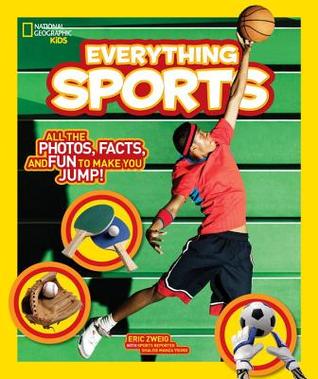
sportsNational Geographic Kids: Everything Sports, by Eric Zweig with Shalise Manza Young, (March 2016, National Geographic Kids), $12.99, ISBN: 9781426323331

Recommended for ages 8-12

I am not a big sports girl, often to my husband’s chagrin. Don’t get me wrong, I love watching the Olympics, and there are sports I enjoy watching, like fencing and gymnastics, but it’s not often that I get to watch those (usually, just during the Olympics). Many of the kids in my library are big sports fans, though, so I need to become better versed in some general sports books, so I can booktalk and show them books that may appeal to them. As always, I start with NatGeo Kids, because 1) their books fly off my shelves; 2) they’re comprehensive, with beautiful photos, and 3) they have little fact tidbits that always help with a booktalk or party talk.

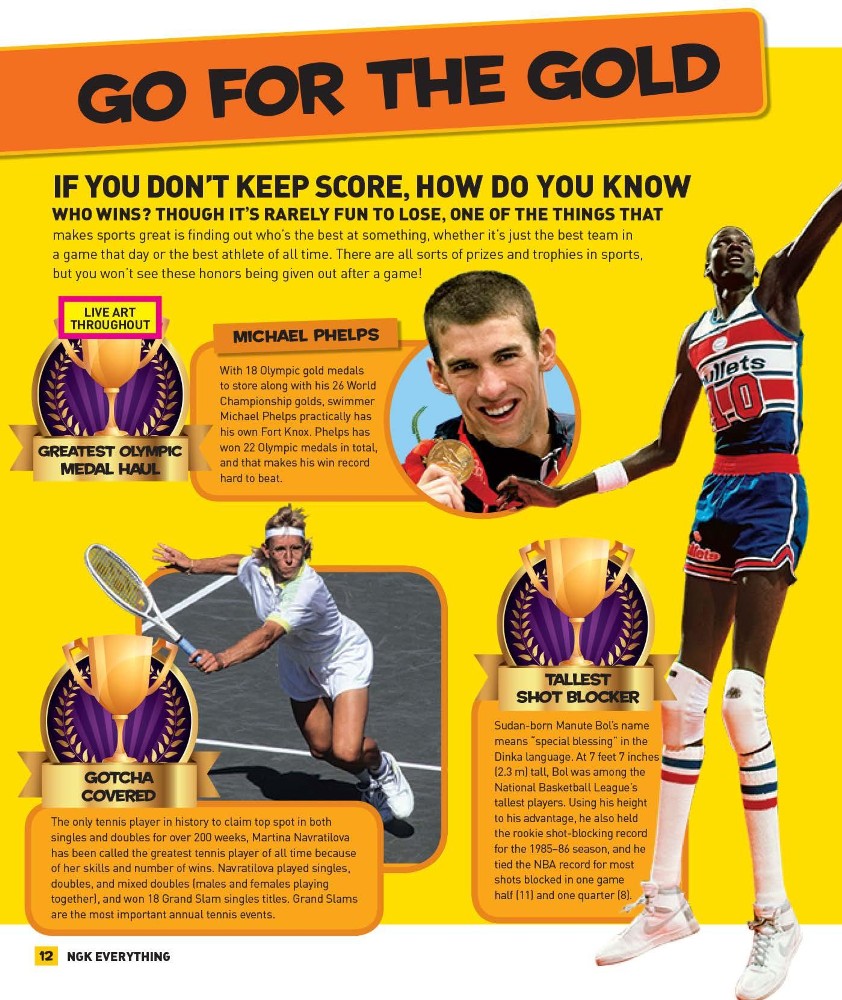
Everything Sports is a great go-to for general sports info, especially for newbies who want to learn more, like me. The book is only 64 pages – not a huge commitment to a history of every sport ever played – and written by two sports journalists who also have a gift for making their complete understanding of sports readable and digestible to all. Sharlise Manza Young shares her knowledge throughout the book in her “Explorer’s Corner” feature, providing a little more background info on some of our most popular sports. There are fun activities and quizzes throughout -kids can make their own sports cards, which opens up a world of program possibilities for me, especially during World Cup season, because my Corona Kids are also devoted soccer (ahem… “football”) fans.

Everything Sports is a great add to where you’re building a strong sports collection. Display with David Stabler’s Kid Athletes and your seasonal sports books, plus any biographies on popular atheletes in your community. Just coming off of a fantastic Olympics showing, you can display from gymnastics books and talk up recent Olympians, including the Fabulous 5 (also a great opportunity to talk up the amazing diversity on this season’s team), Olympic swimmers Simone Manuel, Katie Ledecky, and Michael Phelps, and since yes, there is fencing in the book (yay!), let’s talk about Ibtihaj Muhammad, who set the strip on fire in Rio!

sports_1sports_2

Photos courtesy of DogoBooks.com
Posted in Intermediate, Middle Grade, Non-Fiction, Non-fiction, Non-Fiction, Tween Reads

Ocean Animals: Who’s Who in the Deep Blue!

big blueOcean Animals: Who’s Who in the Deep Blue, by Johanna Rizzo (May 2016, National Geographic Kids), $12.99, ISBN: 9781426325069

Recommended for ages 8-12

When you have a book featuring real life Dory on the cover and a Nemo on the first page of a book, you know NatGeo is paying attention to what kids like. Ocean Animals: Who’s Who in the Deep Blue is another home run from NatGeo Kids, combining breathtaking photos of ocean life (blobfish and anglerfish are breathtaking, if a bit in that gasp of “WHOA!” kind of way, after all) with interesting facts, information, and advocacy. Chapters are broken down by oceans of the world; the three layers the ocean, and the animals that inhabit them, featuring a great infographic; sharks and rays; marine mammals; a separate chapter on whales and dolphins; marine birds; ocean habitats; the Pristine Seas Project, and 20 Ways You Can Protect the Ocean. A glossary and index complete the volume.

I used this book as a companion to my ocean storytime today; it was great to be able to show the kids a beluga whale and an orca after we sang our song about whales. Saying the name over and over is one thing; seeing a picture of the real animal is another. I love NatGeo’s focus on advocacy, and how the organization empowers kids to take action to preserve their planet.

20160825_104603Sorry for the photo glare! Love this detailed infographic.

You all know I love NatGeo books, and now you know this copy’s already in my library. My little guy loves his copy; even though he’s only 4 years old, he loves looking at the photos, and I modify/paraphrase some of the information when he wants me to read it to him. This one’s a great selection for middle grade nonfiction collections and animal lovers.

20160825_104615Beautiful photo of a sea anemone

Posted in Early Reader, Graphic Novels, Intermediate, Non-Fiction, Non-Fiction, Non-Fiction

A touching portrait of a Canadian strongman: The Great Antonio

antonio_1The Great Antonio, by Elise Gravel (Oct. 2016, TOON Books), $12.95, ISBN: 978-1-943145-08-9

Recommended for ages 6-8

Antonio Barichievich was a bear of a man: he weighed as much as a horse, once wrestled a bear, pulled passenger buses full of people, and could eat 25 roast chickens and a dozen donuts in one sitting. He was also a beloved figure: an immigrant from Eastern Europe who loved his adopted country of Canada and its people. He was a wrestler and a strongman; he was a kind and gentle soul who twirled kids around on his gigantic braids, who lived simply, and could often be found in his neighborhood donut shop.

Even if you’re not familiar with The Great Antonio – I wasn’t, before this – this is a sweet tribute to a beloved public figure. The book is accessible to anyone, because it’s a story about a larger-than-life person who did larger-than-life things. Add bright and bold illustration to a story about a man that some people thought of in Paul Bunyan-type terms, even joking that he may have been from another planet – and you have a modern tall tale for a new audience.

A note from the author/illustrator at the end of the book explains her interest in Antonio. She “illustrates a little “About Me”, showing readers things she likes, like fart jokes, grumpy unidentified things, and strong and funny girl characters, which assures that I should probably become BFFs with her, because I like those things too, and my kids and the kids in my library know it. This will make life so much easier when I booktalk this book (and try to find more of her illustrated books in the US).

Check out Elsie Gravel’s website for more of her artwork and books. The Great Antonio‘s page on TOON Books will also have a link to an educator’s guide closer to pub date, so keep it bookmarked. The Great Antonio is a Level 2 TOON Book, so it’s appropriate for readers in grades 1-2 (but you can read it to younger – my 4 year old loved seeing Antonio swing kids from his braids and wrestle a bear). If your kids’ school uses Guided Reading, the book is appropriate for levels G-K, and it’s a Lexile BR-240.

As a biography, it’s pretty niche, at least here in the U.S., but as a story about a person who touched lives and made headlines, it’s a great read.  I love the art and the story, so I’ll see how this one does in my collection, especially with some booktalking/storytimes.


antonio_4