Posted in Fantasy, Fiction, Historical Fiction, Teen, Young Adult/New Adult

The Cure for Dreaming gives us Dracula, suffrage, and mesmerism!

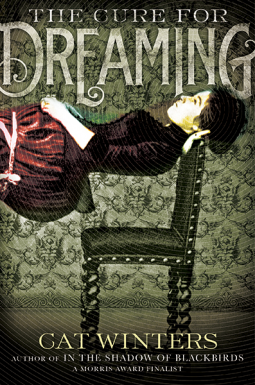
cure for dreaming The Cure for Dreaming, by Cat Winters (Oct. 2014, Abrams), $17.95, ISBN: 9781419712166

Recommended for 13+

Olivia Mead is a strong-willed young woman living in Oregon in 1900. She loves to read fiction – Dracula is her current favorite novel – and she dreams of going to college. She also happens to be a suffragist, something her narrow-minded father doesn’t know anything about. Olivia’s mother left her with her father when Olivia was a young child; she lives in New York where she ekes out a living as a stage actress and dates wealthy men. She sends Olivia money every birthday, but doesn’t seem to be otherwise too involved.

Olivia’s father can’t take much more of his headstrong daughter’s ideas. He fears her behavior will lose him patients, so he contacts Henri Reverie – a mesmerist (a hypnotist) that hypnotized Olivia in a recent performance –  to “cure” his daughter. He asks Henri to help Olivia to “see things as they really are”, and rather than argue with him, to say, “All is well” when she’s angry.

It backfires. Horribly. Olivia does see things as they really are – she starts seeing oppressive men as bat-vampire-wolf creatures, and anti-suffragist women as pale, ghostly beings. She is unable to defend herself, only able to say, “All is well.” She finds herself the target of ridicule as her father glories in his “success”. But he hasn’t succeeded in doing anything other than stoking the fire of Olivia’s independence, and her desire to get away from him at all costs. She seeks Henri’s help in restoring her mind, and finds out that Henri’s story goes far deeper than a mere stage performer.

The Cure for Dreaming is one of those stories that initially makes your head swim – Dracula, suffrage, and hypnotism? It all comes together, but there are moments when the narrative lost me. There is a subplot surrounding Henri’s younger sister that was felt almost tacked on, and Olivia’s father verged on caricaturist in his rage. Olivia seems far too complacent about her absent mother leaving her with a verbally abusive and neglectful father – she left because she couldn’t take it anymore, but it was okay to leave her kid with him? And it’s okay to drop a line and tell her how much she misses her ONCE A YEAR?

Overall, The Cure for Dreaming is an interesting read. The photos that Ms. Winters chose to feature throughout the book, archival photos of suffragists and the time period, drew me right in. The subplot about an anonymous letter that adds fuel to the suffragist fire was one of the best parts of the book.

The author’s website offers a treasure trove of information, including book trailers, information on the periods during which her novels take place, an FAQ, links to social media, and book information.
 

Posted in Fiction, Historical Fiction, Teen, Young Adult/New Adult

The Girls at the Kingfisher Club – a Jazz Age retelling of a beloved fairy tale.

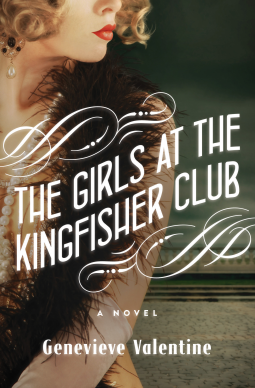
kingfisherThe Girls at the Kingfisher Club, by Genevieve Valentine (Atria Books, 2014). $24, ISBN: 9781476739083

Recommended for ages 14+

The Girls at the Kingfisher Club is a reimagining of the fairy tale, The Twelve Dancing Princesses, set in the Jazz Age. Jo, the oldest – known as “The General” to her sisters – and her 11 sisters are all but prisoners, locked in their businessman father’s townhome. Ashamed that his marriage couldn’t produce a son, he hides his daughters from the world, homeschooling them and giving them a small amount of money toward living expenses, like clothes and shoes. Their mother died, leaving Jo to watch over all of them. Their cold, standoffish father periodically sends for Jo to give him updates, but never spends time with his daughters.

Jo’s had enough. At first, she sneaks out to movie theatres, where she falls in love with dancing. She learns the moves, and teaches them to her sisters. And then, they start going out at night. As each of them are old enough, they join Jo, Lou, and the rest of their sisters, until all 11 girls wait for Jo’s nightly signal, sneak into cabs outside, and head for the speakeasies, where they dance their nights away. They live to dance and flirt, and Jo watches over all of them.

But nothing can last forever. The father has decided to start quickly and quietly marrying them off, and he expects Jo’s help in getting the job done. The time is coming for Jo to make decisions that will change all of their lives forever.

The Roaring Twenties is really a perfect setting for a retelling of The Twelve Dancing Princesses, and Ms. Valentine’s description of the nights out, dancing in the speakeasies, the clothes, and the music really placed me in the setting. One issue I had with the book is that, with so many characters, it was hard to “know” anyone but Jo. We get a very good idea of who she is, but the character development is really just touched on with the other sisters. The narrative sometimes slows down a bit too much, but it’s only because it’s leading to a literary explosion, a little more than halfway through, where I couldn’t put the book down. The tension between Jo and her father, when it finally comes to a head, is fantastic.

The book hits bookstores on June 4, and I think it’s a great summer read for teens. In an age when so many fairy tales are being remade for younger audiences, like Frozen’s retelling of The Snow Queen, we shouldn’t forget that teen readers can enjoy fairy tales, too. It’s also a great look into a prominent decade in American pop culture.

Posted in Historical Fiction, Horror, Teen, Young Adult/New Adult

Of Monsters and Madness – Alternate Historical Fiction, starring Edgar Allan Poe

monsters and madnessOf Monsters and Madness, by Jessica Verday, (Egmont USA) 2014. $17.99, ISBN: 9781606844632

Recommended for ages 14+

Horror and gothic fans will love this book! Annabel Lee – yes, for all intents and purposes of this book, this character is THE Annabel Lee of Edgar Allan Poe fame is a teenage girl, who finds herself moving from Siam to Philadelphia when her mother dies, and she must live with the father she’s never known. Unfamiliar with life and customs in the 1820s United States and confronted with a cold father who keeps her at a distance, Annabel feels left out and pines for her mother and her life in Siam. Her father, once a brilliant surgeon and scientist, now spends most of his time in his laboratory, assisted by Edgar, who unnerves Annabel – yet bears an uncanny resemblance to his cousin, Allan, who Annabel finds herself falling for. Annabel is living in a house full of secrets; when a rash of murders breaks out in Philadelphia, and her father’s strange behavior becomes more erratic, Annabel is determined to unravel the mysteries that consume her life. But finding out answers could put her life in danger.

I loved this book. The idea of making Edgar Allan Poe a character in a gothic mystery, taking place in the United States, is such a great idea – how did no one think of this sooner? We get glimpses of Poe’s writing – he tortures himself over writing The Raven, and bits of The Tell-Tale Heart make an appearance – and the toll that such dark ideas takes on the man. There are some key plot twists that will leave readers staying up all night to finish the book, and then – like me – demand a sequel. Ms. Verday is a New York Times bestselling author, and she knows how to construct a well-paced thriller with smart characters. I’m looking forward to this book hitting shelves in September, and I would recommend it for adults as well as teens.

Posted in Animal Fiction, Fantasy, Historical Fiction, Humor, Tween Reads

The Cheshire Cheese Cat: A Dickens of a Tale, by Carmen Agra Deedy & Randall Wright (Barry Moser, ill.) (Peachtree Publishers, 2011)

Recommended for ages 9-12

Skilley is a street cat who finds himself hired by Ye Olde Cheshire Cheese, a pub in Victorian London where writers like Charles Dickens find themselves inspired to write. Ye Olde Cheshire Cheese makes some of the best cheese in the kingdom, and they’ve got a bit of a mouse problem. It should be a dream job for Skilley, but he has a secret – he doesn’t like to eat mice. He prefers cheese, truth be told. Skilley and the mice of Ye Olde Cheshire Cheese, led by young Pip, work out an arrangement that should keep the staff at the Cheese fooled and Skilley’s belly fed until Pinch – a nasty street cat who’s had run-ins with Skilley before – shows up. Afraid that Pinch will discover his secret, Skilley finds his friendship with Pip at risk and Maldwyn, another guest of the Cheshire, in danger.

The Cheshire Cheese Cat is one of those stories that is just a fun, great read. The authors managed to create a morality tale and a story of friendship that has appeal to a huge age range. It would be a great read-aloud to younger grades, with anthropomorphic characters to keep them interested, and older readers will appreciate the dilemmas Skilley finds himself confronted with: unlikely friendships and looking “cool” in front of one’s peers among them. The characters, human and animal alike, are fleshed out and their interactions have depth. Inserting historical characters like Charles Dickens, who finds himself interested in the goings-on at the Cheese – goings-on that human patrons seem to miss – make the tale more fun, as does the visit from the “surprise guest” teased at the beginning of the book. Black and white illustations by Barry Moser add to the enjoyment and give the readers a little more grease for the imagination’s wheels.

The Cheshire Cheese Cat website offers information about Victorian London, Charles Dickens, The Cheshire Cheese, and more historical references found in the book. A fun page on Cheshire Cheese, thought to be the oldest cheese in England,  provides the history of the cheese and recipes and would be a fun addition to any classes reading the book. Author Carmen Agra Deedy maintains a blog where she also maintains a list of events and appearances, awards and nominations, and her other books.

Posted in Fantasy, Historical Fiction, Tween Reads

Book Review: Icefall, by Matthew J. Kirby (Scholastic, 2011)

Recommended for ages 10-14

Reading Matthew Kirby’s Icefall is like reading an old Norse tale -there is suspense, there is heroism, there are storytellers, and there is battle. The author puts the reader in the banquet hall with the characters, invites you to take a seat and listen in.

Solveig, the middle daughter of a viking king, her older sister and younger brother, are in hiding at a frozen fortress while their father fights a war at home. The king’s warriors protect them, joined later by a group of berserker warriors that he sends as additional protection. Shortly after the berserkers arrive, though, things start going wrong – livestock disappears, food is poisoned, and it becomes all too clear that someone in the group is a traitor. Solveig and her siblings have to figure out how to survive the winter until the spring thaw, and Solveig works to discover who the traitor is before he – or she – destroys them all.

It is a compelling read with complex characters and a tense situation – a siege tale from within. Solveig is the middle daughter – she is plain, unlike her beautiful older sister Asa; she is not an heir, unlike her younger brother Harald; she is merely Solveig. But Solveig is smart and figures things out quickly. She strives to be a storyteller – a skald – like Alric, the skald in her father’s court, but she learns that being a skald means giving your loyalty to those who may not always warrant it. Solveig finds herself angry at Asa for doing nothing during their days in captivity and she protects Harald as if he is one of her own. The story is told in Solveig’s voice, interspersed with Solveig’s anecdotes involving different characters from before the time of the seige, to further flesh out the players. There are layers and layers to this story; as each layer peels back, the revelations keep the reader turning the pages to discover more.
 
This book crosses genres – it can be considered fantasy, it can be historical fiction, or it can be mystery (it was just nominated for an Edgar award). While the main character is female, there is plenty here to pique both boys’ and girls’ interests: battle, complex relationships, and the frustration of family ties are only part of what this well-written tale has to offer all readers.
 
Matthew J. Kirby’s blog, Kirbside, offers information about his books (with hyperlinked titles to bring you directly to points of interest) and contact information. The Scholastic site for Icefall allows readers to download a sample chapter.
 
Icefall has also been nominated for a Cybils award in Middle Grade Fantasy.
Posted in Historical Fiction, Tween Reads

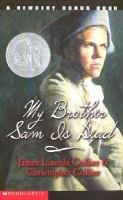
Book Review: My Brother Sam is Dead, by James Lincoln Collier & Christopher Collier (Scholastic, 1974)

Recommended for ages 12+

My Brother Sam is Dead is a look at the Revolutionary War that readers don’t normally get: like the Civil War, this war divided families. We also see a side of the American soldiers that we don’t usually hear about in History class – “our” soldiers weren’t always acting like the good guys, especially to their own countrymen if they weren’t supporters of the cause.

We hear about the Tories and they are demonized. We laugh at stories of them being tarred and feathered, but what My Brother Sam brings home is that Tories were the same Americans that the Revolutionaries were, but they just believed in a different ideal. To the Tories, there was no reason to split with Mother England, who provided for them and protected them. Taxes were a fact of life. Quartering soldiers was a fact of life. To rebel was treason and it was just wrong. When looking at the acts of the Revolutionaries – stealing from, kidnapping and murdering fellow Americans who were Tories – it is difficult to say anyone involved was 100 percent right or wrong. We learn that the Revolution was a black and white issue; My Brother Sam goes beyond that thinking and shows readers that the War was made up of many, many shades of grey.

Tim Meeker is the son of a Connecticut tavern owner whose older brother, Sam, joins the Revolutionary Army under Benedict Arnold while away at college. The relationship between Sam and their father appears to have been conflicted to begin with, as both are stubborn men with strong opinions, and this act leads to a schism within the family that leaves Tim wondering who’s right and who’s wrong Torn between his love for his brother and his love and loyalty to his family, he finds himself stuck in the middle of a far larger conflict when he’s asked to keep secrets about Sam and when his battalion is in the area. Tim sees firsthand the brutality of the American soldiers to his Tory neighbors and he sees the cruelty of the British soldiers. Is there a right or wrong?

My Brother Sam is Dead won the 1975 Newbery Honor and was nominated for a National Book Award that same year. It has also been designated as an ALA Notable Children’s book and was the twelfth most frequently challenged book from 1990-2000 (ALA).

The History of Redding website has extensive information about the novel; Redding, Connecticut is the setting for the story. A 2005 Scholastic edition of the book has an AfterWords bonus feature which includes an interview with the authors, where they compare their story to fellow Newbery winner and Revolutionary War story Johnny Tremain, and discuss parallels between their work, written after the VietNam conflict, and Johnny Tremain, written after World War II.

Posted in Historical Fiction, Tween Reads

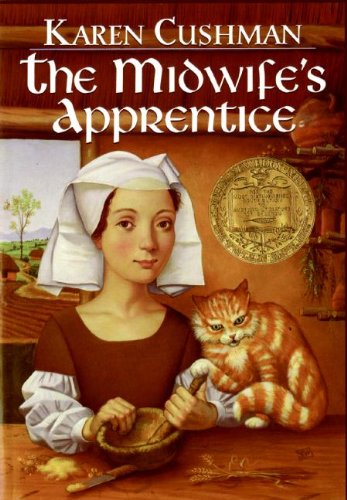
Book Review: The Midwife’s Apprentice, by Karen Cushman (Clarion Books, 1995)

Recommended for ages 8-12

Brat is an orphaned girl with no name or family. When the village midwife discovers her sleeping in a dung heap to keep warm, she takes her on as an apprentice. The reader sees Brat grow in confidence and ability.

A 1996 Newbery winner, this historical fiction novel has a strong message: you can make your own way in this life, no matter what cards you are dealt. Alyce remembers no mother and no home; she is the target of village bullies and sleeps in a dung heap to keep warm, but she never believes in giving up. When the midwife is cruel with her words, she shakes it off and continues to learn by observation. She does not wait for someone to provide her with a kinder name than Brat or Beetle, the name given her by Jane the midwife; she decides she likes the name Alyce and tells people to call her by that name. She finds a way to even the score with the cruel villagers and earns the respect of one of the village bullies when she aids him in delivering a calf. This is medieval girl power.

In addition to winning the Newbery medal, The Midwife’s Apprentice has also been designated as one of the American Library Association (ALA)’s Best of the Best Books for Young Adults and the New York Public Library’s “One Hundred Titles for Reading and Sharing”. Ms. Cushman also received Newbery Honors for her book Catherine , Called Birdy.

The author’s website offers a full bibliography of Ms. Cushman’s books, along with an author biography and “odd facts”. An FAQ is available for popular questions, and there is a link to contact the author for appearances. There are a wealth of resources available online for discussing and teaching this book, including a robust guide at eNotes.