Posted in Fantasy, Tween Reads

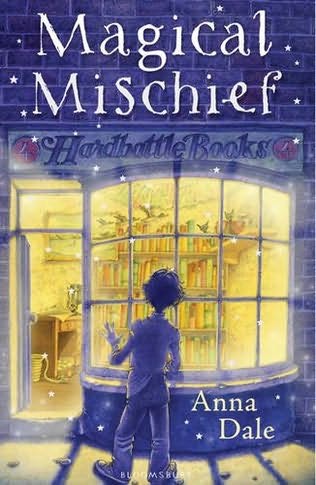
Book Review: Magical Mischief, by Anna Dale (Bloomsbury, 2011)

Recommended for ages 10-13

Magic has taken up residence in Mr. Hardbattle’s bookshop, and it’s causing him to lose business. He hasn’t got the heart to evict the magic, so he decides, with some help from his young friend Arthur and the overbearing Miss Quint, to find a nice home for the magic. While Mr. Hardbattle is away seeking out locations, though, Miss Quint gets herself into some magical trouble when she wishes for people to talk to – and they show up, pulled straight from the books! Now Miss Quint and Arthur are left with a huge mess to clean up, and when Mr. Hardbattle returns, things have gone out of control. With the magic out of control, the threesome have to figure out how to make things right without getting the authorities involved.

Magical Mischief is a fun middle grade read for boys and girls alike. The bookshop setting provides a comfortable, homey setting and invests the reader in the location as much as the characters. The narrative tends to ramble along at points, particularly when it comes to Miss Quint’s bumbling which comes off more often as irritating than endearing. The ending neatly ties up loose ends and provides an overall satisfying read that fantasy fans in particular will enjoy.

Anna Dale is a popular middle-grade fantasy author in the UK and US. Her website offers links to her books, author info, and news. There are several “magical mischief” websites on the Web, but none relate to this book; Bloomsbury’s book detail page for Magical Mischief offers book reviews and links to other books by Ms. Dale.

Posted in Adventure, Fantasy, Middle School, mythology, Tween Reads

Pandora Gets Jealous, by Carolyn Hennesy (Bloomsbury, 2008)

Recommended for ages 10-13

Get ready for Mean Girls meets Clash of the Titans.

Pandora – Pandy to her friends – has no idea what to bring to school for her project on the gods’ presence in their lives. If she brings the piece of her dad, Atlas’, liver again, she’s totally going to fail. When she stumbles across a locked box hidden away, she knows she should not bring it. Her dad told her that she should never open it. But it would be perfect. When the mean girls at school tease her and tell her that the box is worthless, it somehow ends up being opened, and the seven evils escape into the world, and poor Hope ends up being locked in the box.

Zeus and Hera charge Pandora with tracking down and recapturing all of the evils she released in six phases of the moon, or else. Pandy sets off with her two best friends, Alcie and Iole, and a little stealth help from Olympus. Her first stop: Delphi, to recapture Envy.

Pandora Gets Jealous is the first in Ms. Hennesy’s Pandora series; each book features the evil that she and her friends must recapture. Aimed at girls, the writing starts off light, with Pandora appearing almost vapid, but the story becomes intense very quickly. The solid mythology in the book is a great way to bring these stories to a younger, female audience that may still see Greek mythology as something geared toward boys despite there being gods AND goddesses on Olympus. Like Rick Riordan’s Percy Jackson and the Olympians series, Ms. Hennesy makes Greek mythology contemporary for a new audience.

The author, actress Carolyn Hennesy, has a Pandora-focused website with a wealth of additional content on the series including teachers’ guides, book synopses, and a discussion forum.

Posted in Adventure, Fantasy, Graphic Novels, Humor, Steampunk, Tween Reads

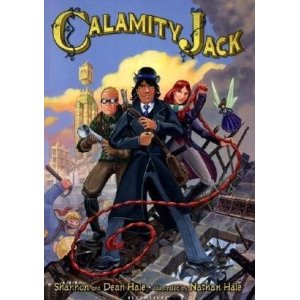
Book Review: Calamity Jack, by Shannon and Dean Hale (illus. by Nathan Hale) (Bloomsbury, 2010)

Recommended for ages 9-12

Calamity Jack is the sequel to the graphic novel Rapunzel’s Revenge and gives readers the backstory on Rapunzel’s buddy, Jack. Like Rapunzel, this is a fun, new take on the Jack and the Beanstalk fairy tale geared to attract older readers.

When readers first meet Jack in Rapunzel’s Revenge, he’s a guy on the run. Calamity Jack tells the story of why he’s on the run and who he’s running from – a kid who can’t stay out of trouble, Jack ends up getting himself, and by extension, his mother, into trouble with the local giants that run his town. He steals a goose that he hears is due to lay a golden egg and goes on the run, hoping that any golden eggs will pay for the destruction of his mother’s bakery. After his early adventures with Rapunzel, she accompanies him back to his hometown where they hope to reunite Jack with his mother – and find the town under siege by giant ants, his mother a prisoner of the giants, and a sneaking suspicion that the giants are at the heart of all the town’s problems.

Anyone who enjoyed Rapunzel will enjoy Calamity Jack. Written in the same fun spirit, the authors give equal time to the main male and female characters with their own adventures. Graphic novels are a good way to reach male readers, and turning a fairy tale into an adventure tale is a smart way to draw in those readers who may feel they are “too old” for these books.
 
Newbery Award-winning author (for Princess Academy) Shannon Hale writes for ‘tweens, teens, and adults. Her husband, children’s author Dean Hale, wrote Rapunzel’s Revenge and Calamity Jack, with Ms. Hale. Ms. hale’s blog offers links to information about her books, events and games. She also offers a list of favorite books for both children and adults, including some recommendations by her husband.
Posted in Fantasy, Fiction, Tween Reads

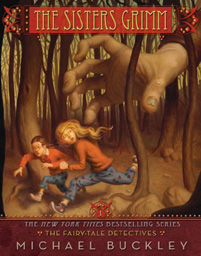
The Sisters Grimm: The Fairytale Detectives, Book 1, by Michael Buckley (Amulet, 2007)

Recommended for ages 9-12

Sisters Daphne and Sabrina have been shuttled from foster home to foster home since their parents disappeared, so when a woman claiming to be their grandmother contacts the orphanage to claim them, Sabrina is suspicious; their parents told the girls that their grandmother was dead.

Not only is their grandmother very much alive, the girls learn that they are descended from the famous Grimm brothers and that their “fairy tales” were actually case studies – magical creatures are very real, and they’re stuck in Ferryport Landing, New York, with a Grimm to act as the guardian.

As Grandma Relda and her friend Mr. Canis are investigating a  mystery involving a giant, Mayor Charming and a house crushed flat, they are kidnapped by a giant and Sabrina and Daphne must find a way to rescue them. But can they trust Jack the Giant Killer, who offers to help them? What magical creatures are there to help them or hurt them – and how can they tell the difference?

This first adventure in the 7-book series is great fun for kids and adults alike – it’s a great bridge between a fun, action-adventure story and the fairy tales we all grew up with. The dialogue is well-paced and smartly written, never talking down to its audience, and the characters are likable and provide a good mix of fantasy and reality. These are children who miss their parents and who fell into the cracks of a child protective system that fails to do its job. Even when they find their fantasy grandmother to love them and connect them back to their family, they face surreal dangers and have to figure out who they can trust. This is a great book for a family book group discussion, providing many ideas to talk about and delve deeper into between parents and kids. The publisher’s website provides a readers’ guide for this purpose (geared at librarians and teachers, but parents can build on this). The site also offers a fairy tale “regurgitator” that helps visitors create their own fairy tales.

Posted in Fantasy, Fiction, Graphic Novels, Tween Reads

Book Review: Rapunzel’s Revenge, by Shannon & Dean Hale (illustrated by Nathan Hale) (Bloomsbury, 2008)

Recommended for ages 9-12

 In YA and kids’ lit powerhouse couple Shannon and Dean Hale’s retelling of the Rapunzel tale, “Punzie”, as her friend Calamity Jack calls her, isn’t sitting around waiting for some prince to rescue her – she’s taking the matter into her own… hair.

 Rapunzel grows up in the care of Mother Gothel, an evil woman with growth magic that she wields to keep the people of the surrounding lands under her control and to bleed them for all of their money. If they cannot pay her taxes, she dries up their land. She enslaves citizens to work in her mines. Rapunzel believes Mother Gothel is her own mother until one day, she ventures outside to the palace wall and meets her real mother. Furious with Gothel’s lies and cruelty, she demands answers from Gothel; Gothel responds by having Rapunzel taken to a forest and enclosed in a tree for four years. Her growth magic assures that Rapunzel has food to eat and small creature comforts; the growth magic also extends to Rapunzel’s famous hair, which grows and grows. Gothel visits Rapunzel every year to see if she will agree to live by Gothel’s ways as her daughter, but when Rapunzel refuses for the last time, she uses her growth magic to seal Rapunzel up in the tree for good. Luckily for Rapunzel, one of the palace guards taught her how to tie a good lasso. She manages to escape and meets Jack, a young man on the run whose only possessions are the clothes on his back, a goose named Goldy, and a magic bean… who could Jack be running from in this fractured fairy tale? Will Jack be able to help Rapunzel brave the arid lands and get her back to Gothel’s palace so she can free her mother and end Gothel’s reign of terror?

 This book is great fun for boys and girls alike. It is a graphic novel that draws on two favorite fairy tales – Rapunzel and Jack and the Beanstalk – with a modern twist that will appeal to kids who are on that cusp of being teenagers, but still appreciate the comfort of a good fairy tale. Rapunzel is a strong female character who ends up saving her friend Jack as often as he saves her, and Jack is a funny charmer who finds himself feeling very awkward around the beautiful Rapunzel. It’s a classic good versus evil tale with action and snappy banter, magic and a strong sense of right, wrong, and justice.

 Shannon Hale is the Newbery Award-winning author (for Princess Academy) who writes for ‘tweens, teens, and adults. Dean Hale, her husband, writes children’s books and has written both Rapunzel’s Revenge and its sequel, Calamity Jack, with Ms. Hale. Her blog offers links to information about her books, events and games. She also offers a list of favorite books for both children and adults, including some recommendations by her husband.

Posted in Fantasy, Fiction, Graphic Novels, Humor, Tween Reads

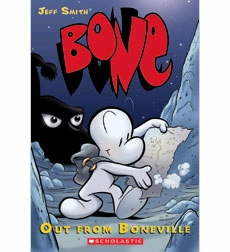
Book Review: Out from Boneville, by Jeff Smith (Scholastic edition, 2005)

Recommended for ages 11-13

Jeff Smith’s Bone was a popular comic book title in the ’90s, winning four Eisner Awards, and three Harvey Awards in 1994. Later on, the book caught on with kids as graphic novels gained more acceptance among educators. Scholastic has taken the 55-issue comic book series and repackaged them into a series of graphic novels. Out from Boneville is the first volume of this series, which follows the adventures of three cousins as they blunder into a fantasy world after being run out of their home, Boneville.

Phoncibile (Phoney for short) Bone is greedy and arrogant, which we are led to believe caused his ouster; Smiley Bone is the laid back one, and Fone Bone, our protagonist, is high-strung but an overall nice guy. Drawn as white humanoid shapes, the Bones resemble Casper with legs. The art is cartoon-like, very tween-friendly, and the banter is light and fun. Even the rat monsters who spend much of the novel trying to eat Fone Bone and seek out Phoney Bone for some dark reason are bumbling and goofy.

Out from Boneville sets up the entire Bone series, so  the storyline leaves a lot of questions unanswered by the end, but they are questions I am willing to pick up another volume to continue the journey.

 For teachers interested in working with graphic novels, Scholastic offers a guide for teachers and librarians (with mentions of Bone). Jeff Smith also maintains a Boneville web page with his touring schedule, his blog, and a section devoted to Bone.

Posted in Fantasy, Fiction, Tween Reads

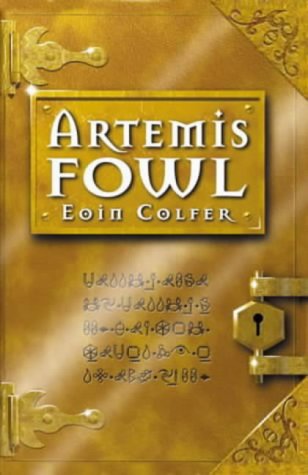
Book Review: Artemis Fowl, by Eoin Colfer (Hyperion, 2002)

Recommended for ages 9-13

When Artemis Fowl was published almost ten years ago, it was hailed as the next Harry Potter type series in terms of kids’ blockbusters. There have been seven novels, plus graphic novels, since, and while it hasn’t reached the Harry Potter level of mania with readers young and old, it is a strong series that has managed to remain on the shelves over the past decade – not something many books can claim these days.

Artemis Fowl the Second is a boy genius and the son of a missing crime lord. To find his father restore his family’s reputation, he needs some help. In this case, “help” means getting a copy of the Rule Book from the Fairy World – because in this world, they are real and they don’t want us to know it – and finding out their secrets to use against them. But now he’s got the attention of the LEPrecon (the Lower Elements Police), and dealing with magic is never predictable.

It took a while for me to warm up to this book. I did not like Artemis, for starters. He is supposed to be an anti-hero, but there was not enough of him to give me a connection; I only thought of him as an annoying kid too smart for his own good for about 3/4 of the book. The LEP characters were somewhat more engaging but they needed some time to hit their stride; when they first appear on the scene, they almost seemed like caricatures in the exaggerated speech and description.

There is a prevalent subplot about how we humans, the Mud People, are destroying the planet. Colfer makes it abundantly clear that The People find humans beneath them and hold them in contempt.

There are plenty of Artemis Fowl websites, incluiding the US and UK websites that provide information about the books, book trailers, and games for visitors. Author Eoin Colfer’s website offers links to author information, information about all of his books, and a message board.

Posted in Fantasy, Fiction, Tween Reads

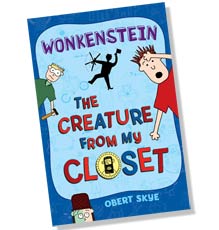
Book Revew: Wonkenstein: The Creature from my Closet, by Obert Skye (Henry Holt, 2011)

Recommended for ages 9-12

Rob is a 12-year old boy whose main use for books is to throw them into his closet. He has better things to do, after all, than read. Plus, Rob’s closet is just strange. It’s not because it’s got a second-hand door with a pony sticker on it that says, “Smile”. For starters, the doorknob is big, gold, and has a bearded man’s face engraved on it – and his expression seems to change. For another, the closet is where Wonkenstein – a creature that seems to be a mashup of Willy Wonka and Frankenstein – comes from one day, and now Rob’s closet will not open so he can send him back.

Rob tries to keep Wonkenstein a secret while trying to get him back to his world, but he ends up getting into more trouble, whether at home or school, the harder he tries. Poor Rob just wants life to go back to normal, but at the same time, he finds himself getting attached to the little guy.

Wonkenstein is a cute book for younger readers and older readers that may have drifted from reading and just need something fun and familiar to pull them back. The book has fun black and white illustrations that look like a child’s drawings and helps, along with the first-person voice of the book, add to the fantasy that Rob is narrating his own true story.

Obert Skye’s website has information about all of his books, plus author and tour information, and the publisher’s website has a book detail page with much of the same information, plus links to the book’s pages on social networking sites incluing Shelfari and LibraryThing.

Posted in Fantasy, Humor, Tween Reads

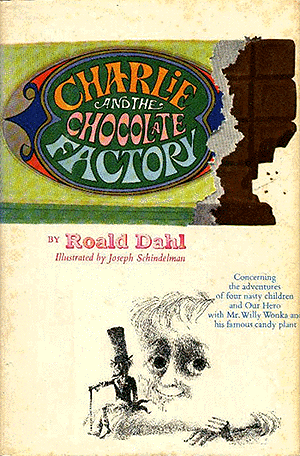
Book Review: Charlie and the Chocolate Factory, by Roald Dahl (Bantam, 1977)

Recommended for ages 8-12 (and ageless)

This was one of my favorite books growing up, and reading it again all these years later, I find that I love it as much now as I did when I was 8. Having spent the last few years watching multiple viewings of Willy Wonka and the Chocolate Factory (Gene Wilder is Willy Wonka), I ended up surprised on a few occasions when I realized that scenes from the movie – such as the Fizzy Lifting Drinks scene when Charlie and Grandpa have to belch their way down from certain doom – were not in the book after all! While the movie retained much of Roald Dahl’s dark comic humor, nothing beats the book, and Dahl’s wry observations on rude children and the parents who indulge them, and how the meek inherit… well, if not the earth, at least a lifetime’s supply of chocolate.

Charlie Bucket is starving – no, really, he is. He lives with his mother, father, and four sickly grandparents, who are so old and sick that they never get out of bed. Father has a menial job screwing the caps onto toothpaste tubes, and they family is very poor. They are so poor, all they can eat is cabbage soup, and Charlie refuses to take more than his share. Every day he walks past the famous chocolatier Willy Wonka’s chocolate factory and lifts his nose, inhaling the delicious smells; the only time he gets to enjoy a Wonka bar is on his birthday.

It all changes when Willy Wonka announces a contest where five winners will be allowed to tour the chocolate factory – and Charlie is holding one of the Golden Tickets. Grandpa Joe, his elderly grandfather who retains the joy and wonder of youth, jumps out of bed and insists that he go with him, and they’re off. Charlie meets the four other winners – the gluttonous Augustus Gloop, spoiled brat Veruca Salt, TV addict Mike Teavee, and boorish Violet Beauregarde – and their overly indulgent parents at the gates of the factory, and when Willy Wonka’s gates open for the first time in years, the fun really begins. Who will make it through the factory tour?

Dahl’s writing weaves words into pictures that are enhanced by Joseph Schindelman’s black and white illustrations. From Willy Wonka’s mysterious origins to the Oompa Loompa’s cautionary songs, this book is Mr. Dahl’s morality play. It’s a great reminder of the golden rules as children enter into the middle grades: be polite. Don’t be a bully. Share. Don’t be a glutton or have bad manners. Modesty and a humble demeanor reap their own rewards. Reading Dahl is like Emily Post for kids, but with chocolate rivers and candy flowers.

Roald Dahl is a well-known classic children’s author. There is an inactive wiki that appeared to be the start of a comprehensive body of work  with 106 articles; there is a call to revive it on the home page. There is also a wonderful Roald Dahl website that is animated and features links to the Roald Dahl store, museum, and his children’s charity. The site features a “book chooser” that will match kids with a “splendiferous read” of his, a biography on the author, and a “Wonkalator” – a calculator game that asks kids to help Wonka with his latest magical formula.
Posted in Fantasy, Post-apocalyptic/Dystopian, Science Fiction, Tween Reads

Book Review: A Boy and His Bot, by Daniel H.Wilson (Bloomsbury, 2011)

Recommended for ages 9-12

On a class trip to a Mek Mound, an ancient Oklahoman Indian land mound reminiscent of the Egyptian pyramids, sixth grader Code Lightfall discovers Mekhos, a manufactured, experimental world inhabited by robots and long forgotten by humans. The world is under the grip of the evil tyrant Immortalis, bent on the world’s destruction; it falls to Code and Gary, an atomic slaughterbot brought to life by Code’s imagination and Mekhos technology, to find the Robonomicon and save the day.

A Boy and His Bot is a journey to Oz tale for a more modern age, complete with beautiful and deadly surroundings like the Toparian Wyldes, the beautiful forest maintained by a race of robots who trim and sculpt anything in their way, their upkeep programming overriding any other directive. Where Oz has a benevolent wizard, Boy  has Immortalis, the evil overlord who pushes all robots to the day of The Great Disassembly, when all of Mekhos will be undone. Code’s main objective, beyond stopping The Great Disassembly from taking place, is to get back home.

I have noticed that heroes in “boy books” often come from dysfunctional families, and Code is no exception. A shy boy, picked on by some classmates, ignored by others, Code is grieving the disappearance of his grandfather John a year prior. His parents are not in the picture. The only positive female force in the book is Peep, the little robotic probe that befriends him and leads him to the world of Mekhos. Gary the Slaughterbot plays the part of the all brawn, no brains protector with the heart of gold.

I wonder why it is that young male characters’ families are so flawed in YA literature. Is this an accurate reflection of the state of families today, or is this the newest hook to keep young boys reading? Is it a way to reach out to young boys that may be in crisis and refuse to speak?  The combination of robotic creatures, a manmade world on the brink of destruction, and an invention like the slaughterbot alone is enough to grab a boy’s attention on the surface, but Code’s background gives him a depth that should help boys and girls alike be interested enough in his journey to travel along with him.
Daniel H. Wilson, Ph.D. is the author of How to Survive a Robot Uprising, Where’s My Jetpack, and How to Build a Robot Army. A Boy and His Bot is his first YA novel, but he has also written Bro-Jitsu: The Martial Art of Sibling Smackdown, and his Robot books are popular with older tweens and teens. He maintains an author website.