Posted in Fantasy, Fiction, Middle Grade, Teen, Tween Reads

Aleks Mickelsen brings us back to Enchanted Norway!

Aleks Mickelsen and the Call of the White Raven (Zaria Fierce #5), by Keira Gillett, (April 2018, self-published), $14.99, ISBN: 978-1942750093

Recommended for readers 10-14

The second Aleks Mickelsen adventure – and the fifth book in the Zaria Fierce series – is here! Aleks Mickelsen and the Call of the White Raven continues the adventure started in last year’s Aleks Mickelsen and the Twice-Lost Fairy Well. Aleks, a changeling raised by his human family, has to work with his fae sister, Nori, and his best friends to stop the chaos dragon Fritjof from wreaking havoc on the fae and human worlds. This time, Aleks has to negotiate with his treacherous fae relations and undergo a series of tests – Harry Potter fans, you’ll love this – to save his friends. Thank goodness he’s getting better at working with Airi (pronounced eye-riii), his white raven.

Everything you love about the Zaria Fierce books is here: the strong friendships, the nonstop adventure, the magical creatures, and the hero’s quest are all here, waiting for fantasy lovers to join them. There are increasingly complex relationships to navigate, with a little love triangle brewing between Filip, Henrik the Stag Lord, and Zaria emerging as a continuing subplot; Aleks continues to have an up-and-down relationship with his fae family, particularly Nori, whose own quest to reunite the fae courts under her family puts the two at odds throughout the book.

Keira Gillett’s at the height of her storytelling here; she starts off the book with fun and friends, easing us back into the fantasy world of Niffleheim, where the group is camping on their quest to find and stop Fritjof. Don’t get too comfortable, though; the action starts quickly and takes you right along for the ride. Keira’s storytelling is rich in imagery and fully realized characters who have grown with each book in the series. She lets her characters retain the essence of who they are, while letting them be formed by their experiences. She understands that they’re now firmly in their teens, and takes that into account by navigating complex feelings and relationships with one another. Alex’s own stress about the potential loss of his unique changeling abilities is at war with his lifelong desire to be “normal”, and if that isn’t the story of being a teen right there in a nutshell, what is?

Eoghan Kerrigan’s illustrations are as breathtaking as ever, giving this series classic fantasy artwork to engage our imaginations; fantasy cartographer Kaitlin Statz’s maps guide us along a wonderfully secret tour of Enchanted Norway. Hmmm… it may be time to consider a scavenger hunt for my Summer Reading program… how about Find the Water Wyvern? (I could never get through a Keira Gillett review without mentioning my beloved Norwick in some form!)

Take your time, treat yourself, and enjoy Aleks Mickelson and the Call of the White Raven, and get ready for Aleks Mickelsen and the Eighth Fox Throne War, due later this year.
Posted in Fiction, Middle Grade, Realistic Fiction

Annie B is Made for TV!

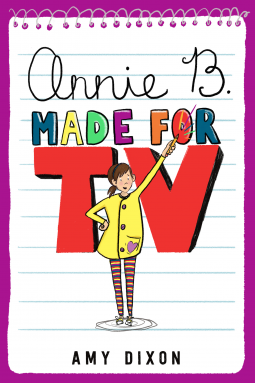
Annie B, Made for TV!, by Amy Dixon, (June 218, Running Press), $16.99, ISBN: 9780762463855

Recommended for readers 7-10

Annie Brown is an 11-year-old who always seems to come in second to her best friend, Savannah. Savannah seems unable to do any wrong: she wins the big awards at school, she’s the MVP of the school track team, and she’s a straight-A student. Savannah tries to be a supportive best friend, and when a local web show called The Cat’s Meow holds auditions, Savannah just knows that Annie has to try out! After all, no one comes up with wacky “As Seen on TV”-type products like she does! Annie’s own dad calls them her “wrinventions”, and they include things like Apology Armor (extra padding on those knees). But Annie freezes at the audition… and Savannah lands the role of announcer, which causes a rift in their friendship – even when Annie is brought on as a show writer. Can Annie outfit herself in some Apology Armor and patch things up with Savannah?

This is one of those middle grade novels that so many readers will understand! Who hasn’t felt jealous of a good friend, especially if they seem to have it all? Who hasn’t felt the disappointment of missing out on something like being cast for a school play, or making a sports team? Amy Dixon captures realistic scenarios and real feelings in the form of a spunky, funny protagonist who wants to be Lucy, but maybe is a little more Ethel. Annie B. Made for TV reminds me of Sarvenaz Tash’s Belle of the Ball, a great story from the anthology The Radical Element. It’s not always about being the one in the spotlight, but about knowing your strengths and how to work them. This one’s a fun, smart read for middle graders, and is filled with black and white line drawings of Annie’s best “wrinventions”.

Posted in Animal Fiction, Fiction, Humor, Middle Grade

Badgers, llamas, horrible people, and… Uncle Shawn?

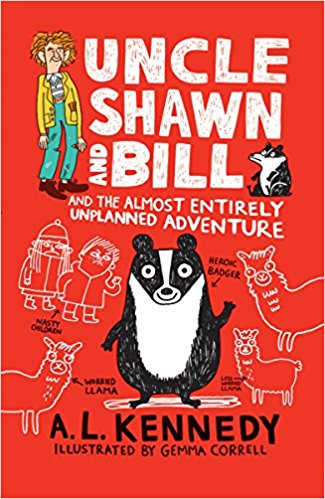
Uncle Shawn and Bill and the Almost Entirely Unplanned Adventure, by A.L. Kennedy/Illustrated by Gemma Correll, (March 2018, Kane Miller), $5.99, ISBN: 9781610677400

Recommended for readers 7-10

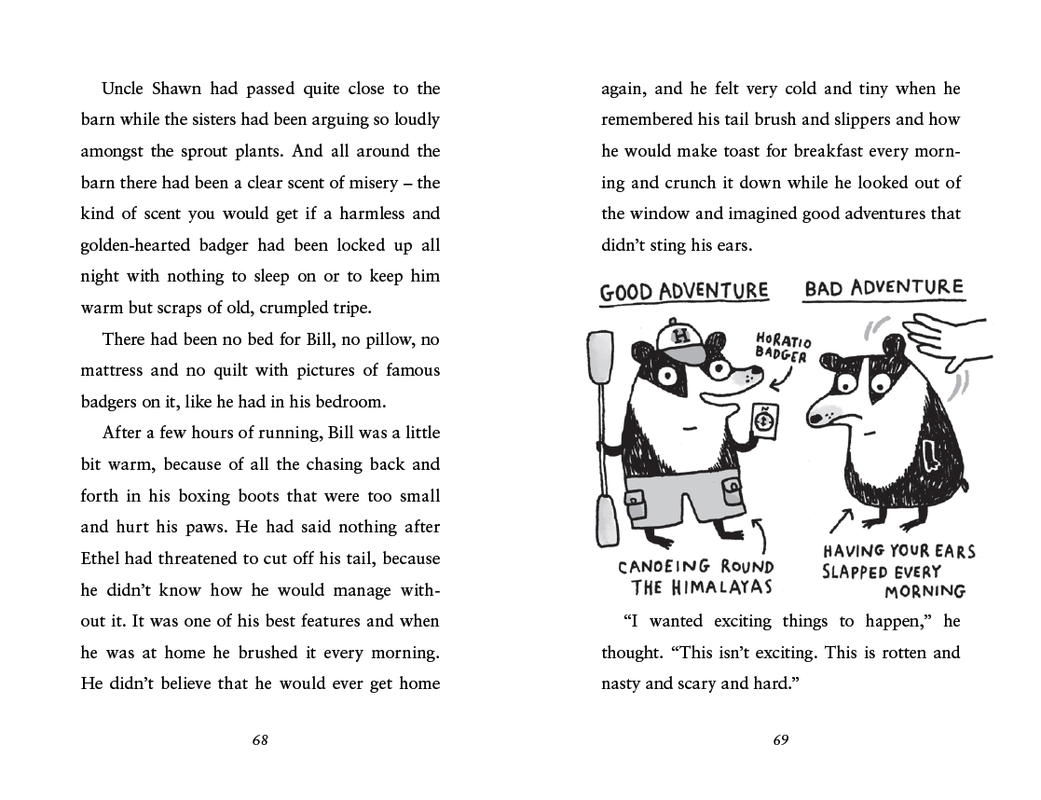
Bill is a peaceful badger who finds himself kidnapped by two awful sisters, who intend to make him fight (even though badgers hate wearing prizefighter shorts) in their badger fighting ring. Turns out the awful sisters are the McGloones, relatives of the awful McGloone family. Seriously, the entire family is just awful; they’re filthy, rude, and all-around mean! Farmer McGloone and his wife also have four llamas held captive, and since they’re depressed and stressed (and ill-fed), they’re not producing enough yarn for the McGloone luxury socks that Mrs. McGloone wants to knit, so they plan to make the llamas into PIES. Such despair! What’s a friendly badger and four depressed llamas to do? Thank goodness for Uncle Shawn, a lovely eccentric who happens to love animals. He comes up with a plan to save everyone and live happily ever after (unless you’re an awful McGloone).

This book is bananas, and I mean that in the most loving sense of the word. Orginally published in the UK in 2017, it’s loaded with madcap, black Scottish humor (come on, they’re making a badger fight in a fight club and threatening to bake llamas) that will make readers laugh out loud when they’re not cringing. Seriously, some of the descriptions of the McGloones are pretty stomach-churning. Black and white cartoons throughout the book add to the laughs. Uncle Shawn and Bill and the Almost Entirely Unplanned Adventure is the first in a new series, so there’s more to come: the second book, Uncle Shawn and Bill and the Pajimminy Crimminy Unusual Adventure, just hit shelves in the UK. Give this to your Roald Dahl and David Walliams fans and expand their global literary palate!

Posted in Fantasy, Fiction, Middle Grade

You’ll want a Bob of your own!

Bob, by Wendy Mass & Rebecca Stead/Illustrations by Nicholas Gannon, (May 2018, Feiwel & Friends), $16.99, ISBN: 9781250166623

Recommended for readers 7-11

Livy is heading to Australia with her mother and new baby sister, BethAnn, to spend time with her grandmother. The last time she was in Australia was five years ago, so she’s a bit anxious about being back; she’s also anxious because her mother is going away for a few days to spend time with friends once she gets there. Once Livy arrives, she’s even more anxious when she doesn’t really remember much about Australia – and she certainly doesn’t remember Bob, the greenish, kinda zombie-looking thing she finds in the closet once she gets there. Bob remembers Livy, though; he’s been waiting for five years for her to come back. The two re-explore their friendship and try to remember how to get Bob back home in this celebration of friendship, the environment, and the magic of childhood.

When two award-winning authors like Wendy Mass and Rebecca Stead collaborate on a book, you just know it’s going to be something amazing, and Bob is. Told in alternating first-person chapters, we get each characters’ point-of-view as the story progresses, which also fills in valuable backstory. Livy is a relatable character, dealing with anxiety: there’s a new baby in the family, she’s got separation anxiety about her mom, and her grandmother and neighbors are living through a five-year drought that’s killing their town and their livelihoods. Bob is sweet and funny, loyal to a fault, and gives his spark to Livy; to give her hope, to rekindle their friendship, to bring back the “old Livy”. I can’t get into too much without giving spoilers, and you don’t want that with this book. So let me just say that Bob is wonderful middle-grade storytelling that embraces imagination and joy. I can’t wait to see an illustrated version (my ARC didn’t have any). (Psst… would also make a good Earth Day reading assignment for next year.)

There’s been a lot of buzz about Bob lately: SLJ and Publisher’s Weekly gave it starred reviews, and you can read author interviews at The Horn Book and Publisher’s Weekly. You can download an excerpt see artwork that will melt your heart, and learn how to start a Bob book club at the Bob and Livy website.

Posted in Fiction, Graphic Novels, Middle Grade, Realistic Fiction, Teen, Tween Reads

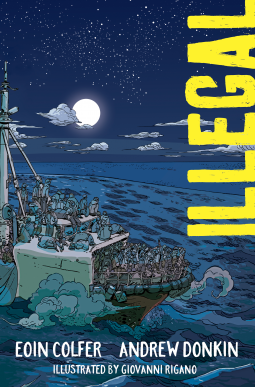
Eoin Colfer’s Illegal is a powerful statement on behalf of refugees

Illegal, by Eoin Colfer & Andrew Donkin/Illustrated by Giovanni Rigano, (Aug. 2018, Sourcebooks), $19.99, ISBN: 9781492662143

Recommended for readers 10+

The Artemis Fowl graphic novel team assembles to bring readers a powerful, emotional story about the struggles of undocumented immigrants: in this story, three African siblings. Ebo’s alone. Orphaned and living in squalor, his sister set out months ago to find her way to Europe and a better life, promising to send for Ebo and their brother, Kwame, when she gets settled. But the boys can’t wait any longer, and Kwame sets out next. Ebo follows Kwame, and the brothers endure a journey across the Sahara Desert to find their way to the sea. The journey is inhumane, often unbearable, but Ebo will not be denied. He deals with loss, hunger, and thirst; filthy living conditions; and brutal treatment by nature and man, but he holds out hope to be reunited with his sister, and the promise of a better life somewhere else.

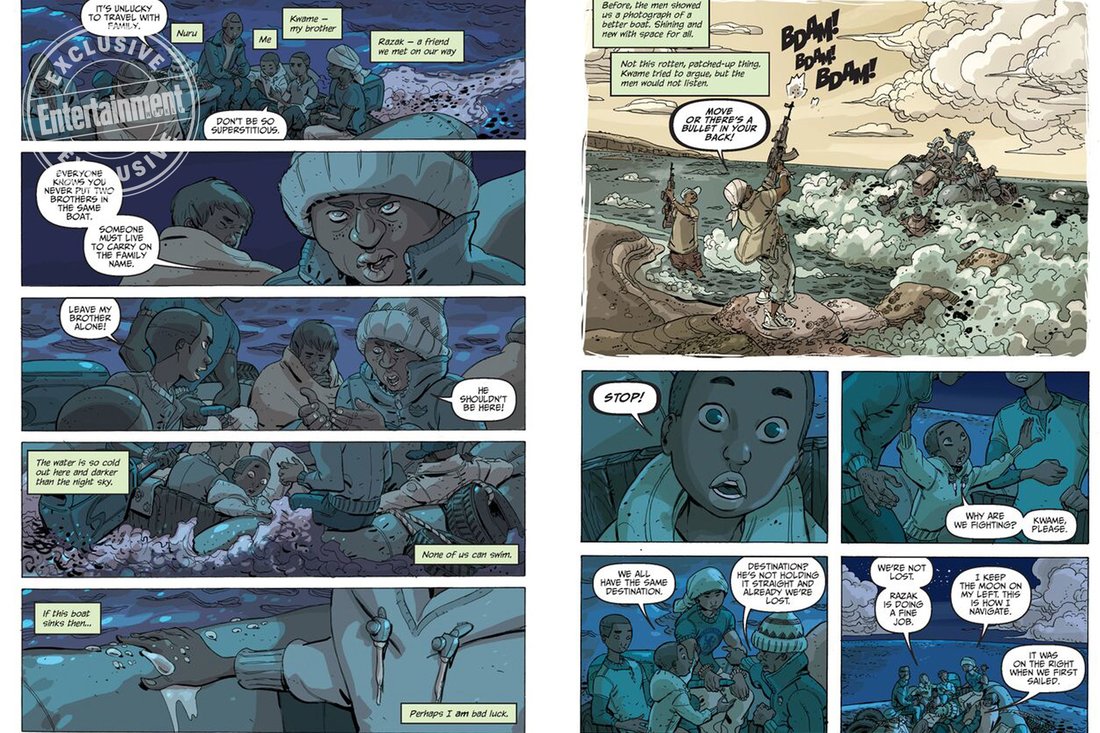
There’s been quite a bit of attention focused on undocumented immigrants, and it’s a conversation we need to continue. War, disease, poverty, and hunger are global problems that force men, women, and children to undergo unthinkable scenarios for the sole purpose of cultivating a better life. Illegal, while fictional, is inspired by true events: just pick up a newspaper or turn on the news. Ebo’s story is one story of millions: the United Nations records 65.6 million people are forcibly displaced worldwide. Told in Ebo’s voice, readers will feel like they are reading a private journal. His voice is strong and clear, and evokes anger, grief, and the desire to do more. The artwork supports the text, laying out the slums of an African neighborhood; the devastating stretch of desert, and the terrifying expanse of the ocean. Ebo’s face will stay with readers long after they finish the book.

(Images courtesy of Entertainment Weekly‘s article)

Illegal should be on every middle school and/or high school’s Summer Reading list, and needs to be discussed in our classrooms and in our homes. The book is currently out in the UK, and there are teaching materials online, including this downloadable one from the U.S. publisher, Sourcebooks. Author Andrew Donkin has articles about Illegal on his website, and Eoin Colfer has the US and UK covers on his website. Entertainment Weekly has a featured excerpt and The Guardian made it the Children’s Book of the Week when it was published in the UK in October 2017.

Illegal was shortlisted for the 2017 Irish Book Awards and was chosen for EmpathyLabUK’s Read for Empathy List (a downloadable copy of which can be found here). I’ve embedded the trailer below:


Booktalk and display Illegal with Michel Chikwanine and Jessica Dee Humphreys’ Child Soldier and Barron’s Children in Our World books (Refugees & Migrants, Poverty & Hunger, Racism & Intolerance, and Global Conflict).


Posted in Fiction, Middle Grade, Tween Reads

Make Way for the Thunder Girls!

Freya and the Magic Jewel (Thunder Girls, #1), by Joan Holub & Suzanne Williams, (May 2018, Aladdin), $16.99, ISBN: 978-1-4814-964-07

Recommended for readers 8-12

I LOOOOVE Joan Holub’s books, from board books to middle grade novels; I read ’em as often as I can and I love every single one of them. When I saw that the Goddess Girls team of Joan Holub and Suzanne Williams were starting a new series on the ladies of Norse mythology, I needed a moment to collect myself. And when I received a review copy from the author herself, I needed a few more moments. Okay, I took another moment. Let’s begin.

Freya is the 11-year-old goddess of love and beauty, happily living on Vanaheim: one of the nine worlds in Norse myth. When she and her twin brother, Frey, are summoned, by Odin, to Asgard to attend Asgard Academy as part of a new initiative to open relations between the nine worlds, Freya is skeptical. Her people have been at war with Asgard, and besides, she has it made at Vanaheim Junior High! But Odin is the king of Asgard, and she’s got to go, so she and Frey head out. Things go wrong from the start when her beloved jewel, Brising, falls from the Bifrost bridge. That jewel is what helps her see the future, and that also happens to be what Odin wants her to help him with! She also runs afoul of Angerboda, a bullying frost giantess, right off the bat. Freya has her work cut out for her, but she’ll learn – with the help of some new friends – that magic can be found in the wildest places.

I love, love, LOVED this book. Not strong on Norse mythology? You don’t need to be; you learn exactly what you need to within the pages of this book. Readers will meet characters whose names are practically household at this point, like Thor, Loki, Odin, and Frigga (thanks, Marvel!). Joan Holub and Suzanne Williams know their mythology and make the Norse tales readable for middle graders (the story of how that wall around Asgard was built is refreshingly kid safe, for starters) and put the same sense of fun into Thunder Girls that they put into Goddess Girls. There’s adventure, friendship, and enough mischief to keep readers happily turning pages. Display and booktalk with (what else?) Rick Riordan’s Magnus Chase and the Gods of Asgard books, KL Armstrong and MA Marr’s Blackwell Pages trilogy, and NatGeo’s Norse Mythology treasury. (Have some copies of Neil Gaiman’s Norse Mythology around for parents, too.)

Joan Holub has amazing printables on her author website, including Goddess Girls and its companion series, Heroes in Training, bookmarks. Suzanne Williams has a reader’s theatre script for one of the Goddess Girls stories, fun quizzes and downloadable stickers at her website. The next Thunder Girls book is out in October, featuring Sif, so I’ll be counting days until then.

Posted in Fiction, Fiction, Graphic Novels, Intermediate, Middle Grade, Teen

Three new graphic novels coming your way in May!

There are some good graphic novels coming out in May. There’s manga-influenced work, an animal tale that brings Watership Down to mind, and a gripping story about being an undocumented immigrant. Let’s see what’s up!


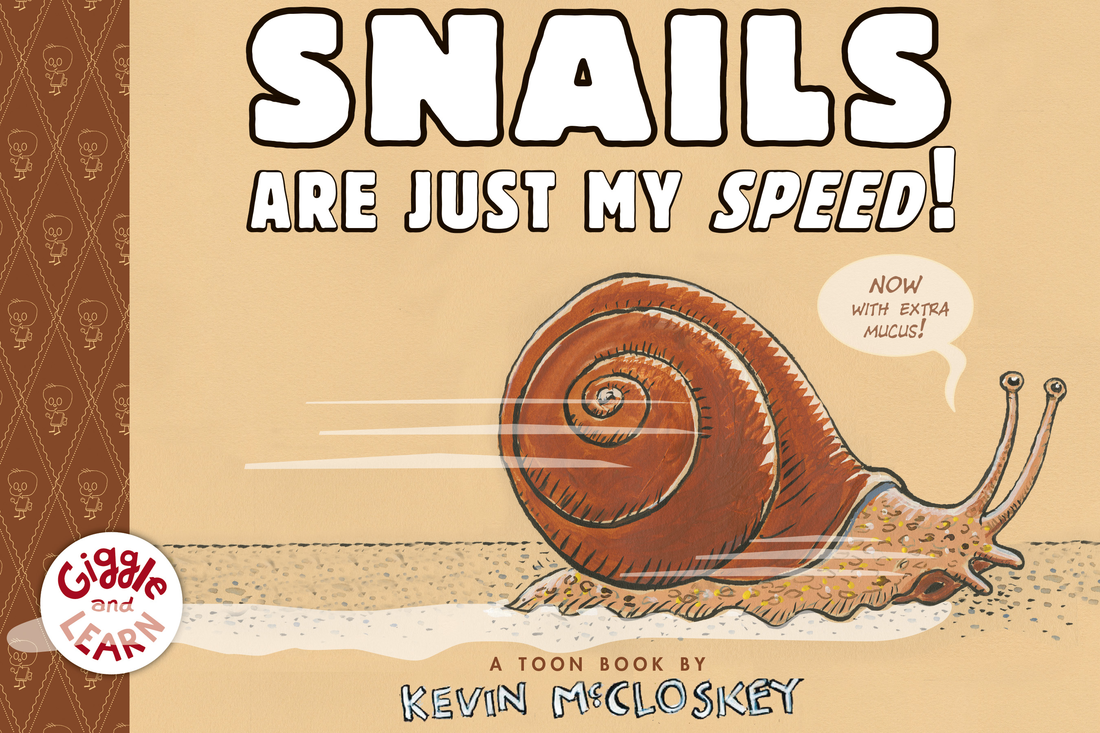
Snails are Just My Speed!, by Kevin McCloskey, (May 2018, TOON Books), $12.95, ISBN: 9781943145270

Recommended for readers 3-7

The latest in Kevin McCloskey’s Giggle and Learn series of graphic novels takes a look at snails! They live in their shells! They like to eat together! They make a LOT of mucus! (So. Much. Mucus.) This latest easy reading, nonfiction graphic novel is perfect for pre-k and Kindergarten science groups and animal lovers. It’s loaded with fun facts, much of it mucus-related, which will make this a guaranteed hit with kids who love to squeal and shriek at “gooey” stuff. I love the infographic, built into the story, of all the animals that are faster – and slower! – than a snail, and the different types of snails that exist, including a hairy snail and a “glass” snail with a see-through shell. There’s a quick drawing lesson at the end – great way to end a storytime or science group session! – and the TOON website always has great teacher’s resources available for download. Kevin McCloskey is aces in my book!


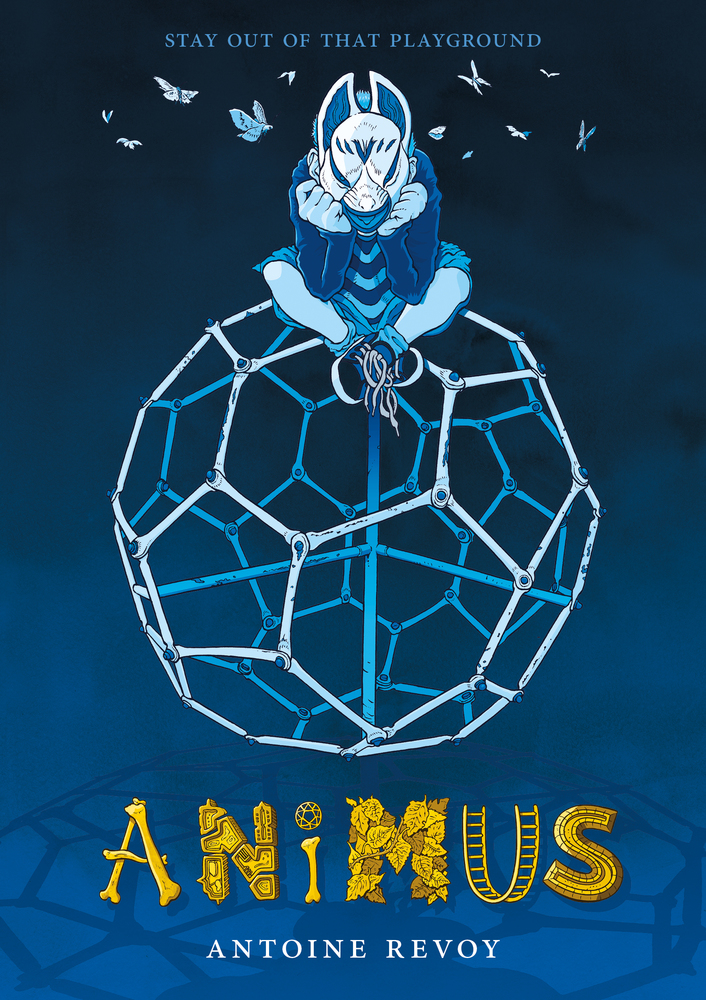
Animus, by Antoine Revoy, (May 2018, First Second), $16.99, ISBN: 9781626721838

Recommended for readers 12+

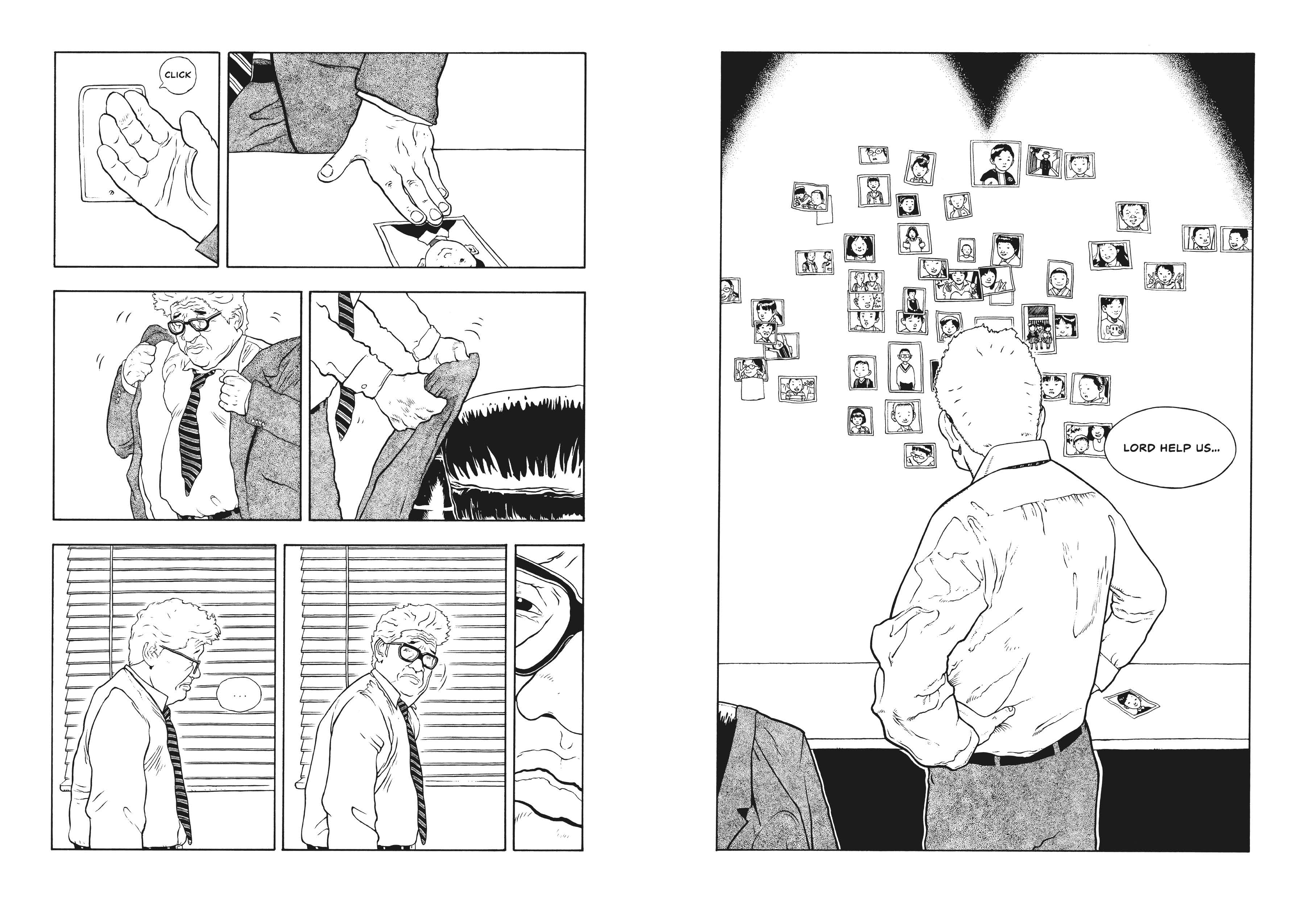
This is a creepy ghost tale/mystery surrounding a ghost destined to haunt a playground. Schoolmates Hisao and Sayrui meet Toothless, a ghost who tells them that the playground is magic: the swings let you look into people’s dreams; the sandbox brings your worst fears to life, and the slide has the power to give or take years from your life, depending on the direction you go. When another friend goes down the slide, rapidly ages, and develops dementia, the two friends must save him – and to do that, they must discover who Toothless really is, and how he came to haunt the playground.

Heavily influenced by Japanese and French comics, this black-and-white graphic novel is eerie and unsettling; a strong noir story with ghostly elements woven throughout to create a story that will stay with readers.


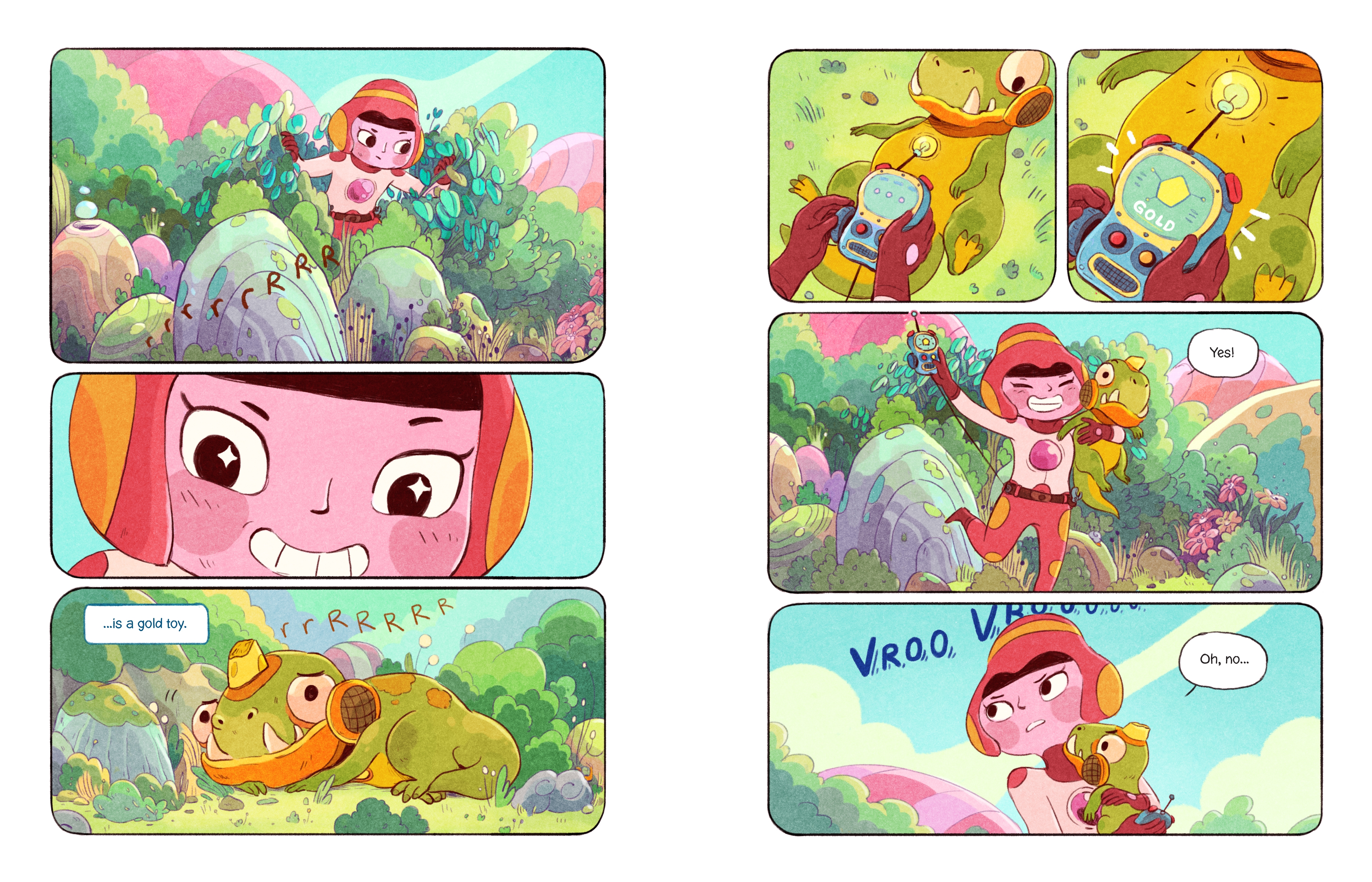
Chasma Knights, by Boya Sun & Kate Reed Petty, (May 218, First Second), $17.99, ISBN: 9781626726048

Recommended for readers 8-12

Beryl is a Neon Knight in the fantasy land of Chasma, where toys “catalyze” with a touch and come to life, merging with their owners and imbued with special abilities. But the thing is, in Chasma, being a Neon Knight isn’t that great – it’s kind of a joke. Neon Knights can’t catalyze; Oxygen Knights do. But Beryl has a talent all her own: she’s an inventor that can repurpose broken toys into new creations. Coro, an Oxygen Knight, meets Beryl at the Toy Market, and the two strike up an initially cautious friendship.

I’ll be honest, this one left me scratching my head – I didn’t always quite get what was going on, but I did appreciate the kid-friendly artwork and storyline: who wouldn’t want to read about toys coming to life? I booktalked this to a few of my library kids – all big manga fans – and they seemed to have a better grasp on the concept than I did, so go them! My best advice? It’s a fun, bright, kid-friendly graphic novel. Let your audience be your guide.

And two that are already out, but that I just read…

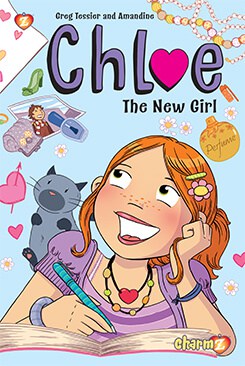
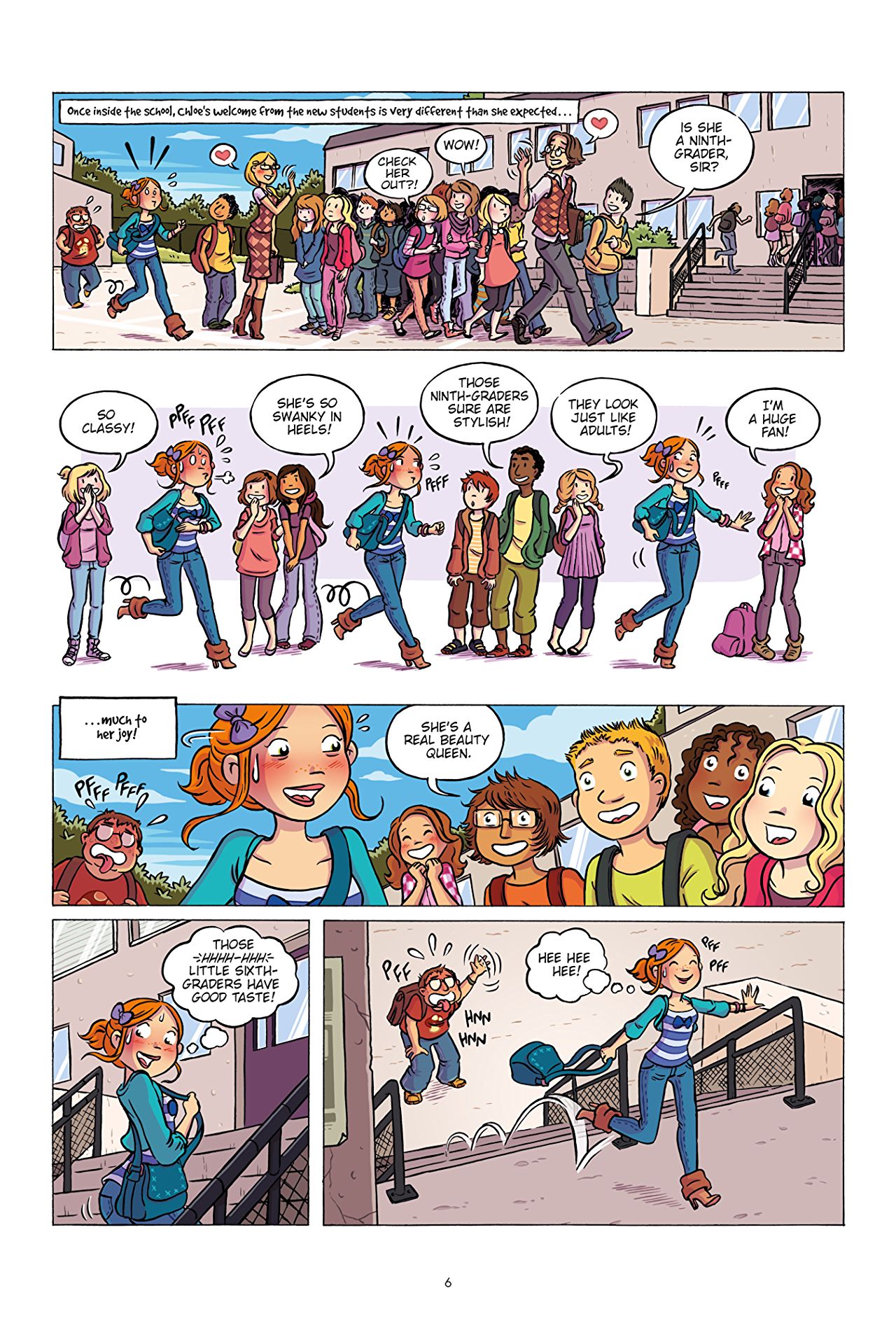
Chloe, Vol. 1: The New Girl, by Greg Tessier and Amandine, (May 2017, Papercutz), $9.99, ISABN: 9781629917634

Recommended for readers 10-12

Originally published in French, the Chloe graphic novels are fun stories about a fashion-fabulous teen named Chloe as she navigates high school, friendships, and relationships. Her family mortifies her, and the mean girl fashionistas at school are mean to her – in other words, she’s totally relatable. In this first issue, Chloe starts high school and tries to get in with the in crowd. The artwork is fun and the subject matter is light.

Chloe, Vol. 2: The Queen of High School, by Greg Tessier and Amandine, (October 2017, Papercutz), $9.99, ISBN: 9781629917634

Recommended for readers 10-12

In this second volume, Chloe is back for her second year of high school and taking things by storm. She’s got a cute new boyfriend, a fashion blog, and a group of friends to call her own. She’s still got embarrassing parents and mean girls at school, but she’s taking it all in stride.
There are four Chloe volumes in total available. These would be good for Summer Reading groups, maybe even in conjunction with a blog project for tweens!
Posted in Fiction, Historical Fiction, Middle Grade, Realistic Fiction, Tween Reads

Social Justice, Union Organizing, Dairy Wars, and an Orphan Band!

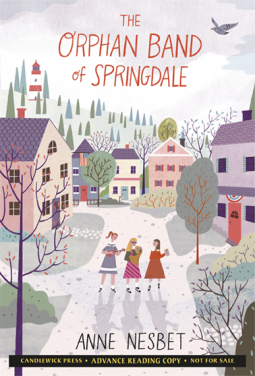
The Orphan Band of Springdale, by Anne Nesbet, (Apr. 2018, Candlewick Press), $18.99, ISBN: 9780763688042

Recommended for readers 8-12

It’s 1941, and things are tense in the U.S. as the world is at war in Europe. Eleven-year-old Gusta is on the run with her father, a German labor organizer, heading toward Maine to stay with her grandmother, when her father disappears. Gusta shows up on her grandmother’s doorstep with the clothes on her back and her beloved French horn. Her grandmother and aunt, who run an orphanage, take her in, and Gusta starts adjusting to life in a place very different from New York. American nationalism runs rampant in Maine, and Gusta’s last name and status as a newcomer brings some suspicion with it, as does her talk about unions and workers’ rights. Her uncle, a mill-worker whose hand was mangled at the factory, can’t work, so Gusta takes it upon herself to approach the owner of the mill to ask him to consider helping with her uncle’s bills. What Gusta doesn’t realize is that her desire to do the right thing puts her at odds with the mill owner, who has a history of his own with her family.

There is such rich and relevant storytelling here. Gusta is a wonderfully realized character with a strong background in social justice: a background that makes her an outsider in her own country. She comes to Small Town America during a time when there of alien registration drives (it really happened) and extreme patriotism; when something as innocuous as a last name aroused suspicion. Gusta is hyper-aware of injustice and determined to do what’s right, whether it’s bringing union reps to her town or point-blank asking for compensation for her uncle’s work-related injury. It’s her unflinching sense of right and wrong that puts her at odds in her community – and her father’s reputation certainly doesn’t help. Thank goodness her tough but loving grandmother is there to lean on. The Orphan Band of Springdale moves at a good pace, has believable characters in relatable situations, and readers can easily draw parallels between 1941 and today.

An author’s note reveals the very personal connection between the author and Gusta’s story. Readers can download a discussion guide and author’s notes from Candlewick’s website. The Orphan Band of Springdale has starred reviews from Publisher’s Weekly and the Bulletin of the Center for Chidren’s Books.


Posted in Fiction, Middle Grade

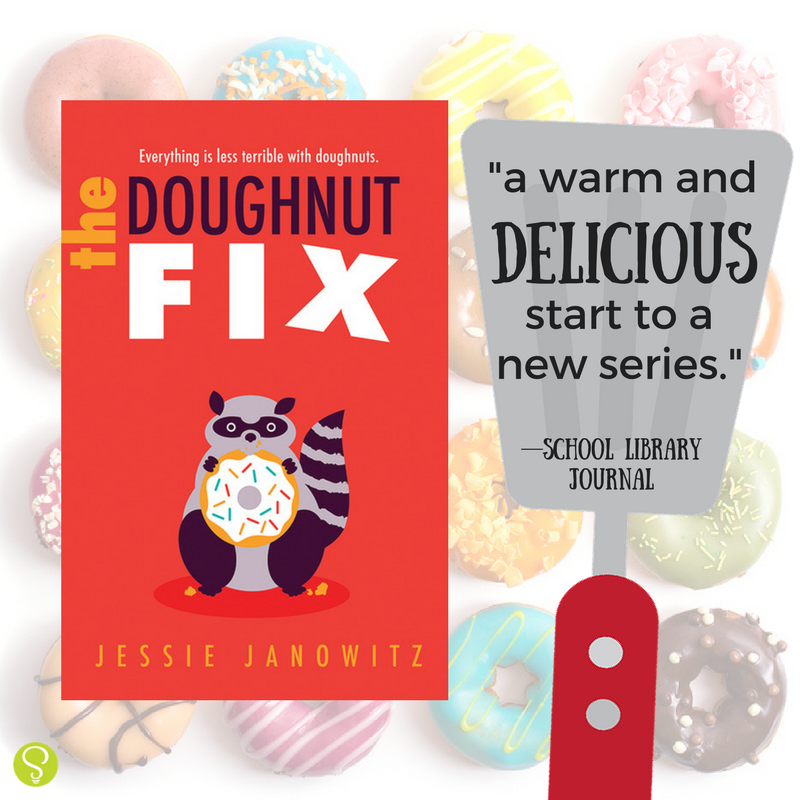
Spotlight on THE DOUGHNUT FIX

Yoinks! I had a scheduling malfunction yesterday; please enjoy today’s spotlight on Jessie Janowitz’s book, The Doughnut Fix (also reviewed here last month): and enjoy a giveaway opportunity (read through to the end of this post)!

Title: The Doughnut Fix

Author: Jessie Janowitz

Pub Date: April 3, 2018

Superfudge meets The Lemonade War in this funny, heartwarming series debut about change, adventure, family, and of course, doughnuts.

Tristan isn’t Gifted or Talented like his sister Jeanine, and he’s always been okay with that because he can make a perfect chocolate chip cookie and he lives in the greatest city in the world. But his life takes a turn for the worse when his parents decide to move to middle-of-nowhere Petersville—a town with one street and no restaurants. It’s like suddenly they’re supposed to be this other family, one that can survive without bagels and movie theaters.

His suspicions about his new town are confirmed when he’s tricked into believing the local general store has life-changing chocolate cream doughnuts, when in fact the owner hasn’t made them in years. And so begins the only thing that could make life in Petersville worth living: getting the recipe, making the doughnuts, and bringing them back to the town through his very own doughnut stand. But Tristan will soon discover that when starting a business, it helps to be both Gifted and Talented, and It’s possible he’s bitten off more than he can chew…


Jessie Janowitz grew up in New York City and is still living there with her husband and three children, all of whom love doughnuts as much as she does.

Buy Links: Amazon | Barnes & Noble | Books-A-Million | Indiebound


Rookie Cinnamon Sugar Doughnuts*

Parental supervision necessary for frying

Makes 8 doughnuts and 8 doughnut holes

Ingredients

Vegetable oil

1 (8-count) tube of premade, large biscuit dough (found in the refrigerated dough aisle at supermarkets)

½ cup sugar

¼ teaspoon ground cinnamon

Directions

Fill a large saucepan with vegetable oil to a depth of 1 inch.

Heat oil over medium heat until it reaches 365°F. You can measure the temperature with a cooking oil thermometer. Or, drop a single kernel of popcorn into the oil as it’s heating. When the kernel pops, you’re ready to fry.

While the oil heats, open the biscuit tube and separate the rounds. Use a 1-inch-round cookie cutter to cut a hole in the center of each biscuit. Save the holes.

Mix the sugar and cinnamon in a large shallow bowl.

Add 2 doughnuts to the hot oil at a time. Cook, turning once, until golden brown—about 1 minute per side.

Drain on paper towels and immediately toss in the cinnamon sugar to coat. Cool on a wire rack. Repeat with the remaining doughnuts and holes.

* Ready to graduate from rookie to experienced baker? You can make the Doughnut Stop’s life-changing chocolate cream doughnuts too. Visit jessiejanowitz.com for the original recipe.


Perfect Chocolate Chip Cookies

Makes 3 dozen cookies

Ingredients

1 cup light brown sugar

¼ cup granulated sugar

2 sticks unsalted butter, softened

2 eggs

1 teaspoon vanilla extract

1 teaspoon baking soda

1 pinch of salt

2 cups all-purpose flour

18 ounces semisweet chocolate, in bars

½ cup unsweetened shredded coconut

1 cup chopped walnuts

Directions

Preheat the oven to 350°F.

Cut parchment paper to cover baking sheets.

Put the light brown sugar, granulated sugar, and softened butter into a large mixing bowl and cream together in an electric mixer on medium.

In a small bowl, crack the eggs and mix them with the vanilla extract.

Combine the egg mixture with the sugar and butter mixture and mix thoroughly on medium.

In another bowl, combine the baking soda, salt, and all-purpose flour.

Add the flour mixture to the sugar and butter mixture in the large bowl and mix on low. Don’t overmix.

Break the chocolate bars into chunks.

Add the chocolate, coconut, and walnuts to the mixture and stir with a spoon.

Once combined, scoop the dough out with a tablespoon and place the balls on the baking sheet. Leave about two fingers width between each cookie.

Bake cookies for 12 minutes.

Remove cookies from the oven and leave on the baking sheet for 1 minute. Then, transfer the cookies to a wire rack to cool.


Want a chance at winning your own copy of The Doughnut Fix? Check out this Rafflecopter giveaway! U.S. addresses only, please. Good luck!

Posted in Fiction, Fiction, Graphic Novels, Intermediate, Middle Grade, Tween Reads

Cuentos populares de latinoamérica en español e ingles!


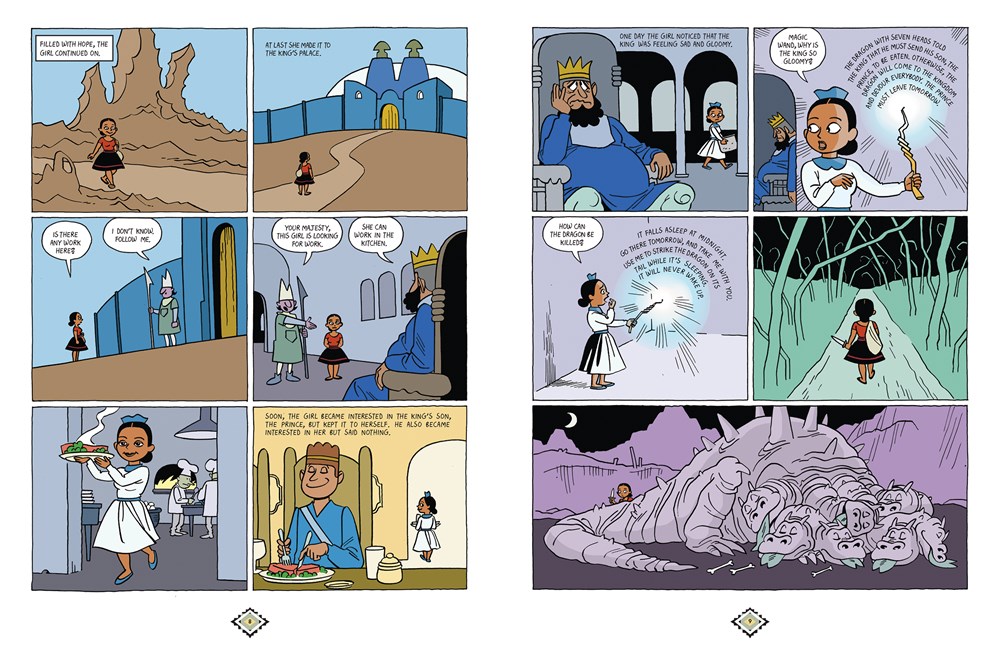
The Dragon Slayer: Folktales from Latin America/La matadragones: cuentos de latinoamérica, by Jaime Hernandez, (April 2018, TOON Graphics), $16.95, ISBN: 9781943145287 (English)/9781943145300 (Spanish)

Recommended for readers 6+

TOON Graphics has a great collection of folktales from Latin America, simultaneously published in English and Spanish. Three tales starring intelligent female characters make up this volume; as with most folk and fairy tales, each one imparts its own wisdom using the story as a vehicle. The title tale, The Dragon Slayer, sees a young woman betrayed by her two horrible sisters; an act of kindness brings a boon in the form of a magic wand, which leads her to employment at a king’s palace, where she falls in love with a prince, who she must save. Twice. It’s got the best parts of a fairy tale: dragons, magic wands and rings, ogres, and a happily ever after; it’s got a strong, smart young woman who can stand toe to toe with mythical monsters and real-life intolerance, and she saves the day AND gets the boy.

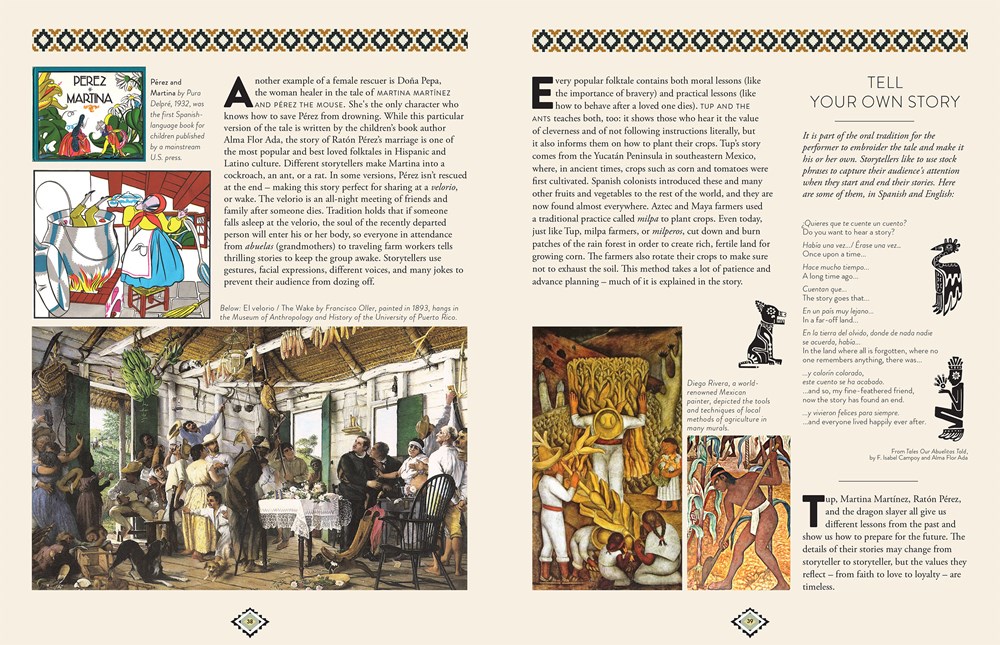
Martina Martinez and Pérez the Mouse stars Ratoncito Pérez, a popular character in Latinx folktales. This version, told by Alma Flor Ada, comes from another book, Tales Our Abuelitas Told”, and is the story of a pretty but shallow young woman, Martina, who marries Pérez after turning down other animal suitors (Martina often shows up as a cockroach in other versions of the tale). When she runs to the store to get salt for a soup, Pérez tries to sneak a taste of onion and falls into the pot! Martina discovers him in the pot and runs sobbing around the village, where birds, a fountain, and a young girl all grieve for her in various ways. It takes a wise old woman to discover that no one has actually tried to save Pérez , and rushes over to put things right again. Always respect your elders, kids! And seriously, use some common sense and try to keep your head in a situation.

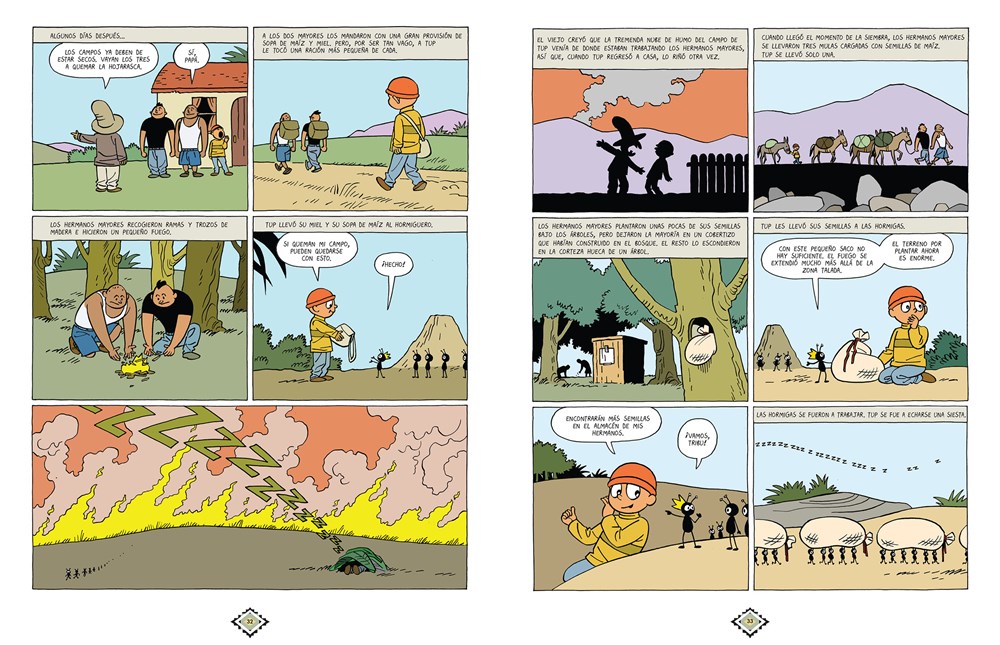
Tup and the Ants is a fun little story about the power of being smart and lazy. Tup is the youngest and laziest of three brothers, who marry three sisters. Tup’s in-laws are not thrilled with their lazy son-in-law, so when they send the three brothers out to clear the land for cornfields, they send Tup with less food to show their displeasure. Doesn’t matter: Tup finds a place to snooze, ends up meeeting a group of ants, and trades his food for their labor. This is a sweet little partnership, and pays off as the two not-so-bright brothers are hopelessly out of their league in clearing and planting a cornfield, and Tup builds his own little empire by continuing to trade food for labor. The moral of the story may be a bit ambiguous, since the lazy guy gets the accolades, but there is something to be said for knowing how to get the job done. And, as a later explanation points out, it’s a story that teaches listeners and readers about planning and undertaking a planting season.

A foreword from F. Isabel Campoy explains the power of folktales and the Latin American tradition, and features beautiful Aztec and Mayan pictograms and popular animals, like jaguars, monkeys, and dogs. An afterword goes into more detail about the origins of these three folktales, with photos and illustrations. A section on the oral tradition invites readers to personalize and create their own tales, with prompts to help them along. A strong bibliograpy includes books and online resources that will strengthen diverse folk and fairy tale collections and provide nice online resources for further research.

I absolutely love this introduction to Latin American folktales, and can only hope there’s a volume 2 somewhere down the line. This is such a great addition to folk and fairy tale collections and diverse, culturally rich collections. This would be great for a storytime for school-age kids – it’s such a fun read! – and a storytelling program.