Posted in Fiction, Fiction, gaming, geek culture, Intermediate, Middle Grade, roleplaying

Invasion of the Overworld – Is Minecraft The Matrix?

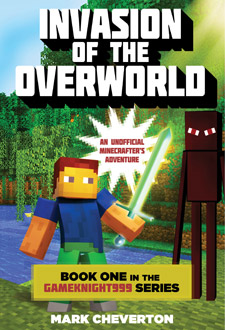
invasionInvasion of the Overworld, by Mark Cheverton (2013, Sky Pony Press) $9.99, ISBN: 978-1-63220-711-1

Recommended for ages 8-12

If you’re around tweens at all in the course of your day, you’ve probably at least heard of Minecraft. It’s an online game and community that allows users to create their own worlds in 8-bit, or face off against other users on other servers. My kids have been Minecrafting for a  few years now, and some of the stuff I’ve seen is nothing short of mind-blowing. I’ve seen Hogwarts, Middle Earth, and castles and creations that defy all explanation, created by anyone from young kids to architects and engineers who use Minecraft. That said, there are – as in real life – creeps who find amusement in destroying other people’s creations. Called “griefers”, they find their way into users’ areas and burn down and destroy other people’s hard work. Invasion of the Overworld addresses this beautifully.

The story begins with a boy whose Minecraft name is GameKnight999. He’s a 12 year-old kid who loves griefing and setting up traps to lure his teammates and friends to. It’s his way of exercising power that he doesn’t have in real life, but it’s not doing him any favors. When – in a scene that reminded me of Disney’s Tron – he finds himself digitized and in the Minecraft world itself, he learns that his online actions have repercussions, and when he’s confronted with the fallout from his actions, he begins to see things in a new light.

He also learns that all is not well in the world of Minecraft. The monsters that exist in the game are finding their way, server by server, to the Source, a source of power that will lead them to our world. GameKnight – called The User That is Not a User – is the one things standing in their way. We see GameKnight on a voyage of personal discovery as he matures and takes on the responsibility not only of defending Minecraft, but his own world.

The book is Minecraft-heavy. There are detailed desriptions of settings, tools, and game vocabulary. Minecrafters will recognize and love this, and newbies to the game (and I count myself in this number) will appreciate Mr. Cheverton’s explanations. Mark Cheverton wrote this series after the Minecraft world he and his son created was destroyed by griefers. Parents will appreciate the discussions about cyberbullying and bullying in real life, and I’m hopeful that kids reading this series will see that every action brings with it some consequence, whether or not they hide behind the anonymity of being online.

I bought a set of these books for my library, because the kids are avid Minecrafters. I haven’t seen the books since the day I put them on the shelves – they’re constantly in circulation, and I really should by a new set, along with Mr. Cheverton’s latest series, The Mystery of Herobrine.

Keep up with Mark Cheverton’s Minecraft novels at his website, where you can sign up for email updates.

Full disclosure, I am mortified by how long it took me to get to this review. I received a copy of the GameKnight999 trilogy at New York Comic Con last year, and only just got to sit down and read this first book in the series. I hope that all the booktalks I’ve given this series in the time it took me to read it helps make up for the delay!

Posted in geek, geek culture

Free Comic Book Day is Coming – Are You Ready?!

Children’s Book Week is coming! From May 4-10, libraries, educators, and booksellers all over the world will be planning programs and initiatives to get kids reading and encouraging a lifelong love of books. But did you know that this year, we’re kicking off Children’s Book Week with Free Comic Book Day?

Free Comic Book Day is an annual celebration of comics. Libraries and comic book stores all over the US, Canada, and worldwide work in conjunction with comic book publishers to get free comics into the hands of ALL readers. It’s taking place on May 2nd this year (it’s always on the first Saturday in May), so check your local library or comic book store to see what they have in store.

Don’t just take it from me. Robin Lord Taylor, better known these days as Penguin on one of my favorite shows, Gotham, wants you to have free comics, too.

Fast Facts about FCBD:

  • On May 2nd, over 2,300 participating comic shop across the US, Canada and worldwide will be giving away free comic books
  • There are 50 designated FCBD titles available to choose from
  • Over 5.6 million comic books will be given away for free making this year’s event the biggest yet!
  • During FCBD, comic shops host special events such as costume contests, guest signings with comic book writers and artists, raffles, giveaways, store-wide sales, games and more for the whole community to enjoy
  • To find a participating comic shop, enter your zip code into the store locator at freecomicbookday.com
Posted in gaming, geek, geek culture

The Family That Geeks Together – TableTop Gaming

I wrote a piece on tabletop gaming for WhatchaReading recently, that’s received some great feedback. I thought I’d post the article here, too, especially with a lot of my readers being librarians and parents, and get some more input.

My 11 year-old son, Alex, and I hang out a lot together. I introduced him to Doctor Who, the Batman ’66 TV series, and Batman’s The Killing Joke; he introduced me to tabletop gaming. We’d played Clue, Monopoly, and Trouble until I thought I was going to weep, and even though we learned how to play Magic a few years ago at New York Comic Con, one game could get so bogged down that I kind of shied away from gaming. That changed last Christmas, when my brother-in-law gave Alex Munchkin, the card game where you loot the treasures, kill the monsters, and stab your buddy. He was immediately hooked. Next thing I knew, he was an authority in the making on tabletop gaming. He introduced me to Wil Wheaton’s TableTop web series. He collected different Munchkin games. We went to New York Comic Con together, and he showed me Fluxx, King of New York, and other tabletop games. We went home and played Munchkin with my 15 year-old, and we had a blast. I was hooked.

The Family That Geeks Together: Tabletop Gaming

Many Munchkin games later, we’ve expanded to include Cthulhu Fluxx, Machi Koro, Sushi Go, and We Didn’t Playtest This At All. We go at each other, talking smack and trying to trip each other up, laughing and talking about everything – school, books, crazy members of the family – as we go along. Tabletop gaming has given me a great way to tighten my relationship with my kid as he enters – shudder – puberty; it’s “our thing”: something that’s for us, we have together. Alex is a gamer, not really a talker, but if we’re playing Machi Koro, and something’s on his mind, it’ll come up as we’re stealing one another’s resources to build our city. If his brothers are driving him crazy, I’ll hear about it as he’s attacking a monster during a round of Munchkin. He’s relaxed. I’m relaxed. If we can defeat Cthulhu and find the Necronomicon, dealing with a 2 year-old who’s sticking fruit snacks in your hair is a piece of cake.

Cthulhu Fluxx munchkin cthulhu machi koro

Alex’s influence has spread to my library, where I just started a Tabletop Gaming club. Our first session, I had six kids and a parent show up to play another Fluxx game, Oz Fluxx. These kids had a BLAST. It exceeded my wildest hopes, because I haven’t had a lot of geekery catch fire with the kids at the library these days. When I finished the “learning round”, as I called the first game, they immediately asked for another round. I handed off the deck to the dad who sat in, who was more than happy to take over as game leader.

Fluxx Oz we didn't playtest      sushi-go

Gaming works. It gets kids thinking strategically, using numbers, words, reasoning. It helps them plan, it helps them understand cause and effect. Candyland and Chutes and Ladders, TiddlyWinks, Break the Ice – start playing with the little ones early. You can start when they’re about 3. But when they’re as young as 5, you can start teaching them Magic – it’s how Alex became more comfortable with numbers as a Kindergartener. I have a 6 year old in my Fluxx group at the library, and she was the kid who won the game. Her proud dad was the dad who joined my group, and he can’t wait until next week, when the group meets again. Gaming brings people together, so why wouldn’t it bring parents and kids together? It’s one of the few times they can oppose you without grief, right?

Now I’m scouring Kickstarter for new games to bring home, and to my library. I’ve got 3 in the hopper now: Gryphon Games’ 12 Days of Christmas and King’s Kilt, and Exploding Kittens, by Ellan Lee, Shane Small, and The Oatmeal’s Matthew Inman. Which also happens to be the most-backed Kickstarter EVER. Once I get these, I’ll make sure to report back.

12days kingskilt explodingkittens


In the meantime, what are YOU guys playing? I’d love to hear about it. Weigh in on Twitter, or in the comments below!

This article appeared on WhatchaReading on 2/21/15.

Posted in Fantasy, geek culture, Graphic Novels, roleplaying, Science Fiction, Teen, Tween Reads, Uncategorized

In Real Life: Where online worlds cross over to reality.

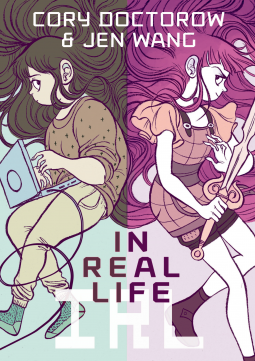
in real lifeIn Real Life, by Cory Doctorow/Illustrated by Jen Wang (:01 First Second, Oct. 2014). $17.99, ISBN: 9781596436589

Recommended for ages 13+

I’m a Cory Doctorow fan. I loved Little Brother, and I was fascinated by For the Win, which examines the lives of “gold farmers” – people whose job it is – in real life – to acquire gold and magic/rare items in games, and sell them to players for real-world currency. The gamers – which include children – are from poor families in third-world countries: India, China, and Singapore, working in deplorable conditions, and exploited by sweatshop bosses who pay pitiful wages.

In Real Life is a graphic novel about a girl named Anda, who loves playing a MMORPG (Massively Multiplayer Online Role-Playing Game) named Coarsegold. She makes friends in the gamespace, ultimately falling in with Lucy, a more experienced gamer who takes Anda under her wing. They stalk and “kill” the “gold farmers” they encounter, believing them to be cheating by selling gold and rare items to fellow gamers. The farmers look small, almost childlike, and Anda – despite doing this in the gamespace – feels guilty. She strikes up a friendship with one of the farmers, a Chinese teenager named Raymond, who tells her about his life and his job – laboring under sweatshop conditions to farm so that he can help support his family – and Anda decides that something needs to be done.

The story is similar to Doctorow’s plot in For the Win, but without delving into the global politics and economics involved in the novel. I loved this graphic novel, which could be an introduction or supplement to For the Win. We get to see positive representations of female gamers, teenagers, and we have a moral central character who is forced to understand that even morals don’t come solely in black and white. At the same time, In Real Life calls attention to a form of human rights violation taking place all over the world, yet located in our homes, our libraries, and anywhere we game.

Jen Wang’s art is perfect for Doctorow’s story. She’s got a manga style that works for me. Her use of color works to as a soft contrast to the tech storyline, and brings out the humanity at the tale’s core.

In Real Life publishes in October of this year, and I can’t wait to get it on my shelves. It’s going to be a great addition to any graphic novel collection, and a must-read for older tweens and teens, especially those who game. Social Studies courses could get some great discussions by adding this book to their curriculum.

Posted in Fantasy, Fiction, gaming, geek, geek culture, Humor, roleplaying, Science Fiction, Teen, Young Adult/New Adult

Attack the Geek: Geek Culture Gone Wild!

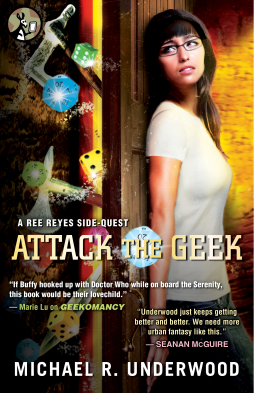
attackthegeekAttack the Geek, by Michael R. Underwood. Gallery, Threshold, Pocket Books (2014), $2.99, ISBN: 9781476757780

Recommended for 18+

Attack the Geek is more of a New Adult read than it is a YA read, but there are plenty of pop culture, gaming, and garden variety geek references in there that will appeal to younger audiences. There’s a content heads-up for language, but it’s nothing the kids aren’t screaming at each other these days.

Attack the Geek is a side adventure to a series created by Michael R. Underwood; his previous two books, Geekomancy and Celebromancy, are available via digital download on Amazon for a very reasonable price. I haven’t read the two previous books which could be a reason why I felt off-kilter with Attack the Geek.

For any gamers out there – did you ever have a roleplaying session where one bar fight or battle took up hours of your campaign? If you know what I’m talking about, that’s how I felt while reading Attack the Geek. It’s a single combat story, with barista Ree Reyes, the heroine and protagonist of the series, and her fellow geekomancers coming under attack at Grognards, the establishment owned by Ree’s boss, Grognard. The geekomancers have the ability to channel the power of geek culture by consuming it – Ree, for instance, keeps clips from her favorite movies, like X-Men or Spider-Man, to draw upon when she needs power – and she’ll be able to shoot webs or toss people with telekinesis. There are props aplenty, including working Star Trek phasers and Star Wars lightsabers, and collectible card game cards merely need to be torn to release their  magic in this world, if channeled by the geekomancer. So when they come under attack from a Strega witch named Lucretia, it’s a hairy battle, loaded with pop culture references and witty banter.

This being a side adventure is my own issue – I am unfamiliar with the geekomancy power and these characters, so in a sense, I was at a disadvantage. But I also thought the book was trying to be too witty, throw too many references in, for its own good. The references took over the plot, and after a while, I was just reading about a battle where there was Spider-Man web slinging, Star Trek phasers, and lots of collectible card game references. This just wasn’t my book. For anyone who’s a devoted sci-fi/fantasy/gaming/comic book fan, it’s worth a shot. It’s why I requested it from NetGalley, after all, and I may read Geekomancy now just to see if having more of a background will help me better grasp the book.