Posted in Fiction, Historical Fiction, Middle Grade, Realistic Fiction, Tween Reads

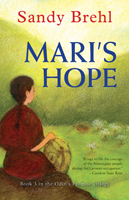
Mari’s Hope brings Odin’s Promise to a beautiful close

Mari’s Hope, by Sandy Brehl (Sept. 2017, Crispin Books), $14.95, ISBN: 978-1-883953-89-8

Recommended for readers 9-12

The conclusion of Sandy Brehl’s Odin’s Promise trilogy is finally here! Mari’s Hope continues the story of Mari, a Norwegian girl living under the German occupation during World War II. Mari, who was 11 when the story began, is approaching age 14 when the latest book begins. Her family is active in the resistance, and Mari’s involvement increases as she is older now, willing and able to take greater risks. She works with the local doctor to care for the sick and elderly in her village, Ytres Arna; travels to the city of Bergen to procure more medicine – and information – for her village, and tries to stay out of the way of the Nazi officers who live in her home; particularly the one she calls Goatman, who is a drunk and a thief.

Written in third-person narrative with first-person journal entries from Mari to her brother, Bjorn, Mari’s Hope is written with the same gentle strength as the previous two entries in the series. We see Mari grow over the three books from girl to young woman – a change that has come too quickly under the occupation – and deal not only with being a member of the Norwegian resistance, but with the stress of worrying about her brother; grieving her dog, Odin, killed by Nazi soldiers in the first book; struggling with a former friend who threw in his lot with the NS – Nasjonal Samling – Norway’s version of Hitler Youth. The family and neighbors stick together, sharing what little they have to provide for one another, whether it’s to have a birthday party for Mari or a holiday dinner for Jul. There are tense moments that kept me turning pages, sometimes biting my lip with concern, and there are moments where I just needed a moment to process my relief. Sandy Brehl never whitewashes the German’s devastation; rather, she states it quietly, eloquently, and leaves it there for Mari – and us – to process and move on.

The Odin’s Promise trilogy is a gorgeously written series of books that take us into a part of World War II history we don’t often hear about. Hitler invaded Norway with the lie that he was sending soliders to “protect” his “Viking brothers”, but proceeded to strip all freedoms from them and tried to supersede his vision of Aryan superiority over their rich culture. Odin’s Promise, Bjorn’s Gift, and Mari’s Hope tell this story through the experiences of one village, one family, one girl, who pushed back. I love spending time with Mari and her family; while I’m sad to see this story end, the beauty of books lies in knowing I can meet them again whenever I want to.

Odin’s Promise received the 2014 Midwest Book Award for Children’s Fiction. It was also noted as one of A Mighty Girl’s Best Girl-Empowering Books of 2014 and one of Foreword Magazine’s Ten Best Indie Middle Grade Novels of 2014.
Posted in Fiction, Historical Fiction, Intermediate, Realistic Fiction

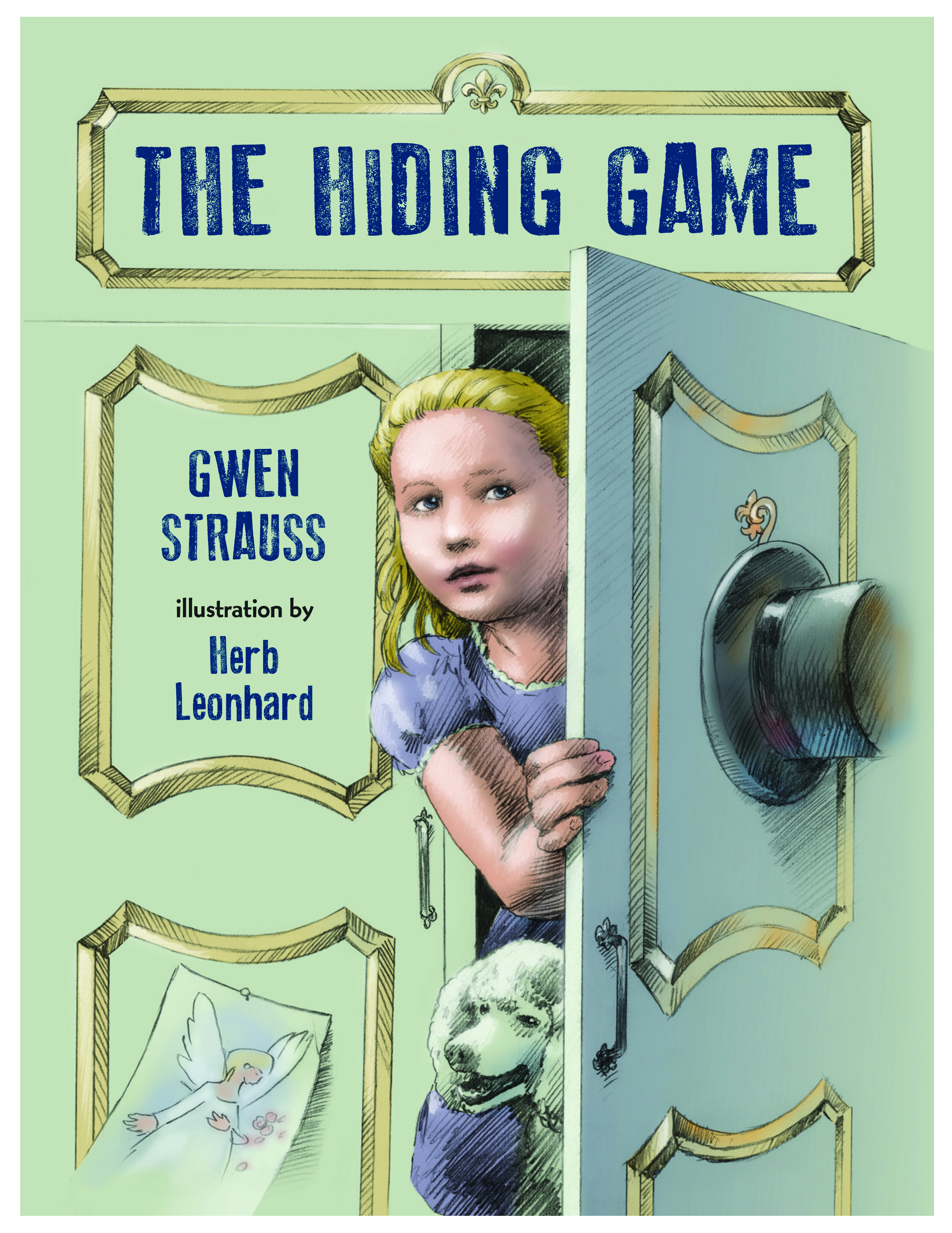
Rescuers play a Hiding Game with the Nazis

The Hiding Game, by hiding-game-coverGwen Strauss/Illustrated by Herb Leonhard, (Feb. 2017, Pelican Publishing), $17.99, ISBN: 9781455622658

Recommended for ages 7-10

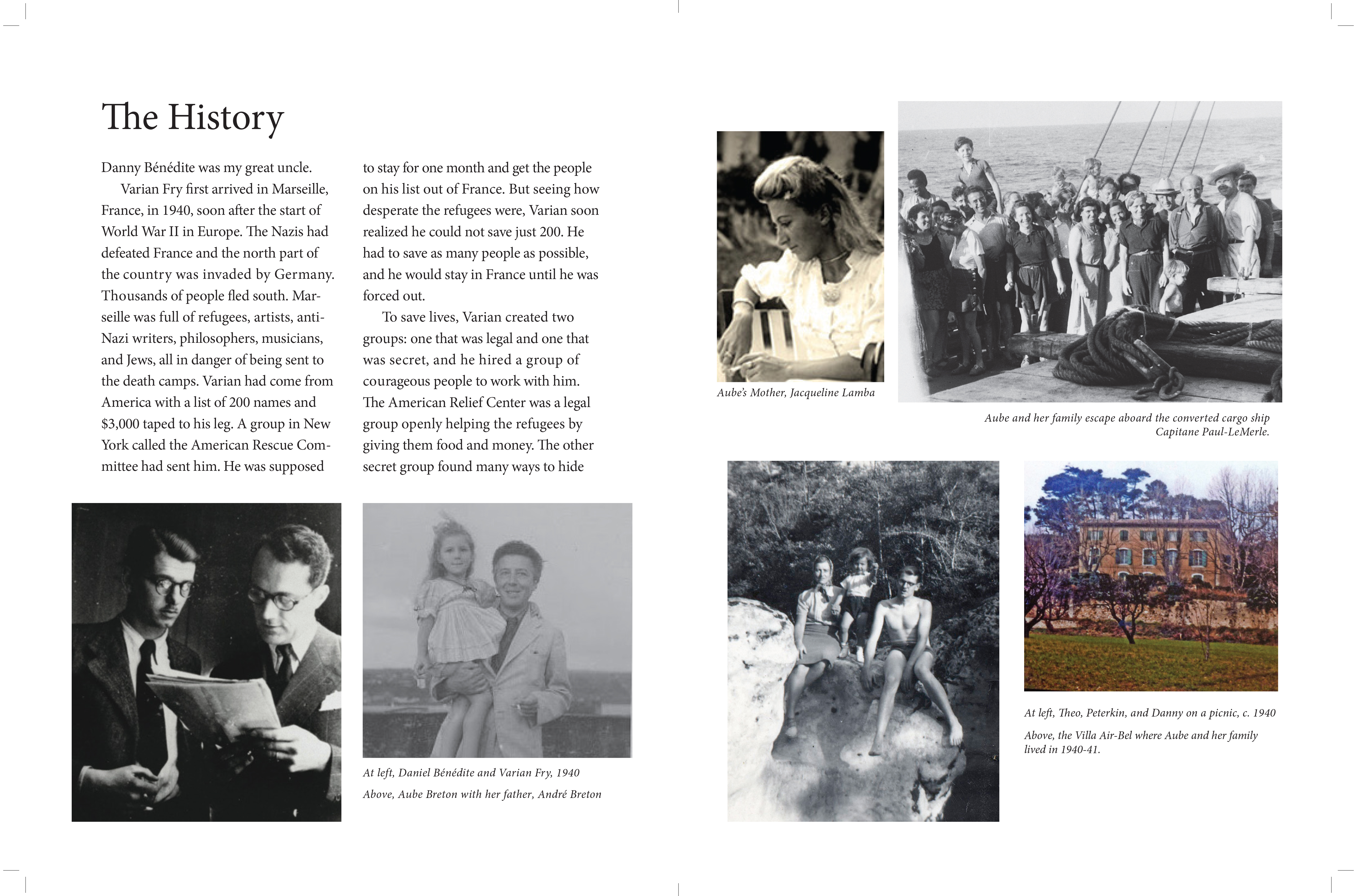
A young girl and her family settle into a new home in the Villa Air-Bel in France. They’re used to hiding things: the radio, a cow, anything of value that the Nazis could seize. Aube Breton – the daughter Dada pioneer Andre Breton – even learns to hide herself in case of a raid. You see, Villa Air-Bel was a safe place for refugees during World War II, a place where those on the run could await passage to safety. Aude spends her days with luminaries like artists Marc Chagall and Max Ernst; helping hold art sales to raise money for transport out of occupied France, and playing, as a child should.

A very different experience from Anne Frank and the families ensconced in the Secret Annex, Aude’s story is no less powerful. She witnesses a Nazi raid and hides while her father and other men are rounded up and taken in for questioning, and she faces her situation with love and laughter. The stories of the Villa Air-Bel refugees is a lesser-known part of World War II France, and The Hiding Game is a strong introduction to younger readers. Its message is as strong today as ever.

Herb Leonhard’s illustrations and subdued color palette are gentle on the eyes in some spreads, more powerful in others, enhancing the story with strong images that will lead to deep discussions with school-age readers.

hiding-game-layout-lowres-11-1

A historical note and further resources round out this story, and the author explains that her uncle was one of the men who risked his life to bring refugees to safety.

hiding-game-layout-lowres-17-1A recommended addition to history collections.

Posted in Fiction, Fiction, Historical Fiction, Middle Grade, Realistic Fiction, Tween Reads

The Last Cherry Blossom remembers Hiroshima

cherry-blossomThe Last Cherry Blossom, by Kathleen Burkinshaw, (Aug. 2016, Sky Pony Press), $16.99, ISBN: 9781634506939

Recommended for ages 10-14

Narrated in the first person by 12 year-old Yuriko, The Last Cherry Blossom tells the story of a family living in Hiroshima during the last year of World War II. Yuriko lives with her widowed father, her aunt Kimiko, and obnoxious 5 year-old cousin, Genji. She and her best friend Machiko stealthily listen to American Jazz records; Machiko’s father got rid of (almost) all of their records because the government wants to be rid of any American influence. She’s used to the air raid drills, even if they annoy her, but when her neighbor is called to fight for Japan, and then Machiko is called to leave school to work at the factory, Yuriko starts feeling the impact of war. She hears whispers from the neighborhood – and her father does run a newspaper – that Japan is not faring as well as the radio and newspapers would have you believe. When the true horror of war is brought to Yuriko’s door, we see, through her eyes, the devastation that the bombing of Hiroshima brought.

The Last Cherry Blossom is powerful. Even as an account of a family’s life during World War II, it’s a strong book, because it shows readers – in parallels we can make today – that the “enemy” isn’t an entire country; an entire group of people. The enemy were children teasing one another, rolling their eyes at annoying aunts and cousins, worried about their parents remarrying, and secretly listening to music that their parents may not approve of. The enemy loved eating sweet treats and held celebrations and cried when they lost people they loved in war, just like we did. Inspired by the author’s mother’s own life living as a child in Hiroshima, Ms. Burkinshaw writes so beautifully, yet packs a literary gut-punch that left me biting back tears.

There has been some strong World War II realistic/historical fiction for middle grade in the last couple of years, for which I am grateful. I’m very happy to see fiction that explores life outside the U.S. during World War II: we need perspective; reminders to look outside ourselves; to see the cost that war demands on everyone.

An author afterword tells readers about the author’s mother, and how her daughter’s class visits eventually led to the book being written. There’s also a bibliography, notes on the use of honorifics in the story, a glossary, and statistics about Hiroshima, complete with sources.

This is a good add to historical and realistic fiction collections. Booktalk with Sandy Brehl’s World War II books, taking place in Norway under the Nazi occupation; Sharon McKay’s End of the Line, taking place in Amsterdam, and most closely related to Burkinshaw’s work, Sadako and the Thousand Cranes (and please have tissues available).

Posted in Fiction, Historical Fiction, Middle Grade, Tween Reads

Bjorn’s Gift continues the story of a family under Nazi occupation

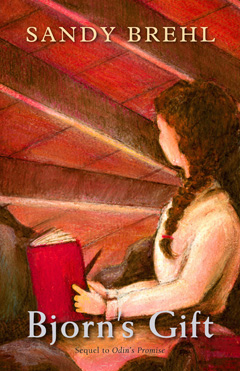
bjorns-giftBjorn’s Gift, by Sandy Brehl, (Oct. 2016, Crickhollow Books), $14.95, ISBN: 978-1-883953-84-3

Recommended for ages 9-13

A couple of years ago, I was a first round Cybils judge for Middle Grade realistic fiction, so I had the chance to read a lot of new, independent fiction that I never would have discovered otherwise. One of the books, Odin’s Promise by Sandy Brehl, is the story of a young girl and her beloved dog, Odin, living in Norway during the Nazi occupation during World War II. The sequel – the second in a planned trilogy! – continues the story of Mari and her family, living under the tightening yoke of the Nazi invasion.

We see Mari, her family and friends, staying strong as the Nazis move into Mari’s home and encroach on every facet of her life. Her friend, Leif, is thrilled to be a member of the Unghird – Norway’s answer to Hitler Youth – and insists on reminding Mari that she should be honored to receive his attention. The families are faced with increased rationing, book banning, and watching friends and neighbors disappear under the Nazi regime, yet engage in quiet acts of resistance; Bestemor still has her radio to receive BBC broadcasts, her father shelters refugees in the attic; and, most importantly, Mari’s brother Bjorn is a full-fledged member of the resistance. Although absent throughout the story, Bjorn’s presence is strongly felt through Mari’s journal, taking the form of letters to him, and his carved toys that give Mari and her friend, Per, the strength to carry on.

If you haven’t had the pleasure of reading Odin’s Promise yet, I highly recommend it. It’s a reminder that the Nazi occupation and their reign of terror against anyone of the Jewish faith or those who would dare to disagree with their policies was not limited to Germany. It’s an uplifting story about how everyone makes a difference in face of overwhelming odds. And Bjorn’s Gift is every bit as heart-rending and inspirational as its predecessor. I was so happy to revisit Mari and her family, and am so grateful to know that I will get to meet them again in one more novel.

Put this series in your classroom libraries and your historical fiction collections. Display and booktalk them with books that offer a wide range of information about children during World War II, like Susan Campbell Bartoletti’s Hitler Youth, The Boy in the Striped Pajamas by John Boyne, Sharon McKay’s End of the Line, Eleanor Coerr’s Sadako and the Thousand Paper Cranes, and Karen Levine’s Hana’s Suitcase.

Odin’s Promise was the winner of the 2014 Midwest Book Award for Children’s Fiction. You can find discussion guides for both Odin’s Promise and Bjorn’s Gift at author Sandy Brehl’s website.

Posted in Fiction, Historical Fiction, Teen, Young Adult/New Adult

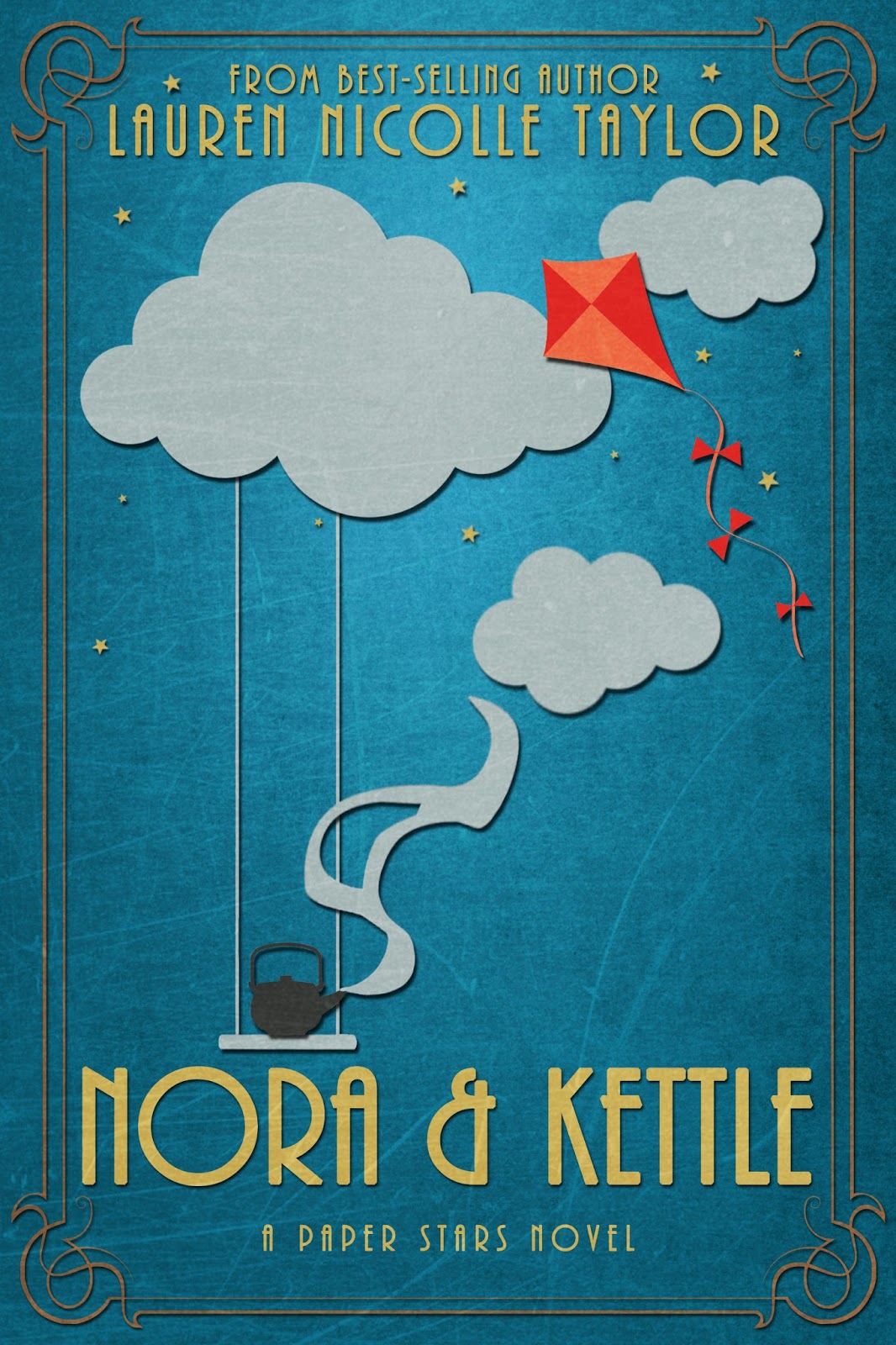
YA Cover Reveal: Nora and Kettle by Lauren Nicolle Taylor!

Nora & Kettle
Release Date: 02/29/16
Clean Teen Reads
Summary from Goodreads:
What if Peter Pan was a homeless kid  just trying to survive, and Wendy flew away for a really good reason?

Seventeen-year-old Kettle has had his share of adversity. As an orphaned Japanese- American struggling to make a life in the aftermath of an event in history not often referred to—the internment of Japanese Americans during World War II and the removal of children from orphanages for having “one drop of Japanese blood in them”—things are finally looking up. He has his hideout in an abandoned subway tunnel, a job, and his gang of Lost Boys.

Desperate to run away, the world outside her oppressive brownstone calls to naïve, eighteen-year-old Nora—the privileged daughter of a controlling and violent civil rights lawyer who is building a compensation case for the interned Japanese Americans. But she is trapped, enduring abuse to protect her younger sister Frankie and wishing on the stars every night for things to change.

For months, they’ve lived side by side, their paths crossing yet never meeting.  But when Nora is nearly killed and her sister taken away, their worlds collide as Kettle, grief stricken at the loss of a friend, angrily pulls Nora from her window.

In her honeyed eyes, Kettle sees sadness and suffering. In his, Nora sees the chance to take to the window and fly away.

Set in 1953, NORA AND KETTLE explores
the collision of two teenagers facing extraordinary hardship. Their meeting is inevitable, devastating, and ultimately healing. Their stories, a collection of events, are each on their own harmless. But together, one after the other, they change the world.
 
About the Author
Lauren Nicolle Taylor lives in the lush Adelaide Hills. The daughter of a Malaysian nuclear physicist and an Australian scientist, she was expected to follow a science career path, attending Adelaide University and completing a Health Science degree with Honours in obstetrics and gynaecology. 
She then worked in health research for a short time before having her first child. Due to their extensive health issues, Lauren spent her twenties as a full-time mother/carer to her three children. When her family life settled down, she turned to writing. She is a 2014 Kindle Book Awards Semi-finalist and a USA Best Book Awards Finalist.
 
Author Links:
 photo iconwebsite-32x32_zps1f477f69.png  photo icongoodreads32_zps60f83491.png  photo icontwitter-32x32_zpsae13e2b2.png  photo iconfacebook-32x32_zps64a79d4a.png
Posted in Fiction, Fiction, Historical Fiction, Middle Grade, Tween Reads

World War II fiction reminds us that there are stories outside of Germany and the U.S.

A lot of WWII fiction takes place in Germany or the U.S., with good reason – Germany and the U.S. were two big players in the war, after all. But how many people remember that the Nazis occupied Norway? Or that Anne Frank wasn’t the only little Jewish girl with a story to tell, coming out of Amsterdam?

I recently read two great books taking place during World War II, both nominated for the first round of Cybils consideration.

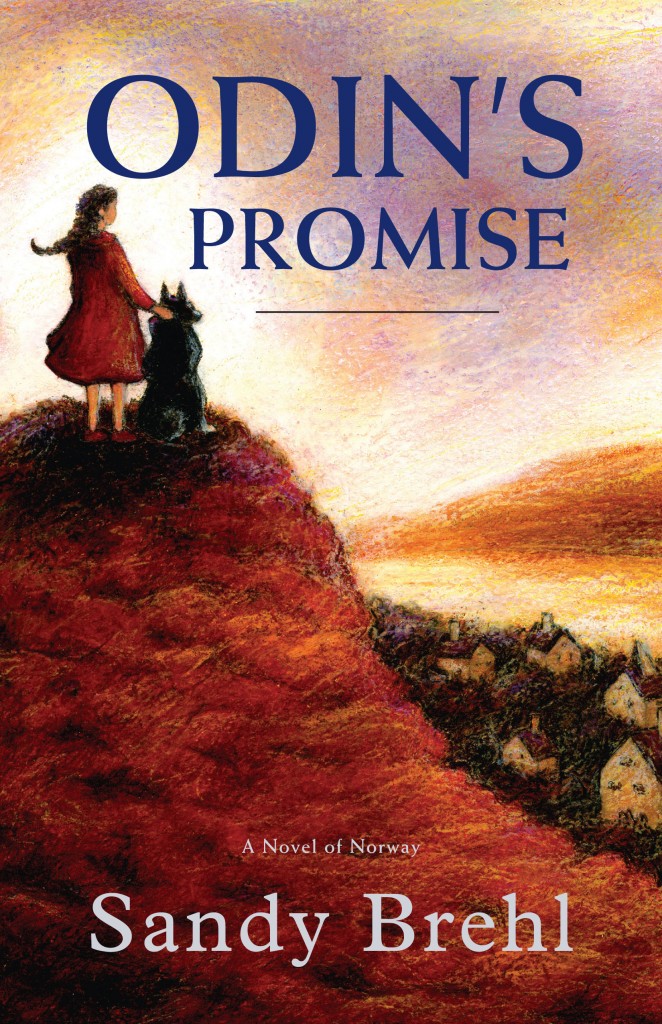
Odins-PromiseOdin’s Promise (2014, Crispin Books, $13.95, ISBN: 978-1-883953-65-2) by Sandy Brehl, looks at life in Norway under Nazi occupation. All signs of nationalism are illegal, but young Mari’s family finds a way to resist – and it becomes a family-wide effort.

Mari and her dog, Odin, find themselves under Nazi scrutiny on a few occasions. Fiercely protective of Mari, Odin is severely beaten by the soldiers, which only strengthens Mari’s resolve to get these men out of her country.

Odin’s Promise is a novel that also gives us a glimpse – briefly, but skillfully – into what life was like for young Nazi soldiers, shuttled to a country where they were actively hated, and “assigned” to families. Not every soldier wanted to be there, and not every soldier was personally detestable, no matter how awful their agenda was.

The story is a slow build to several outcomes – some bittersweet, some awful, some happy – and it’s the story of a young girl’s coming of age in a brutal time.

Sharon E. McKay’s The End of the Line (2014, Annick Press, end of the line$12.95, ISBN: 9781554516582) is based on a true story that I’ve never heard before, but blew me away.

Beatrix, a 5 year-old Jewish girl in Amsterdam, is on the run with her mother. Her Christian father has been taken away, and her mother tells her to trust no one. But when her mother is taken off the train by soldiers, what is she to do? Two elderly brothers, Lars and Hans, who work for the railroad, take the girl home and feed her. They realize what’s happened to her mother and see the heartbroken, malnourished little girl, and decide, with the help of their neighbor, Mrs. Vos, that they will keep her, telling neighbors that she is their niece.

This is an amazing story of what happens when a community comes together to take care of a child. The brothers and Mrs. Vos protect, feed, and clothe Beatrix. They make sure she receives an education, including a religious education, so that she can answer Christian questions if she’s pulled aside at any time.

The End of the Line is one of those stories that makes your heart feel like it’s beating out of your chest with each turn of the page. It’s wonderfully descriptive with emotion, and brings home how the people the Nazis supposedly felt kinship with (like the Norwegians) suffered under their watch. You’ll be angry, you’ll be horrified, but ultimately, you will feel incredible love and relief. I loved this book.

I’ve had a recent spate of middle graders coming into my library and asking for historical fiction related to both the Holocaust and World War II. In addition to Jane Yolen’s Devil’s Arithmetic and Lois Lowry’s Number the Stars, I’ll be recommending these titles.

Posted in Graphic Novels, History, Tween Reads

Hidden: A Child’s Story of the Holocaust tells a powerful tale, gently for younger readers.

Hidden: A Child’s Story of the Holocaust, by Loic Dauvillier (First Second, 2014), ISBN: 978-1-59643-873-6, $16.99

Pub Date: April 1, 2014

hiddenRecommended for ages 8-12

Hidden is a graphic novel, tells the story of the Holocaust as it stormed through Vichy France, from a child’s eyes.

Elsa is a little girl who discovers her grandmother deep in thought one night. She curls up on her lap, and her grandmother tells her why she’s been feeling sad. Doumia, Elsa’s grandmother, has had a nightmare, and proceeds to tell Elsa about her life as a little girl.

Doumia was a happy child, living in France, going to school, and had friends and a loving family. One day, her father tells Doumia that they are to become “a sheriff’s family”, as her mother sews yellow stars on their clothing. She later learns, when her friends and her own teacher ignore her, that the yellow star is not a sheriff’s star, but the mark of being a Jew. Nazi soldiers harass people in the streets; Doumia’s father loses his job, and, fearing for her safety, Doumia leaves school to be homeschooled by her parents.

Doumia’s parents scramble to hide her when the Nazis come for them. She is discovered by a neighbor, who, with a network of the French Resistance, change her name and send her, along with her neighbor, to a farm to wait out the danger. When the War ends, we wait, as Doumia does, to learn her parent’s fate.

This is a powerful, emotional, story of the Holocaust because it is told through a survivor’s eyes, but the eyes of a child. We hear this story, as Elsa does, in the safe, warm embrace of a  grandparent, with Marc Lizano’s and Greg Salsedo’s gentle cartoon art, with subdued colors, easing younger readers into history. Where is difficult in parts, there are bright spots to keep younger readers interested and happy – Doumia living safely in the French countryside with women who care for her; the farm animals she helps care for, reunions with lost family members. It’s a safe place to talk about a horrific event.

An afterword by Hellen Kaufmann, the President of AJPN – an organization dedicated to telling the stories of rescue and solidarity during World War II – gives us an overview of Vichy France during World War II.

This is a fantastic pick for younger readers, particularly with the difficult task of finding interesting, captivating, non-fiction to fit with the Common Core Learning Standards. The book is a valuable teaching tool for parents and educators alike.