Posted in Uncategorized

The Secret Mission of William Tuck – A Revolutionary Adventure!

william tuckThe Secret Mission of William Tuck, by Eric Pierpont (Sept. 2015, Sourcebooks Jabberwocky), $7.99, ISBN: 9781402281747

William Tuck is a young teen who watches helplessly as his older brother, a soldier in the Revolutionary War, is cut down by a firing squad. In his anger and desire for payback, he runs away to join the Revolutionary Army as a drummer boy and work his way up to fighter. After his first battle, a dying soldier gives him a watch and sends him on a mission that will take him straight to George Washington’s side – and make him a target for the British army.

I enjoyed this book. I’ve been a Revolutionary War buff since I was a kid, and there just aren’t many good middle grade fiction pieces about this era in history, with a younger character at the forefront. We’ve got the classics, My Brother Sam is Dead and Johnny Tremain, and another one of my favorites, Phoebe the Spy, but there hasn’t been much recently.

This should please the Common Core diehards out there – there is a lot of history packed into this book, with actual historical figures getting page time, including Peter Francisco, the Virginia Giant, who is brought to four-color, 3-D life here. Mr. Pierpont has put a lot of research into this book, make no mistake, but he also gives each character a vibrant personality to appeal to readers.

We’ve got an interesting female supporting lead character, a stint on one of the infamous prison ships, and a tremendous battle at Yorktown wrapped around a mission that has more layers to it than poor William ever counted on. Add this to your shelves, consider enhancing your social studies/American history unit by assigning it.

Sourcebooks has a great section for librarians and educators on their website, separated by imprint. Keep your eye on the Jabberwocky space for additional materials on William Tuck.
Posted in Fantasy, Fiction, Teen, Uncategorized, Young Adult/New Adult

The Scorpion Rules: War Becomes Personal

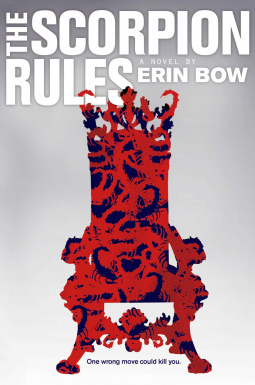
cover70208-mediumThe Scorpion Rules, by Erin Bow (Sept. 2015, Simon & Schuster), $17.99, ISBN: 9781481442718

Recommended for ages 13+

It’s a new world and it comes with a new age of warfare. When environmental cataclysm led to widespread war, an AI gained sentience and decided to end things his way: start bombing until everyone quieted down. Years later, under the Talis – the ruling AI – war is decidedly more personal: the children of the ruling parties are all held hostage, in a location called the Precepture, until the age of 18. If nations decide to go to war, the children of those nation’s leaders, known as the Children of Peace, are killed.

Greta is a Princess of the Pan Polar Confederacy, the superpower formed from the ashes of what we currently know as Canada. She and her co-hostages witness the arrival of a new hostage, Elian, who rebels with everything he has and endures painful punishments because of it. Elian’s parents are farmers, not diplomats, but his grandmother is a different story. Through Elian’s eyes, Greta begins seeing things very differently. Elian’s and Greta’s countries stand on the brink of war and the very real consequences stare them in the face, but things really swing into action when Elian’s grandmother takes things a step further and invades the Precepture, igniting Talis’ fury. A lot of people stand to die unless Greta can think of a solution that will save everyone.

This is an interesting concept – avoid war by making it more personal. Sadly, the AI seems to forget that world leaders want what they want, and sometimes, you can’t make an omelette without breaking some eggs. Children die in this story, don’t think for a moment that this is a benevolent dictatorship to keep the peace. Talis is an AI that’s got way too much emotion, and while parents feel really bad about being responsible for killing off their kids via third person, it happens.

Greta is an interesting character, taking in everything she sees. She’s not a victim and she’s not a martyr, but she’s not entirely a hero, either. She’s flawed, Elian’s is obnoxiously valiant, and the co-hostages are all doing what they can to survive. While Elian is tortured because he tries to rebel and refuses to accept his circumstances, comparing himself to Spartacus, Greta endures the brunt of the brutality to come with resignation.

The story is a near-unputdownable read, with solid character development and world-building, layered with plot twists and some truly cringe-worthy characters you’ll love to hate. You’ll rage inwardly at the world these children exist in, and I know I’ll never look at HAL from 2001 in the same way again (that’s the voice I ascribed to Talis). There’s a brilliantly diverse cast, and the real jewel in the novel is the relationship that develops between Greta and fellow hostage, Xie. The awakening and confirmation of their feelings for one another is portrayed beautifully and with tremendous respect, and it was a bright spot among the dark places in the story.

The Scorpion Rules should be a popular Fall read, and would be a great enhancement to a social studies class on world relations. I’m going to see if I can foist it upon my own 16 year-old, as well as the teens at my library. Off to create discussion questions!


Posted in Graphic Novels, History, Middle Grade, Non-fiction, Tween Reads

Child Soldier tells a survivor’s story

child soldierChild Soldier, by Michel Chikwanine & Jessica Dee Humphreys/Illus. by Claudia Davila, (Sept. 2015, Kids Can Press), $18.95, ISBN: 9781771381260

Recommended for ages 10+

In 1993, Michel Chikwanine was a 5 year-old boy living in the Democratic Republic of Congo. He admired his father, a human rights lawyer, and loved his mother, who took care of children from all over the neighborhood who needed food or care. He was surrounded by friends and family, played soccer, and goofed off with his friends.

His father talked to him about the world as they listened to the news on the radio together; he had no idea that he would become directly involved in world events so soon, though.

On the way home from school one day, he was kidnapped by rebel militants and forced to become a child soldier. He was drugged and forced to kill, tortured and starved, until weeks later, he was able to escape and return to his family. But how do you return to a life when, at the age of 5, your childhood has been taken away?

This heartbreaking, yet inspirational biography is Chikwanine’s story, told in graphic novel format. Michel provides a brief background on his country, so that we may follow the history of conflict that has led to a society that creates child soldiers. We see his parents struggle to give Michel his life back and the risks they take as activists to fight against this happening to another child, ever again: his father is jailed, his home attacked, and his family separated as they escape to protect Michael and his siblings.

The story is told, both in words and pictures, in a way that will grasp younger readers’ attention. They can see themselves in Michel’s childhood: playing games, enjoying friends and family, attending school. The story, while horrific, never becomes too graphic for younger readers – it’s important, because we need younger readers here to know this is happening to children their age and younger. It’s also important for children to see that adults can take care of their children; we see Michel escape on his own, but adults in his village return him to his family, and his family takes action to protect their son.

Child Soldier is ultimately an inspirational story: Michel’s childhood has been taken from him, but he rises from the ashes and recreates himself, becoming a young man with a mission. He is a human rights activist with a story to tell and motivates young people to action. A graphic novel is a wonderful and powerful way to introduce a discussion on human rights in the classroom, and Child Soldier includes discussion questions and information, information on how to get involved and help, and primary sources for further research to facilitate these discussions.

Over the last two summers, I’ve noticed more books on child soldiers showing up on summer reading lists for kids in grades 4 and up. I’m glad to see this subject being addressed in the schools, and hope that this book is on next year’s summer reading lists.

Child Soldier is a book in Kids Can Press’ Citizen Kid series, a collection of books about global issues that seeks to make our kids better global citizens.

Child Soldier is on sale on September 1, but you can take a look at the book trailer here and see some of Claudia Davila’s beautiful artwork.

Posted in Fiction, Middle Grade, Tween Reads

The Soldier – Bravery takes many forms.

the soldier The Soldier, by M.G. Higgins (2014, Saddleback Educational Publishing), $7.95, ISBN: 978-1-62250-901-0

Recommended for ages 8-12

Leyla is a 12 year-old girl living in a war-torn area. She knows the rules for going to the water pump near the market – always stop between the buildings, see who is there. One day, she notices a soldier who looks different from the others: the soldier is female.

When Leyla’s life intersects with the female soldier’s life, Leyla finds herself making big decisions. Can she keep herself out of trouble while keeping her new friend safe?

The Soldier is one of Saddleback Publishing’s Hi-Lo novels written for struggling readers. The ideas are complex, but are communicated with succinct text, and short, direct sentences. The illustrations add extra interest, and at 60 pages, allows the reader the experience of reading a full novel without the stress. I love this idea! I’ve got some struggling readers at one of my library sites, and books like this could really be the thing that makes readers out of those kids.

Saddleback offers teacher resources and more hi-lo novels at their website, and are sold through Amazon and BN.com. Take a look at The Soldier, and realize that Higgins communicates an impressive story in a concise and engaging way that will invite any reader to sit down and spend some time.

M.G. Higgins is an award-winning children’s and YA novelist and non-fiction writer. Her author website offers information about her books and a bio.

Posted in Historical Fiction, Tween Reads

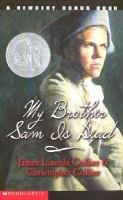
Book Review: My Brother Sam is Dead, by James Lincoln Collier & Christopher Collier (Scholastic, 1974)

Recommended for ages 12+

My Brother Sam is Dead is a look at the Revolutionary War that readers don’t normally get: like the Civil War, this war divided families. We also see a side of the American soldiers that we don’t usually hear about in History class – “our” soldiers weren’t always acting like the good guys, especially to their own countrymen if they weren’t supporters of the cause.

We hear about the Tories and they are demonized. We laugh at stories of them being tarred and feathered, but what My Brother Sam brings home is that Tories were the same Americans that the Revolutionaries were, but they just believed in a different ideal. To the Tories, there was no reason to split with Mother England, who provided for them and protected them. Taxes were a fact of life. Quartering soldiers was a fact of life. To rebel was treason and it was just wrong. When looking at the acts of the Revolutionaries – stealing from, kidnapping and murdering fellow Americans who were Tories – it is difficult to say anyone involved was 100 percent right or wrong. We learn that the Revolution was a black and white issue; My Brother Sam goes beyond that thinking and shows readers that the War was made up of many, many shades of grey.

Tim Meeker is the son of a Connecticut tavern owner whose older brother, Sam, joins the Revolutionary Army under Benedict Arnold while away at college. The relationship between Sam and their father appears to have been conflicted to begin with, as both are stubborn men with strong opinions, and this act leads to a schism within the family that leaves Tim wondering who’s right and who’s wrong Torn between his love for his brother and his love and loyalty to his family, he finds himself stuck in the middle of a far larger conflict when he’s asked to keep secrets about Sam and when his battalion is in the area. Tim sees firsthand the brutality of the American soldiers to his Tory neighbors and he sees the cruelty of the British soldiers. Is there a right or wrong?

My Brother Sam is Dead won the 1975 Newbery Honor and was nominated for a National Book Award that same year. It has also been designated as an ALA Notable Children’s book and was the twelfth most frequently challenged book from 1990-2000 (ALA).

The History of Redding website has extensive information about the novel; Redding, Connecticut is the setting for the story. A 2005 Scholastic edition of the book has an AfterWords bonus feature which includes an interview with the authors, where they compare their story to fellow Newbery winner and Revolutionary War story Johnny Tremain, and discuss parallels between their work, written after the VietNam conflict, and Johnny Tremain, written after World War II.

Posted in History, Non-Fiction, Tween Reads, Women's History

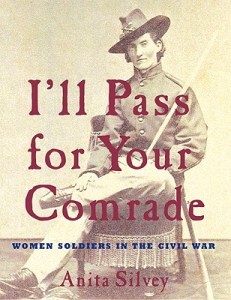
Book Review: I’ll Pass for Your Comrade, by Anita Silvey (Clarion, 2008)

Recommended for ages 9-12

I’ll Pass for Your Comrade is a line taken from a Civil War Ballad, “The Cruel War”; a woman is saying goodbye to her love, leaving to fight, and begs to join him in combat. She offers to “pass for his comrade” – something that, according to the National Archives, at least 250 women did during the Civil War. Many women fought to be with their husbands and fiances. Some women fought for revenge. Some women fought for the thrill of battle. Unfortunately, because they had to keep their stories silent, most of these stories have been lost. I’ll Pass for Your Comrade tells the stories of some of the women who donned men’s uniforms, cut their hair, and went to war.

We hear the words of the women who fought, like Loreta Janeta Velazquez, who wrote about her participation in the Battle of Bull Run as Lieutenant Harry T. Buford. We see photographs of women like Frances Clayton, featured in the book both dressed in her uniform and her dress. We learn about their lives after the War, and how some of them took their secrets to the grave, their families only discovering their truth after death.

The book has black and white photographs and primary documents reprinted throughout, offering students the chance to see history as they read about these women. The author also provides a bibliography for further reading. This would be a strong selection to use during Women’s History Month or during a Civil War unit.