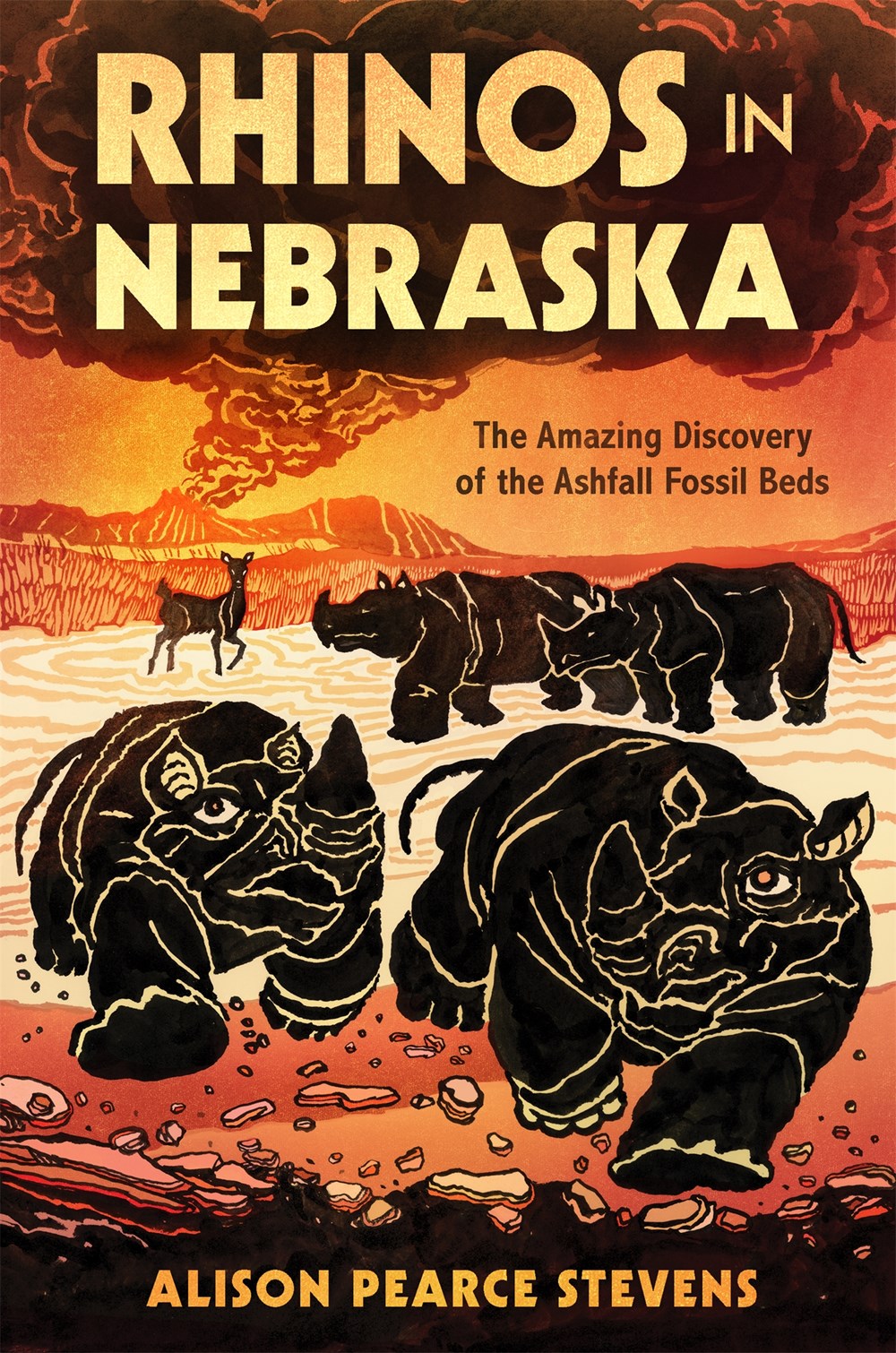
Rhinos in Nebraska, by Alison Pearce Stevens/Illustrated by Matt Huynh, (July 2021, Henry Holt & Company), $19.99, ISBN: 9781250266576
Ages 8-12
Twelve million years ago, a supervolcano exploded in what we now call the state of Nebraska; animals who used a nearby watering hole were buried under a blanket of ash, and lay quietly undiscovered for milennia, until 1953, when a 17-year-old farm worker and his father discovered a complete jawbone sticking up out of cliff at a spot called Bone Hill. Rhinos in Nebraska is the story of these animals, the supervolcano that killed them, and the discovery and construction of Ashfall Fossil Beds, where more than 200 perfectly preserved fossils have been uncovered. Author Alison Pearce Stevens worked with Ashfall researchers at the University of Nebraska State Museum as she wrote this story, which reads like adventure fiction, moving back and forth through different time periods to tell the story of this incredible archaeological discovery. Black and white illustrations and photos bring the story to life; the black artwork bringing to mind woodcut artwork that beautifully lends an ancient feel to these prehistoric animals. Alison Pearce Stevens generates emotion as she describes the agonizing deaths caused by the volcanic ash as deftly as she explains how a horse’s hoof evolved from three toes to one for easier movements like pivoting to evade predators. Back matter includes a glossary of terms – bolded in the book’s text – that come up throughout the narrative. There is also an author’s note and additional resources. Essential for ancient history readers.
A Trip to the Top of the Volcano with Mouse, by Frank Viva, (May 2019, TOON Books), $12.95, ISBN: 9781943145362
Ages 4-7
Mouse and his friend are off to explore Italy and climb Mount Etna in this second Mouse adventure! The explorer can’t wait to go start the adventure, but all Mouse can think of is pizza. Together, the friends lay out the plan: supplies (walking sticks, warm gloves, strong mountain boots, thick sweaters, and cool sunglasses) and set out for the mountain. They discover the different foods that grow at the base of the mountain (but not pizza), hike to the top, and see what types of wildlife wander around the area, before ending their day with a trip to the pizzeria.
A Trip to the Top of the Volcano is a fun mix of fiction and nonfiction, with stylish, vibrant graphics. There’s a beautiful cross-section spread, showing not only how plant life grows up the mountain, but the parts of the volcano, including the magma chamber, vents, and crater. There is information about local wildlife, plant life, and volcano characteristics, all communicated with simple, straightforward sentences that new readers will love reading and pre-readers will love listening to.
This is the second Mouse adventure from Frank Viva and TOON; the first, A Trip to the Bottom of the World with Mouse, sees the two friends off on an expedition to Antarctica. A Trip to the Top of the Volcano with Mouse has a free, downloadable Teacher’s Guide.
NatGeo Kids rolled out a new series of books. The Absolute Expert series helps kids become experts on a favorite, high-interest topic: current topics are Dolphins, Dinosaurs, Volcanoes, and Soccer. Experts in the field act as guides, leading readers through the info-packed books. Stunning photos, facts, and activities make each volume a great reference for science and STEM collections, and great desk references for kids who just can’t get enough of their favorite topics.
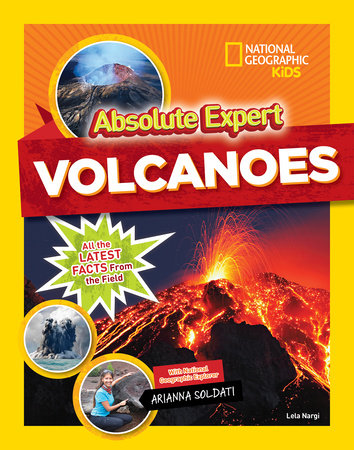
Absolute Expert: Volcanoes, by Lela Nargi and Arianna Soldati, (Aug. 2018, National Geographic Kids), $14.99, ISBN: 9781426331428
Ages 8-12
Volcanologist Arianna Soldati guides readers through a solid volume on volcanoes. Kids learn about ocean volcanoes, volcanoes in space, and deadliest eruptions (psst… Vesuvius isn’t #1!) The book explains plate tectonics and features a world map noting explosive volcanoes, and gives readers a heads-up on staying safe during a volcanic eruption, including an evacuation plan strategy exercise. Four “Get in the Flow!” sections provide activities that will take kids deeper; from building and cataloging a rock collection to creating a volcanic (soda) eruption of one’s own. Resources for further reading and an index finish up this book.
I buy all the volcano/natural disaster books I can get my hands on, because the schools here do a science unit on natural disasters, and the kids raid our libraries, usually heading for the volcano books first. I remember my first year as a librarian, hosting a class trip, and having the teacher ask me where those books were. I pointed out the shelf, and the kids swarmed me. TWO SHELVES. EMPTY. Since then, I don’t play games with my natural disaster books, and neither should you.
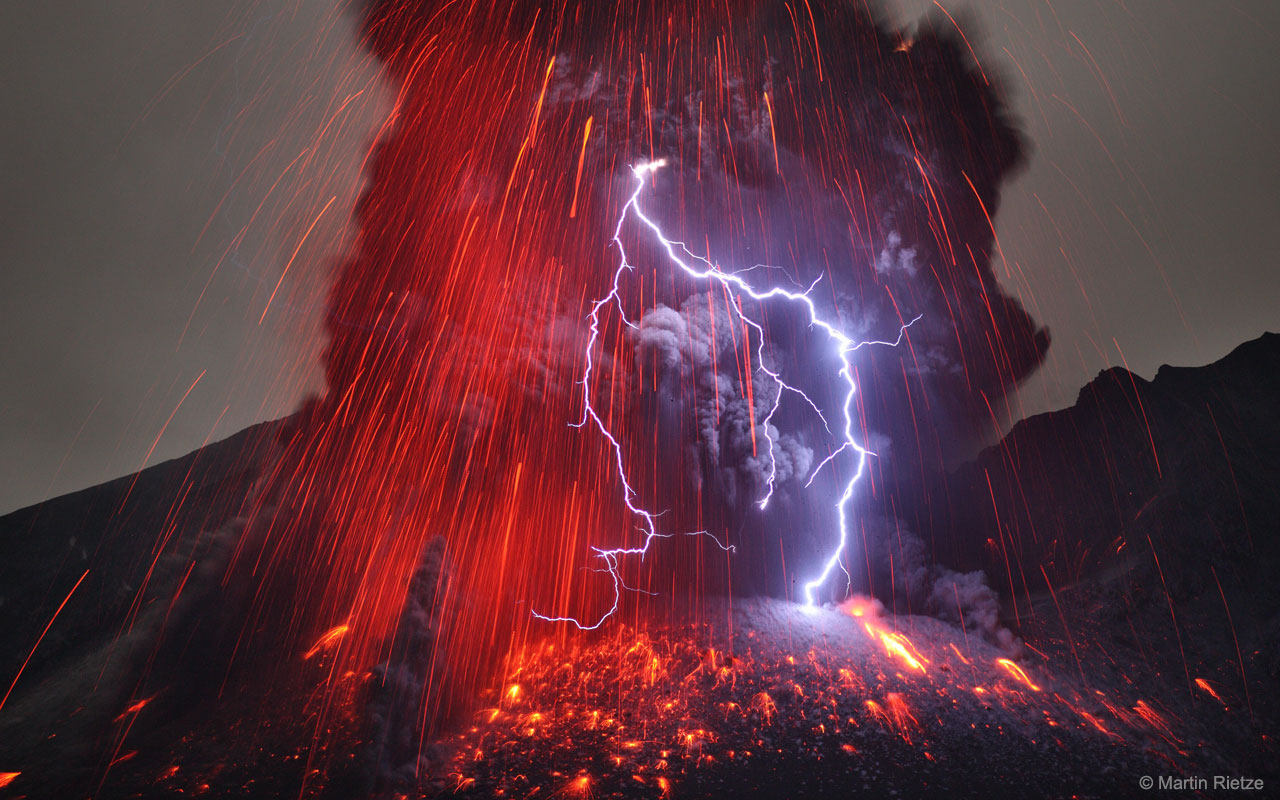
The writing is geared for middle grade to early middle school, with scientific terms that may send kids to the dictionaries (and good for that!) for new terms, while photos and illustrations provide a look at volcanoes in various stages of being, from quiet to very, very active. If seeing lightning hit a volcano spewing lava doesn’t inspire an awesome respect for nature, I don’t know what will.
Absolute Expert: Dinosaurs, by Steve Brusatte and Lela Nargi, (Aug. 2018, National Geographic Kids), $14.99, ISBN: 9781426331404
Ages 8-12
Paleontologist Steve Brusatte combines forces with author Lela Nargi to make dino EXPERTS out of readers. My favorite section? The little callout box that tries to unravel the mystery of T-Rex’s itty bitty arms. Turns out, they were incredibly strong, and have to have served some purpose, but what? We still don’t know, but there will be countless memes to entertain us until we do. There are details on some of the biggest and smallest dinosaurs; a dinosaur family tree that shows how dinosaurs evolved as history marched on, and a nice section dedicated to feathered dinosaurs, including the evolution of dinosaur feathers, with a picture of a fossilized archaeopteryx feather! Photos of fossils and dino digs make this a perfect volume for budding archaeologists, and beautiful illustrations help readers put faces to those bones they see in the museums. (Jurassic Park does a pretty good job of that, too, but the dinos are usually trying to eat people; this is much less threatening.) A world map spread points out where dino evidence has been found, worldwide, and four “Dig In” sections teach kids about dino tracking, offer quizzes, and invite kids to make their own dinosaur teeth and paleontologist field kits.
Do I even need to say this book is a given in your collections? It’s NatGeo, and it’s dinosaurs. Put this NatGeo dino page on your reference resources list of links: there are videos, activities, and games, and there’s a YouTube video playlist of nothing but dinosaurs! That is a program all by itself!
Absolute Expert: Dolphins, by Jennifer Swanson and Justine Jackson-Ricketts, (May 2018, National Geographic Kids), $14.99, ISBN: 9781426330100
Ages 8-12
Marine biologist Justine Jackson-Ricketts serves as the guide in this volume, taking readers deeper into the world of dolphins. A world map spread shows kids the waters where dolphins tend to spend their time. There are tips on becoming a dolphin trainer, what to do if one encounters a stranded animal, and important life lessons dolphins have to impart (“Thanks for the all the fish” is not one of them). As Justine Jackson-Ricketts’ research involves ecology, there’s substantial information on preservation and conservation of our waters and of our dolphins; the authors also shed some light onto the captivity debate. Four “Dolphin Deep Dive” sections help kids design a dolphin study, offers suggestions on how to move and like a dolphin, tests kids’ ability to find dolphin figures in everyday objects, and organize a beach clean-up. Resources for further reading and an index are included.
There are wonderful pictures of dolphins and orcas in here, sure to please animal fans and make some new ones. There are great call-out facts here – perfect for adding to projects and classroom/library displays, too! There’s good scientific writing that challenges readers, and some information on the National Geographic Pristine Seas Initiative; National Geographic’s commitment to explore and help save the last wild places in the ocean. This is a good site to keep in your reference links: there are videos taken on the Initiative’s expeditions, mission descriptions, and updated news events as they unfold. Conservation projects and ocean research projects can get a nice boost from this site.
Absolute Expert: Soccer, by Eric Zweig and Mark Geiger, (May 2018, National Geographic Kids), $14.99, ISBN: 9781426330087
Ages 8-12
Professional soccer referee Mark Geiger is here to talk soccer with author Eric Zweig. Conversation goes into supporting one’s team and the different ways fans around the world show their love, including the now-famous vuvuzela; soccer jargon and the 17 Laws of the Game. There are maps of the field and the positions’ places on the field, an explanation of the penalty cards, and a history of “the beautiful game”. A Soccer Around the World section celebrates the diversity of the game and its fans, and since this is a book on sports, there are World Cup numbers, results by nation, and a US map of MLS teams, for us Americans just getting on the soccer bandwagon. Facts and stats throughout give readers some extra street cred knowledge, and four “Get in the Game” activities encourage kids to make up their own game and offer quizzes. There are great photos and illustrations of soccer players and equipment through history, and there are callout biographies on major players throughout. The text is easily readable by middle grade and middle schoolers; this is a volume that soccer fans are going to love.
Check out the National Geographic World Cup 2018 website for vintage photos, World Cup facts, and articles on the science of sport. This 2014 National Geographic blog post, Why the World Cup is About More Than Soccer, puts into words how the sport brings people together, worldwide.
NatGeo, keeping it real for my nonfiction section.
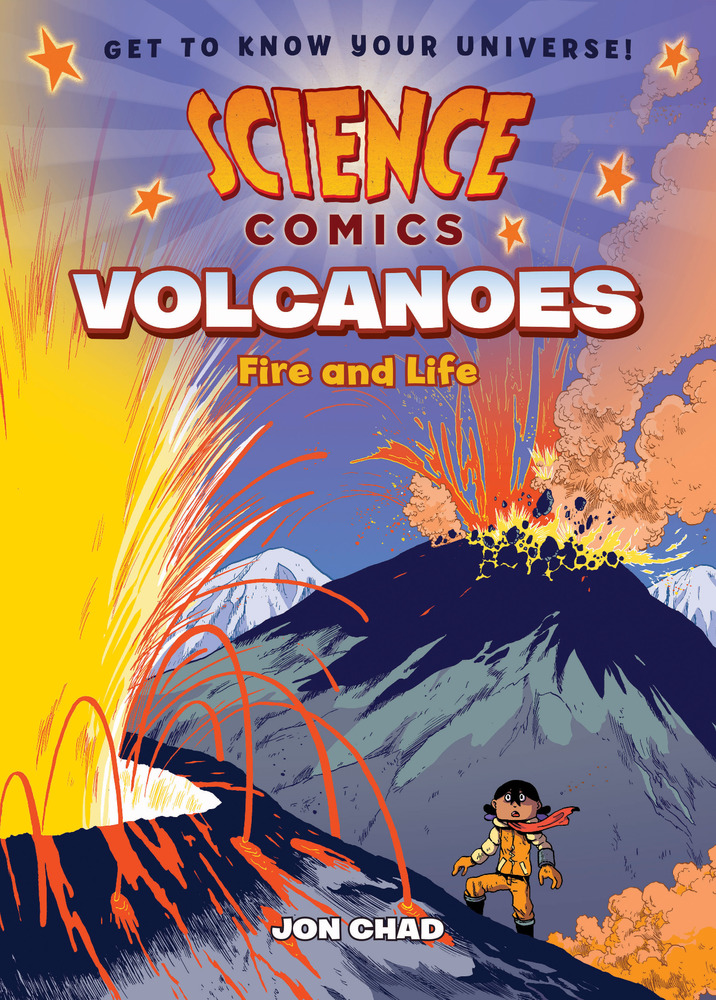
Science Comics: Volcanoes-Fire and Life, by Jon Chad, (Oct. 2016, First Second), $12.99, ISBN: 9781626723603
Recommended for ages 8-12
Earlier this year, we got a look at First Second’s two Science Comics, Coral Reefs and Dinosaurs. There’s great science and fun art wrapped up in each of these comics, so I was super-psyched when I met a First Second rep at the PLA Conference this year, and she told me that there were more Science Comics coming. True to her word, we’re getting Volcanoes in just a couple of weeks.
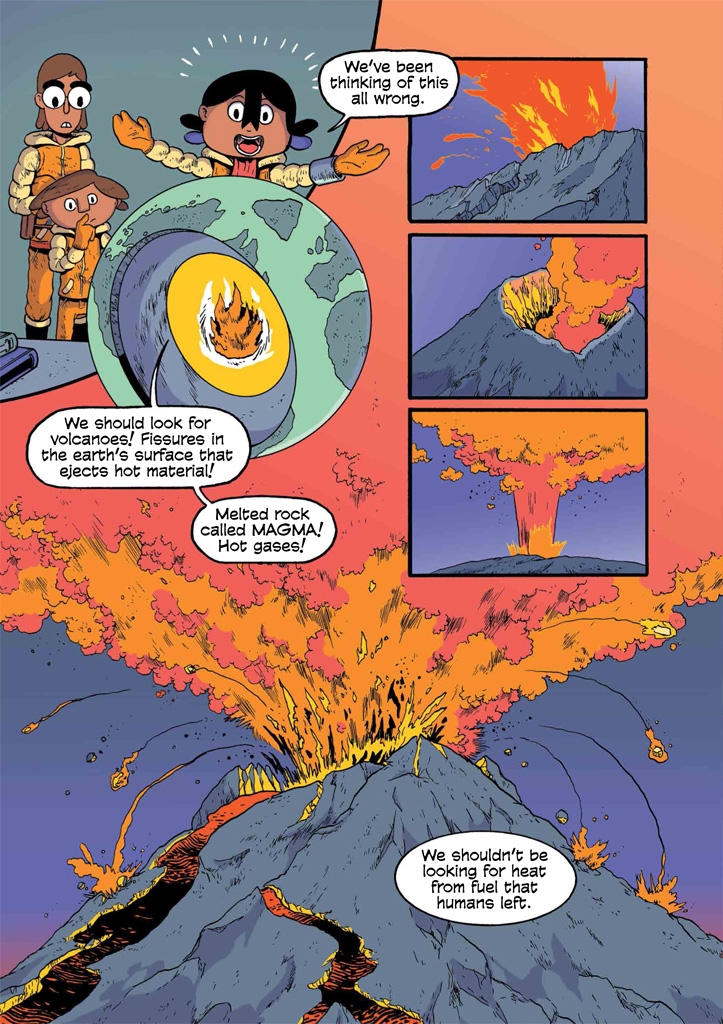
Similar to Coral Reefs, Volcanoes wraps information about volcanic activity into a story: there’s been some sort of environmental cataclysm, and Earth is freezing. A tribe is scanning books when Aurora, one of the kids, discovers a book about volcanoes; she is HOOKED. She’s saved her tribe! The power to warm the planet is right underneath their feet!
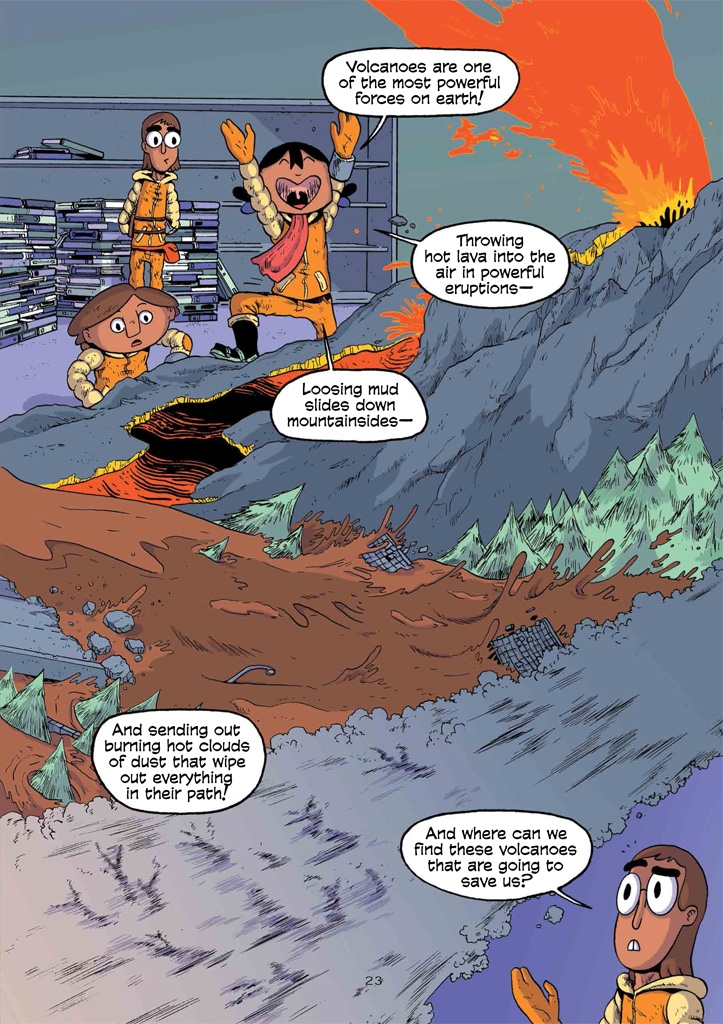
From there, Aurora becomes the reader’s guide through a look into the activity bubbling under the earth’s crust: there are magma vents, shifting tectonic plates, and volcanic eruptions. Volcanoes create just as much as they destroy: there are entire land masses that owe their existence to a volcanic eruption, just as there are entire cities that have been wiped out by them.
I’m very happy with the Science Comics I have at my library. The kids love them, and they appreciate the graphic representation and sequential paneling of information. The diagrams are vibrant, with comic book art adding some fun and easily memorable background information to the mix. I have a nicely developing nonfiction display full of comics, and the kids at my library love volcanoes and natural disaster books, so I’ll be booktalking this one, expounding on the joy of comic books.
Go mix up some papier mâche for your volcano project, and enjoy Volcanoes: Fire and Life.
 Rhinos in Nebraska, by Alison Pearce Stevens/Illustrated by Matt Huynh, (July 2021, Henry Holt & Company), $19.99, ISBN: 9781250266576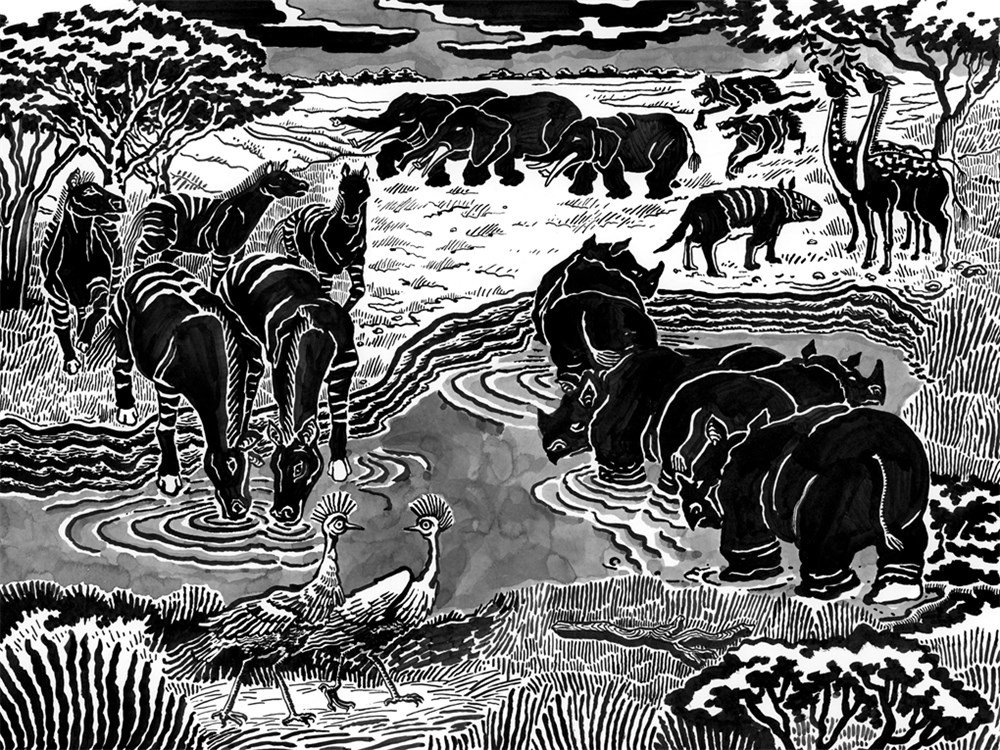




 Mom Read It