Posted in Preschool Reads, Toddler Reads

Book Review: If You’re a Monster and You Know It, by Rebecca & Ed Emberley (Orchard Books, 2010)

If-You-re-a-Monster-and-You-Know-It-9780545218290Recommended for ages 2-5

The classic song “If You’re Happy and You Know It” gets a monster makeover from Rebecca Emberley and her father, Caldecott Award winner Ed Emberley.

Caregivers have taught toddlers and preschoolers that song, “If You’re Happy and You Know It”, for years. Rebecca and Ed Emberley put a fun, new spin on a familiar song by incorporating monsters, with all of the snorts, growls, wiggles and roars that go with them. Most children will be familiar with the tune, so slotting in new, fun, silly words and actions will be easy and exciting. The neon-bright, digitally created monsters pop off the black page backgrounds, appearing to almost pop off the page. The story font is a bright green for easy reading, but small and almost comic-like in appearance. The action words – stomp, snort, growl, wiggle, roar – are large, brightly colored, and appear to be digitally rendered along with the rest of the artwork, providing an easy prompt for children to take action.


This would be a great interactive read-aloud for toddlers and preschoolers alike, especially for a fun Halloween storytime. There could be a mask-making workshop before the storytime, where participants can color in blank printouts and create their own monsters that will stomp and roar and twitch their tails during the reading. Ed Emberley’s website offers printable mask activities and other October activities that would work with a Halloween read-aloud. There are many fingerplays and songs to be sung during a Halloween storytime; plus, the book comes with a link to a free, downloadable version of the song from the Scholastic website that can be played for a full-on monster dance party.

The authors have further resources on their websites (http://www.rebeccaemberley.com/, http://www.edemberley.com/pages/main.aspx) for more printable, downloadable activities.

The book has received several accolades, including nomination for the Grand Canyon Reader Award and the Building Block Picture Book Award, and designation as an IRA Children’s Choice.

Posted in Preschool Reads, Toddler Reads

Book Review: In the Small, Small Pond by Denise Fleming (Henry Holt & Company, 1993)

In-the-Small-Small-Pond-9780805059830Recommended for ages 2-4

Denise Fleming’s In the Small, Small Pond gives readers get a glimpse of life among the animals living in a small pond as the seasons change. A child – who could be either a boy or a girl – watches life in a small pond change throughout the seasons. Beginning in the spring, tadpoles wiggle and jiggle and baby geese waddle and wade; as the seasons progress, we see turtles doze, minnows scatter, muskrats stack, and finally, a frog – a presence throughout the book – burrow under the mud as winter sets in, waiting for spring.

The artwork uses color to take readers through the seasons: the bright greens and yellows of spring, the blue and green laziness of a hot summer day, the brown and yellow of fall setting in,  and the cool blues and whites of the winter. Ms. Fleming gives life to her story by using collages created by poured cotton pulp through hand-cut stencils onto handmade paper, giving her illustrations a beautiful, handmade feel that will attract the attention of children and adult audiences. The rhythm of the rhyming text will appeal to young readers. The text is bold and black, with few words to a page; more often than not, the text blends with the background, but this is a book meant to be read-aloud; this will not be a distraction to participants. This is a companion book to the author’s In The Tall, Tall Grass, which uses the same type of artwork and storytelling.

In the Small, Small Pond received Caldecott Honors in 1994 and a Child Study Children’s Book Committee award in 1995.

The book would be a great addition to a read-aloud on seasons or it can be part of a read-aloud on pond life: frogs, birds, fish, or turtles, for instance. There are many ideas on seasonal read-alouds and read-alouds related to pond animals on the Web that can be used for free. The author’s website offers a printable “finish the picture” coloring page where children can create their own pond scene, and there is also a match-up game for older audiences where the children match the animal with the verb (i.e., geese waddle, turtles doze).

Posted in Preschool Reads, Toddler Reads

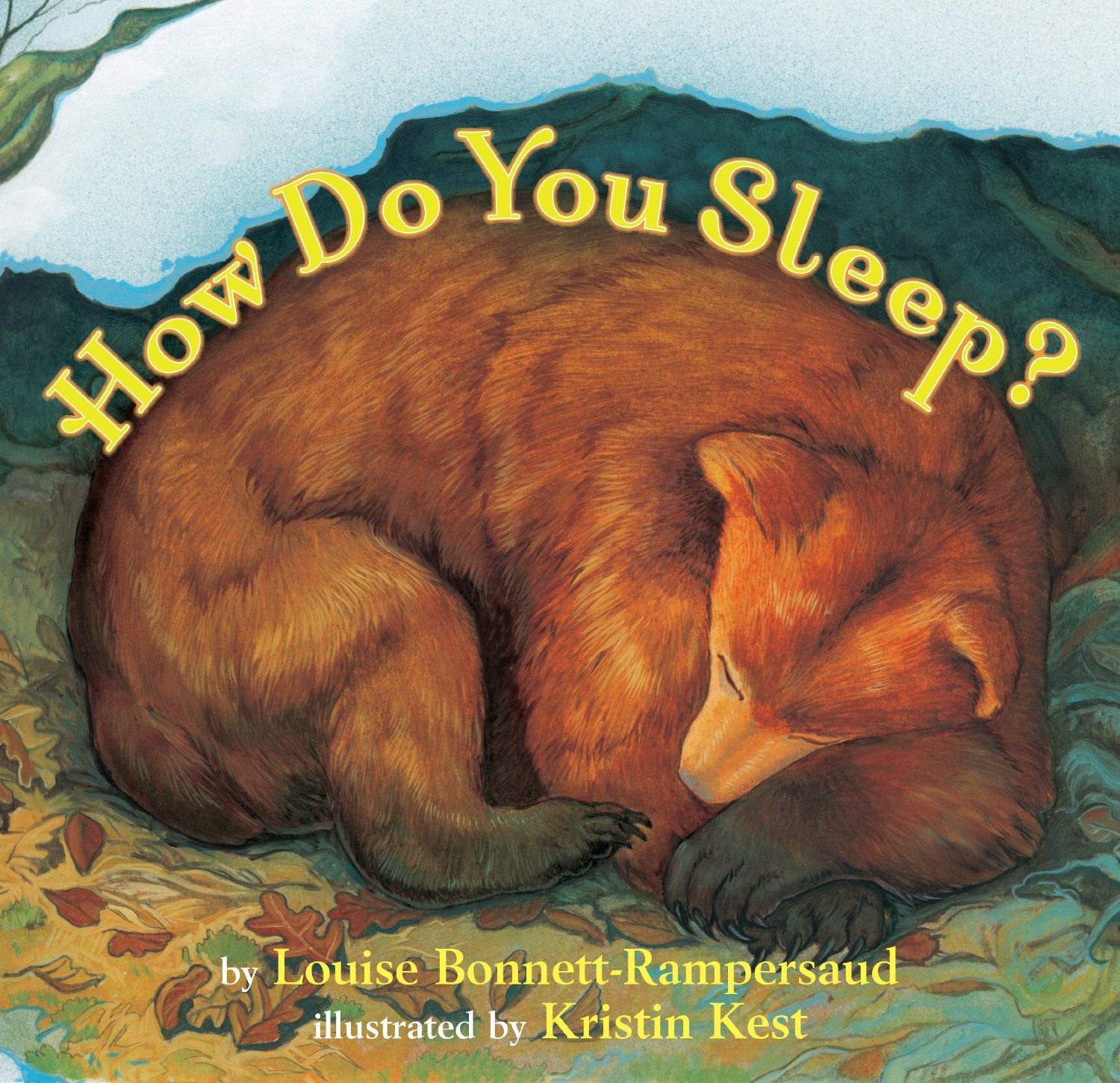
Book Review: How Do You Sleep, by Louise Bonnet-Rampersaud (Marshall Cavendish Children, 2005)

how do you sleepRecommended for ages 2-4

Different animals answer the question of how they sleep in rhyme. Children conclude the story by describing how they sleep.

This is a rhyming story about how different creatures sleep, ranging from birds to frogs to human children. The pace is soothing and repetitive: one spread asks the question, “How do you sleep?” and a different animal answers on the next. The realistic pictures of animals (and children) are rendered in oil paintings, and makes for a read-aloud that will keep viewers and listeners interested with the large and small details: the flowers on the branches where a bird sits; the mouse sitting on a bell hook in the pig sty; the cozy bed the children sit in, listening to their father read them a bedtime story. The font is a larger version of a standard one, similar to Times Roman, but it does not need to capture the reader here – the story is in the pictures.  There is a board book version of this available for younger audiences.

This is a great story to build on for a bedtime read-aloud. Encourage audiences to wear their favorite pajamas and bring a beloved toy. There are bedtime songs like Twinkle Twinkle Little Star and Star Light, Star Bright that would work well here.

The author does not appear to have her own website, but her publisher offers a link to her other book and offers the chance to sign up for updates.

Posted in Preschool Reads, Toddler Reads

Book Review: Is Everyone Ready for Fun? by Jan Thomas (Beach Lane Books, 2011)

is everyone ready for funRecommended for ages 2-5

A group of rowdy cows want to have fun on a chicken’s sofa. The chicken does not share their enthusiasm.

The repetitive story follows three cows who want to have fun – jumping, dancing, wiggling fun – on Chicken’s sofa. Chicken is not at all happy about this. Reminiscent of another Jan Thomas’ story, “What Will Fat Cat Sit On?”, the cartoon illustrations use exaggerated expressions for the cows and the Chicken. The colors are bright but not overwhelming; the page backgrounds are either bright blue, green, or lime green, and the characters are boldly outlined in black. The story begins and ends with the endpapers, and Thomas uses the margins to denote offscreen action, most notably when the Chicken’s head appears to look in on the madness. Communicated in speech bubbles, the text allows young readers and listeners to imagine different voices for each of the speakers – and allows the storytime reader to affect different voices during the reading.

The book allows for a great deal of interactivity and falls into a comfortable pattern that younger readers and listeners can catch on to right away. The title phrase – “Is everyone ready for fun?” begins the series, followed by the Chicken’s protest, the cows’ latest attack on the sofa, and the Chicken’s growing aggravation. Storytime participants can get up and jump, dance, and wiggle along.

The author’s website offers links to other books and printable activities, several of which include recognizable characters from Is Everyone Ready for Fun? The activities can enhance a storytime, as can farm animal-related songs and fingerplays.

Posted in Toddler Reads

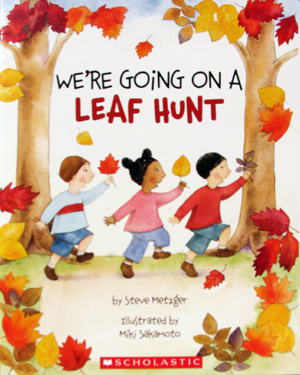
Book Review: We’re Going on a Leaf Hunt, by Steve Metzger/illus. by Miki Sakamoto (Scholastic, 2008)

leaf huntRecommended for ages 2-5

A group of friends goes on a leaf hunt, which leads them on adventures over a mountain, through a forest, around a waterfall, and across a lake.

I have a special place in my heart for this book; it was one of my son’s favorite books, because of its repetitive interactivity. The story follows a group of friends on a leaf hunt. They state their beginning intention – “We’re going on a leaf hunt. We’re going right away. Let’s find colorful leaves. It’s a wonderful day!”. The group’s arrival at each point – a mountain, a forest, a waterfall, and a lake – comes is accompanied by a repetitive phrase (“climb, climb, huff puff. We made it!”). They collect leaves from a different tree at each spot, and when they return, they revisit these areas, arriving home ready to jump and play. It makes for a fun read-aloud, where children can echo the repeated phrase and act out the group’s actions (climbing a mountain, crossing a lake).

The artwork appears to be watercolor, with lively reds, browns and yellows to create a beautiful fall day. The story font is mostly brown and bold, but words with emphasis receive a different treatment: the world “colorful” is spelled out with different fall colors; the names of the trees are bright orange, and water-related words are blue.

There are many websites available that offer printouts of different leaves that children can color for a fun, seasonal craft. There are also many seasonal and Fall-related songs and fingerplays.

The author’s website offers links to all of his books, with printables related to some of his books.

Posted in Toddler Reads

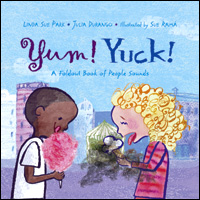
Book Review: Yum! Yuck! A Foldout Book of People Sounds, by Linda Sue Park and Julia Durango/Illustrated by Sue Rama (Charlesbridge Publishing, 2005)

yum yuck

Recommended for ages 0-4

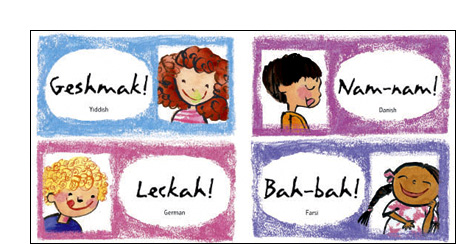
There are a lot of different people speaking different languages, but we all make the same sounds. Yum! Yuck! helps English speakers pronounce words for popular sounds from languages like Farsi, Yiddish, Korean, Chinese and Spanish. Sounds in different languages are presented on a two-page spread, with a lift-the-flap revealing the English version of the sound.

Toddlers and preschoolers will enjoy Yum! Yuck!’s  cartoon artwork. The children’s multicultural children’s faces are expressive and the expressions are written in large, bold handwriting font with its language written in an Arial-type font directly underneath. Large lift the flaps will appeal to little hands.

This book also sets the stage for a fun stoytime, whether at home or in the library. Storytime leaders can encourage speakers of other languages to share their expressions and to think of some that didn’t make it into the book – how do you say “Mommy” or “Daddy” in your language?

Fun craft ideas: Create your own “Yum! Yuck!” artwork using your child’s photo next to an expression in another language and color in the background.

Linda Sue Park’s author website offers more extras for older readers, but there are some links and a “Who Am I?” game for their younger children.

yum yuck interior

Posted in Toddler Reads

Book Review: A Truck Goes Rattley-Bumpa, by Jonathan London/Illustrated by Denis Roche (Henry Holt, 2005)

truck goes rattley bumpaRecommended for ages 0-4

Trucks come in all shapes and sizes. Readers learn about different types of trucks – what they carry, what sounds they make, what colors they can be – as a family of three gets ready to move into a new house.

A Truck Goes Rattley-Bumpa’s gouache artwork and brief, rhyming text will appeal to young readers and would work well for storytime. Truck and car books are always popular, and there are many storytime songs, fingerplays and crafts that can work with this book. The author, Jonathan London, is also the author of the popular Froggy book series.