I am an unabashed fan of NatGeo for my nonfiction sections. They have books on EVERYTHING, and the kids love it. They also make every single thing they cover amazing, hilarious, or both, which makes my life a lot easier when I have kids trudging into my children’s room, moaning that they have to read more nonfiction. Excuse me, do you see the GIANT WATER FAUCET on the cover of this book? Guess what? Nonfiction. Suddenly, they’re a lot more amenable to what I have to offer.
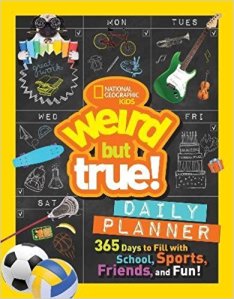 Let’s start with the backpack essential: The Weird But True Planner ($12.99, ISBN: 978-1426327933). The Weird But True books come in second only to the NatGeo Kids joke books when it comes to demand in my children’s room. It’s got the planner essentials: it’s spiral bound and sturdy, so kids can use it and it will hold up. It’s got paper that won’t tear when you turn a page. You know that paper; it’s usually the one that flies away and has the details of your homework on it. The space is smartly laid out, with NatGeo’s trademark gorgeous photos sharing space with planning and goal pages that help your kids keep it together during the school year. And because it’s NatGeo, it’s got the fun, weird holidays, crazy facts, pages for scribbling areas where you need homework help, little writing prompts, and an overall fun vibe that demands you embrace your weirdness. I have a copy that I desperately want to keep for my own library notes, programs, and scheduling the lives of my weird family; now, the key is making sure the kids don’t take mine off my desk at work OR at home.
Let’s be clear: this is not a library book; it’s a book meant to be written in, used, and yeah, even a little abused. But it IS an essential buy.
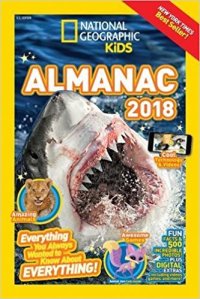
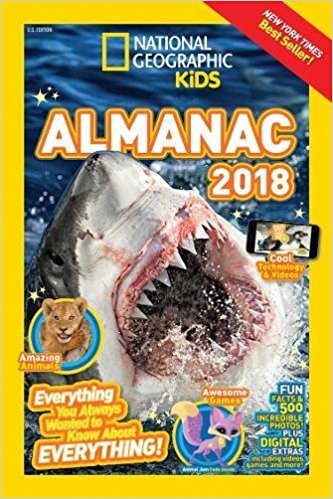
Next up is the NatGeo Kids 2018 Almanac ($14.99, ISBN: 978-1-4263-2772-8). Updated for 2018, this is another go-to for my library kids. There are 12 sections – up from last year’s 10 – and cover current events, life science, engineering and technology, space and earth, and more. The fun and games section is still here, and the overall fun spirit of discovery runs through the book. A spread in life science tells readers “18 Fantastic Facts About Fungi”, with facts about cheese mold, to mushrooms, to athlete’s foot (it’s just a photo of a bare foot). Feel bad for the Ugly Food, but rejoice in reading how being ugly doesn’t mean being garbage – make banana bread with those brown bananas (that’s when they’re the best), or make a smoothie using that bruised peach. A companion page on the time it takes different types of trash to decompose is a powerful call to action for recycling and re-purposing our trash. Homework help tips, quizzes, jokes, fun facts, and breathtaking photos make this Almanac a keeper.
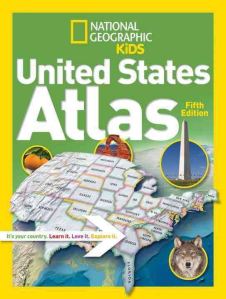
Atlases are always handy to have around, especially with increased importance on understanding global affairs and cultures.
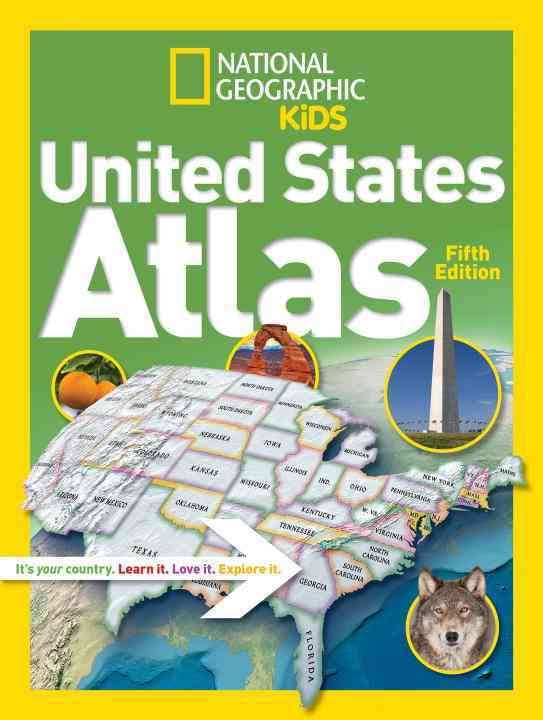
The United States Atlas (Fifth Edition, $12.99, ISBN: 978-1-4263-2831-2) gives readers a literal lay of the land, with political and physical maps by territory: Northeast, Southeast, Midwest, Southwest, and West. There are maps and statistics for each state within the territories; economy symbols to illustrate local economies like crops and industries. Photos and infographics round out each state’s profile. The atlas also includes U.S. territories, a glossary, postal abbreviations, and additional web resources.
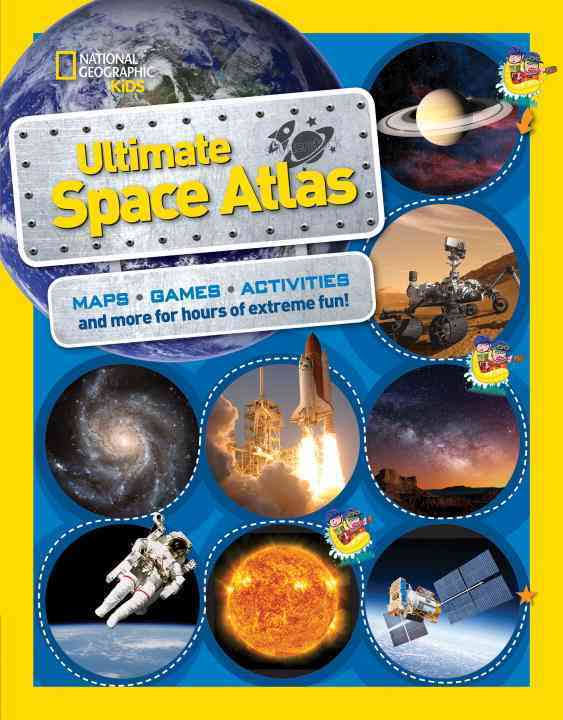
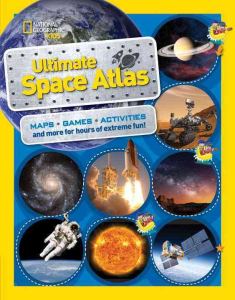 The Ultimate Space Atlas
 ($12.99, ISBN: 978-1-4263-2802-2) is a handy guide to what’s “up there”: phases of the moon, seasonal constellation maps for each hemisphere, what’s new in space exploration. “Digital Traveler” boxes help readers expand their learning by using going online. There are fun facts, amazing photos, diagrams, and Space Travel Attractions to visit… you know, from here. Earth. There’s a section with some fun activities at the end, and a glossary and index complete this handy astronomy desk reference. Both atlases will be helfpul during the school year, so load up your bookshelves if you’re in a library, or consider these when you’re buying school supplies.
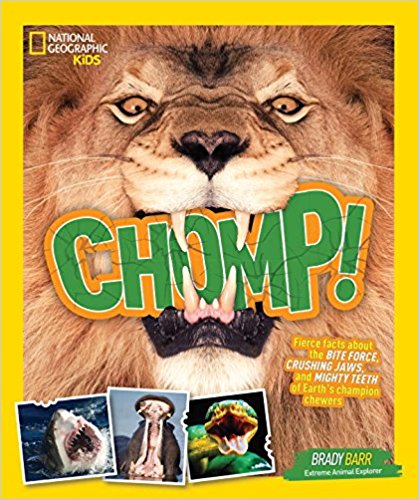
C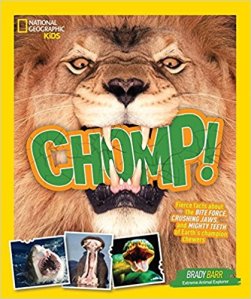 HOMP!: Fierce Facts About the Bite Force, Crushing Jaws, and Mighty Teeth of Earth’s Champion Chewers
 ($12.99, ISBN: 978-1-4263-2839-8) has been on my shelves since this summer, and I see it wandering around the tables at the library (meaning, the kids are reading it while they’re in the library during the day) pretty regularly. Written by “Extreme Animal Explorer” Brady Barr, CHOMP! has a lot of pictures of a lot of big, mean teeth. The first page has a hippo, jaws open wide, greeting readers, and those choppers are intimidating! Barr organizes his chompers into four groups: the grippers, slicers, crushers, and gulpers; bite force and preferred menu for each animal profiled appear on each page. Barr jumps in with his own entertaining anecdotes, Brady’s Bite Stories, that will make kids squeal and cringe all at once; I’m thinking of reading the one about Barr squeezing a live otter out of a gator the next time I have a class visit. I like to be memorable. Further resources, a glossary and an index, make this a good companion guide for animal reports and fun reading for animal fans.
Last but never least,
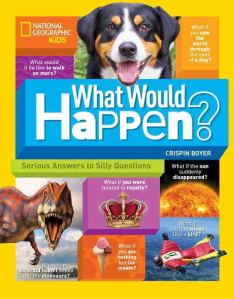
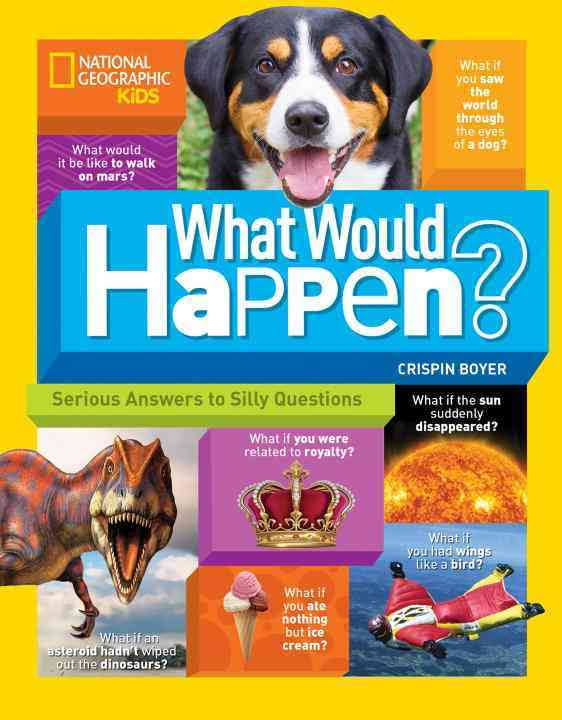
What Would Happen? Serious Answers to Silly Questions ($14.99, ISBN: 978-1-4263-2770-4) looks at the logic and science behind some wild, weird questions. Starting with questions like, “What if you ate nothing but ice cream?” (short answer: DON’T) and working their way up to “What if you could wield The Force?” (You may call me Lady Vader), questions are organized into areas covering humans, space, nature, time, technology, natural wonders, worst-case scenarios, and just plain surreal. Each question is examined by giving readers a background on the deeper question (ice cream tastes great, but without protein and fiber, you’re in for some problems); primary repercussions (those problems could include going to the bathroom, no matter how much you love butter pecan); side effects (you’ll get weak and possibly develop scurvy from lack of Vitamin C); and finally, could it happen (unless you’re putting chunks of chicken or tofu, plus some broccoli and tomato on that ice cream, probably not)? This is going to move right along with my Weird Facts books. Heck, I may just turn this one into a program – write your own
What Would Happen? and let’s swap; research it and find out the answer. But I’m totally developing The Force.
Go forth and fill up backpacks, and have a great school year!
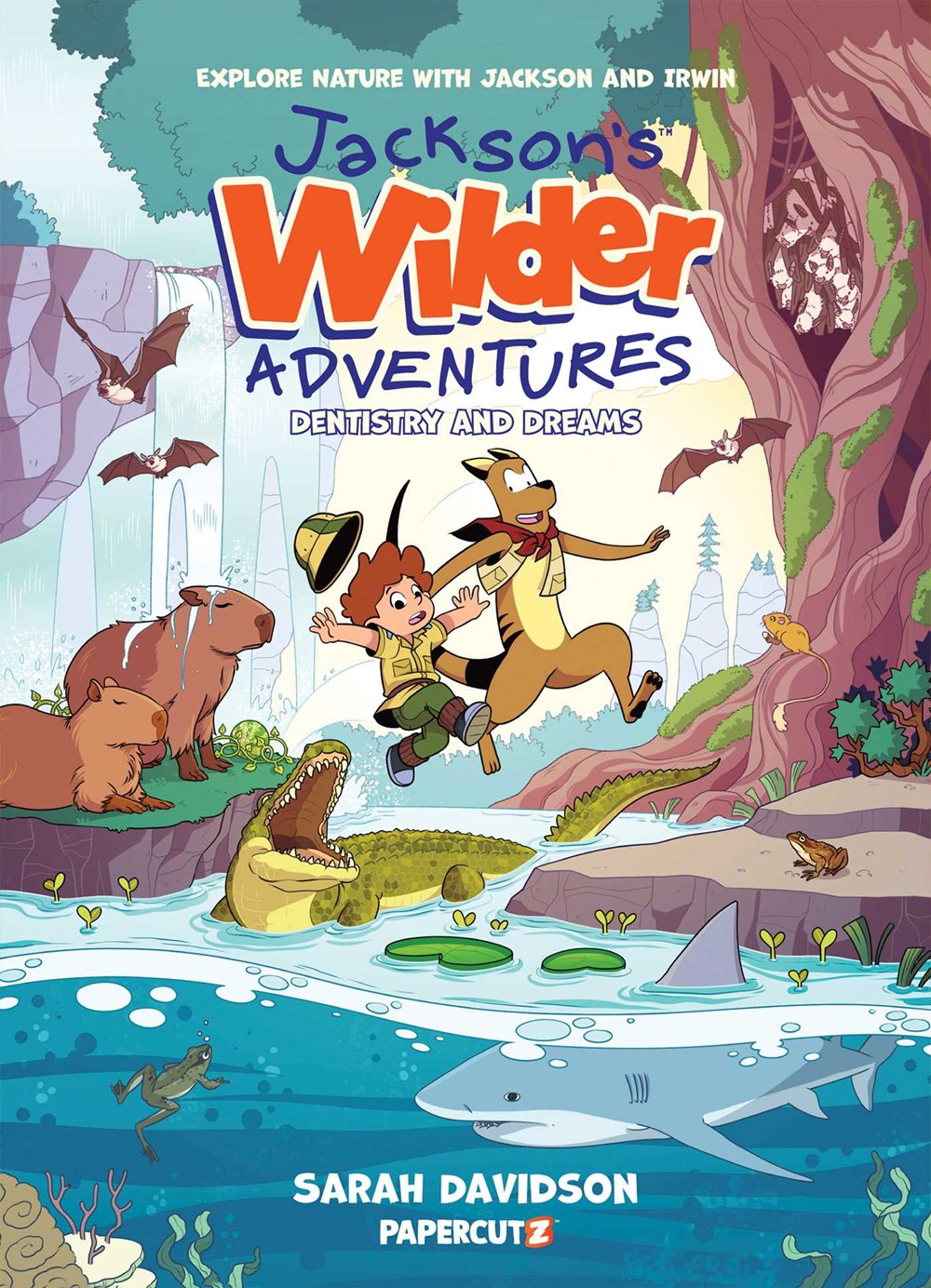 Jackson’s Wilder Adventures Vol. 2: Dentistry and Dreams, by Sarah Davidson, (June 2025, Papercutz), $9.99, ISBN: 9781545818350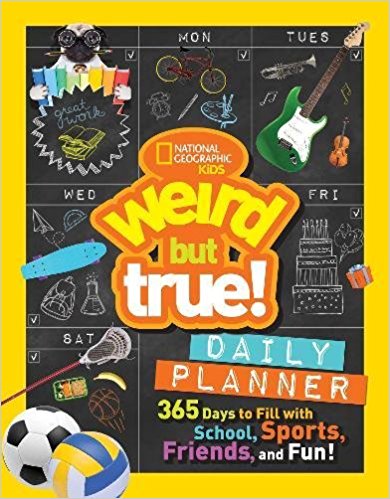


 Mom Read It