Posted in Post-apocalyptic/Dystopian, Science Fiction, Tween Reads

Book Review: The Hunger Games, by Suzanne Collins (Scholastic, 2008)

Recommended for ages 12+
Welcome to Panem, the post-apocalyptic United States of America, divided into the Capitol and 12 districts. Every year, two “tributes” between the ages of 12 and 18 are selected from each district to take part in a brutal contest called The Hunger Games, where they fight to the death. There is only one winner. Sixteen-year old Katniss volunteers to her district’s tribute after her 12-year old sister’s name is drawn.

The Hunger Games is the brutal version of a reality game show – think of Stephen King’s (written as Richard Bachman) novel, The Running Man and you’ll have a good frame of reference. The tributes are given mentors – former winners, condemned to preparing future tributes for the games – and stylists to make them look good. The contestants have to project personality in the week of interviews and preparation so that they have a chance at receiving help from sponsors, who can send food, medicine, and supplies to their contestants during the games. The games are televised for all the districts to watch. Katniss struggles to keep her humanity in the midst of the game and rails against being the Capitol’s pawn.

The book moves at a breathtaking pace with an intensity that starts mere pages in and doesn’t let up until the book’s end. The main characters have a good base for character development that will likely continue in the two following books in the series, Catching Fire and Mockingjay; the others are as developed as they need to be in order to further the story and keep the pace. Ms. Collins makes her point about valuing bloodsport over humanity as eloquently as she is brutal in several key scenes in the book. With a strong mix of violence and compassion, boys and girls have both seized on this series and catapulted it to the top of their reading lists. Katniss emerges as a heroine not only for her strength but her ability to retain her sense of self in the middle of the games. She is a complex, conflicted heroine who resonates with ‘tweens and teens alike.

The Hunger Games has won multiple awards and honors. It is a New York Times and Wall Street Journal besteller, and was one of Kirkus and School Library Journal‘s Best Books of 2008. It is an Americna Library Association (ALA) Notable Children’s Book and one of the Young Adult Library Services Association’s (YALSA) Teens Top Ten for 2009. Lionsgate Studios will release a movie based on the book in March of 2012.

A comprehensive wiki exists for the series and the author’s website offers author and book information. There are many teacher’s resources for teaching the series available on the Web, including Scholastic’s and Hunger Games Lessons.
Posted in Post-apocalyptic/Dystopian, Science Fiction, Tween Reads

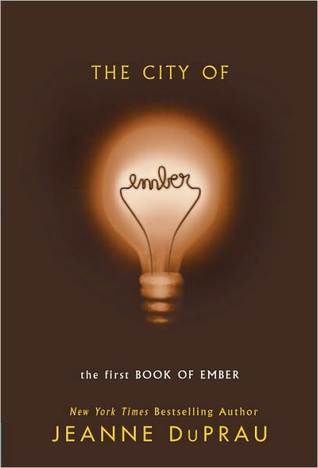
Book Review: The City of Ember, by Jeanne DuPrau (Yearling, 2004)

Recommended for ages 9-12
A post-apocalyptic novel, The City of Ember begins with The Builders, who created an underground city that would save humankind from an assumed environmental catastrophe. The city was to last for 220 years, at which time they hoped it would be okay to return to the surface. They created Instructions to leave Ember, which they gave to the Mayor, to be passed down to every Mayor until it was time; the box containing the Instructions would then open.

The box was lost after the seventh Mayor tried to force the box open.

In the year 241, the City of Ember is failing. They are running out of food and supplies and there are rolling blackouts that last for longer stretches each time. There are whispers that the generator is failing. Because the population of Ember does not know their above-ground origins, they do not know that there is another choice. Lina and Doon, two 12-year old residents of Ember, learn about some of Ember’s secrets, like the stores of food available to those who know the “right people”. Lina also happens upon a document long hidden in her grandmother’s closet; torn into shreds by her baby sister, she tries to unravel the mystery and thinks she has happened upon a way to leave Ember. Will anyone other than Doon believe her, or will the Mayor and the police try to keep them quiet?

The book tells an intelligent story with fairly well-drawn characters. Ms. DuPrau does not speak down to her audience, but I do wish she had fleshed out the characters a bit more; the Mayor, for instance, is the typical bloated, corrupt politician; Lina’s grandmother’s memory is slipping away, but she remembers that there is something lost that she must find before she dies; the police are one-dimensional, just-following-orders good/bad guys. The overall story, however, is solid and compelling – what happens to a society if their lights go out for good?

The City of Ember is the first in the Books of Ember series and was made into a movie in 2008. Designated as an American Library Association (ALA) Notable book, the book has received Kirkus Editors Choice status and was awarded the 2006 Mark Twain Readers Award. The author’s website offers information on all of Ms. DuPrau’s books, a biography, and an FAQ. The site also offers the chance for visitors to solve a puzzle similar to the document in City of Ember.

Posted in Adventure, Realistic Fiction, Tween Reads

Book Review: Hatchet, by Gary Paulsen (Aladdin, 1987)

Recommended for ages 10-13

Hatchet is a Newbery Award-winning survival novel by Gary Paulsen. The book tells 13-year old Brian’s story of survival in the Canadian woods after the pilot of the plane he’s in has a heart attack and dies at the controls; Brian alone must figure out how to get the plane down and how to survive until help comes – if it comes.

He spends the summer learning how to survive and adapting to his new environment, starting out with only the hatchet his mother gave him when he left. He learns how to identify edible plants, how to hunt and trap animals, and how to cook them; he can make simple tools and fashion a shelter for himself. When he finds hiself with time to think he is consumed with thoughts of his parent’s divorce and his mother’s role in it.

Brian’s story of survival, and the subplot of his parent’s divorce – in the background, but always there – make this a very readable book for boys and girls alike. While the main character is a boy, the struggle to survive and the feelings he finds himself confronted with, told with urgency, make this a page-turner that communicates emotions all tweens and teens can relate to.

Hatchet is the first in Brian’s Saga, a series of books about Brian Robeson written by Gary Paulsen. The author’s Random House site  has information about the other books, with excerpts and teachers’ guides. The book was made into a movie, A Cry in the Wild, in 1990 and is available on DVD. The book has received numerous awards and honor in addition to the Newbery, including designation as an American Library Association (ALA) Notable Book (1987) and a Booklist Editor’s Choice Citation (1988).

There are a wealth of discussion materials for the book available online. Scholastic offers a free lesson plan and unit plan on teaching imagery with Gary Paulsen; Literature Index offers free PowerPoint presentation, clip art, and templates; and BookRags offers a study guide.

Posted in History, Non-Fiction, Tween Reads

Book Review: Little House in the Big Woods, by Laura Ingalls Wilder (HarperCollins, 1971)

Recommended for ages 8+

Most people know Laura Ingalls Wilder’s stories, if not through her books, then through the long-running television series, Little House on the Prairie. A a pioneer child who wrote down her experiences and later had them published, Ms. Wilder wrote nine Little House books, originally published between 1932 and 1943. The series resonated with girls and young women and is popular to this day.

Little House in the Big Woods is the first book in the Little House series, and introduces the reader to the Ingalls family: Laura, her older sister, Mary, baby sister, Carrie, and parents, Ma and Pa (Caroline and Charles). The family lives in the Big Woods in Wisconsin in the later part of the 19th Century, shortly after the Civil War. (Laura even mentions a family member who is “wild since he came back from the army”.)

We go through each of the seasons with the Ingalls family and learn how families lived, ate, and had fun. There are family dances and visits, trips to town, and encounters with bears and bees. There is always time for work, though, and this is where the book acts as a primer. Laura details the process of preserving meats and vegetables to keep the family fed through the lean winter months; how Pa prepares an animal skin to be used as leather goods; how to get sap from a tree, and how to smoke bees out of a hive to be able to get to the honey. It’s a fascinating look at a different time, and while it is written with a girl’s voice, this is should not be considered a “girl’s book”: boys and girls alike can learn much about the wildnerness life.

Laura writes in a clear voice, drawing her readers in because her stories are real. The love of family and nostalgia as she looks back on her life bring to mind the feeling a child gets when listening to a parent or grandparent talking about their childhood. Black and white drawings by Garth Williams add to the book.

There is a wealth of information about Laura Ingalls Wilder online. Wilder’s home in Rocky Ridge Farm in Mansfield, Missouri, where she wrote the Little House books, is now the Laura Ingalls Wilder Historic Home and Museum and word finds, quizzes and coloring pages. The Little House Books website features a family tree tracking the girls of the Little House series from Laura’s great-grandmother to her daughter, Rose. The site also offers games and craft ideas, as well as information for teachers interested in teaching the book.

Posted in Middle School, Post-apocalyptic/Dystopian, Science Fiction, Tween Reads

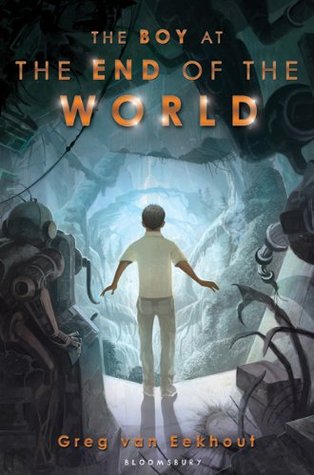
Book Review: The Boy at the End of the World, by Greg Van Eekhout (Bloomsbury Children’s Books, 2011)

Recommended for ages 9-12

A preteen boy (we are led to guess), wakes up in a pod in a devastated shelter. Destruction lies all around him; he sees being similar to himself lying dead in pods similar to his. The only other functional being is a robot, who calls out to him. The boy runs, but the robot catches up to him and reveals the boy’s name, Fisher, to him. Fisher learns that he is the only survivor of the human race.

It’s the usual post-apocalyptic story: Humans ruined the earth and nature took back her planet. Humans genetically engineered animals and more humans, putting them in gel-filled pods, with robots to oversee their care, until the time when conditions allowed for them to awake and rebuild society. The humans were individually programmed with specific survival skills to help create communities. Fisher is programmed to be a fisherman. Click, the name he gives his robot companion, tells Fisher that he has been tasked with helping Fisher “continue existing”, and the two set off to search for more humans in another Ark – the facilities were humans and animals were engineered and kept in hibernation.

Born a blank slate, Fisher learns and adapts through the story’s progression, developing not only intelligence outside of his initial programming but emotional depth. The characters they meet are not cute and cuddly woodland creatures: they’re often chilling. There are groundhogs who blame humanity for the planet’s destruction and hold a grudge; there is a robot who takes his task of preserving the human race  permanently – these characters bring a new dimension to the story of a boy and his robot. This is a survivalist tale.

It is difficult to write a postapocalyptic tale without sounding like hundreds of similar books on the market, and the “humans and technology bad, nature good” call to action beats the reader over the head throughout the book. Humans bring the planet to the brink of environmental collapse, so they leave the rest of the planet to deal with it while they go into hiding until the coast is clear. The technology that humans created to save them ultimately turns on them and brings the race to the point of near-extinction, further painting us as hapless ne’er do wells.

That said, the YA market in post-apocalyptic fiction isn’t as saturated as the adult market is yet, so perhaps a younger audience will read this story through different eyes. That said, this is a generation that has been fed this storyline since they were babies: think of Happy Feet, a movie that deceptively sold us a cute story about a penguin who didn’t fit in, and gave us a Greenpeace horror movie halfway through the picture. Think of Wall-E, where we were drowning our society in junk, so we had to go into space to get away from it.

I don’t want it to sound like I didn’t like this book, because I did. I think older middle grade readers, starting with 10-11 year olds, will see Fisher as a hero they can identify with as a young boy who needs to learn to survive, and whose robot companion acts as a friend and parent. Kids can also relate to the marriage of technology and environmental awareness contained in the book’s message.

Greg Van Eekhout knows how to write for kids – he has a Masters in Education and spent ten years developing online curricula for K-12 and college students. He is kid- and teacher-accessible, offering teachers tips on having author events at schools (and libraries), and providing his e-mail address to be contacted about school visits. He offers two presentations that he follows in his appearances. His website is geared toward grownups who are interested in reading his reviews, about his books, and where he’ll be next.