Posted in picture books, Preschool Reads

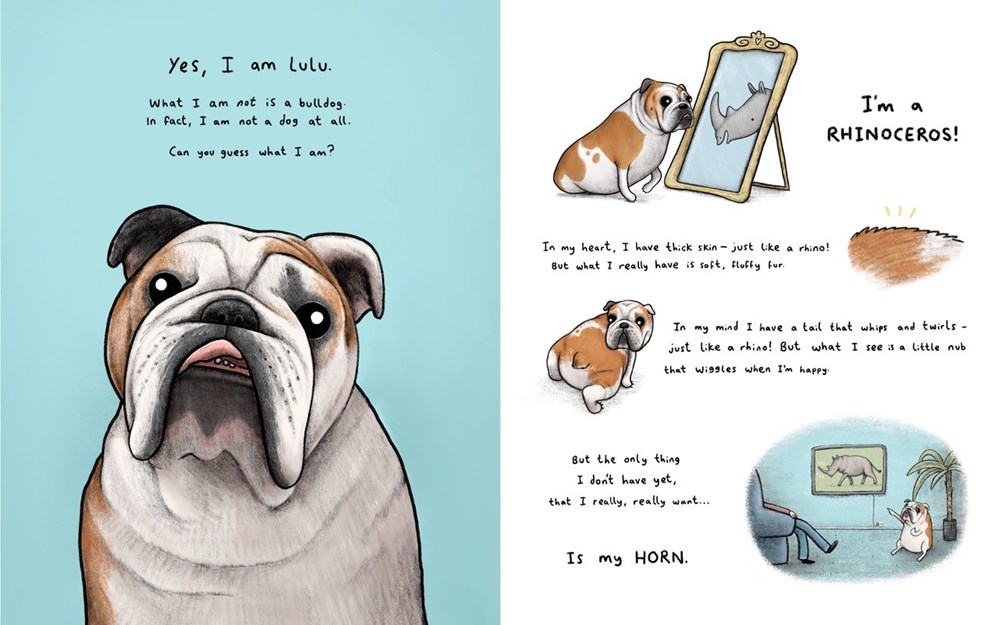
Doesn’t matter what you think you see, Lulu is a Rhinoceros.

Lulu is a Rhinoceros, by Jason Flom & Allison Flom/Illustrated by Sophie Corrigan, (June 2018, Wicked Cow Studios), $16.99, ISBN: 9780692070987

Ages 4-7

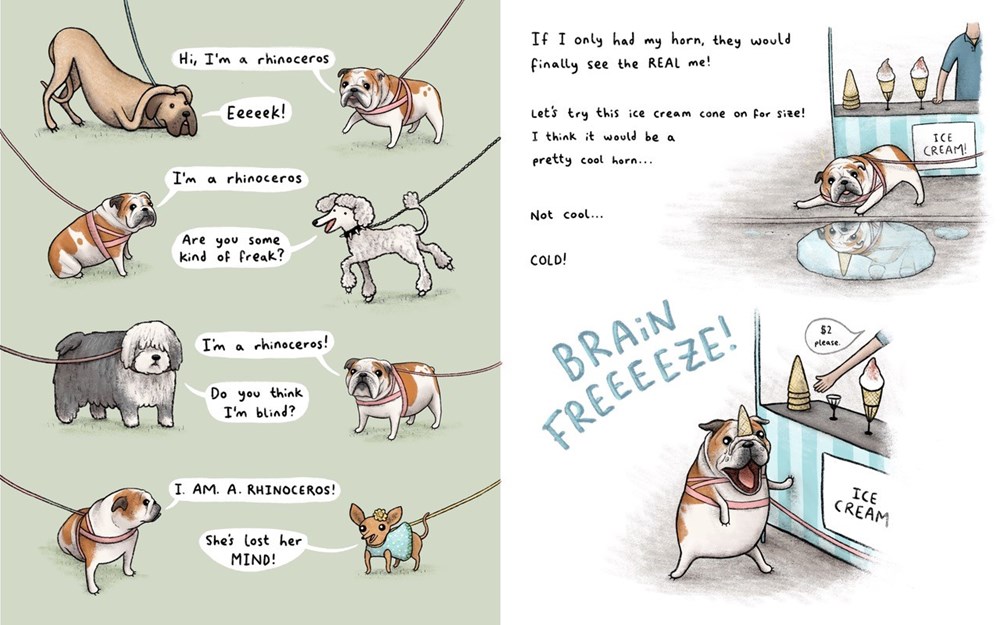
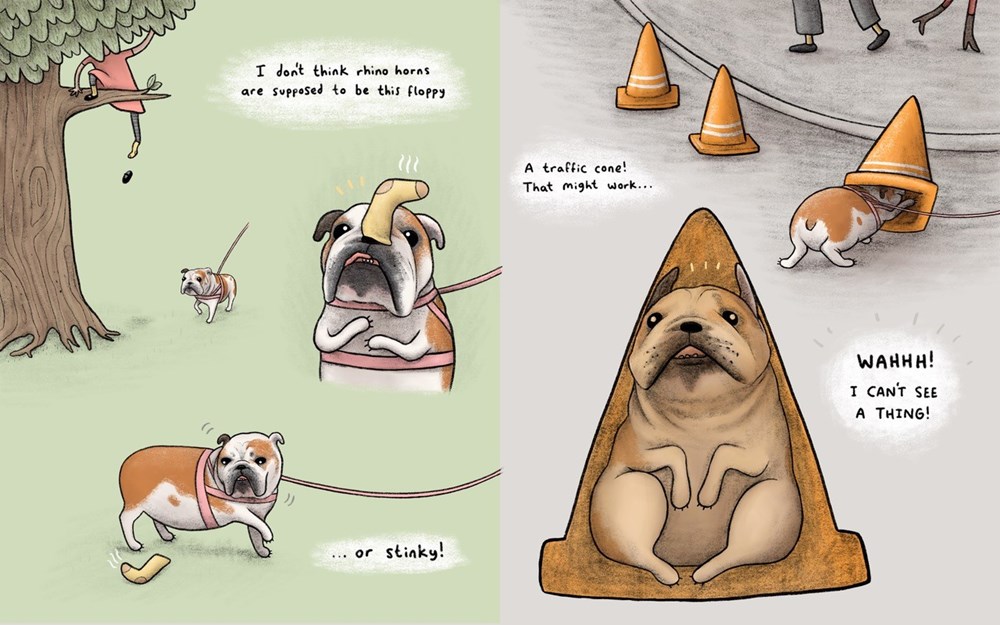
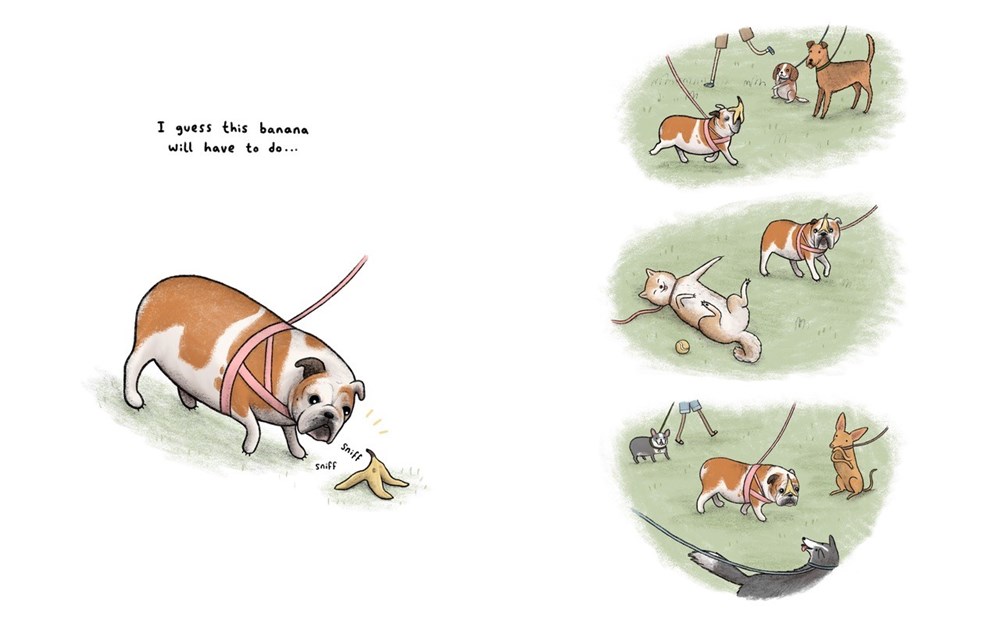
Lulu may look like an bulldog to you and me, but when she looks in the mirror, she sees a rhinoceros. In her heart, her fluffy, soft fur is really thick skin, and her nubby little tail is actually whiplike. The only thing she needs is a horn: then everyone will know she’s really a rhino! But as she searches for her horn, others laugh at her and cruelly mock her; her Cinderella-like search for the perfect horn takes a few sweet, giggle-worthy turns, especially at the ice cream cart. When Lulu wanders into a rhino enclosure at a zoo, she meets a friend who uses common sense to see her for who she is, and they come together to form a mutually beneficial, wonderful, friendship.

This sweet story is perfect for everyone: in addition to addressing gender identity, Lulu speaks to readers who don’t feel like they quite fit in; readers who don’t want to go with the crowd. The message is strong: be true to yourself. It also extols the virtue of finding – or being – that one friend who can see through the exterior to who you are inside. The softly drawn artwork has muted colors, bringing a sense of calm to the story and allows readers to focus on Lulu’s internal dialogue. The story addresses social issues like introspection, friendship, social issues, tolerance, and yes, gender identity, and I love it. A portion of all the proceeds from sales of Lulu is a Rhinoceros are being donated to the African Wildlife Foundation to help protect Africa’s endangered wildlife and their habitat, so you’re doing two good deeds by buying the book! There’s an interview with authors Jason and Allison Flom (with real-life Lulu!) on the African Wildlife Foundation’s webpage. Pair this one with Bow-Wow Meow, by Blanca Lacasa.

Posted in Animal Fiction, Fantasy, Fiction, Middle Grade, Tween Reads

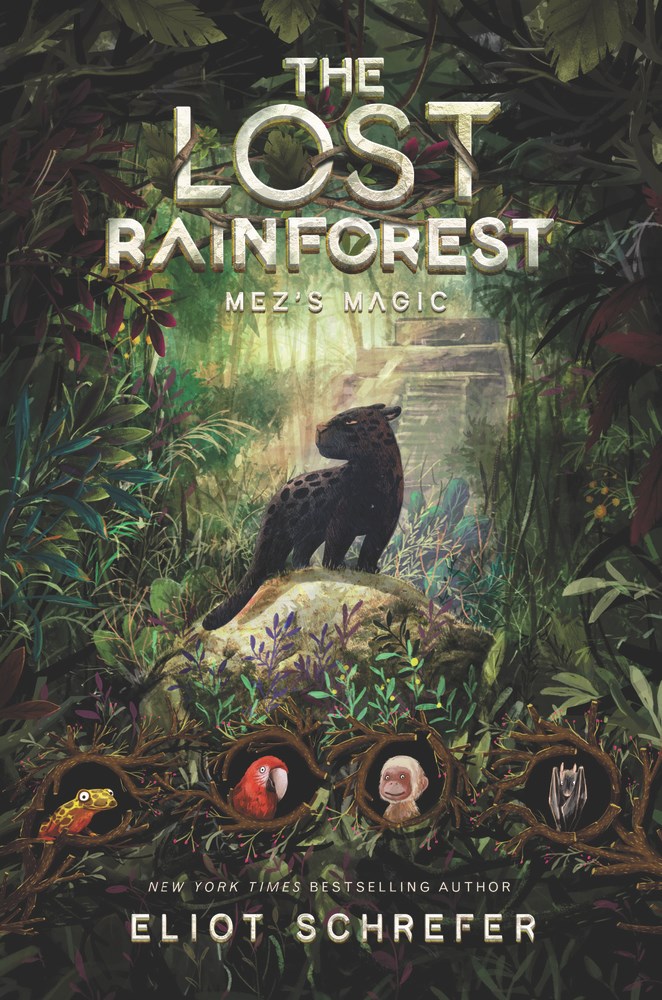
Rainforest, magic, and mystery: The Lost Rainforest – Mez’s Magic

The Lost Rainforest: Mez’s Magic, by Eliot Schrefer/Illustrated by Emilia Dziubak, (Feb. 2018, HarperCollins), $16.99, ISBN: 9780062491077

Recommended for readers 8-13

Mez is an orphaned young panther living with her sister, under the care of their aunt in the rainforest of Caldera. Panthers are nightwalkers – primarily nocturnal, they prowl in the evenings and sleep during the day. Except for Mez. Born during the eclipse, she can cross the Veil – the sleep that overcomes the animals during the day hours – and explore the daytime world. She meets a snake who tells her that she and he are gifted, eclipse-born, and they must discover other animals like them in order to save the world. Banished by her aunt after discovering Mez’s secret, she joins the search for other shadowwalkers in their quest to defeat the Ant Queen. But the Queen isn’t the only one they have to defend themselves against. They’ll encounter animals that mistrust the shadowwalkers, and cope with betrayal and mistrust even among one another.


Mez’s Magic is the first book in what looks like an exciting new animal adventure. There’s plenty for readers to love here: intrigue, adventure, and ancient magic are just a few of the ingredients. It’s a satisfying standalone, yet leaves readers waiting for more answers. There’s an animal friend for everyone here; Mez, the star of the show, is burdened with responsibility and largely naïve to the rainforest at large; Rumi is a lovable, nerdy tree frog and Lima is a talkative, sweet bat; Gogi is a capuchin monkey with an inferiority complex; Auriel is a wily snake who seems to have all the answers. The book weaves a story that addresses racism, intolerance and ignorance through the individual animal species and the concept of the shadowwalker. Black and white chapter illustrations give the reader an idea of what’s coming up, and an author’s note at the end discusses the beauty and importance of the rainforest.

Mez’s Magic received a starred review from Kirkus.


Posted in Early Reader, Fiction, Preschool Reads

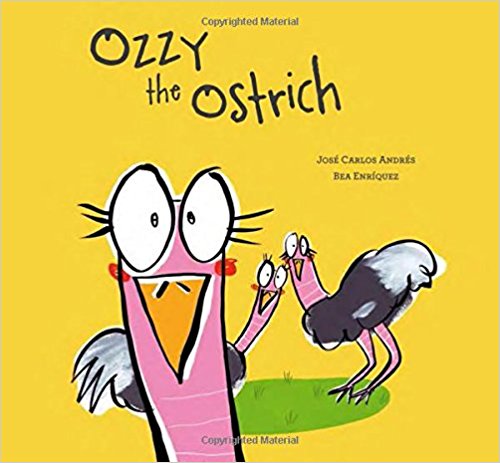
Ozzy the Ostrich teaches kids to stand up to bullies

Ozzy the Ostrich, by José Carlos Andrés/Illustrated by Bea Enríquez, (June 2017, NubeOCHO), $15.95, ISBN: 978-8494541599

Recommended for readers 3-6

Ozzy Ostrich and two friends trot across the plain, munching on flowers, until three lions threaten to eat them! Ozzy – who also has an egg to defend – stands up to the bullies, scaring the so badly that one loses his teeth, one loses all of his fur, and one turns completely white. The former bullies befriend the ostriches, but what happens when another pride of lions shows up to menace the group?

Ozzy the Ostrich is a good introduction to the concepts of bullying and standing up for oneself and others. When the first group of lions bullies Ozzy, she stands up for herself and the bullies back down. When the next group comes along, Ozzy sees that her actions resonate. The art is bright, vibrant, and bold; both lions and ostriches have exaggerated facial expressions that readers will enjoy and laugh at (especially when the chastised lions react).

Originally published in Spanish under the title Un avestruz con much luz (2016), Ozzy the Ostrich makes a good social issues read-aloud for storytime. Pair with Kathryn Otoshi’s One for an anti-bullying storytime message.

Posted in Early Reader, Fiction, Preschool Reads

The Blue Songbird discovers her song

The Blue Songbird, by Vern Kousky, (Apr. 2017, Running Press Kids), $22.49, ISBN: 9780762460663

Recommended for readers 4-8

A young blue songbird wishes that she could sing like her sisters. She wants to sing along with them, but she can’t seem to sing like they do. Her mother encourages her to go and find a special song that only she can sing, and the little bird sets off in search of her special song. She meets other birds and experiences the world, only to discover that, upon reaching home again, her song was inside of her all along.

The sweet story of self-awareness also shows readers that your experiences help make you who you are. The songbird’s song is influenced by her travels and who she met; the music was inside of her all along, but venturing out – and returning home – helped shape the music into a song.

The watercolor artwork is beautiful to look at. The colors are soft and the depiction of the music, as a spray of notes and color, is lovely and stirring. The text encourages kids to explore their world, even if, at a young age, that world is their backyards, their playgrounds, their friends’ homes. At the same time, it reassures kids that they can always return home.

There are so many ways to enjoy and extend the lessons put forth in this story. The little birds can be recreated with thumbprint art. Have little readers make their own songbird families by using watercolor paint, dipping their thumbs into a color, and giving their own songbirds adventures in finding their songs. Encourage kids to go on scavenger hunts – I love this idea for scavenger hunt bags and plan to go on an adventure with my little guy once this crazy NYC weather lets up – to explore the world around them.

Good readalikes for this book include A Song for Papa Crow, by Marit Menzin, and the classic Over in the Meadow. Over the Meadow also makes a good singalong and flannel play.

Vern Kousky is an adjunct professor of English for Touro College and the author of the award-winning book, Otto the Owl Who Loved Poetry. You can see more of his artwork, including some interior art from The Blue Songbird, at his website.

Posted in Early Reader, Fantasy, Fiction, Fiction, Intermediate

An overscheduled princess takes a day off: Princess Cora and the Crocodile

Princess Cora and the Crocodile, by Laura Amy Schlitz/Illustrated by Brian Floca, (March 2017, Candlewick Press), $16.99, ISBN: 978-0-7636-4822-0

Recommended for readers 4-8

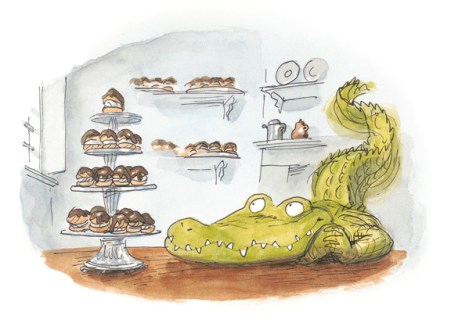
A king and queen have a baby that they coo and marvel over – until they realize that she’s clearly not ready to run an entire kingdom. From that moment on, Princess Cora’s life is a nonstop schedule of lessons, physical training, and nonstop bathing (seriously, her nanny’s got a bit of a complex). Cora writes to her fairy godmother in desperation, and the response, while not necessarily what Cora expected, is exactly what she needs. A crocodile shows up to take Cora’s place for a day; while Cora takes a day off to enjoy being a kid, the crocodile sets to teaching the king, queen, and nanny a thing or two.

Newbery Medalist Laura Amy Schlitz and Caldecott Medalist Brian Floca have joined their considerable forces to create a book that parents need to read (cough, cough, and education administrators, cough, cough) as much as their children do. Princess Cora and the Crocodile is all about the stresses our kids face today: the lack of time to enjoy being a kid, doing kid things. The king and queen are so stressed out about what Cora’s not ready for, they strip the joy not only from Cora’s childhood, but rob themselves of the chance to enjoy watching Cora grow up; of playing on the floor with her as an infant, climbing trees and running around their considerable lands with her, of reveling in the carefree fun that parents should embrace.

When Cora’s fairy godmother sends a crocodile to her family, the croc immediately – if a bit roughly – sets to whipping Cora’s family into shape, with hilarious results. While the croc wreaks havoc at home, Cora spends the day picking strawberries, climbing trees, even stepping in a cow pie, and enjoying every moment of it. Every. Unscheduled. Moment. Brian Floca’s ink, watercoor, and gouache artwork is fun, hilarious, and every bit as free and joyful as the story’s text.

Image courtesy of Brian Floca

Parents, read this one. Please. It’s as much for us as it is for our kids. Schlitz and Floca created this fairy tale to let kids know that it’s okay to be a kid, but the message here is for us adults, because we’re the ones who can make the changes kids need to be happy – to be kids – again.

Princess Cora and the Crocodile received starred reviews from School Library Journal, Booklist, and Publisher’s Weekly.

Illustrator Brian Floca has a fantastic webpage, with lots of online extras, information about school visits, and upcoming events.

Posted in Early Reader, Fiction, Preschool Reads

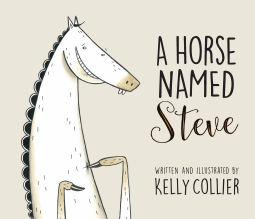
A Horse Named Steve is exceptional!

steveA Horse Named Steve, by Kelly Collier, (April 2017, Kids Can Press), $16.95, ISBN: 9781771387361

Recommended for readers 4-8

Steve is a horse that’s just fine as he is, but he thinks he can be better. He wants to be exceptional. He finds a beautiful gold horn lying on the ground in the forest, and that’s it: he’s found the pass to being exceptional! He ties the horn on his head and showboats to all of his woodland friends, who are so taken, they find items to tie on their own heads: sticks, rocks, anything they can find. But Steve accidentally loses his horn – oh no! What’s an exceptional horse to do when he loses his exceptional horn?

A Horse Named Steve is hilarious in its side commentary (notes throughout the book explain words like devastated: “that means really, really bummed”, or refer to his moods: “Mr. Mopeypants”) and its execution of an image-obsessed horse, but kids will get it: it’s not what you wear, or how you look. The commentary adds a little wink, wink, nudge, nudge humor to kids, bringing them in on the joke, and the raccoon that isn’t quite as enamored of Steve gives kids an entry point to a discussion: why doesn’t he think Steve’s so great? Do you think Steve is treating his friends with respect? What really makes our friends special?

Kelly Collier’s two-color ink and watercolor art, finished in Photoshop, is adorable and fun. Steve’s physicality plays up his ego for laughs, and there are visual jokes aplenty, especially when his golden horn slips from on top of his head to under his chin. Playing with fonts brings more humor to the page by emphasizing different words and making Steve’s very name a standout with curlicues and bolding.

You can have a lot of storytime fun with this book: make horns with your readers! For older readers, pair this one with Dr. Seuss’ The Sneetches for a good discussion on the value we place on appearances.

Posted in Fiction, Realistic Fiction, Teen, Young Adult/New Adult

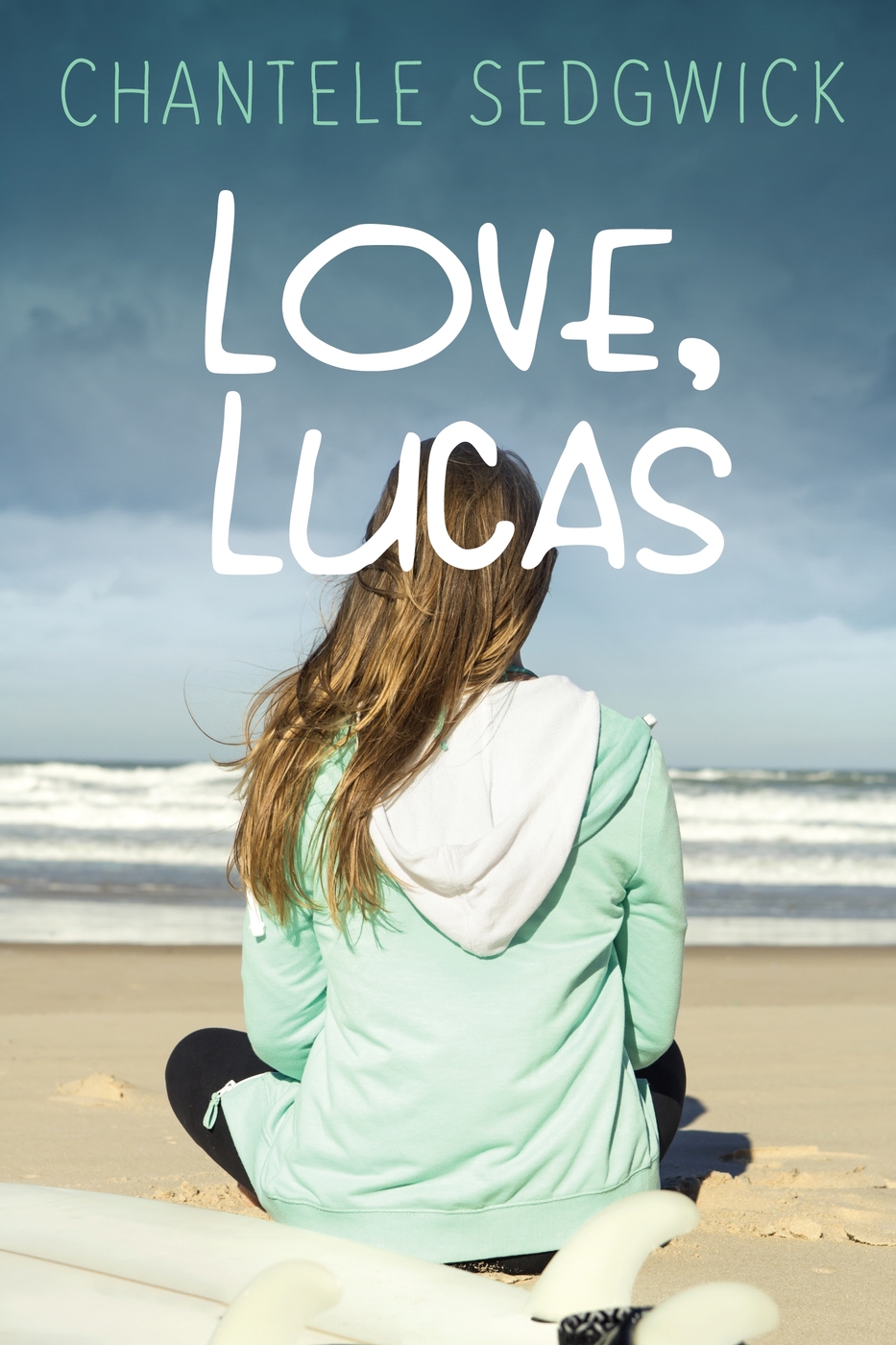
Love, Lucas is in paperback! Read an excerpt.

61608104718690LLove, Lucas, by Chantele Sedgwick (2015, Sky Pony Press), $9.99, ISBN: 9781510709928

Recommended for ages 13+


I reviewed Love, Lucas when it was originally published in hardcover last year. You can read my review here. To celebrate the book’s paperback release, I’m posting a 5-page excerpt, courtesy of Sky Pony Press. Read on and enjoy!

Love, Lucas, by Chantele Sedgwick (Excerpt)

CHAPTER 1

Everyone tells me funerals help with the grieving process, but I think those people are full of crap. If anything, they make you more depressed than you already are.

I stare at my brother’s casket as we gather around the gravesite. A few inches of snow covers the ground around us and I shiver at the cold breeze biting at my skin. Dad blows his nose and I glance over and see Mom crying into the shoulder of his coat. I’m not sure how she even has tears left.

I know I’m supposed to feel something. Anything. Relief that Lucas is out of pain. Anger that he was taken so early from us. Sadness that I’ll never hear his laugh or see his smiling face again.

Instead I feel only a hollow emptiness inside my chest. He took part of me with him. I can already feel the hole he left behind, waiting for something to fill it. But I know no one can ever take the place of my best friend.

Mom grabs my arm and gives it a squeeze. She holds out a tissue but I don’t take it. I haven’t cried since the night at the hospital. The night he left us. I know so much emotion is built up inside of me, looking for a chance to escape, but for some reason I can’t, no, won’t let it out. Something’s wrong with me.

Dad wraps an arm around my waist. I don’t move. My arms are like weights at my side. Lifeless. Like Lucas.

Mom says something to me and presses a long stemmed rose into my hand. I stare at it and say nothing. I’ve always hated flowers at funerals. They’re supposed to make you feel happy. Not depressed.

People around me move one by one toward the casket and place their roses on top. As I watch them, my fist closes and I crush the delicate petals of my flower into my palm. The maimed rose slides from my fingers and drops to the ground.

I can’t handle this. Everyone is so sad. Red faces, puffy eyes. The world seems to move in slow motion as Dad places his rose on the casket. Mom does the same. My breath catches as I notice everyone staring at me, waiting for me to do something. Anything.

Dad urges me forward to take my turn, but my feet refuse to move. He keeps his hand on my back and I take a deep breath before I look up at him. His eyes are sad as they fall on the pieces of the rose at my feet. He doesn’t say anything about it, just grabs my hand and meets my gaze, but the look

he gives me while his eyes fill with tears is more than I can handle. I have to get out of here. I step away from him, take one last look at the casket, and turn around.

“Oakley? Where are you going?” Dad asks.

I don’t answer, just push past him and move through the crowd as my heart hammers in my chest.

Mom calls my name. Dad calls for me, too. I keep walking and don’t look back.


CHAPTER 2

My parents are arguing again. Mom quit her job at the bank. It didn’t go over very well with Dad, who has thrown himself into his job like a madman. I know they’re both grieving in their own ways but they should talk to each other about it, not fight. Fighting gets you nowhere.

I listen to their raised voices for a moment and put on my headphones when Mom starts crying. I can’t handle hearing her sob all night again, so I turn my iPod on and music blasts in my ears. Nothing like a bunch of guitars and screaming to drown out my parents and my own thoughts. If I can’t hear them, they’re not there.

I lie on my bed and stare at the glow-in-the-dark stars that light up the ceiling. Lucas bought them for me for my sixteenth birthday. He even made his own constellation out of them and called it Luca Major. Stupid, but funny. It makes me miss him even more.

The light flips on and I turn my head to see Mom standing in the doorway. I pause my music and sit up.

“Sorry,” she says. “I knocked, but you didn’t answer.”

I shrug. “It’s fine.” My voice is hoarse. It was so hard for me to say those two words. I haven’t spoken since the funeral three days ago, and no one’s really spoken to me either.

She hesitates in the doorway but finally comes to sit on the edge of my bed. “Oakley,” she starts. She takes a deep breath and reaches out to tuck my dark hair behind my ear. I pull away from her touch. After all the time and energy she’s spent on my brother the past few years, it’s foreign to me. “Your father and I have been talking. I’ve decided to go live with Aunt Jo for a while. Maybe just until summer. I need some time . . .” She swallows and blinks back the moisture in her eyes. “I need time away

from here for a while.”

“Okay . . .” I say. Great. She’s abandoning me. First Lucas, now her. I breathe in and out. I still don’t feel much. Just empty.

“I wanted to see if . . . well . . .” She smoothes my hair down, and though I consider protesting, I let her. “Honey, I want you to come with me.”

My heart races. “You’re not getting divorced, are you?” I pray she says no. I can’t handle anything else going wrong. Not now. Not when I need at least some normalcy in my life.

She shakes her head. “No. Your father and I are fine. We just . . . grieve differently.” The way she says it confirms that they’re not fine. She takes a shaky breath. “Anyway, just think about coming with me, okay? You don’t have to be in school since you graduated early, and you don’t have a job or anything. I think it could be good for you to get away from everything.”

I think about her offer. Even though I’ll miss Dad, I’d love to get away. I could leave my depressing life behind for the spring and maybe heal a little before I have to decide what to do with my life. College and all that crap. I’ll leave my house and put all the memories of Lucas and my old friends and their whispers behind my back. It would be nice to get away from it all. Away from the uncomfortable silence whenever I see anyone who knows me. I know they aren’t sure what to say; I mean, what do you say to someone who just lost her brother? Even if they have something to say, I’m not sure I’d want to hear it anyway.

“Remember, Jo lives in California now, if that makes a difference. Huntington Beach. She has a really nice house with room to spare.”

I crack a smile. It feels strange on my lips but it’s a start. If I go with Mom, I could use my camera again. The thought of taking pictures comforts me. Just a little. I turn toward her and meet her eyes. “Okay,” I whisper.

She puts her arms around me in an awkward hug. I’m not sure what to do with my own arms, so I lift one and softly pat her back. Physical contact has been nonexistent with her for a while now. She’s not the touchy-feely type. We get along well enough, but for her to hug me . . . I’m sure it takes a lot.

“We’re going to be okay,” she says. It sounds like she’s trying to reassure herself more than me. She pulls away, pats my leg, and stands. “We’re leaving tomorrow morning, so you’d better start packing. I’ve already booked the flights.”

I frown. That doesn’t surprise me at all. “So . . . you were going to drag me there whether I wanted to go or not?”

She shrugs. “I think it will be good for you. For us.”

I want to say something else but don’t have the energy as thoughts of Lucas pop into my head again. Instead, I swallow the lump in my throat, give her a quick nod, and she leaves me alone.

Spending the next few months with Aunt Jo might be a good thing. She’s a marine biologist or veterinarian or something, so maybe she’ll distract me with some of her work. And I’ve never been to a real beach before since our family doesn’t really leave the state of Utah. The only beachy place I’ve been is Antelope Island. This tiny island in the middle of the Great Salt Lake that’s covered with mosquitoes, flies, and brine shrimp. As for animals, I’m sure there are a few antelope here and there, but I’ve never seen any. Just a whole lot of buffalo. Antelope Island . . . covered in buffalo. Go figure.

A real beach. The thought sounds amazing. I’ve only seen pictures of Aunt Jo in the ocean. I’d love to have some photos of my own to hang on my wall. I climb off my bed and go look for a suitcase. Tomorrow can’t come soon enough.

My ears pop as we land in California. Mom grabs her

carry-on from the overhead compartment and passes me my guitar. I already have my backpack on my lap. We both keep our jumbled thoughts to ourselves. When the line starts to move, I stand, and we follow the crowd and exit the stuffy plane.

Aunt Jo is waiting for us at baggage claim. She runs to Mom and they hug forever, even though they saw each other at the funeral four days ago. Everyone around us is staring, so I move away from them and wait for our suitcases to come down the chute and onto the turnstile. I don’t want to talk about Lucas, so I let them have a moment to themselves.

“How are you doing, Oakley? You hangin’ in there?”

I flinch at Jo’s hand on my shoulder. “I’m good.” I grab my suitcase and she lets go. I don’t miss the look she gives Mom.

They’re worried about me. They can see through the fake smile I put on for everyone who asks how I’m doing. I don’t know why I pretend everything’s okay when clearly it’s not. Lucas is gone. How can anything be okay when he’s not here? He was the only person in my life I could count on.

“Oakley, honey, you ready?” Mom looks over at me with a sad but hopeful smile.

“Yes.” I throw my backpack over my shoulder and my guitar over the other and follow them to the car, dragging my suitcase behind me.

The drive to Jo’s house is quiet. I study her and my mom for a while. It’s weird that they’re even sisters. They look nothing alike. Mom’s short dark hair is neat and straight, while Jo’s is long with light wild curls. Mom is pale with soft skin, and Jo is tan and rough-looking from being outside all the time. I look like Mom. Dark hair and pale skin. Sort of like death.

They’re so different. Their lives especially. Mom married Dad when she was only nineteen. They were high school sweethearts. Obviously it isn’t working out too well. I wonder why Jo never married, but I don’t ask. I’m not in the mood for conversation.

Jo’s house is beautiful. It’s right across the street from the beach. There are windows everywhere. Huge rectangular windows that face the ocean. I’ve always dreamed of living in a house like this. It seems so peaceful. Safe from whispers and gossip. Just what I need.

“You like it?” Jo asks.

I meet her eyes in the rearview mirror and smile. “It’s perfect.”

She puts the car in park and glances at Mom for a second before looking at me again. “I fixed one of the guest rooms up for you so you’ll have some privacy while you’re here. I remember what it was like being a teenager. And your mom told me you like your space. Hopefully you can call it your home away from home for a while.” She gives me a wink before she gets out.

I open the door and step outside as well, breathing in the salty air. It’s strange and different from what I’m used to back home, but right and wonderful at the same time. This is where I’m supposed to be right now and I’m so happy I came.

Palm trees peak around the edge of the house and I have the sudden desire to climb one. I breathe in the ocean air again and grin. For some reason I feel lighter than before. Like all my troubles will magically melt away the moment I step into that beautiful house. But as memories of the past few weeks slam into me again, I realize the depressing fact that fantasy never wins over reality. Even when it should.

We unload our bags and I follow Jo and Mom up the front steps. Jo opens the door and Mom steps back so I can go in first. My jaw drops as I look around.

The inside is gorgeous. Sunlight spills in through the windows, making it almost as bright as outside. The rooms are open. Not stuffy or crowded, but roomy. I’m surprised by Jo’s color choice. The furniture is white, with yellow flowers and throw pillows to accent the living room. A perfect choice for a house like this.

I drop my bags near the door for a moment and take my time walking around the front room, admiring the little seashells accenting the tables. Of course they’re not plastic. They’re very real, and that makes me happy.

Mom’s heels click on the white tile floor and echo through the house. She turns around and smiles. “Jo, I love it,” she says. “It’s amazing.”

“Thanks. It was a bunch of work fixing it up, but I think it turned out nicely.” Jo smiles and turns to me. “Your room is the last one on the left if you want to check it out.”

I grab my bags as I make my way down the hall and open my bedroom door. My eyes widen as I see how big it is. A bed dominates most of the room, with a dresser and mirror across from it. The same sort of decorations are in here as well. Seashells on the glass nightstand near the bed and a few pictures of the ocean hung up on the walls. I throw my backpack on the ground and set my guitar on the bed. My fingers skim the pretty white bedspread. It’s not quite my style, since my room back home is decorated with orange, pink, and lime green, but it works.

I glance around and notice a walk-in closet. Nice. Not that I have a ton of clothes, but still. My favorite part of the room is the French doors that lead outside to a small covered patio. I peek out the window and grin. There’s a hammock and lounge chair and a huge swimming pool. It’s nice and blue. Clean. I wonder if Jo has a pool man, since she obviously makes a ton of money to live in a place like this.

I walk around for a while and go through the fence to the front yard. It’s surreal to be so close to the ocean. My feet start walking on their own and I cross the street and head toward the sand and waves. My first time ever at a beach, and I’ve heard Huntington is really nice.

My flip-flops are covered in sand so I slip them off. I smile at the feel of the sand between my toes. Again, I feel safe. Free. Ready for a new beginning.

The beach is different than I imagined. In all the pictures I’ve seen, there are always a ton of people lying on the sand, tanning. I look around. There aren’t a lot of people out at all. At least not today. An older couple sits a few yards away under big umbrellas. The lady is reading a book and the man I assume is her husband is taking a nap. A few people are playing volleyball further down the beach and there are some surfers bobbing in the water.

It’s like heaven. I walk until I feel the icy ocean water touch my feet. It sends a little shock through my body, but I don’t care. It’s awesome. After a few minutes of watching the tiny waves roll up around my ankles while my feet sink into the mud, I walk back up the beach and sit down in the sand. It’s warm, but a cool breeze caresses my skin. Fascinated, I watch the waves crash into the beach and the surfers riding them so effortlessly.

I sink my toes deeper into the sand and smile. I think I’m going to like it here.

Posted in Uncategorized

Benny and Penny Say Goodbye to a Friend

bennypenny1Benny and Penny in How to Say Goodbye, by Geoffrey Hayes (Sept. 2016, TOON Books), $12.95, ISBN: 978-1-935179-99-3  

Recommended for ages 4-8

While playing outside, Penny discovers Little Red, a salamander, has died. She’s upset, but her brother, Benny, seems more irritated by Little Red – and Penny’s grief – than anything else. Penny and her friend Melina bury Little Red and hold a little ceremony for him, which stirs up mixed feelings for Benny.

This latest book in the Benny and Penny early graphic novel series takes on the tumultuous emotions that death can stir up: grief being one, and guilt being another. These feelings are often overwhelming to adults; to children, they must feel like a tidal wave. Benny remembers times he was unkind to Little Red, which triggers his grief. Benny’s guilt motivates him to take part in Little Red’s memorial, and Mr. Hayes gives Benny, Penny, and readers a bright spot to end on.

There are some great books on dealing with grief and loss with children: most recently, Margaret Wise Brown’s The Dead Bird and Ida, Always, by Caron Levis. Each book speaks beautifully to children, and each handles grief differently – just like people do. How to Say Goodbye is a sensitive look at dealing with strong feelings in the wake of loss. An important addition to graphic novel collections and readers advisory lists.

There will be an educator’s guide closer to the book’s publication. Keep an eye on the Benny and Penny TOON Page for details.

Benny and Penny is an award-winning early graphic novel series. Benny and Penny in the Big No-No received the 2010 Theodore Geisel Award.

bennypenny5

Posted in Fiction, Humor, Middle Grade, Realistic Fiction, Tween Reads

The Only Girl in School is no shrinking violet!

only girl in schoolThe Only Girl in School, by Natalie Standiford/Illustrations by Nathan Durfee (Jan. 2016, Scholastic Press), $16.99, ISBN: 9780545829960

Recommended for ages 9-12

Claire’s best friend, Bess, moves away just before the start of fifth grade, leaving her the only girl in her entire elementary school. To make matters worse, her other best friend, Henry, has just decided to stop talking to her, and replaced her with Webby (aka Webster), a colossal jerk! How is Claire going to get through this school year?

Told in letters from Claire to Bess, The Only Girl in School is a quick, fun read about growing up, friendship, and the hunt for pirate treasure. Claire is a funny and sympathetic protagonist, whether she’s lamenting the loss of the girl’s locker room, now the coach’s private office (“he probably likes having an office with his own shower in it”) or asking “Yucky” Gilbert – who has a tremendous crush on her – to crew for her for the upcoming boat race (“…the first and most important rule is: No Slobbering”). It’s a story about change: friendships change; being on the verge of leaving elementary school for middle school; and approaching the way boys and girls see one another. It’s also about how adults may treat boys versus girls, especially when there’s only one girl in an entire school: when there’s only one female voice, injustices, no matter how seemingly small, are overlooked a lot more easily, whether it’s removing a locker room where Claire can change or ignoring aggressive and chauvinistic behavior on a soccer field.

I like Claire: she’s smart, she’s athletic, and she’s spunky. She calls out unfair attitudes and behavior when she sees and experiences it, even if it’s happening in her own dining room. She isn’t going to let anyone get to her or make her feel badly for being the only girl in her school. She misses her best friends, but she doesn’t mope around school. She draws pictures on the wall in her “clubhouse” at school to journal her feelings but when her sanctum is invaded by someone who’s defacing her pictures, she takes it upon herself to act and launches an investigation. She’s a fun heroine, and the fact that she can inject snarky humor into her story should resonate with tweens.

The Only Girl in School is a fun middle-grade read and open the doors for interesting discussions about gender relations. Ask boys and girls alike to read it, and see what the different feedback sounds like. Read along with The Last Boy at St. Edith’s and compare the two main characters’ situations!

Posted in Fiction, Humor, Puberty, Realistic Fiction, Teen, Young Adult/New Adult

Kill the Boy Band takes aim at fandom

boyybandKill the Boy Band, by Goldy Moldavsky, (Feb. 2016, Point), $17.99, ISBN: 9780545867474

Recommended for ages 14+

Four super fangirls stalk their boyband favorites with disastrous results in this insanely funny dark comedy.

The Ruperts are the boy band of the moment, and our narrator – who takes on the names of ’80s teen movie heroines – and her three (mainly online) friends have a plan to be near them, securing a room in the same hotel as the boys. When one of the girls encounters her favorite Rupert (they all have the same first name) at the ice machine, she overreacts and the girls find themselves with an unconscious boy bander in their hotel suite. And things get crazier from there. Each girl has a different agenda, and before the day is over, there are going to be some ugly revelations and even uglier circumstances.

Kill the Boy Band is at once a laugh-out loud black comedy in the vein of Pulp Fiction and Fargo and a scathing look at fandom and fangirl culture. Ms. Moldavsky takes aim at the culture that expects us to destroy our idols, even as we worship them. She looks at the long-established culture of loathing popstar girlfriends, celebrity stalking, and what happens when you find out that the man behind the curtain really isn’t Oz at all.

As a Duranie who was a teenager during the social media-bereft ’80s, Kill the Boy Band made me laugh and cringe, often at the same time. With boy band and fandom culture at an all-time frenzy now, teens will recognize themselves (hopefully, not too much) or laugh in recognition of someone they know. There’s a great whodunit that will keep readers guessing until the very last page – and maybe even after. You’ll laugh, and you’ll think – it’s a great book to have a discussion group with.

Great addition to collections with a thriving teen population that’s plugged in. This should be a good summer read. For older teens, consider introducing them to Pamela Des Barres’ I’m With the Band for a look at pre-online fandom culture.

Kill the Boy Band has been selected as an Independent Booksellers’ Debut Pick of the Season.