Posted in Toddler Reads

The Bunnies Are Not in Their Beds: A Book About Not Going to Sleep.

The Bunnies Are Not in Their Beds, by Marisabina Russo (Dragonfly, 2013), ISBN: 978-0307981264
Recommended for ages 3 – 7
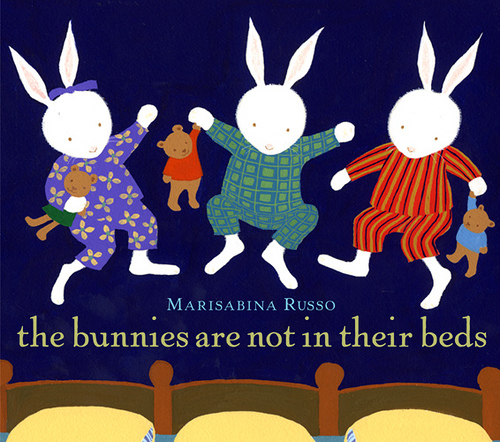
bunnies It’s bedtime for three bunny siblings. Mama and Daddy put them to bed, and settle in to have some relaxing time together, when all sorts of noises erupt from the baby bunnies’ room! Mama and Daddy go up to check and discover that the bunnies are not in their beds – they’re playing! Will Mama and Daddy ever get the bunnies to go to sleep for the night?

The book is perfect for a preschool age group, who will identify with the young bunnies. Parents and caregivers will see themselves in the tired, near-exasperated parents, who hear a ruckus every time they put the bunnies to bed and start to relax. The story itself is perfect for a fun read-aloud; there is repetition and fun noises that make the story interactive: the parents saying, “good night, good night, sleep tight”, and the bunnies playful chaos: clips and clops, zooms and vrooms, and clashes and smashes give listeners a chance to jump up and act out the post-bedtime play.

The soft, gouache art lends itself to a relaxing atmosphere that allows the children to focus on the characters – a quiet bedtime read – and bold, big text for the bunnies play allows the reader to punch up the story for a more playful reading. Ms. Russo’s use of collage adds another dimension of fun to the artwork.

The author’s website offers contact information and information about her books.

This would be a great addition to a read-aloud about bedtime; I can see it being paired with a book like Jane Yolen’s How Do Dinosaurs Say Good Night? or Mercer Mayer’s Little Critter story, Just Go to Sleep. Allow listeners to jump around until they get themselves ready for nap time (and the caregivers will likely be grateful!). There are many songs and fingerplays about bedtime available online.
Posted in Preschool Reads

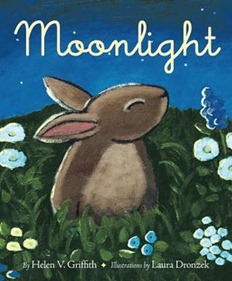
Book Review: Moonlight, by Helen V. Griffith/Illus. by Laura Dronzek (Greenwillow Books, 2012)

moonlightRecommended for ages 2-6

Told in rhyme, Moonlight tells the story of a rabbit that is so sleepy, he cannot wait for the moon to come out from behind the clouds, and heads to his burrow to sleep. When the moonlight emerges from behind the clouds, it coats everything it touches in a “butter trace”. It even reaches into Rabbit’s burrow and into his dreams, waking him up.

The illustrations, done in deeply saturated acrylics, set a drowsy, sleepy tone as readers see the moon lazily “butter” everything in its path with its light. The stars and comets look almost like Van Gogh’s Starry Night; the animals bathed in its light all sleep peacefully, and the landscapes  – mountains, trees, and  streams  – all seem soft, relaxed. The brief text itself seems quiet and relaxed, showing up unobtrusively on each spread and without punctuation to halt the eye or the mind.

This would be a wonderful addition to a bedtime read-aloud. Audiences can attend in their pajamas with a favorite stuffed animal, and serving milk and cookies would add to the storytime atmosphere. There are many bedtime rhymes and songs that can fit in with this theme. Using a flannel board may add to young audiences’ appreciation of the story.

Posted in Preschool Reads, Toddler Reads

Book Review: Twinkle, Twinkle, Little Star, by Iza Trapani (Whispering Coyote, 1997)

twinkle-twinkle-little-star-illustrated-by-iza-trapaniRecommended for ages 0-5

“Twinkle Twinkle Little Star” is one of the first nursery rhymes many children learn, either from their parents, daycare providers, or preschool teachers. Ms. Trapani’s extended version of the song allows children to sing along as they view the story of a little gold star who takes a little girl on a trip through the night sky. After taking her to see the planets and sun, the star shows the girl how it guides ships at sea and shines light on loving families and sleeping animals and children. The star promises to shine on the little girl every night when it returns her back to her bed. The watercolor illustrations give a soft, dreamlike feel to the story, and the star itself appears to be rendered in a foil of some sort, so it stands out. The colors are muted, nighttime colors but for the light by the sun and the moon. There is a companion CD that lets readers sing along and can also help beginning readers sharpen their skills. There is also a Spanish translation available for a Spanish storytime.

This is a great candidate for a nursery rhyme-centered storytime, either with or without the CD accompaniment. There are many fingerplays available for Twinkle, Twinkle Little Star, and a felt board may be fun to incorporate into the story, with the many sights the star takes the little girl to see through the course of the tale. The sheet music and lyrics are available in the back of the book and, with permission, may be handed out at the beginning of the storytime for parents, guardians, and children to sing along. The book’s publisher, Charlesbridge, has a free printable of the cover art that would make for a fun coloring project. The Perry Public Library has a wonderful “Star Light Star Bright” storytime that includes songs, rhymes and a star chart, an updated one of which can easily be found online.

The author’s webpage also offers downloadable activities and guides for her books.

Posted in Preschool Reads, Toddler Reads

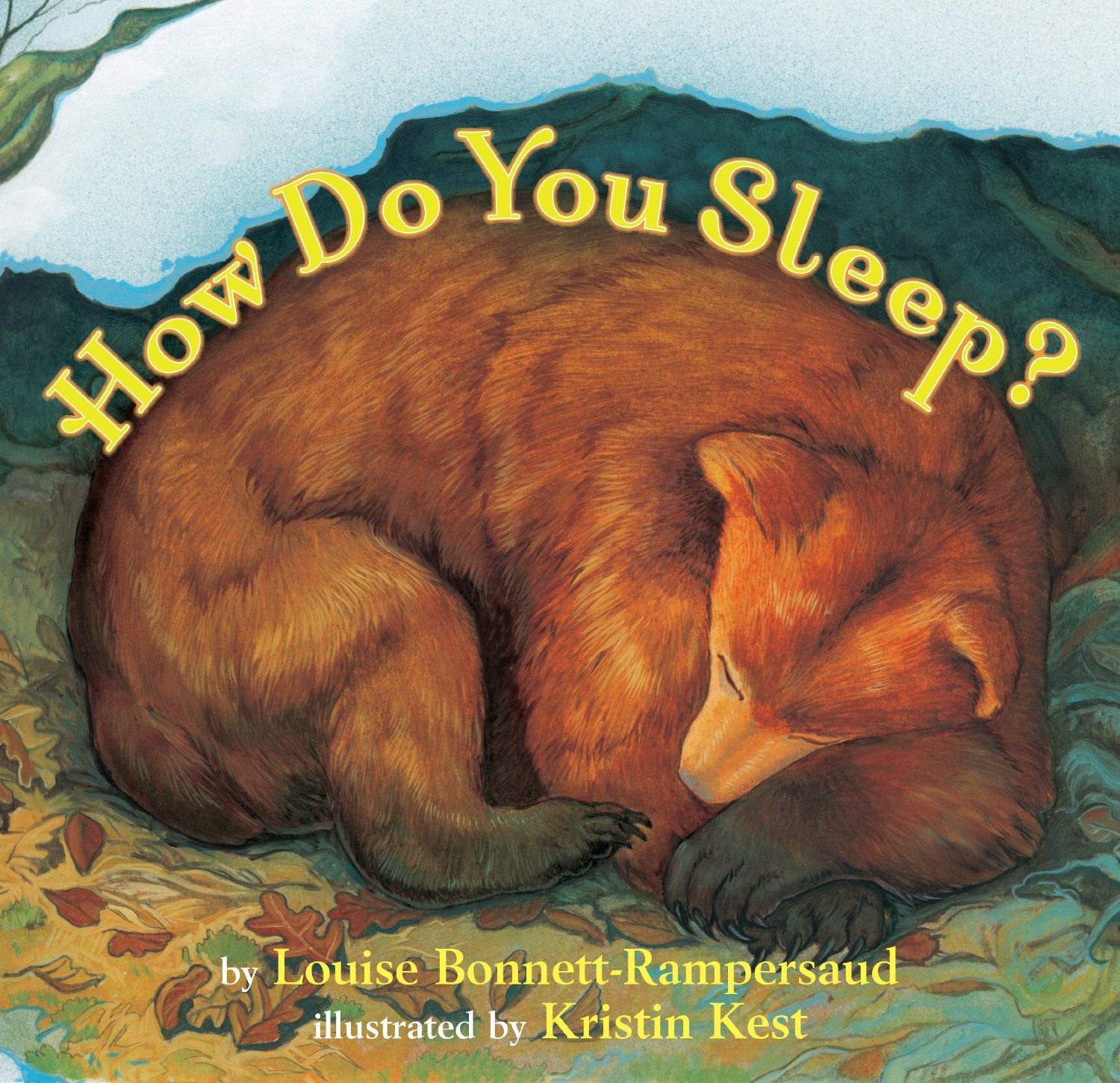
Book Review: How Do You Sleep, by Louise Bonnet-Rampersaud (Marshall Cavendish Children, 2005)

how do you sleepRecommended for ages 2-4

Different animals answer the question of how they sleep in rhyme. Children conclude the story by describing how they sleep.

This is a rhyming story about how different creatures sleep, ranging from birds to frogs to human children. The pace is soothing and repetitive: one spread asks the question, “How do you sleep?” and a different animal answers on the next. The realistic pictures of animals (and children) are rendered in oil paintings, and makes for a read-aloud that will keep viewers and listeners interested with the large and small details: the flowers on the branches where a bird sits; the mouse sitting on a bell hook in the pig sty; the cozy bed the children sit in, listening to their father read them a bedtime story. The font is a larger version of a standard one, similar to Times Roman, but it does not need to capture the reader here – the story is in the pictures.  There is a board book version of this available for younger audiences.

This is a great story to build on for a bedtime read-aloud. Encourage audiences to wear their favorite pajamas and bring a beloved toy. There are bedtime songs like Twinkle Twinkle Little Star and Star Light, Star Bright that would work well here.

The author does not appear to have her own website, but her publisher offers a link to her other book and offers the chance to sign up for updates.