Posted in Toddler Reads

The Bunnies Are Not in Their Beds: A Book About Not Going to Sleep.

The Bunnies Are Not in Their Beds, by Marisabina Russo (Dragonfly, 2013), ISBN: 978-0307981264
Recommended for ages 3 – 7
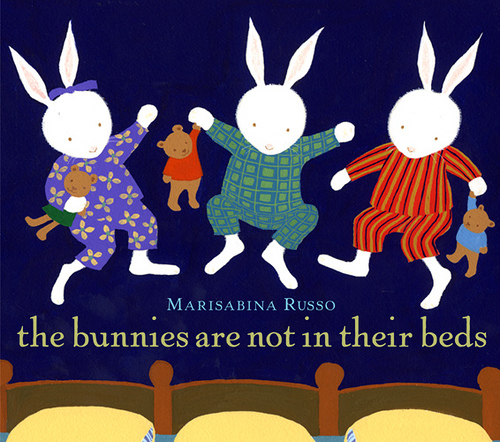
bunnies It’s bedtime for three bunny siblings. Mama and Daddy put them to bed, and settle in to have some relaxing time together, when all sorts of noises erupt from the baby bunnies’ room! Mama and Daddy go up to check and discover that the bunnies are not in their beds – they’re playing! Will Mama and Daddy ever get the bunnies to go to sleep for the night?

The book is perfect for a preschool age group, who will identify with the young bunnies. Parents and caregivers will see themselves in the tired, near-exasperated parents, who hear a ruckus every time they put the bunnies to bed and start to relax. The story itself is perfect for a fun read-aloud; there is repetition and fun noises that make the story interactive: the parents saying, “good night, good night, sleep tight”, and the bunnies playful chaos: clips and clops, zooms and vrooms, and clashes and smashes give listeners a chance to jump up and act out the post-bedtime play.

The soft, gouache art lends itself to a relaxing atmosphere that allows the children to focus on the characters – a quiet bedtime read – and bold, big text for the bunnies play allows the reader to punch up the story for a more playful reading. Ms. Russo’s use of collage adds another dimension of fun to the artwork.

The author’s website offers contact information and information about her books.

This would be a great addition to a read-aloud about bedtime; I can see it being paired with a book like Jane Yolen’s How Do Dinosaurs Say Good Night? or Mercer Mayer’s Little Critter story, Just Go to Sleep. Allow listeners to jump around until they get themselves ready for nap time (and the caregivers will likely be grateful!). There are many songs and fingerplays about bedtime available online.
Posted in Post-apocalyptic/Dystopian, Teen

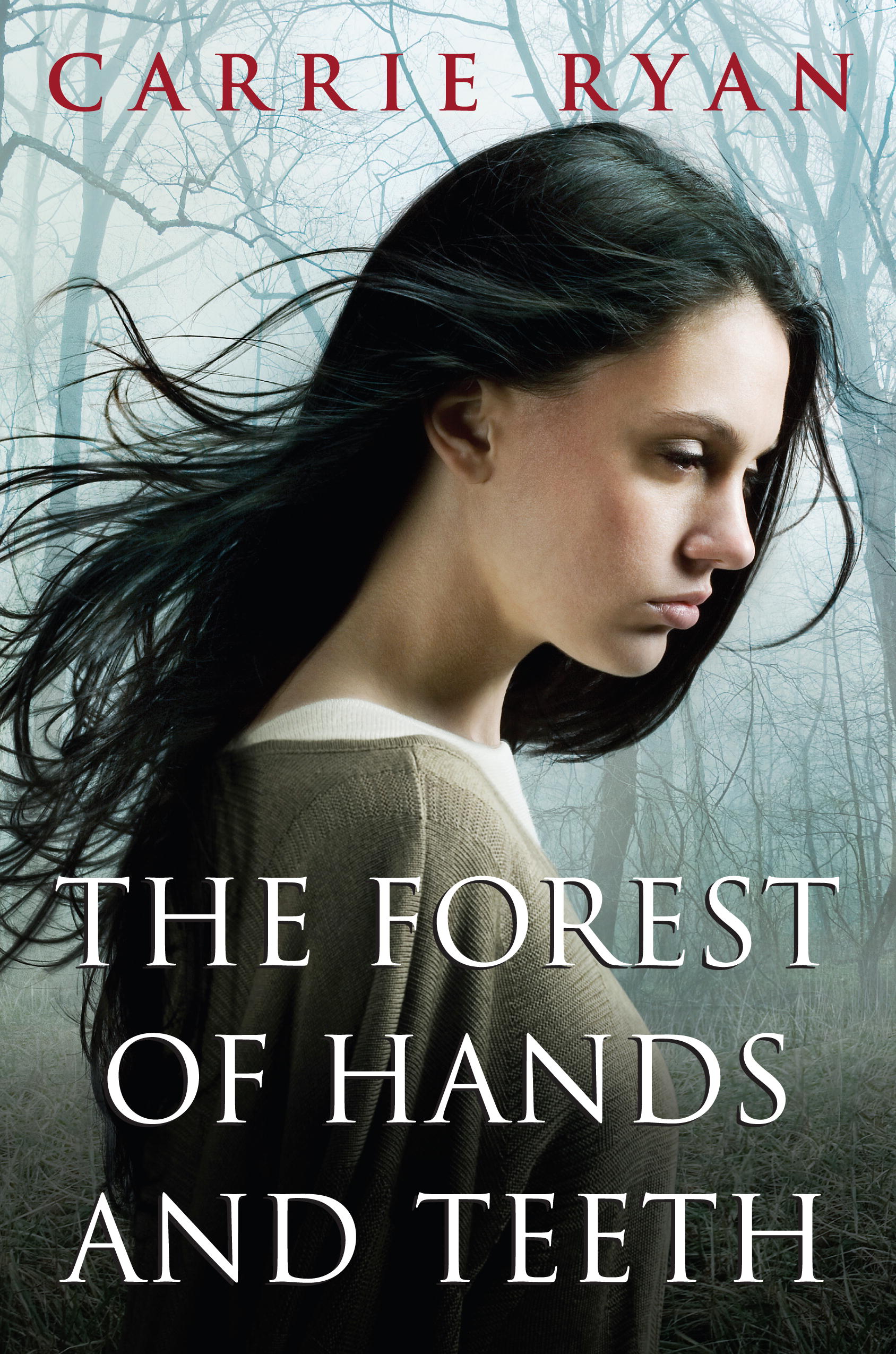
Book Review: The Forest of Hands and Teeth, by Carrie Ryan (Random House, 2009)

the-forest-of-hands-and-teethRecommended for ages 14+

Mary and her brother Jed live in a post-apocalyptic world, in a small village overseen by the Sisterhood and the Guardians. The Sisterhood is the reunion of church and state, a governing body that rules through their faith. The Guardians keep them safe from the Forest of Hands and Teeth, always outside their gates.

The Forest of Hands and Teeth refer to the zombies that wander, ever-present, just outside of the settlement. When the settlement fences are breached, Mary, her brother and a small group of survivors escape and seek the ocean, where Mary believes they will be able to start over. But they have to make it through the forest first.

The Forest of Hands and Teeth is one of those books that has layer upon layer of complex storytelling, all centered around the main character, Mary. Ms. Ryan explores her relationships – with her mother, her brother, her best friend, fiance, and his brother, her true love – against the backdrop of the aftermath of a zombie apocalypse. She is an obsessive character, driven by her drive to question. What lies beyond the settlement? Are there more settlements, more people, out there? What secrets does the Sisterhood keep from everyone? Where is the ocean, that her mother raised her on stories about? At times, the character appears cold and self-serving; she is single-minded in her purpose.

As the first in a post-apocalyptic series (The Dead-Tossed Waves and The Dark and Hollow Places are the sequels), the book is bleak but compelling. It doesn’t focus on the zombie horror, but it’s an ever-present threat that crawls down the reader’s spine and makes one’s heart beat with a sense of urgency at key points.

Author Carrie Ryan writes for middle grade and young adult readers, and has a full list of work available on her website, where readers can also follow her blog, follow her on social media, find out about appearances and news, and download icons, buttons, banners, and bookmarks.

Posted in Preschool Reads

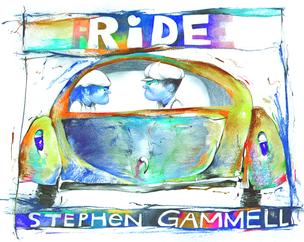
Book Review: Ride, by Stephen Gammell (Harcourt, 2001)

rideRecommended for ages 3-6

A mother and father decide to take their children on a Sunday ride. The siblings don’t share their parents’ enthusiasm. Once in the car, it begins. First come the insults: “You’re a poopy face.” “You have booger breath.” The argument escalates into an all-out fantasy brawl, with furniture flying, rockets blasting off, and a dinosaur showdown. Mother offers a snack, which calms things down momentarily: but for how long?

Mr. Gammell’s pastel-pencil-watercolor illustrations are bursting with color and energy. His rainbow palette is reminiscent of a Spin-Art machine, with splatters and smudges throughout each page. The text is woven into the story, as there is no narrator, only the dialogue between family members. The bold text exists in the same space as the illustration, with exaggerated sizes, colors, and splatters. The book will appeal to young audiences, especially those with siblings or other family members who can relate to being stuck in a car with someone who drives them crazy, and the imaginative tussles that the siblings create.

This would be a fun addition to a sibling read-aloud. It may also be enhanced by using puppets to act out the family’s interactions; in particular, the brother and sister, whose battle frames the book. There are songs and fingerplays about siblings available that can be easily taught to audiences, including “Here is Sister/Here is Brother”, to the tune of Frere Jacques.

Posted in Preschool Reads

My Beastly Brother, by Laura Leuck/illus. Scott Nash (HarperCollins, 2003)

beastly brotherRecommended for ages 3-6

A young monster reflects on life with his older brother, who can be  truly beastly or very kind. Ms. Leuck uses two monster brothers to illustrate the ups and downs of sibling relationships. The younger brother makes a laundry list of his older brother’s “beastly” – a double entendre here – behavior toward him: he will not allow him to play with his stuff, feed his pets, and outdoes his younger brother at everything he does, from burping to spewing spider spit. He throws his toys away, bothers him, and never lets him win.  But when he has scary dreams of humans coming after him, the younger monster learns that sometimes, his beastly brother is not so beastly after all.

Scott Nash’s cartoon illustrations bring humor to the monster family; they are not scary at all.  He turns the idea of the traditional family on its head by creating a monster nuclear family, complete with details like eyeball wallpaper and skull upholstery. The humans are the monsters in this tale; to that end, Mr. Nash illustrates the young monster’s nightmare with scary humans with frozen smiles and outstretched arms. The text is black, bold font on a stark white background, with a single image beneath the text, allowing the illustrations to take center stage. The monsters, other than being hairy, are fairly normal.  Their faces are pleasant and expressive, with large eyes and big smiles fully of pointy teeth. The boys wear jeans and t-shirts; Mom wears a pink dress with a spider print pattern, and Dad mows the lawn in shorts, a t-shirt and a baseball cap.

Laura Leuck and Scott Nash’s monsters show up again in My Creature Teacher.

This would be a fun book to incorporate into a family read-aloud. There are many family printables available for coloring on DLTK, along with family puppets, and poems.

HarperCollins offers an author webpage that allows interested readers to sign up for author updates.

Posted in Fantasy, Humor, Tween Reads

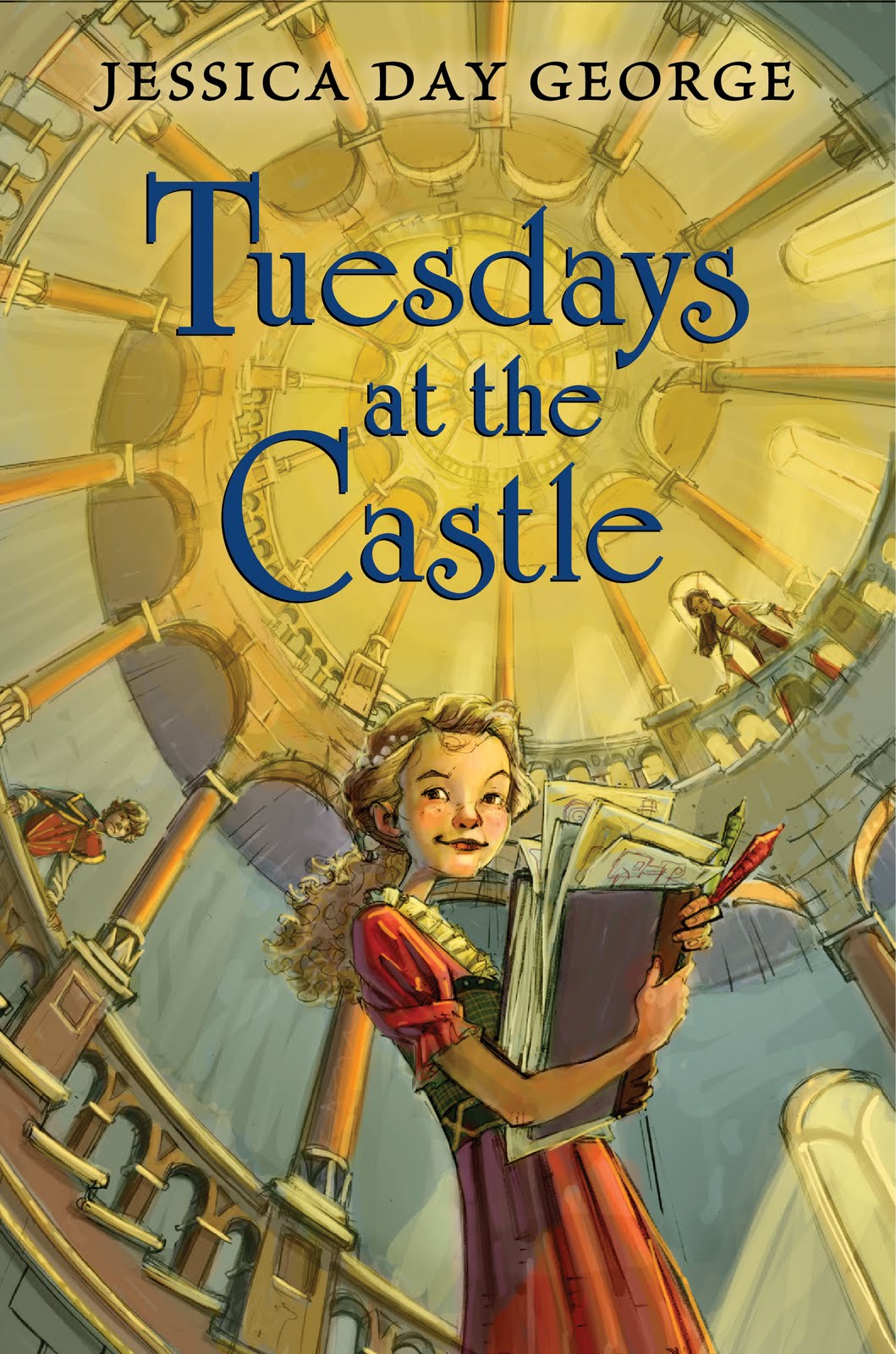
Book Review: Tuesdays at the Castle, by Jessica Day George (Bloomsbury, 2011)

Recommended for ages 9-12

Princess Celie lives with her brother, sister and parents at Castle Glower, a castle that’s alive much in the way Hogwarts is – rooms crop up when they’re needed, and new staircases and passages appear seemingly at will. When her parents, King Glower and Queen Celina leave to attend their eldest son’s graduation from wizard school and are reported missing after their carriage is attacked, Councilors and foreign dignitaries show up and start ordering Celie’s brother Rolf – the heir to the throne – around. The Glower children, the castle staff, and Castle Glower itself all sense that something’s wrong, and work together to get rid of the evil prince that’s trying to take over Castle Glower – and bring their parents home safely.

Jessica Day George is great at writing princess books without all the saccharine included- her heroines are smart, funny, and can keep their heads about them when things are going crazy. Celie is no different, nor is her older sister, Lilah, which is a pleasant change from the “one beautiful and dumb, one smart and resourceful” sister that tends to pop up in YA and ‘tween literature. Their brother, Bran, is an intelligent boy who can defend himself verbally and allies with his siblings and staff to brainstorm solutions and make things happen. Ms. George provides good character development and the action is well-paced. While mostly girls will likely gravitate to this book, there are strong male and female characters for young readers to be inspired by.

Jessica Day George’s website has a section dedicated to Tuesdays at the Castle, in addition to her other books, appearances and news.

Posted in Fantasy, Historical Fiction, Tween Reads

Book Review: Icefall, by Matthew J. Kirby (Scholastic, 2011)

Recommended for ages 10-14

Reading Matthew Kirby’s Icefall is like reading an old Norse tale -there is suspense, there is heroism, there are storytellers, and there is battle. The author puts the reader in the banquet hall with the characters, invites you to take a seat and listen in.

Solveig, the middle daughter of a viking king, her older sister and younger brother, are in hiding at a frozen fortress while their father fights a war at home. The king’s warriors protect them, joined later by a group of berserker warriors that he sends as additional protection. Shortly after the berserkers arrive, though, things start going wrong – livestock disappears, food is poisoned, and it becomes all too clear that someone in the group is a traitor. Solveig and her siblings have to figure out how to survive the winter until the spring thaw, and Solveig works to discover who the traitor is before he – or she – destroys them all.

It is a compelling read with complex characters and a tense situation – a siege tale from within. Solveig is the middle daughter – she is plain, unlike her beautiful older sister Asa; she is not an heir, unlike her younger brother Harald; she is merely Solveig. But Solveig is smart and figures things out quickly. She strives to be a storyteller – a skald – like Alric, the skald in her father’s court, but she learns that being a skald means giving your loyalty to those who may not always warrant it. Solveig finds herself angry at Asa for doing nothing during their days in captivity and she protects Harald as if he is one of her own. The story is told in Solveig’s voice, interspersed with Solveig’s anecdotes involving different characters from before the time of the seige, to further flesh out the players. There are layers and layers to this story; as each layer peels back, the revelations keep the reader turning the pages to discover more.
 
This book crosses genres – it can be considered fantasy, it can be historical fiction, or it can be mystery (it was just nominated for an Edgar award). While the main character is female, there is plenty here to pique both boys’ and girls’ interests: battle, complex relationships, and the frustration of family ties are only part of what this well-written tale has to offer all readers.
 
Matthew J. Kirby’s blog, Kirbside, offers information about his books (with hyperlinked titles to bring you directly to points of interest) and contact information. The Scholastic site for Icefall allows readers to download a sample chapter.
 
Icefall has also been nominated for a Cybils award in Middle Grade Fantasy.
Posted in Fantasy, Tween Reads

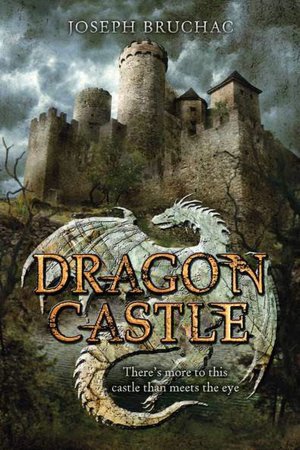
Book Review: Dragon Castle by Joseph Bruchac (Dial Books, 2011)

Recommended for ages 10-13

Prince Rashko, a 14-year old prince, is frustrated by his family. They’re so dumb. His parents are kind, but simple; his older brother Paulek, while a near-perfect warrior, is content to let Rashko do all the heavy thinking. They all live in Hladka Hvorka, a castle rumored to have magical origins, and there is peace in Rashko’s parents’ land – until Rashko’s parents disappear, and the Baron Temny shows up, expecting his young hosts to accommodate him and his entourage. The Baron also brings his ‘daughter’ with him as a potential bride for Paulek, who is thrilled to have company. Rashko suspects that neither there is more to both the Baron and his daughter, and works to find his parents and keep Hladka Hvorka in his family’s name.

Running parallel to Rashko’s story is the story of the legendary warrior Pavol, a hero in Rashko’s land. Orphaned when an evil king took his parents’ land and murdered them, Pavol is raised by a husband and wife living in the magical woodlands on the outskirts of the castle, and trained for the day he will avenge his parents’ deaths. This legend eventually converges with Rashko’s story, and he learns that Hladka Hvorka holds even more secrets than he imagined.

Author Joseph Bruchac is Native American and Slovakian, and draws upon his Slovakian heritage for Dragon Castle. The book contains phrases and words in Slovakian, always reinforced in English, and includes a glossary in the back. It is a great way to introduce younger readers to a new language within a fantasy setting.
 
The story is woven like a classic hero’s tale, with adventure and humor in equal parts. Rashko comes across as a bit petulant and stuck-up at times, particularly in the beginning of the book when he spends most of his time lamenting his superior intelligence and his parents’ and brother’s abject stupidity, but he’s an adolescent – he’s written well. He also realizes, as he gets deeper into his family’s background, that there is more to his parents – and possibly, his brother – than he ever thought possible, and this gives him pause.
 
Having two male main characters is a great way to bring this adventure fantasy to male readers; supplemental female characters will not draw any female readers in that weren’t planning on reading it already, but Dragon Castle is a strong fantasy tale that should appeal to boys and girls who enjoy fantasy, complete with evil sorcery, dragons, and castles.
 
Joseph Bruchac’s website focuses mainly on his music and poetry and features .mp3 files for listeners to enjoy. There is some information about his books and schedule available.
Posted in Horror, Tween Reads

Book Review: Goosebumps: The Beast from the East, by R.L. Stine (Scholastic, 1996)

Recommended for ages 9-12

R.L. Stine is the Stephen King of kid’s horror. His Goosebumps series has been scaring the daylights out of kids for almost 20 years now, and he has branched out into other Goosebumps series (Horror Land, Hall of Horrors) and a television series based on the novels.

The Beast from the East is like reading a demented version of the old nursery song, Teddy Bear’s Picnic(also referenced in the story). Twelve year-old Ginger, her ten year-old twin brothers Nat and Pat, and their parents go on a camping trip one summer. While their father sets up the campsite, Ginger and her brothers go exploring and end up getting lost in the woods, where they come upon a group of big, blue, furry bearlike beasts that want to play a game where the winners get to live, but the losers get eaten. There are a lot of rules – can they figure them all out and get back to their parents, or will they end up as dinner?

Stine’s stories are short, creepy fun, and end with a macabre twist every time. There isn’t a lot of character development here, but there doesn’t need to be – you learn what you need to know to get through the story, because it’s really the situation that makes the book. Stine is great at describing panic and fear, giving readers the good scare they want in the safety of their own space. The twist is one last parting shot to keep you thinking after the book’s end, or until you pick up the next book.
 
Several books from the series have won Nickelodeon Kids’ Choice Awards and is one of the best-selling children’s series of all time. Scholastic has an official Goosebumps site.
Posted in Fantasy, Humor, mythology, Tween Reads

Book Review: Thor’s Wedding Day, by Bruce Coville (Harcourt, 2005)

Recommended for ages 8-12

Based on the humorous Norse tale about the theft of Thor’s hammer, Bruce Coville fleshes the story out with other pieces of Norse mythology to give readers this amusing story of cross-dressing gods, talking goats, and dopey giants.

Told by Thor’s goat boy Thialfi, Thor’s Wedding Daybegins with Thor discovering his mighty hammer, Mjolnir, missing. His trickster brother Loki discovers that their enemies, the giants, have somehow gotten hold of the hammer and refuse to give it back unless their sister, Freya, marries Thrym, king of the giants and Thor’s enemy. Freya refuses, and Loki concocts a scheme to dress Thor up as Freya and get his hammer back. Loki agrees to accompany Thor as a bridesmaid and Thialfi must dress up to be Thor’s goat girl. While in the company of the giants, Thialfi discovers that their plan goes far deeper than just handing Mjolnir back to “Freya” after the wedding, and he finds himself in the position of saving Asgard.

Bruce Coville can tell a funny story, and Thor’s Wedding Day is no exception. He stays true to the tale that inspired him and to make it accessible to new, younger audiences. It’s downright silly in some parts with a touch of adventure and intrigue – a good combination to keep more reluctant readers interested.
 
Bruce Coville’s website offers information about this and other Coville titles. For readers interested in learning more about Norse mythology, there are a variety of resources available on the Web.
Posted in Post-apocalyptic/Dystopian, Science Fiction, Tween Reads

Book Review: The Hunger Games, by Suzanne Collins (Scholastic, 2008)

Recommended for ages 12+
Welcome to Panem, the post-apocalyptic United States of America, divided into the Capitol and 12 districts. Every year, two “tributes” between the ages of 12 and 18 are selected from each district to take part in a brutal contest called The Hunger Games, where they fight to the death. There is only one winner. Sixteen-year old Katniss volunteers to her district’s tribute after her 12-year old sister’s name is drawn.

The Hunger Games is the brutal version of a reality game show – think of Stephen King’s (written as Richard Bachman) novel, The Running Man and you’ll have a good frame of reference. The tributes are given mentors – former winners, condemned to preparing future tributes for the games – and stylists to make them look good. The contestants have to project personality in the week of interviews and preparation so that they have a chance at receiving help from sponsors, who can send food, medicine, and supplies to their contestants during the games. The games are televised for all the districts to watch. Katniss struggles to keep her humanity in the midst of the game and rails against being the Capitol’s pawn.

The book moves at a breathtaking pace with an intensity that starts mere pages in and doesn’t let up until the book’s end. The main characters have a good base for character development that will likely continue in the two following books in the series, Catching Fire and Mockingjay; the others are as developed as they need to be in order to further the story and keep the pace. Ms. Collins makes her point about valuing bloodsport over humanity as eloquently as she is brutal in several key scenes in the book. With a strong mix of violence and compassion, boys and girls have both seized on this series and catapulted it to the top of their reading lists. Katniss emerges as a heroine not only for her strength but her ability to retain her sense of self in the middle of the games. She is a complex, conflicted heroine who resonates with ‘tweens and teens alike.

The Hunger Games has won multiple awards and honors. It is a New York Times and Wall Street Journal besteller, and was one of Kirkus and School Library Journal‘s Best Books of 2008. It is an Americna Library Association (ALA) Notable Children’s Book and one of the Young Adult Library Services Association’s (YALSA) Teens Top Ten for 2009. Lionsgate Studios will release a movie based on the book in March of 2012.

A comprehensive wiki exists for the series and the author’s website offers author and book information. There are many teacher’s resources for teaching the series available on the Web, including Scholastic’s and Hunger Games Lessons.