Posted in Preschool Reads

Book Review: All You Need for a Snowman, by Alice Schertle/illus. by Barbara LaVallee (Harcourt, 2002)

all-you-need-for-snowmanRecommended for ages 3-5

A group of children list all the important materials you need to create a snowman, beginning with the first snowflake.

The process of building a snowman takes on a life of its own in cadence and rhyme in this story, which builds excitement as it goes along, teasing the reader with each spread. “One small snowflake/fluttering down—/that’s all you need/for a snowman” begins the first spread, but the word EXCEPT on the lower right hand corner of the page tells the reader there’s more to come. The next spread brings the next adds more snowflakes: “two more snowflakes…/three flakes… four…/five… six… seven thousand…/eight million more…”, followed by the rolling of the snow into a ball, then two smaller balls, then choosing a hat, until the snowman stands,  towering over the group. The word EXCEPT shows up on every other spread, pushing the reader to continue the story and building anticipation in the listener. The artwork brings an interesting look at a multicultural group of children by emphasizing the children’s profiles and shadowing one half of each face as if the children possess both light and dark skin. Ms. Lavallee’s watercolor and gouache paintings use light blue snowflakes as a background to the children’s snowman building activity, and  she  changes perspective from close-ups to full scenes that work with the pace of the text. The plain black font plays with the space, never interfering with the story and yet becoming part of it as it stacks to the side of the artwork or teases at the bottom of a page.

This would be a great story to read during a winter/snow read-aloud. The rhyme and cadence of the text would be soothing to listeners even as they became excited to learn what comes next in the snowman-building process. There are many printables and fingerplays available featuring snowmen, and a fun craft would allow children to create their own snowmen with cutout shapes that mirror some of those mentioned in the story: big snowballs, smaller snowballs, hats, “bottle caps” for eyes, “carrots” for noses, scarves, earmuffs, boots and belts. The Perry Public Library has many suggestions for Winter read-alouds.

The Children’s Literature Network offers an author webpage for Ms. Schertle with a biography and featured covers of some of her works.

Posted in Preschool Reads, Toddler Reads

Book Review: In the Small, Small Pond by Denise Fleming (Henry Holt & Company, 1993)

In-the-Small-Small-Pond-9780805059830Recommended for ages 2-4

Denise Fleming’s In the Small, Small Pond gives readers get a glimpse of life among the animals living in a small pond as the seasons change. A child – who could be either a boy or a girl – watches life in a small pond change throughout the seasons. Beginning in the spring, tadpoles wiggle and jiggle and baby geese waddle and wade; as the seasons progress, we see turtles doze, minnows scatter, muskrats stack, and finally, a frog – a presence throughout the book – burrow under the mud as winter sets in, waiting for spring.

The artwork uses color to take readers through the seasons: the bright greens and yellows of spring, the blue and green laziness of a hot summer day, the brown and yellow of fall setting in,  and the cool blues and whites of the winter. Ms. Fleming gives life to her story by using collages created by poured cotton pulp through hand-cut stencils onto handmade paper, giving her illustrations a beautiful, handmade feel that will attract the attention of children and adult audiences. The rhythm of the rhyming text will appeal to young readers. The text is bold and black, with few words to a page; more often than not, the text blends with the background, but this is a book meant to be read-aloud; this will not be a distraction to participants. This is a companion book to the author’s In The Tall, Tall Grass, which uses the same type of artwork and storytelling.

In the Small, Small Pond received Caldecott Honors in 1994 and a Child Study Children’s Book Committee award in 1995.

The book would be a great addition to a read-aloud on seasons or it can be part of a read-aloud on pond life: frogs, birds, fish, or turtles, for instance. There are many ideas on seasonal read-alouds and read-alouds related to pond animals on the Web that can be used for free. The author’s website offers a printable “finish the picture” coloring page where children can create their own pond scene, and there is also a match-up game for older audiences where the children match the animal with the verb (i.e., geese waddle, turtles doze).

Posted in Toddler Reads

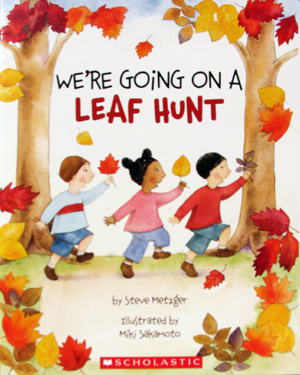
Book Review: We’re Going on a Leaf Hunt, by Steve Metzger/illus. by Miki Sakamoto (Scholastic, 2008)

leaf huntRecommended for ages 2-5

A group of friends goes on a leaf hunt, which leads them on adventures over a mountain, through a forest, around a waterfall, and across a lake.

I have a special place in my heart for this book; it was one of my son’s favorite books, because of its repetitive interactivity. The story follows a group of friends on a leaf hunt. They state their beginning intention – “We’re going on a leaf hunt. We’re going right away. Let’s find colorful leaves. It’s a wonderful day!”. The group’s arrival at each point – a mountain, a forest, a waterfall, and a lake – comes is accompanied by a repetitive phrase (“climb, climb, huff puff. We made it!”). They collect leaves from a different tree at each spot, and when they return, they revisit these areas, arriving home ready to jump and play. It makes for a fun read-aloud, where children can echo the repeated phrase and act out the group’s actions (climbing a mountain, crossing a lake).

The artwork appears to be watercolor, with lively reds, browns and yellows to create a beautiful fall day. The story font is mostly brown and bold, but words with emphasis receive a different treatment: the world “colorful” is spelled out with different fall colors; the names of the trees are bright orange, and water-related words are blue.

There are many websites available that offer printouts of different leaves that children can color for a fun, seasonal craft. There are also many seasonal and Fall-related songs and fingerplays.

The author’s website offers links to all of his books, with printables related to some of his books.