Posted in Intermediate, Non-Fiction

Experiment with What a Plant Needs to Grow – Science Fair Help is Here!

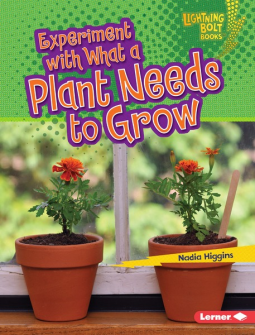
what a plant needsExperiment with What a Plant Needs to Grow, by Nadia Higgins (Mar. 2015, Lerner Publishing Group) $26.65, ISBN: 9781467757300

Recommended for ages 8-12

There are few absolutes in life, and the annual school Science Fair is one of them. Experiment with What a Plant Needs to Grow is here to rescue your child (and you) from yet another ice cube melting experiment. With full-color photographs and easy to read, step-by-step language, the book guides you and your child through the necessaries in keeping a plant alive – sunlight, air, water, minerals – and the finer details: how much water does a seed need to sprout? What will a plant do to find the light it needs (hint: a LOT)?

The book is a science fair project in one convenient spot. There are several experiments from which to select, and the book never gives anything away for free – it asks questions to guide your child in the scientific process, never handing your child the answer. These are hugely helpful questions that they can use to write their own notes and summaries, and bring home that winning ribbon. Good luck!


Posted in Fiction, Humor, Middle Grade, Tween Reads, Uncategorized

Frank Einstein and the Antimatter Motor – Jon Scieszka makes science awesome.

anitmatter motorFrank Einstein and the Antimatter Motor, by Jon Scieszka (2014), $13.95, ISBN: 9781419712180

Recommended for ages 8-12

In his neverending quest to get boys – and guys! – to read, Jon Sciezska has taken on alternative history (The Time Warp Trio), fractured fairy tales (so very many), and anthology genres (his Guys Read series). He’s got a website devoted to getting men and boys to love books, and understands that there are biological and sociological factors tied into the recent decline in boys’ reading; he’s determined to find the best books and the best subject matter to write about.

Frank Einstein and the Antimatter Motor is Sciezka’s foray into science, and it is fantastic. Frank Einstein is a kid who loves science. While his parents are away, scoping out travel locations for his dad’s job, he’s with his grandfather, working on experiments in his quest to win the science fair. He’s up against his archenemy, the bratty T. Edison, who is not above stealing others’ ideas to further his own fame – and buy up Einstein’s grandpa’s shop.

Frank finds that one of his experiments wasn’t a bust after all – his attempt to create robots worked, with some lighting providing electricity! Klink and Klank are a hilarious duo who work to help Frank create an antimatter machine – until T. Edison starts to make trouble.

Scieszka loads his novel up with legit science backup, and it is amazing to read. I learned about antimatter and robotics in a way that no science textbook ever taught me as a kid. Teachers and librarians should be all over this book for its nonfiction elements that will enhance their Common Core curriculum, but mainly because it’s fun, it’s hard science made readable and understandable, and Scieszka never, ever talks down to his audience. Brian Biggs’ illustrations will empower every kid to make their own antimatter machines at home – trust and believe it. And while they’re at it, kids will be breaking down states of matter so that we parents can finally figure it out.

The book releases on August 19th. Pre-order yours from Amazon today.

Posted in Fiction, Middle School, Tween Reads

The Fourteenth Goldfish – family bonding through science!

fourteenth goldfishThe Fourteenth Goldfish, by Jennifer L. Holm (Random House Children’s, August 2014). $16.99, ISBN: 9780375870644

Recommended for ages 10-16

Eleven year-old Ellie isn’t a big fan of change – she only just found out that her goldfish, the one she thought lived to a ripe old age, was a series of 13 goldfish. Her mother didn’t have the heart to tell her otherwise. So when this awkward teenaged boy named Melvin shows up, claiming to be her grandfather – he certainly dresses the part – she’s thrown for a loop.

Grandpa Melvin has figured out the secret to reversing aging, and he can’t wait to release his results. Ellie finds herself reading more about science, and the men and women whose discoveries changed the world – but she also learns that there are consequences for every discovery, no matter how groundbreaking. Now, if her grandfather could just get out of detention, she could share her thoughts with him.

Jennifer L. Holm is best known for her Babymouse and Squish graphic novel series, which I love. The Fourteenth Goldfish just continues her winning streak. The book is fantastic. The pacing is perfect for middle-graders, and they won’t want to put it down. She’s given readers some memorable characters, most notably, the irascible Grandpa Melvin – the misunderstood genius, the cantankerous old man in a kid’s body; Holm takes what could have been an arrogant, annoying character, and gives him depth and pathos. Ellie’s relationship with her grandfather grows roots as she learns more about his life, and even though she (and, through narration, we readers) understands his motivations, finds a strength within herself to stand apart. It’s a great coming of age story on one level, and a sweet tale about family on another.

Make sure The Fourteenth Goldfish is on your bookshelves when it hits stores on August 26th. This is the back-to-school novel to read.

Posted in Non-Fiction, Tween Reads

How to Make a Planet makes astronomy accessible – and awesome – to middle graders

how to make a planetHow to Make a Planet, by Scott Forbes/Illustrated by Jean Camden. Kids Can Press (2012), $17.95, ISBN: 9781894786881

Recommended for ages 8-12

How to Make a Planet takes the best part of an astronomy textbook and makes it accessible to middle grade students. Written as a how-to-guide to making your own planet, Scott Forbes breaks down the entire process of Earth’s formation, from the Big Bang through to the arrival of… well, us. Mr. Forbes writes about quarks and neutrons, the periodic table of elements and continental drift, all in a way that neither speaks down to his audience nor bores them. Accompanied by Jean Camden’s fun illustrations, including kids working on their planetary masterpiece and bike riding across the solar system, with giant insects, dinosaurs and more, there is always something exciting to read and see. A running “Time Check” box contains information bullets describing what’s happening at different intervals in the Earth’s creation. There is an Amazing Facts page, glossary and index.

This book is a great resource for teachers and librarians to have available in classroom, school, and public libraries. It’s a great way increase science literacy and interest younger readers in the sciences.


HowToMakeAPlanet_2336_spr2 (1)