Posted in Fiction, Middle Grade, Realistic Fiction, Tween Reads

Invisible Isabel wants to be seen

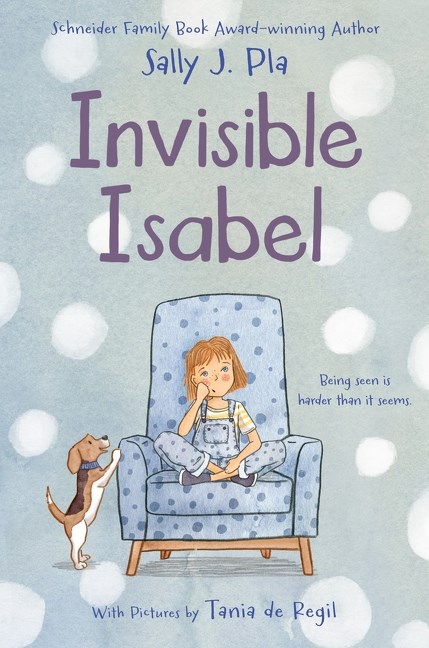
Invisible Isabel, by Sally J. Pla/Illustrated by Tania de Regil, (July 2024, Quill Tree Books), $19.99, ISBN: 9780063268852

Ages 8-12

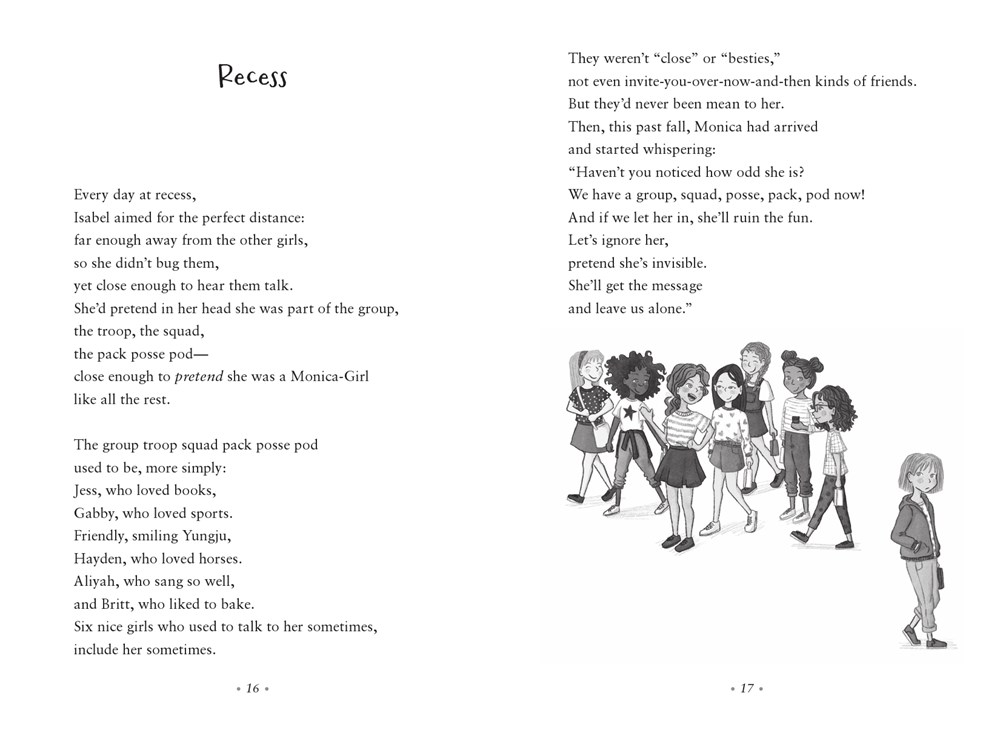
Isabel Beane is an introverted girl lost in the chaos of her home: her two younger siblings are “toddler tornadoes”; her teenaged older sisters chase her away, and her middle schooler older brother just wants to play video games and have his stinky friends over. It isn’t much better at school: her militaristic teacher doesn’t understand the “worry-moths” that cause Isabel to freeze up during class, and new girl Monica has managed to get all Isabel’s former friends to ignore her. Isabel’s parents don’t really hear or see her, either; waving away her fears as normal kid blues. Abandoned by her friends, ignored by her family, Isabel yearns to find her voice, but her fears threaten to overpower her. A sensitive story in verse with soft black and white illustrations, Isabel’s story unfolds as a journey of discovery. The reader gets clues to Isabel’s neurodiversity with mentions comforting routines like rocking, or her sensitivity to sound and scent. Mean girl Monica, Isabel’s antagonist, has reasons for her behavior and has a father who tries to steer his daughter in a better direction. Readers will spend a good part of this book frustrated with everyone around Isabel as they continue ignoring or disregarding her; Pla creates a feeling of responsibility in the reader – we want to protect her! Pla and de Regil create a story of kindness and discovery for all. An excellent choice for realistic fiction and books in verse collections.
Posted in picture books

Two siblings support each other in Benji, the Bad Day, and Me

Benji, the Bad Day, and Me, by Sally J. Pla/Illustrated by Ken Min, (Oct. 2018, Lee & Low Books), $17.99, ISBN: 9781620143452

Ages 5-8

Sammy is having a terrible, horrible, no-good, very bad day. He’s been in trouble at school, the cafeteria ran out of pizza for lunch, and he had to walk home in the rain. When he gets home, he discovers that Benji, his little brother who has autism, is having a bad day, too: but a bad day for Benji is totally different. Benji has a special hiding place and a block city set up, and Mom even wraps Benji up “like a burrito” in a special blanket when he’s having a bad day. When Sammy has a bad day, no one seems to notice – or so he thinks. Because Benji does notice, and in a touching moment of sibling affection, gets out his blanket and leads Sammy to it. Because Sammy his his little burrito.

Benji, the Bad Day, and Me will resonate with anyone who loves Judith Viorst’s classic, Alexander and the Terrible, Horrible, No Good, Very Bad Day; Sammy’s frustrated narrative is so close to Alexander’s, readers may wonder if Sammy’s about to pack it all in and head for Australia. Sally J. Pla is wonderful at using this narrative device to introduce readers to a story about siblings and the challenges of being a sibling to a child with autism. Sometimes, it may feel like one’s feelings get lost, or no one’s paying attention, but Sally Pla and illustrator Ken Min show readers that family will always be there for you. The story is inspired by the author’s experiences of “sibling rivalry and neurodiversity, all wrapped in a big blue blanket”. Ken Min‘s acrylic and colored pencil artwork uses digital enhancements to give us a warm household; Benji’s isolation shows in the cool blue color depicted inside his box fort; a color repeated in Sammy’s recollection of Benji’s appointments with his occupational therapist, who Sammy refers to as “Super-Happy Lady”. As Benji gazes out at Sammy, reduced to tears when he hits his final straw, the shadow falls across Benji’s face, warming up his eyes and nose as he gazes out at his brother. Sammy and his family appear tan-skinned, with dark brown hair.

Benji, the Bad Day, and Me has a starred review from Shelf Awareness and is a solid add to your collections. It is a strong book to suggest when explaining neurodiversity, autism acceptance, and exploring sibling relationships. As author Sally J Pla notes on her website, “I once heard someone describe autism as “not a spectrum, so much as a constellation.” I love that. We are all stars shining with different lights.”