Posted in Preschool Reads, Toddler Reads

Book Review: My Two Hands/My Two Feet, by Rick Walton/illus. by Julia Gorton (Putnam, 2000)

my two handsRecommended for ages 2-5

My Two Hands/My Two Feet is two stories in one, each story celebrating the many things that hands and feet can do over the course of a day. On one side, we have hands: stretching, washing, making a cup for water, holding onto someone, and folding together at bedtime. Flip the book over and discover what feet can do: wiggle, dance, stomp, twirl, and lie still at bedtime. The stories meet in the middle, with the two narrators asleep side by side. The endpapers clue readers in as to which body parts they will read about first, with overlapping hands decorating one side and overlapping feet, the other. The stories are told in rhyme and illustrated in airbrushed acrylics, with bright colors and full-bleed images on each page. The illustrations are flat, and the characters are semi-realistic looking, with large heads and small, black shiny dots for eyes. The only texture in the images comes by way of the characters’ knitted sweaters, which appear to be collage.

The story, told in rhyme, uses simple language that younger readers will understand and enjoy. The font is a simple yet decorative font, alternating in black and white to stand out on the brightly colored backgrounds.

This is a great opportunity for an interactive read-aloud. Children can be invited to pantomime the movements mentioned in the book, like wiggling their toes and stretching their hands.  This would also allow for a fun, movement-based storytime: get the children up and dancing, play Ring Around the Rosie, maybe even a game of Simon Says. Younger attendees can play “Head, Shoulders Knees and Toes”.

The author’s website links to information about Mr. Walton, including school visits and a biography; he also links to free book resources online for parents, writers, and educators.

Posted in Preschool Reads

My Beastly Brother, by Laura Leuck/illus. Scott Nash (HarperCollins, 2003)

beastly brotherRecommended for ages 3-6

A young monster reflects on life with his older brother, who can be  truly beastly or very kind. Ms. Leuck uses two monster brothers to illustrate the ups and downs of sibling relationships. The younger brother makes a laundry list of his older brother’s “beastly” – a double entendre here – behavior toward him: he will not allow him to play with his stuff, feed his pets, and outdoes his younger brother at everything he does, from burping to spewing spider spit. He throws his toys away, bothers him, and never lets him win.  But when he has scary dreams of humans coming after him, the younger monster learns that sometimes, his beastly brother is not so beastly after all.

Scott Nash’s cartoon illustrations bring humor to the monster family; they are not scary at all.  He turns the idea of the traditional family on its head by creating a monster nuclear family, complete with details like eyeball wallpaper and skull upholstery. The humans are the monsters in this tale; to that end, Mr. Nash illustrates the young monster’s nightmare with scary humans with frozen smiles and outstretched arms. The text is black, bold font on a stark white background, with a single image beneath the text, allowing the illustrations to take center stage. The monsters, other than being hairy, are fairly normal.  Their faces are pleasant and expressive, with large eyes and big smiles fully of pointy teeth. The boys wear jeans and t-shirts; Mom wears a pink dress with a spider print pattern, and Dad mows the lawn in shorts, a t-shirt and a baseball cap.

Laura Leuck and Scott Nash’s monsters show up again in My Creature Teacher.

This would be a fun book to incorporate into a family read-aloud. There are many family printables available for coloring on DLTK, along with family puppets, and poems.

HarperCollins offers an author webpage that allows interested readers to sign up for author updates.

Posted in Preschool Reads, Toddler Reads

Book Review: Twinkle, Twinkle, Little Star, by Iza Trapani (Whispering Coyote, 1997)

twinkle-twinkle-little-star-illustrated-by-iza-trapaniRecommended for ages 0-5

“Twinkle Twinkle Little Star” is one of the first nursery rhymes many children learn, either from their parents, daycare providers, or preschool teachers. Ms. Trapani’s extended version of the song allows children to sing along as they view the story of a little gold star who takes a little girl on a trip through the night sky. After taking her to see the planets and sun, the star shows the girl how it guides ships at sea and shines light on loving families and sleeping animals and children. The star promises to shine on the little girl every night when it returns her back to her bed. The watercolor illustrations give a soft, dreamlike feel to the story, and the star itself appears to be rendered in a foil of some sort, so it stands out. The colors are muted, nighttime colors but for the light by the sun and the moon. There is a companion CD that lets readers sing along and can also help beginning readers sharpen their skills. There is also a Spanish translation available for a Spanish storytime.

This is a great candidate for a nursery rhyme-centered storytime, either with or without the CD accompaniment. There are many fingerplays available for Twinkle, Twinkle Little Star, and a felt board may be fun to incorporate into the story, with the many sights the star takes the little girl to see through the course of the tale. The sheet music and lyrics are available in the back of the book and, with permission, may be handed out at the beginning of the storytime for parents, guardians, and children to sing along. The book’s publisher, Charlesbridge, has a free printable of the cover art that would make for a fun coloring project. The Perry Public Library has a wonderful “Star Light Star Bright” storytime that includes songs, rhymes and a star chart, an updated one of which can easily be found online.

The author’s webpage also offers downloadable activities and guides for her books.

Posted in Preschool Reads

Book Review: There Was an Old Lady Who Swallowed a Trout! by Teri Sloat/Illus. by Reynold Ruffins (Henry Holt, 2002)

there was an old ladyRecommended for ages 3-7

The book puts a new spin on the popular cumulative tale, There Was an Old Woman Who Swallowed a Fly,  this time, telling the story of an old woman who begins by swallowing a trout, and goes on to ingest a salmon, an otter, a seal, a porpoise, a  walrus, a whale, and finally, the entire ocean. The story, told in rhyme, is increasingly funny as the old woman swallows increasingly larger sea animals. Reynold Ruffins depicts the Pacific Northwest setting of the story through brightly colored double-paged spreads inspired by folk art. The action words are silly and will keep young listeners giggling as they “slippity-flippity-flop”, “splish and splash”, and squeal along with the old woman. The rhyme and rhythm of the story make it a very good read-aloud candidate.

This story would be a good companion story to the original, There Was an Old Lady Who Swallowed a Fly. It would also be a good addition to a cumulative tales read-aloud, with old favorites like The House That Jack Built. This is a great chance to use a felt board to illustrate the different animals that the Old Lady eats; there are also popsicle stick puppet printables on Making Learning Fun that storytime attendees can color and bring home to play along with.

The author’s webpage offers downloadable printables and games, art galleries, and information about school visits.


Posted in Preschool Reads

Book Review: All You Need for a Snowman, by Alice Schertle/illus. by Barbara LaVallee (Harcourt, 2002)

all-you-need-for-snowmanRecommended for ages 3-5

A group of children list all the important materials you need to create a snowman, beginning with the first snowflake.

The process of building a snowman takes on a life of its own in cadence and rhyme in this story, which builds excitement as it goes along, teasing the reader with each spread. “One small snowflake/fluttering down—/that’s all you need/for a snowman” begins the first spread, but the word EXCEPT on the lower right hand corner of the page tells the reader there’s more to come. The next spread brings the next adds more snowflakes: “two more snowflakes…/three flakes… four…/five… six… seven thousand…/eight million more…”, followed by the rolling of the snow into a ball, then two smaller balls, then choosing a hat, until the snowman stands,  towering over the group. The word EXCEPT shows up on every other spread, pushing the reader to continue the story and building anticipation in the listener. The artwork brings an interesting look at a multicultural group of children by emphasizing the children’s profiles and shadowing one half of each face as if the children possess both light and dark skin. Ms. Lavallee’s watercolor and gouache paintings use light blue snowflakes as a background to the children’s snowman building activity, and  she  changes perspective from close-ups to full scenes that work with the pace of the text. The plain black font plays with the space, never interfering with the story and yet becoming part of it as it stacks to the side of the artwork or teases at the bottom of a page.

This would be a great story to read during a winter/snow read-aloud. The rhyme and cadence of the text would be soothing to listeners even as they became excited to learn what comes next in the snowman-building process. There are many printables and fingerplays available featuring snowmen, and a fun craft would allow children to create their own snowmen with cutout shapes that mirror some of those mentioned in the story: big snowballs, smaller snowballs, hats, “bottle caps” for eyes, “carrots” for noses, scarves, earmuffs, boots and belts. The Perry Public Library has many suggestions for Winter read-alouds.

The Children’s Literature Network offers an author webpage for Ms. Schertle with a biography and featured covers of some of her works.

Posted in Preschool Reads, Toddler Reads

Book Review: Mama Mama by Jean Marzollo/illus. by Laura Regan (HarperFestival, 1999)

mama mamaRecommended for ages 0-4

The bond between mothers and babies is strong, as illustrated by different animals. Seven different animal babies tell their mothers, in rhyme, how they love them. Each spread features a realistic illustration of an animal mother and baby – lions, leopards, chimpanzees, koalas, pandas, elephants, and sea otters – and a four-line rhyme celebrating their love: “Mama, Mama,/Nuzzle, hug,/I’m your little/golden cub”. The font is simple and black, meant for mothers to read to their children during cuddle time. The book is a sweet tribute to mothers and their babies and should be a popular board book selection in any library.

This would be a good read-aloud for a family-related lapsit or a Mother’s Day lapsit. The Perpetual Preschool website offers many Mother’s Day songs and fingerplays that would work well with this type of lapsit.

The author’s website offers free ebooks and activities using her other books. She has written a companion book to Mama Mama called Papa Papa.

Posted in Preschool Reads, Toddler Reads

Book Review: Duck Sock Hop, by Jane Kohuth/illus. by Kane Porter (Dial Books for Children, 2012)

ducksockhopRecommended for ages 2-4

Once a week, ducks grab a bunch of socks from the sock box and head over to dance at the sock hop. They dance and wear all sorts of fun socks that they get from the sock box. Naturally, the party gets a little out of control, but it all ends well, and the ducks get ready for the next sock hop.

The illustrations are fun; cartoon-style and outlined in black with textured with hand-printed patterns on both the socks and the ducks are interesting to look at, and younger readers get a little lesson in shapes as the story describes the exciting socks found in the sock box: socks with squares, dots, moons, cars and spoons! The story is told in rhyme and allows for a fun, movement-oriented read-aloud once the sock hop gets underway as the ducks teeter, tumble, twist and trip their way through the dance. The story font is a bold, rounded font that curves around the pictures, creating further interest.

 This would be a great addition to a movement-oriented storytime. Books like Karen Katz’s Shake it Up, Baby! and Helen Oxenbury’s Clap Hands are good additions to this type of storytime. The Perry Public Library has great Move Your Body storytime suggestions, including fun songs like “Head, Shoulders Knees and Toes” and “If You’re Happy and You Know It”. The author’s website also offers Duck Sock Hop activities, including a Duck Sock Hop Kit that allows you to create your own sock hop – attendees could bring a pair of fun socks to donate to the sock box!

Posted in Preschool Reads, Toddler Reads

Book Review: If You’re a Monster and You Know It, by Rebecca & Ed Emberley (Orchard Books, 2010)

If-You-re-a-Monster-and-You-Know-It-9780545218290Recommended for ages 2-5

The classic song “If You’re Happy and You Know It” gets a monster makeover from Rebecca Emberley and her father, Caldecott Award winner Ed Emberley.

Caregivers have taught toddlers and preschoolers that song, “If You’re Happy and You Know It”, for years. Rebecca and Ed Emberley put a fun, new spin on a familiar song by incorporating monsters, with all of the snorts, growls, wiggles and roars that go with them. Most children will be familiar with the tune, so slotting in new, fun, silly words and actions will be easy and exciting. The neon-bright, digitally created monsters pop off the black page backgrounds, appearing to almost pop off the page. The story font is a bright green for easy reading, but small and almost comic-like in appearance. The action words – stomp, snort, growl, wiggle, roar – are large, brightly colored, and appear to be digitally rendered along with the rest of the artwork, providing an easy prompt for children to take action.


This would be a great interactive read-aloud for toddlers and preschoolers alike, especially for a fun Halloween storytime. There could be a mask-making workshop before the storytime, where participants can color in blank printouts and create their own monsters that will stomp and roar and twitch their tails during the reading. Ed Emberley’s website offers printable mask activities and other October activities that would work with a Halloween read-aloud. There are many fingerplays and songs to be sung during a Halloween storytime; plus, the book comes with a link to a free, downloadable version of the song from the Scholastic website that can be played for a full-on monster dance party.

The authors have further resources on their websites (http://www.rebeccaemberley.com/, http://www.edemberley.com/pages/main.aspx) for more printable, downloadable activities.

The book has received several accolades, including nomination for the Grand Canyon Reader Award and the Building Block Picture Book Award, and designation as an IRA Children’s Choice.

Posted in Preschool Reads, Toddler Reads

Book Review: In the Small, Small Pond by Denise Fleming (Henry Holt & Company, 1993)

In-the-Small-Small-Pond-9780805059830Recommended for ages 2-4

Denise Fleming’s In the Small, Small Pond gives readers get a glimpse of life among the animals living in a small pond as the seasons change. A child – who could be either a boy or a girl – watches life in a small pond change throughout the seasons. Beginning in the spring, tadpoles wiggle and jiggle and baby geese waddle and wade; as the seasons progress, we see turtles doze, minnows scatter, muskrats stack, and finally, a frog – a presence throughout the book – burrow under the mud as winter sets in, waiting for spring.

The artwork uses color to take readers through the seasons: the bright greens and yellows of spring, the blue and green laziness of a hot summer day, the brown and yellow of fall setting in,  and the cool blues and whites of the winter. Ms. Fleming gives life to her story by using collages created by poured cotton pulp through hand-cut stencils onto handmade paper, giving her illustrations a beautiful, handmade feel that will attract the attention of children and adult audiences. The rhythm of the rhyming text will appeal to young readers. The text is bold and black, with few words to a page; more often than not, the text blends with the background, but this is a book meant to be read-aloud; this will not be a distraction to participants. This is a companion book to the author’s In The Tall, Tall Grass, which uses the same type of artwork and storytelling.

In the Small, Small Pond received Caldecott Honors in 1994 and a Child Study Children’s Book Committee award in 1995.

The book would be a great addition to a read-aloud on seasons or it can be part of a read-aloud on pond life: frogs, birds, fish, or turtles, for instance. There are many ideas on seasonal read-alouds and read-alouds related to pond animals on the Web that can be used for free. The author’s website offers a printable “finish the picture” coloring page where children can create their own pond scene, and there is also a match-up game for older audiences where the children match the animal with the verb (i.e., geese waddle, turtles doze).

Posted in Preschool Reads, Toddler Reads

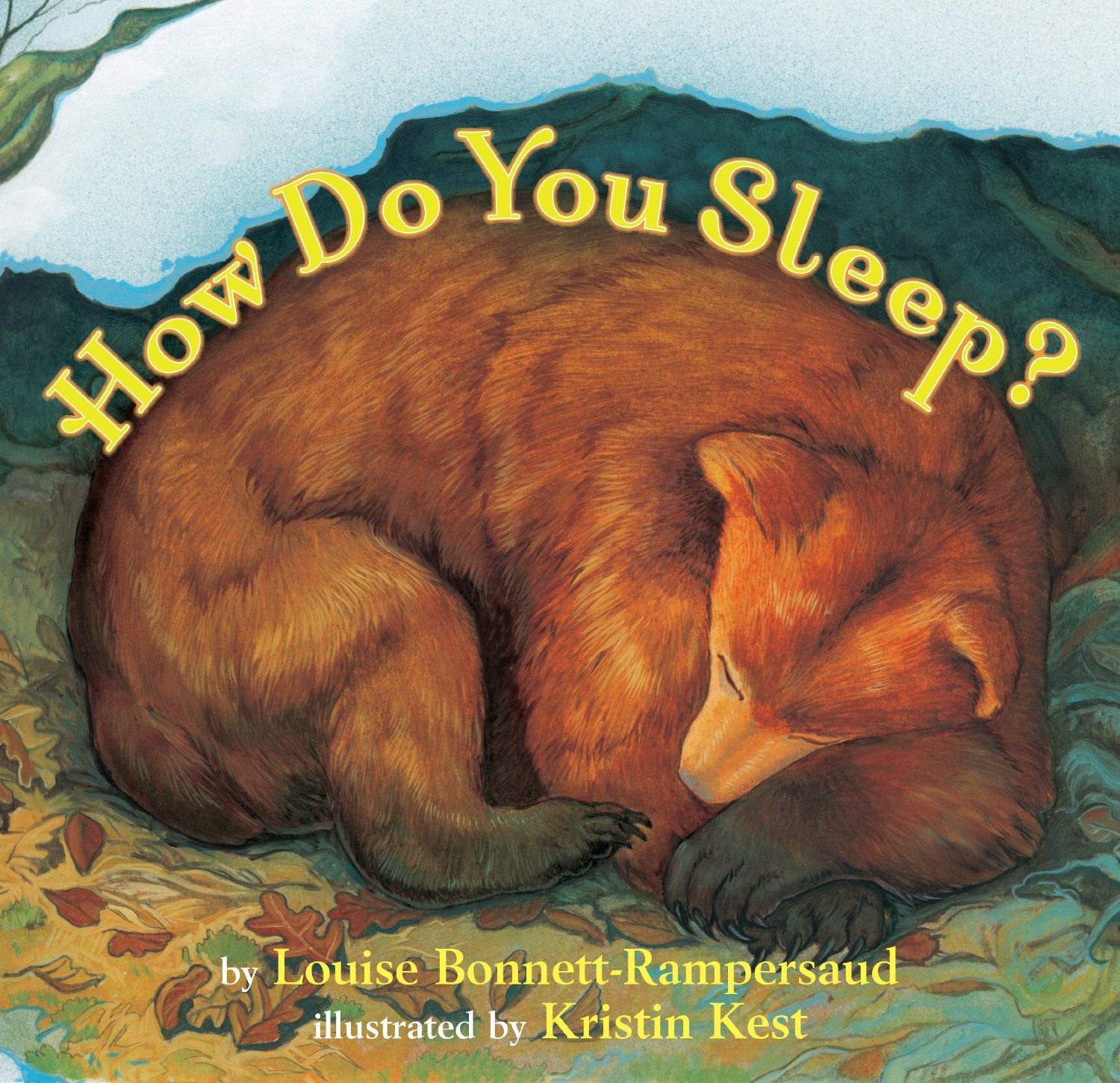
Book Review: How Do You Sleep, by Louise Bonnet-Rampersaud (Marshall Cavendish Children, 2005)

how do you sleepRecommended for ages 2-4

Different animals answer the question of how they sleep in rhyme. Children conclude the story by describing how they sleep.

This is a rhyming story about how different creatures sleep, ranging from birds to frogs to human children. The pace is soothing and repetitive: one spread asks the question, “How do you sleep?” and a different animal answers on the next. The realistic pictures of animals (and children) are rendered in oil paintings, and makes for a read-aloud that will keep viewers and listeners interested with the large and small details: the flowers on the branches where a bird sits; the mouse sitting on a bell hook in the pig sty; the cozy bed the children sit in, listening to their father read them a bedtime story. The font is a larger version of a standard one, similar to Times Roman, but it does not need to capture the reader here – the story is in the pictures.  There is a board book version of this available for younger audiences.

This is a great story to build on for a bedtime read-aloud. Encourage audiences to wear their favorite pajamas and bring a beloved toy. There are bedtime songs like Twinkle Twinkle Little Star and Star Light, Star Bright that would work well here.

The author does not appear to have her own website, but her publisher offers a link to her other book and offers the chance to sign up for updates.