Posted in Fantasy, Horror, Teen, Tween Reads

Once Upon a Zombie – these aren’t the fairy tales you’re used to!

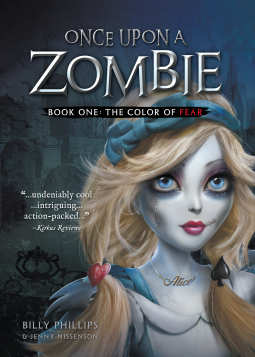
once upon a zombieOnce Upon a Zombie: Book One – The Color of Fear, by Billy Phillips and Jenny Nissenson (Oct. 2015, The Toon Studio Press), $17.95, ISBN: 9781935668343

Recommended for ages 12+

Caitlin Fletcher and her wonderkid sister, Natalie, have moved to London with their dad to try and start their lives over. Caitlin’s and Natalie’s mom disappeared four years ago, and Caitlin suffers from severe anxiety, and starting over at a new school, where the mean girls have no qualms about letting Caitlin know she doesn’t measure up, is causing more anxiety than ever. The one bright spot is Jack, the super-cute boy at school who’s been friendly to her and invites her to a school dance, but a phone mixup lands Caitlin alone, in a cemetery, where she falls down the proverbial rabbit hole and lands in a fairy tale universe! The only drawback is, in this universe, all of the inhabitants are blood-eyed zombies, living under a strange curse. The fairy tale princesses we all know and love – Snow White, Rapunzel, Cinderella, and Sleeping Beauty – have been sent to find Caitlin, because she holds the key to restoring order in their world and saving her own. But how is Caitlin, who’s two steps away from a panic attack, supposed to save an entire world, let alone herself?

Where do kids go after Goosebumps? Right here. This first book in a new series is a great way to ease younger horror fans into the zombie genre. The horror is slightly ramped up, with gorier descriptions of the living dead princesses and inhabitants of the fairy tale world, and there are allusions to zombies doing what zombies do best – Cinderella has to be yelled at to stop sniffing at Caitlin on a few occasions – but we’re not leaping into full-on gore and horror just yet. The secondary characters are familiar; we’ve grown up with them and heard about them for generations, so readers will get a kick out of this latest twist on the fractured fairy tale genre. There’s just enough romance to keep middle school girls happy, especially if they like their adventure light on the romance and heavy on the action.

Related to the book and mentioned in the story is the site, UnexplainableNews.com, a tabloid site the kids love checking out and aspire writing for. Direct your readers here (and check it out yourself) for some fun “news videos” on the zombie sightings happening all over the world that garner mention in the book.

Once Upon a Zombie is good fun for readers who love things that go bump in the night, but are ready to be just slightly more scared. Shelve it with a display of Monster High books!

Posted in Fantasy, Fiction, Tween Reads

Book Review: Dragon Slippers by Jessica Day George (Bloomsbury, 2008)

Recommended for ages 10-14

This is a princess-y book for girl who don’t normally like princess book. Creel, the main character, is not a princess, but she is independent and smart; a rags-to-riches character we’ve started expecting from fantasy heroines.

Orphans Creel and her brother live with their poor aunt and uncle, who have enough children of their own. Creel’s aunt leaves Creel to the local dragon in the hope that either a rich noble or prince will save her and marry her – and share the wealth with the rest of the family – or that the dragon will eat her, giving the family one less mouth to feed. Luckily for Creel, Theoradus the Dragon doesn’t want to eat anyone; he wants to be left alone to enjoy his hoard of shoes (each dragon has his or her own preferred hoard).
 
Creel strikes out for the king’s city, Feravel, to find her fortune as a seamstress, taking a pair of slippers given to her by Theoradus and befriends two more dragons, Shardas and Feniul, along the way. Upon arriving in Feravel, she finds seamstress work where her embroidery designs gain notice – as do her shoes. The awful princess Amalia, engaged to Feravel’s crown prince Milun, tries to force Creel to surrender the slippers. She ultimately gets them through Creel’s co-worker, Larkin, who Amalia makes a lady-in-waiting if she can get Amalia the slippers.

Amalia’s desire for the shoes has nothing to do with being fashionable, and her engagement to prince Milun is a sham – her father’s kingdom wants to take over Feravel, and the slippers give her the power to control the dragons. Creel must join forces with the king’s younger son, Luka, to find a way to break through to the dragons and bring peace to the land.

I enjoyed this book because it was unexpected. The heroine was intelligent, self-sufficient, and funny – a wry sense of humor permeates the characters without feeling forced or contrived. Jessica Day George carefully builds up without it ever feeling tedious, and she tightly weaves the various characters, plots, and subplots together to keep  readers on their toes. Just when I thought I had reached the climax of the book, I realized there was more – and I liked it. The author does not take its young audience for granted.
 
Dragon Slippers is the first book in Jessica Day George’s Dragon trilogy, and I may visit Creel, Prince Luka, and Shardas the dragon again in the future wiith Dragon Flight and Dragon Spear. Ms. Day George has written other fairy tales with smart heroines, including Princess of the Midnight Ball, winner of the Children’ Literature Association of Utah’s 2011 Beehive Award and its sequel, Princess of Glass. She keeps in touch with her fans through her blog and her website, which links to more information about the author, her books, and social media. She is also featured on the Mormon Arts wiki.
Posted in Animal Fiction, Fantasy, Fiction, Tween Reads

Book Review: The Tale of Desperaux, by Kate DiCamillo (Candlewick, 2008)

Recommended for ages 9-12

I picked this book up post-hype and after not really watching more than about 10 minutes of the movie (there really is something to be said for the movie-going experience over the at-home one). My expectations were tempered with the worry that comes when a book has been so talked about and featured in the media as Desperaux, but I needn’t have worried.

Desperaux is a story with many layers. It’s a cute animal fable with an adorable hero. It’s a love story between our hero and a princess. It’s a story that addresses hate and it addresses the darker side of nature, and how even the darkest creatures can crave the light. I wasn’t expecting the depth of character that DiCamillo invested in her characters, and I wanted to keep reading.

Desperaux is the only surviving mouse in his mother’s final litter. Born small and with his eyes open, his mother and father both write him off, but he survives. He’s tinier than his siblings and is different from the start, preferring to read books rather than eat them. He falls in love with the Princess Pea. She is enchanted with the tiny mouse, but her father, who hates rats – and equates all rodents with them – chases him away. For allowing himself to be seen by and talk to humans, the mouse council – members of whom include Desperaux’s own father and brother – decide to punish him with a death sentence, and they send him to the dungeon, ruled in darkness by the rats.

In the basement, we meet Chiaroscuro, a rat who loves the light but is forced to live in the darkness after a brief trip up to the castle living area ended with a terrible accident. He seethes and plans his revenge in the darkness, using a slow-witted servant girl with her own tragic past as a pawn in his game.

This book won the Newbery Award in 2004, and as you delve into the book, you can see why. For a children’s book, the characters’ backgrounds are incredible in their detail and complexity. I was amazed at DiCamillo’s ability to create characters with such depth and yet still make them accessible to children. The story moved along at a pace that kept me turning pages; I wanted to know what was going to happen next. Timothy Basil Ering’s illustrations were stark and beautiful, adding more depth to the story by adding to the vision the author’s words painted in my imagination.

There are some very good teaching guides for Desperaux available. Candlewick Press offers an illustrated discussion guide. Scholastic’s reader’s guide considers the movie and includes some illustrations from the animated feature. Reading is Fundamental (RIF) also has a free, downloadable Teacher’s Guide.