Posted in Non-Fiction, Teen, Tween Reads, Uncategorized

Place Hacking: A Don’t Try This At Home guide to urban exploration

place hackingPlace Hacking: Venturing Off Limits, by Michael J. Rosen (Feb. 2015, Twenty-First Century Books), $33.32 ISBN: 9781467725156

Recommended for ages 12-16

Activities like urban exploration and BASE jumping have become hugely popular over the last decade. Is it because we live in such a disposable society, that people have a need to preserve a moment in time? Is it the chance to find something new in a world that has been exhaustively explored and catalogued? There are many reasons and theories behind “place hacking”, as these kinds of activities have come to be known, and Michael J. Rosen explores the reasons, as well as the different types, of hacks. From urban explorers, seeking out abandoned and underground structures, to BASE jumpers, who look for the next (literal) high, to urban infiltrators – folks who get a kick out of showing up and gaining access to places they shouldn’t be, this is a great guide for anyone fascinated by the phenomenon.

Rosen does make sure to tell his audience that this is NOT a place hacking handbook, and emphasizes the dangers and hazards these explorers take on themselves, not the least of which is the risk of arrest and incarceration. Armchair urban explorer like myself will love this vicarious trip, and history fans can pair this with a favorite episode of the old History Channel show, Cities of the Underworld, and enjoy. Classrooms and libraries can use this in a history feature or an urban adventure feature (but PLEASE warn your audience not to try this at home!).

You can find Mr. Rosen’s author page here; he features information about his other works, links to social media, and information about school visits.

Posted in History, Middle Grade, Non-fiction, Tween Reads, Uncategorized

Women Heroes of the American Revolution introduces us to the unsung heroines of history

women heroes of the american revolutionWomen Heroes of the American Revolution: 20 Stories of Espionage, Sabotage, Defiance, and Rescue, by Susan Casey (Mar. 2015, Chicago Review Press), $19.95, ISBN: 9781613745830

Recommended for ages 10-14

You’ve heard about Dolly Madison saving Washington’s portrait as the White House burned during the War of 1812. You’ve probably even heard of Molly Pitcher, who took up arms against the British after her husband fell in battle. But did you know about Sybil Ludington, the daughter of a revolutionary colonel, who rode twice as far as Paul Revere in order to warn her father and his troops of an impending attack? Or Deborah Sampson, who donned a man’s uniform and went to war, only to be denied a pension until George Washington himself intervened? Did any of us learn Phyllis Wheatley, kidnapped and sold into slavery at the age of 7, who supported America’s independence and wrote poetry celebrating George Washington?

You can find stories about these women and 11 more in Susan Casey’s Women Heroes of the American Revolution. The book is divided into five parts:Resistors, Supporters and Rescuers; Spies; Saboteurs; Soldiers and Defenders of the Homefront, and Legendary Ladies. Each section highlights 3-5 women who contributed, each in her own way, to the American Revolution. There are images and sources aplenty available for further research, along with a bibliography and further notes available for readers who want to learn more. A glossary helps readers with some terms they may be unfamiliar with.

This is a great go-to reference when beginning a project. I’ve had students come in and ask for books on the American Revolution, where they want to write on a more specific historical figure, but aren’t exactly sure where to begin. Getting some focus on lesser-discussed historical women would be a great way to generate interest for those students who may want something, or someone, “new”.

Women Heroes of the American Revolution is a great addition to Chicago Review Press’ “Women Heroes” series.

Susan Casey’s author page has great resources for librarians, particularly about her Women Invent! and Kids Invent! books.

Posted in Non-Fiction, Teen, Young Adult/New Adult

Alice + Freda Forever looks at a shocking murder – in 1892

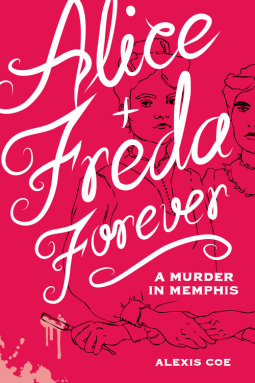
alice and fredaAlice + Freda Forever, by Alexis Coe (Oct 2014, Zest Books) $16.99, ISBN: 9781936976607

Recommended for ages 15+

The late 1800s was a buttoned-down time in America. Girls were expected to marry, but were encouraged to cultivate intimate female friendships-a practice called “chumming”-with one another. Same sex love, though? Same sex marriage? Not even entertained as a concept.

Alice Mitchell and Freda Ward were two teenage girls whose feelings for one another went beyond “chumming”. They planned to run away and marry. Alice intended to live her public life as a man, working to support her Freda, and live happily ever after. When their plot was discovered and communication forbidden between the two, Freda obeyed her mother, moving on with her life. Alice snapped.

On a cold January day in 1892, Alice slashed Freda’s throat, in public, in front of horrified onlookers. What followed was a trial that became the event of the century, that forced both legal teams to examine the supposed insanity of same-sex love.

While same-sex love became a hotly debated topic, the country was still years away from another issue that emerged during this trial – racial equality. It was never in doubt that Alice murdered Freda, but being a young, white girl from a good family. the punishment was an issue. How could you send a young woman like that to hang? Meanwhile, three black grocers, in the same jail as Alice, were dragged out and hanged by a lynch mob for defending their store from a robbery by whites.

I’d seen something about Alice and Freda a couple of years ago on a History Channel show – the name long escapes me – so when I saw this book mentioned in School Library Journal, I HAD to read it. This book is fantastic – Alexis Coe is an archivist who spent the time to collect this story in primary sources – letters, newspaper clippings, court proceedings – and her work shows. It’s nonfiction that reads like fiction, with companion drawings of evidence.

This is an amazing book for teen readers and beyond. Its historical relevance is not to be ignored, and while readers can appreciate where we’ve come as a society, they can also see where, sadly, we’ve become stuck.

All in all, Alice + Freda Forever is an unputdownable read.


Posted in Middle School, Non-Fiction, Tween Reads

ChitChat Makes Phonics and Language Made Interesting for Middle Graders

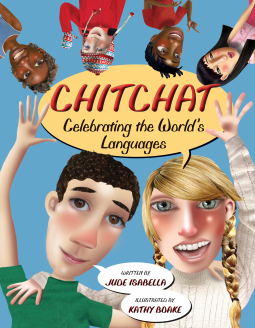
chitchatChitChat: Celebrating the World’s Languages, by Jude Isabella/Illustrated by Kathy Boake. Kids Can Press (2013), $17.95, ISBN: 9781554537877

Recommended for ages 9-12

ChitChat takes a look at language – spoken, written, and sign;  how it’s evolved, and how it continues to evolve over time. Author Jude Isabella talks about everything from phonics sentence structures to the Rosetta Stone, slang, dead and endangered languages to how babies and toddlers can learn up to one new word every 90 seconds – all in 44 pages. It’s an incredible amount of information packed into a relative handful of pages, and yet nothing feels forced, rushed, cut off, or – and this is the most important part – boring.

Kathy Boakes’ illustrations are fun and interesting; she creates fun graphics using distorted faces from a wealth of ethnicities and giant mouths that call attention to interesting facts. There are fun callout boxes and graphics, including an interesting look at endangered languages of the world set against a map of the world. I was particularly happy to see a section devoted to diagramming a sentence – I haven’t seen one of those in far too long!

ChitChat is a good book to have in school and home libraries. Middle graders will get a kick out of the bite-sized facts and information, and pick up some Victorian slang while they’re at it (“fizzing fart catcher” is really a term I’d like to see someone bring back).

Posted in Non-Fiction, Tween Reads

Helaine Becker’s Zoobots – The Future is Now, and there are robot snakes!

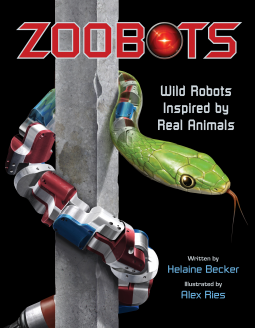
zoobotsZoobots: Wild Robots Inspired by Real Animals, by Helaine Becker/illustrated by Alex Ries. Kids Can Press (2014), $17.95, ISBN: 9781554539710

Recommended for ages 8-12

Robot Snakes. That’s the first thing that jumped out at me when I saw the cover of this book on NetGalley, and I knew that not only would my 10 year-old love this book, but so would every 10 year-old in the several library sites I oversee. That is the kind of book Zoobots is – it’s a win-win situation. You have robot animals, complete with facts about the functions and statistics on the robotic creatures, plus profiles on the animals influencing them; you also have the nonfiction aspect, which makes it compatible with Common Core focus on nonfiction texts, with the extra STEM (Science, Technology, Engineering, Mathematics) appeal that will hopefully inspire a reader or 3 to become a scientist and actually work with these robots.

Helaine Becker’s text is chunked into a dossier-type format, complete with futuristic fonts. We get the name of the robot – some include the Shrewbot, the Octobot, the Ghostbot, and the Nanobot – and what class of animal its influence belongs to (i.e., mammalia, reptilia). There are skills, specifications, and applications: the growing number of robotics dedicated to the medical industry alone is amazing, as is the idea of using pill bug-inspired robots to help prevent raging forest fires. Special Ops describes special talents these robots can use while in the field; my favorite is the Uncle Sam snake robot, who can actually assemble itself!

There is no science fiction here – all of the 12 robot animals profiled are in some sort of prototype stage, whether being developed or in existence. A section on the future wonders what further robots future minds will create, which I hope spurs some readers to start sketching and joining robotics teams. There is a glossary of terms and a full index.

I loved this book, and think it belongs in libraries and science classes throughout elementary and middle schools. The illustrations, by concept artist and illustrator Alex Ries, give life to the robotics, spotlighting their flexibility and their features. The book is only 36 pages, but the number of lesson plans and ideas that can come out of this? Boundless.

Posted in Non-Fiction, Teen, Tween Reads

Daniel Stefanski Teaches Us How to Talk to An Autistic Kid

HowToTalkToAnAutisticKidHow to Talk to an Autistic Kid, by Daniel Stefanski/illustrated by Hazel Mitchell. Free Spirit Publishing (2011), $12.99, ISBN: 978-1575423654

Recommended for 8+

Daniel Stefanski, an autistic teen, wrote this book to teach other kids (and adults!) about autism from a more personal point of view. There are many guides and books out on the market, but Daniel’s personal approach and point of view, combined with Hazel Mitchell’s friendly, two-toned digital illustrations, make a greater impact. He isn’t using clinical speech and medical language, nor is he a parent taking sides in a debate. He’s a kid who wants other kids to understand him, befriend him, like him, and understand, befriend, and like other kids with autism. He explains behaviors that other kids may not understand, like flapping or humming, for instance; he discusses issues including eye contact, personal space, and most importantly, how other kids can reach out to and connect with autistic kids in their lives.

This book is only 48 pages, and can be quickly and easily read, but the information is invaluable in teaching children and adults to see things from another person’s point of view. As Stefanski himself says, “Even though my brain is different, I’m still a kid. I like to have fun and I want to have friends.” This is a book that needs to be available not only in public libraries, but in school and classroom libraries, where it is easily accessible and kids are actively encouraged to read it.

TalktoAutisticKid-800

Posted in History, Non-Fiction, Tween Reads

Book Review: Chasing Lincoln’s Killer, by James L. Swanson (Scholastic Press, 2008)

Recommended for ages 12+

Chasing Lincoln’s Killer is the story of the plot to kill President Abraham Lincoln, the assassination and ensuing manhunt for John Wilkes Booth and his fellow conspirators. Author James L. Swanson based this YA version on his previous book, Manhunt: The 12-Day Chase for Lincoln’s Killer (William Morrrow, 2006).

A lifelong Lincoln aficionado who shares the 16th President’s birthday, the author wanted to bring his story to a younger audience. He never dumbs down the narrative to reach this audience; rather, he makes it more accessible by featuring over 70 photos of artifacts, newspapers and photos taken from various archives; he summarizes trial manuscripts and interviews, and moves the events along at a pace that younger, less patient readers will enjoy and stick with.

Scholastic’s website offers free teaching resources to use with the book including an audio book excerpt, video interview with the author, and printable Wanted! poster for Booth.

Manhunt received an Edgar Award for the best true crime book of the year in 2007; Chasing Lincoln’s Killer has received recognition as a Young Adult Library Services Association (YALSA) Best Book for Young Adults. Mr. Swanson holds a seat on the advisory council of the Ford’s Theatre Society. He has collected books and artifacts on President Lincoln since he was 10 years old and has written a photographic history, Lincoln’s Assassins: Their Trial and Execution.

Posted in Espionage, History, Non-Fiction, Tween Reads

Book Review; Secrets, Lies, Gizmos and Spies, by Janet Wyman Coleman with The International Spy Museum (Abrams Books for Young Readers, 2006)

Recommended for ages 9-12

Kids like spies. Spies are cool, after all. James Bond is suave and rocks the coolest gadgets in the world, and Chuck is a computer store geek turned international man of mystery. There was Agent Cody Banks, and there are the Spy Kids movies. Fast food restaurants have give spy toys away as prizes in their kids’ meals. The romantic mystique of the spy appeals to all ages.

Secrets, Lies, Gizmos and Spies, written in conjunction with the International Spy Museum, is a visual history of spying. There are photos and artifacts, with the stories of real-life spies from all over the world and throughout recorded history. The book provides key terms and timelines and even an imagined interview with George Washington using actual quotes from the first President with regard to his spying operations during the Revolutionary War. The book has beautiful color and black and white photos on every page, and will interest both boys and girls interested in adventure or history.

The International Spy Museum’s website offers the usual museum fare including membership and ticket information. They also have a podcast (with new episodes roughly every two weeks) and a blog, both with RSS feed capability. They offer birthday parties, school field trips, and Spy City Tours where visitors will be briefed by former intelligence officers and learn how to be a master of disguise.
Posted in History, Non-Fiction, Tween Reads, Women's History

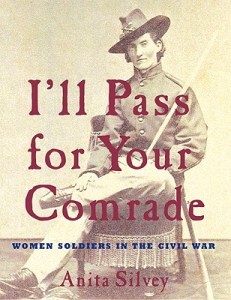
Book Review: I’ll Pass for Your Comrade, by Anita Silvey (Clarion, 2008)

Recommended for ages 9-12

I’ll Pass for Your Comrade is a line taken from a Civil War Ballad, “The Cruel War”; a woman is saying goodbye to her love, leaving to fight, and begs to join him in combat. She offers to “pass for his comrade” – something that, according to the National Archives, at least 250 women did during the Civil War. Many women fought to be with their husbands and fiances. Some women fought for revenge. Some women fought for the thrill of battle. Unfortunately, because they had to keep their stories silent, most of these stories have been lost. I’ll Pass for Your Comrade tells the stories of some of the women who donned men’s uniforms, cut their hair, and went to war.

We hear the words of the women who fought, like Loreta Janeta Velazquez, who wrote about her participation in the Battle of Bull Run as Lieutenant Harry T. Buford. We see photographs of women like Frances Clayton, featured in the book both dressed in her uniform and her dress. We learn about their lives after the War, and how some of them took their secrets to the grave, their families only discovering their truth after death.

The book has black and white photographs and primary documents reprinted throughout, offering students the chance to see history as they read about these women. The author also provides a bibliography for further reading. This would be a strong selection to use during Women’s History Month or during a Civil War unit.

Posted in History, Non-Fiction

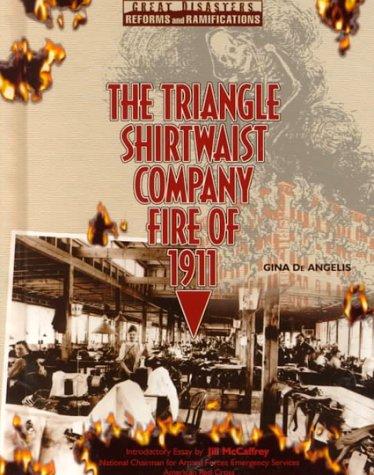
Book Review: The Triangle Shirtwaist Factory Fire of 1911, by Gina De Angelis (Chelsea House, 2001)

Recommended for ages 10+

The shirtwaist was a high-necked, long-sleeved blouse design popularized by the iconic Gibson Girl image in the early 1900s. At this time, New York boasted about 450 shirtwaist factories, but building codes and labor laws left a lot of room for interpretation. As a result, on March 25, 1911, a fire broke out in the Triangle Shirtwaist Company in the Asch Building in downtown Manhattan. Multiple factors – locked doors to prevent workers from leaving early or stealing materials; ineffective and too few fire escapes and elevators, and crowded office conditions among them – caused the deaths of 146 workers, mostly women, many recent immigrants. The fire and the ensuing trial – which exonerated the company’s owners – gave rise to movements pushing for stronger building safety standards and unionization of garment workers, which would help them lobby for better working conditions and better pay.

The Triangle Shirtwaist Company Fire of 1911 tells the story of the fire and the aftermath. Black and white photos taken at the scene and the makeshift morgue bring home the pain of the event and drive home the magnitude of the fire. Readers learn that the owners, Max Blanck and Isaac Harris, went on to continue business and continue the business violations that caused so many deaths at the Asch Building, having been cleared of any wrong doing because the Asch Building was legally sound. The owners made money after the insurance settlement, causing an outcry among the deceased’s family members. The book also details the story of the garment workers labor movement and takes the reader into present-day sweatshop conditions and the continued fight for safe working conditions and a living wage. 

Cornell University’s Kheel Center for Labor Documentation’s web exhibit with primary and secondary sources, a link to a transcript of Blanck and Harris’ trial, and a bibliography. Nonprofit organization Remember the Triangle Fire Coalition, seeking a permanent memorial to the victims, offers an open archive where contributors add their own modern-day remembrances and information and a names map which lists the name, country of origin, New York address, and final resting place of the identified victims.

Short PBS documentary on the Triangle Fire.