Posted in Fiction, Fiction, Graphic Novels, Intermediate, Middle Grade, Non-fiction, Non-Fiction, Tween Reads

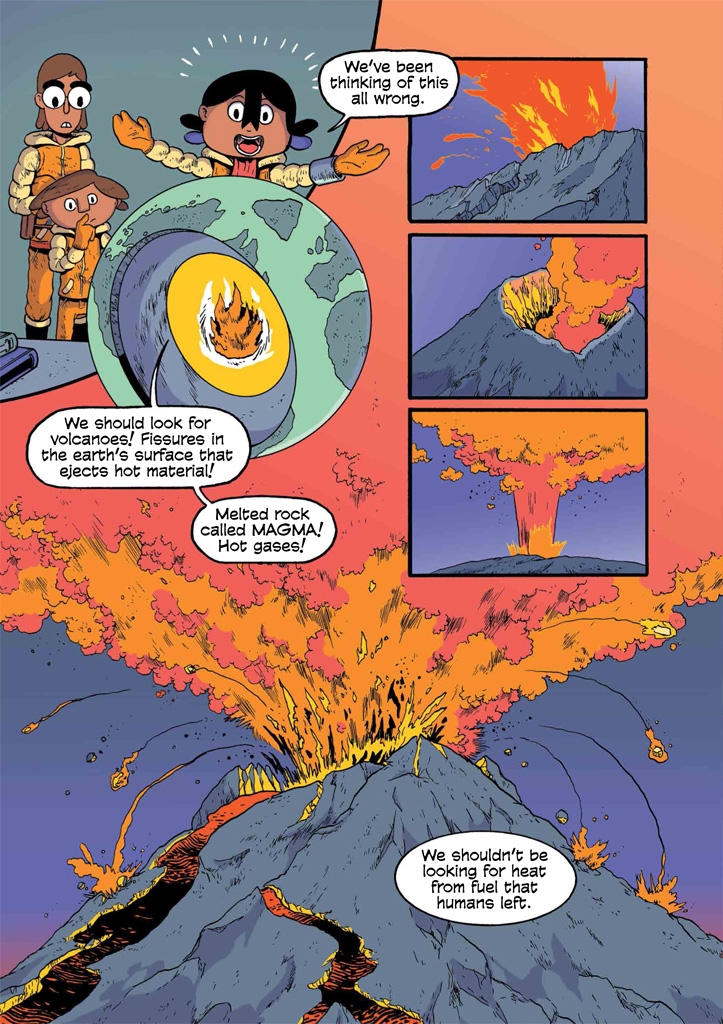
Science Comics explores Volcanoes

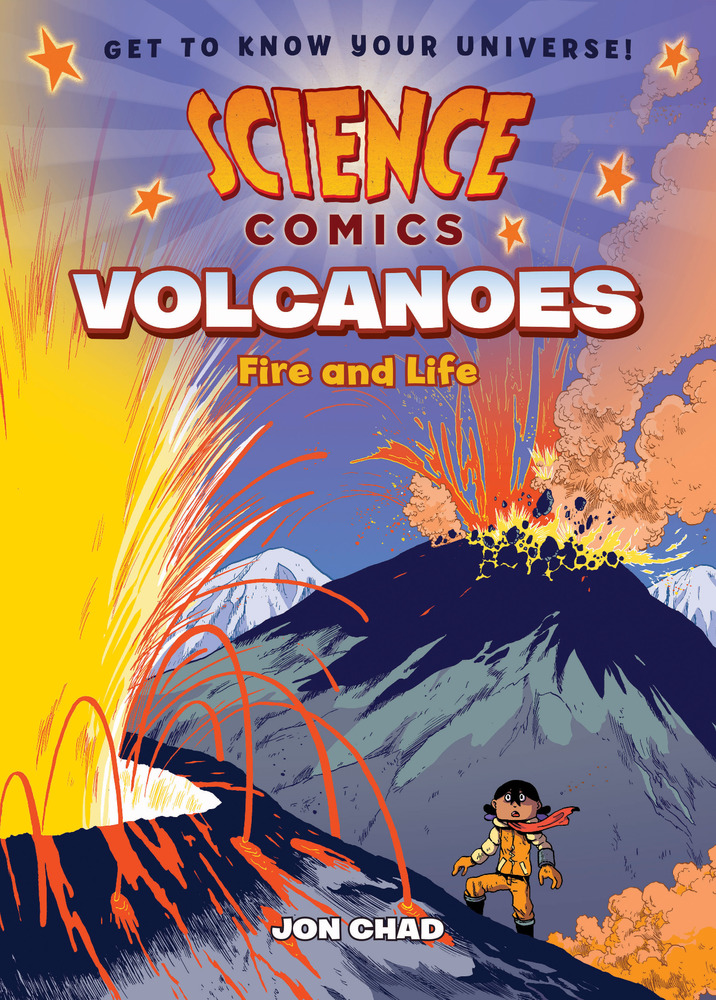
volcanoesScience Comics: Volcanoes-Fire and Life, by Jon Chad, (Oct. 2016, First Second), $12.99, ISBN: 9781626723603

Recommended for ages 8-12

Earlier this year, we got a look at First Second’s two Science Comics, Coral Reefs and Dinosaurs. There’s great science and fun art wrapped up in each of these comics, so I was super-psyched when I met a First Second rep at the PLA Conference this year, and she told me that there were more Science Comics coming. True to her word, we’re getting Volcanoes in just a couple of weeks.

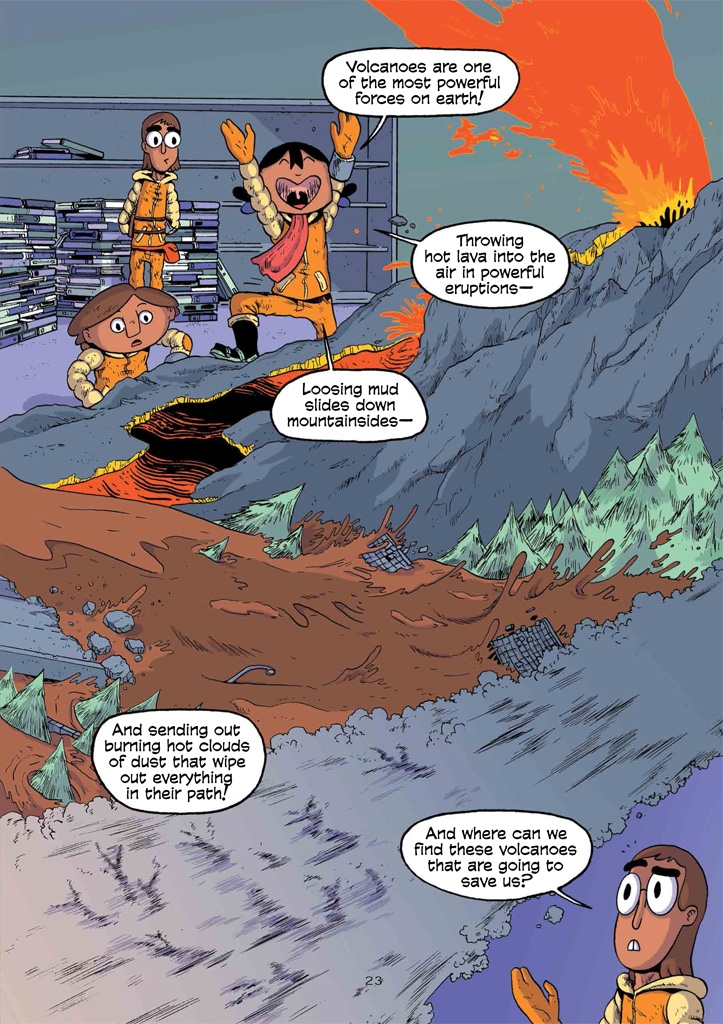
Similar to Coral Reefs, Volcanoes wraps information about volcanic activity into a story: there’s been some sort of environmental cataclysm, and Earth is freezing. A tribe is scanning books when Aurora, one of the kids, discovers a book about volcanoes; she is HOOKED. She’s saved her tribe! The power to warm the planet is right underneath their feet!

From there, Aurora becomes the reader’s guide through a look into the activity bubbling under the earth’s crust: there are magma vents, shifting tectonic plates, and volcanic eruptions. Volcanoes create just as much as they destroy: there are entire land masses that owe their existence to a volcanic eruption, just as there are entire cities that have been wiped out by them.

Posted in Animal Fiction, Fiction, Fiction, Intermediate, Middle Grade, Non-fiction, Non-Fiction

What Dog Knows

what-dog-knowsWhat Dog Knows, by Sylvia Vanden Heede, (Sept. 2016, Gecko Press), $16.99, ISBN: 9781776570362

Recommended for ages 7-10

Wolf is tired of his cousin, Dog, always knowing more than he does, so he checks a book out of the library (never mind that he can’t read), and tries to outsmart Dog with his new knowledge about mummies, knights, and dinosaurs.

Mixing facts into the fictional tale of the Dog and Wolf, this seems like it’s geared toward younger readers, but then throws in the process of mummification, and a plotline where Wolf intends to mummify Cat, his antagonist, and suddenly, things take a little bit of a weird turn. This wasn’t really my book, and I don’t see the kids in my library really catching on with this one because it’s a bit disjointed and quirky. The art is very sweet, and I did love that Cat struck fear into Wolf’s heart, but overall, it didn’t work for either age group (4-7 vs 8-12) for me.

This is the second Dog and Wolf book from Gecko. Wolf and Dog was published in 2013.

Posted in Middle Grade, Middle School, Non-Fiction, Non-fiction, Teen, Tween Reads

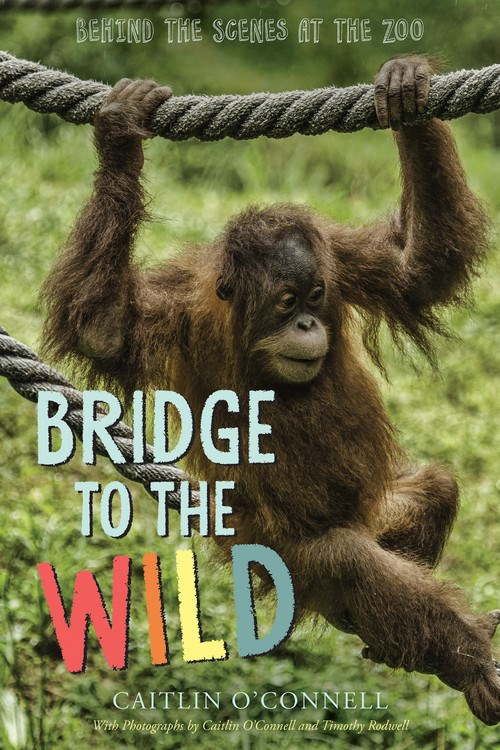
Bridge to the Wild: Zoos connect people and animals

bridge-to-the-wildBridge to the Wild, by Dr. Caitlin O’Connell/Photographs by Timothy Rodwell, (Aug. 2016, HMH Books for Young Readers), $18,99, ISBN: 9780544277397

Recommended for ages 10 and up

I’m about to gush here. If you read my reviews often enough, you probably have guessed that I love any nonfiction book about animals, conservation and preservation, and even better when the ideas are combined. In Bridge to the Wild, Dr. Caitlin O’Connell begins by recalling a childhood visit to the zoo – back when animals were still largely kept in cages (I remember it well), and saw a gorilla, seemingly in deep despair over living in a cage not much bigger than he was.

Thankfully, those days are (mostly) over. Zoos are more like natural preserves now, offering many animals larger spaces to roam; conservation and preservation is the order of the day, with zoo staff rescuing and caring for animals all over the world. As more animals face extinction at the hands of poachers, habitat devastation, and pollutants that contaminate their environment, zoos are playing a bigger part in keeping our wildlife alive, and conducting valuable research on improving their conditions and our world. Bridge to the Wild is Dr. O’Connell’s manifesto, where she lays out the valuable ways zoos are a bridge for humans, to the wild outside our doors.

Dr. O’Connell spent a week working with the staff at Zoo Atlanta –  a private, nonprofit wildlife park and zoo – to observe the relationships between animals and caretakers, to help strengthen this bridge. After all, what we see as observers is only the tip of the iceberg; many, many loving and brilliant people are behind the scenes, learning about and learning from the animals, caring for them, loving them. From the Dawn Chorus – the morning symphony conducted by the tenants as the day begins, to the Dusk Chorus, when they start winding down for the night, Dr. O’Connell and Tim Rodwell introduce us to the inhabitants of Zoo Atlanta, from the pandas, to the hornbills, meerkats, gorillas, tigers and more.

There are anecdotes and beautiful photographs, a “Keeper Feature” that profiles the different keepers at Zoo Atlanta, and a fantastic note on ignorance and extinction, which is a real call to action to end senseless poaching of animal parts for talismans and “remedies” that simply don’t work. A full bibliography and sources are available and provide more research opportunities, and data sheets encourage budding zoologists to do some research on their own, guided by Dr. O’Connell, who lays out simple experiments to observe and record behaviors.

Animal books are hugely popular with my Corona Kids, and I’ve been stacking my collection with plenty of rescue, preservation, and conservation titles for them, to drive home the point that this planet doesn’t only belong to us. Bridge to the Wild is going to be one of those books I talk endlessly about, especially since my library is about a stone’s throw away from the Queens Zoo. I may even slip copies of this book into teachers’ hands during class visits, with a “hint, hint” nudge for a class trip activity (sorry, kids!). That’s how important this book is to me.

Bridge to the Wild has received a starred review from School Library Journal. Learn more about Dr. O’Connell’s work and books at her author website.

Take a peek at a chapter excerpt on meerkats, then go order this book for your animal lovers!
meerkat_1


Posted in Middle Grade, Non-Fiction, Non-fiction, Teen, Tween Reads

You want football stats? SI Kids has them! 1st and 10 is loaded with lists, stats, and photos!

sikidsfootballSports Illustrated Kids 1st and 10: Top 10 Lists of Everything in Football (Revised & Updated), by the Editors of Sports Illustrated for Kids, (July 2016, Sports Illustrated, $19.95, ISBN: 978-1-61893-173-3

Recommended for ages 8+

Do you love lists? Do you love stats? Do you love football? There’s something for everyone in this updated edition of Sports Illustrated for Kids’ book, 1st and 10: Top 10 Lists of Everything in Football. There are loads of Top 10 lists, sure: Top 10 Rivalries, Nicknames, Fantasy Performers, Stadiums, and more, but each of these lists is loaded with stats: dates, scores, major games, players, you name it. There are 36 lists in all, with some great career highlights for longtime football fans and new ones who want to learn some of the history behind the sport.

Since I’m not well-read or conversant in sports, I’ve been trying to beef up some of that knowledge so I can guide the kids at my library to books that will interest them; 1st and 10 is a great book for me to lead them to. I can easily booktalk it, because it’s quick bites of information. There are things I can focus on, like the Top 10 Artifacts (the first Super Bowl ring! A football from 1895! My inner archivist and history nerd is rejoicing!), Movies (The Replacements is a long guilty pleasure of mine), and Hairstyles (My hair on the most humid of days has nothing on Troy Polamalu).  Add in the stunning photography that you’d expect from Sports Illustrated, and you have a book that collectors of any age will enjoy.

1st and 10 is part of a series of Top 10 lists for each sport: you can also add Full Count: Top 10 Lists of Everything Baseball, Slam Dunk! Top 10 Lists of Everything Basketball, Face-Off! Top 10 Lists of Everything Hockey, and The Top 10 of Everything Sports. I’ll be putting these books on my shelves, now that I know about them. They’re great go-to resources for any library that has sports fans coming through the doors.

Posted in Early Reader, Intermediate, Non-Fiction, Non-Fiction, Non-Fiction

Celebrate diversity with The Barefoot Book of Children!

barefoot_1The Barefoot Book of Children, by Tessa Strickland and Kate DePalma/Illustrated by David Dean, (Oct. 2016, Barefoot Books), $19.99, ISBN: 9781782852964

Recommended for ages 3-8

“Every morning, millions of children open their eyes and start another day.”

Using broad statements and insightful questions about how we live, love, and play,  The Barefoot Book of Children introduces readers to children all around the world. David Dean’s bright, hand-painted illustrations show how families around the globe live; dress; and pray and worship. We get glimpses into the treasures we all keep, the stories we all have to tell, the meanings behind our very names. With questions like, “How do you share your love?” and “What will happen in your story?”, the book invites kids to come together and talk about their lives and their families, learning how we are unique and the same, all at once. Illustrated notes at the end of the book provide a deeper examination of the book, focusing on homes, special places, and hobbies featured in the book.

I’m from Queens, New York; one of the most diverse places in the country. The Barefoot Book of Children is what every library, every school, in my borough should be reading and making available to the kids we serve, because every child here will see themselves in this book. That’s tremendous. It brings us together by introducing us to other cultures through the familiar: play, family, home. The bright artwork is so inviting, you can’t help but pull up a comfortable seat and spend some time getting to know your world better.

I loved this book, and I think parents, educators, and most importantly, kids, will, too. Take a look at more of the book and consider adding it to your wish lists.

barefoot_5

barefoot_6

barefoot_4


Posted in Intermediate, Middle Grade, Non-Fiction, Non-fiction, Non-Fiction, Tween Reads

Need to know about sports? NatGeo’s got you covered.

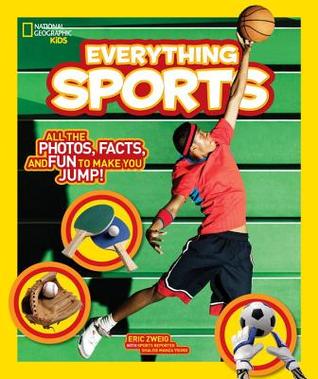
sportsNational Geographic Kids: Everything Sports, by Eric Zweig with Shalise Manza Young, (March 2016, National Geographic Kids), $12.99, ISBN: 9781426323331

Recommended for ages 8-12

I am not a big sports girl, often to my husband’s chagrin. Don’t get me wrong, I love watching the Olympics, and there are sports I enjoy watching, like fencing and gymnastics, but it’s not often that I get to watch those (usually, just during the Olympics). Many of the kids in my library are big sports fans, though, so I need to become better versed in some general sports books, so I can booktalk and show them books that may appeal to them. As always, I start with NatGeo Kids, because 1) their books fly off my shelves; 2) they’re comprehensive, with beautiful photos, and 3) they have little fact tidbits that always help with a booktalk or party talk.

Everything Sports is a great go-to for general sports info, especially for newbies who want to learn more, like me. The book is only 64 pages – not a huge commitment to a history of every sport ever played – and written by two sports journalists who also have a gift for making their complete understanding of sports readable and digestible to all. Sharlise Manza Young shares her knowledge throughout the book in her “Explorer’s Corner” feature, providing a little more background info on some of our most popular sports. There are fun activities and quizzes throughout -kids can make their own sports cards, which opens up a world of program possibilities for me, especially during World Cup season, because my Corona Kids are also devoted soccer (ahem… “football”) fans.

Everything Sports is a great add to where you’re building a strong sports collection. Display with David Stabler’s Kid Athletes and your seasonal sports books, plus any biographies on popular atheletes in your community. Just coming off of a fantastic Olympics showing, you can display from gymnastics books and talk up recent Olympians, including the Fabulous 5 (also a great opportunity to talk up the amazing diversity on this season’s team), Olympic swimmers Simone Manuel, Katie Ledecky, and Michael Phelps, and since yes, there is fencing in the book (yay!), let’s talk about Ibtihaj Muhammad, who set the strip on fire in Rio!

sports_1sports_2

Photos courtesy of DogoBooks.com
Posted in Intermediate, Middle Grade, Non-Fiction, Non-fiction, Non-Fiction

Animal Planet’s Animal Atlas is a passport to the world’s habitats

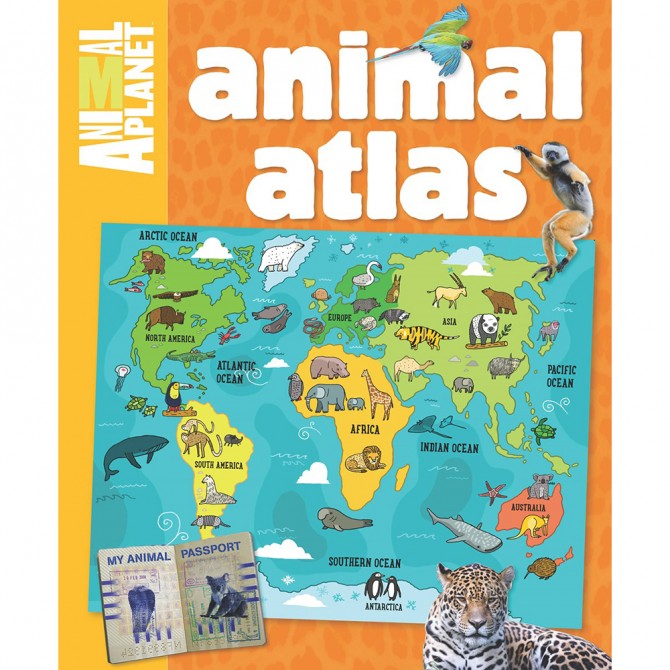
animal-planet-animal-atlas-hardcover-book-658_670Animal Planet Animal Atlas, by Animal Planet (May 2016, Animal Planet), $17.95, ISBN: 978-1618931658

Recommended for ages 7-10

I have tons of animal nonfiction books in my library, and I have a bunch of really good books on habitats, too.  What Animal Planet’s Animal Atlas does it bring together explanations of different biomes/habitats, and the animals who live in them on each continent and in the oceans of our world.

The atlas begins with a map to present the major biomes of the world, and describes each biome: alpine, desert, marine, grassland, rain forest, temperate forest, tundra, and taiga. Animal tour guides for each continent take readers through a look at different animals that inhabit each biome on each continent, and features like ROAR (Reach Out. Act. Respond.) – Animal Planet’s initiative, dedicated to improving the lives of animals worldwide – empower kids with knowledge about how humans are working to change the world for the better through conservation and protective measures. Surprisingly Human boxes provide facts about the similarities between animals and people. Each continent section ends with a spotlight on an animal from the area, giving readers a close-up look at animals like the bald eage, anaconda, or Sumatran tiger. Spotlights include a Where in the World section, where maps detail the animals’ living areas; Animals Facts, and information on what they eat and how animals adapt best to their environments.

Combining colorful illustration and full-color photographs of over 200 animals, the atlas is a great resource for young readers. It’s got information ready at a glance for my Corona Kids, who come in asking for books about various habitats and then, what animals live in those habitats. It’s a strong companion book for slightly bigger kids, who will need more in-depth books to complete a report, but it’s a great starting point for anyone who wants a little more info on different habitats, and who may not realize that different continents have so many different biomes. A brief glossary and index round it all out.

This is a good addition to primary nonfiction collections if you have strong books that provide more detail that kids can jump to if they want to go further into a topic. Or, if you’re like me, and your kiddo just loves learning about different animals, where they live, and what they eat, it’s a nice add to your bookshelf. The passport and guide animal features add a cute touch that brings something different and fun to learning. Hmmm… now, I’m thinking of an animal program for my Discovery Club… learning about a new animal each week, and stamping a “passport” with an animal sticker or stamp… I’ve got to talk to my Discovery Team!

Posted in Early Reader, Intermediate, Non-Fiction, Non-Fiction

Animal Planet’s Animal Bites series is great for young readers!

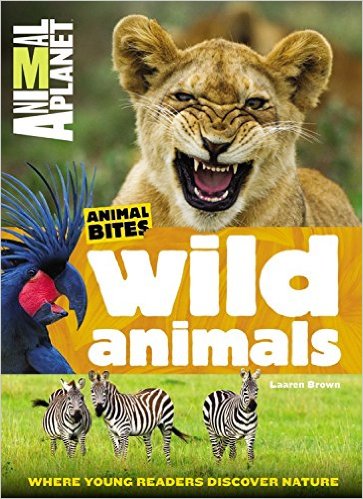
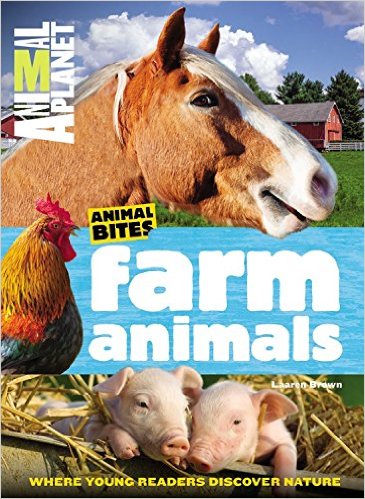
Animal books are KING with younger readers. I gush constantly about the NatGeo books, but I’ve just been made aware of Animal Planet’s Animal Bites series: books spotlighting animals from different habitats, like Farm Animals and Wild Animals, and loaded with bite-sized info (see what I did there?), questions for discussion, and yes, outstanding photos.

wild animalsEach book is organized to guide readers through information about family relationships, animal bodies, ecosystems, play time, conservation, and so much more. Check boxes throughout prompt discussion about whether these animals are friendly or would make good pets (bears, not so much; horses, yes) and discussion questions ask kids to compare themselves with animals: do you like to play games, like a border collie does? We get infographics on featured animals, including geographic location, weight, and height, and to help younger kids form a more solid frame of reference, a comparison to something most of us see every day, from a truck to a computer printer.

I love the emphasis on conservation, particularly in the Wild Animals book. Features on animals that have been saved from the brink of extinction, like the gray wolf, make very real the idea that conservation works when there is awareness.

Each book ends with a quiz, an activity and a craft, and a robust list of resources, a glossary, and an index. Endpapers lead readers in and send them off with a gorgeous photo of an animal.

There are over 200 photos in each book, along with infographics, maps, and informative Quick Bites. Other books in the series include Animal Planet Polar Animals and Animal Planet Ocean Animals.farm animals

Further committing to conservation, a portion of the proceeds benefits Animal Planet’s R.O.A.R. (Reach Out. Act. Respond.) campaign that partners with leading animal organization to make the world a better place for domestic and wild animals.

My 4 year old LOVES these books: trying to get them back so I could refer to them for this review was fun (he’s at school right now). Every page is a new discovery, something waiting for him to find and explore. Sometimes, he plays with his animal toys, showing me his horses when I read the section on horses; he’ll show me a lion when I get to a spotlight on lions. If he asks why his shark is missing, I’ll explain that I have to buy him a copy of Ocean Animals. 😉

Kids love animals. Animal Planet books make it easy for you to bring more animals into their lives, and even more importantly, to discuss humane treatment of animals and the importance of conservation of our planet with them. The books are a nice, sturdy softcover, perfect for tucking into your tote bag when you’re traveling (or sneaking your kid’s copy out so you can read it on the way to work), and it’ll hold up to repeated reads.

Animal Planet: Animal Bites – Wild Animals, by Laaren Brown (Animal Planet, June 2016), $12.95, ISBN: 978-1618934147

Animal Planet: Animal Bites – Farm Animals, by Laaren Brown (Animal Planet, June 2016), $12.95, ISBN: 978-1618934130

Recommended for ages 4-8

Posted in Humor, Intermediate, Middle Grade, Non-fiction, Non-Fiction, Tween Reads

My Weird School: nonfiction on the run with Fast Facts!

My Weird School_GeoMy Weird School Fast Facts: Geography, by Dan Gutman/Illustrated by Jim Paillot, (June 2016, HarperCollins), $5.99, ISBN: 9780062306173

Recommended for ages 8-12

ajAJ and Andrea from the hugely popular My Weird School series are here to stuff your heads full of fun facts! The Fast Facts series is just that: loads of factoids, split into subject areas, narrated by My Weird School characters AJ, the attention-loving goof-off, and Andrea, who’s going to run the country one day.

Fast Facts: Geography covers the definition of geography, and starts out big: like, Planet Earth big, with facts about the earth’s rotation and its “imaginary lines”: its axis, the equator, and the international date line. Next, AJ and Andrea tackle the continents; bodies of water; mountains, deserts, and forests; the fifty United States; and finally, AJ’s favorite topic, natural disasters. Each fact is bulleted by a picture of AJ or Andrea, so you can tell who’s talking to you, and the dialogue is loaded with back and forth bantering between the two characters. There are black and white photos and line drawings throughout the book to add to the reader’s interest.

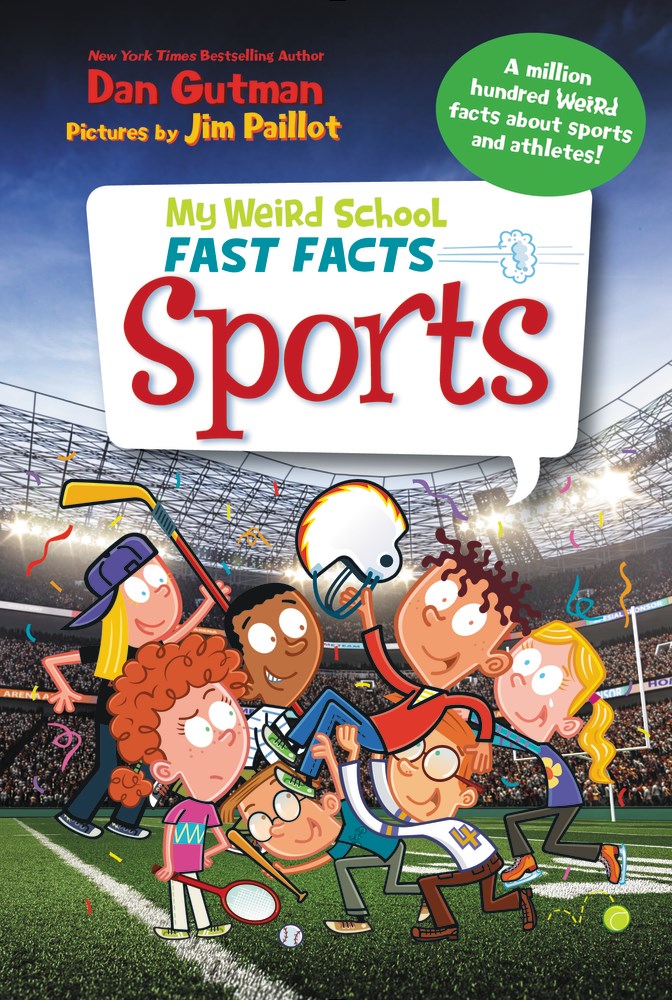
My Weird School_SportsMy Weird School Fast Facts: Sports, by Dan Gutman/Illustrated by Jim Paillot, (June 2016, HarperCollins), $5.99, ISBN: 9780062306173

Recommended for ages 8-12

Next up, we have Fast Facts: Sports, with chapters devoted to the biggies: baseball, football, soccer, basketball, hockey, golf, and auto racing. Other chapters include facts about speed records; other sports, like skating, skiing, bowling, and tennis; the Olympics, and a wrap-up of other weird sports facts. You want to know why umpires have to wear black underwear? The answer’s in here. Like Fast Facts: Geography, Fast Facts: Sports is loaded with photos, statistics and fun facts, and black and white illustrations by My Weird School illustrator Jim Paillot.

andreaThe Fast Facts books are fun. The Sports books will be popular with kids who are fans of the series or just sports fans in general; it’s a good companion book for kids who love wacky facts and ephemera. The Geography book is a good companion book that you can booktalk when kids come in with a geography project – it’s a companion book, an additional book, but the My Weird School brand will make sure it gets read, and maybe, just maybe, inspire a reader to explore an interesting topic.

Kids love My Weird School and all its offshoots. These are the second and third books in a nonfiction series (the first, My Weird Writing Tips, was published in 2013). Having some nonfiction feature popular characters hopefully spikes some interest.

Dan Gutman is a prolific children’s author, with My Weird School and The Genius Files being two of his hugely popular book series. He’s got a great author website where you can find out about all of his book, read excerpts, download study guides, watch book trailers, and read about ways that kids can change the world.

Illustrator Jim Paillot has illustrated for School Library Journal, Weekly Reader, Boys Life, and many other children’s books. He has a great website with funny comics for kids, illustrations, samples of his work, and a shop where you can buy prints of his artwork.

(images courtesy of My Weird School Wikia)
Posted in Intermediate, Middle Grade, Non-Fiction, Non-fiction, Non-Fiction, Tween Reads

NatGeo’s Awesome 8 has the lists kids love!

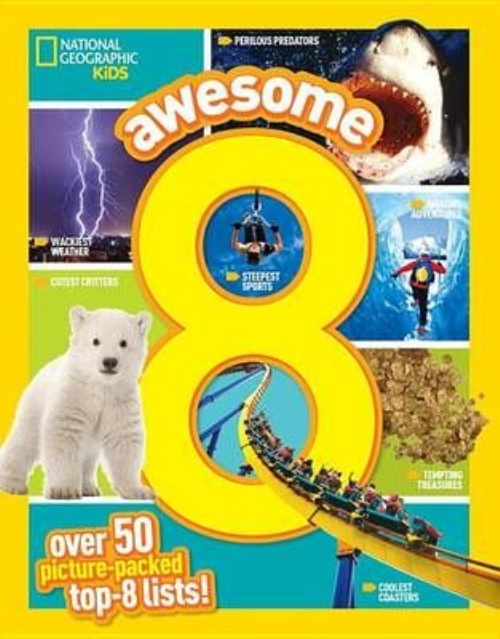
awesome8Awesome 8: 50 Picture-Packed Top 8 Lists! (National Geographic Kids), by Jen Agresta & Sarah Wassner Flynn, (May 2016, National Geographic), $12.99, ISBN: 978-1426323379

Recommended for ages 7-12

I love lists. I make them, I read them, it’s just a fun thing that people do. It gives you some cool insight into people, like when you read lists of their favorite books, foods, or things; it can make short work of a project, when you have a list of best books or coolest science fair projects. Bottom line, lists are helpful and fun. NatGeo Kids has taken that idea and run with it, giving us Awesome 8: 50 Picture-Packed Top 8 Lists!

This book is loaded with lists of the wildest things, from the most hair-raising roller coasters (that new Joker one at Six Flags Great Adventure may have to be in an updated version, tho’) to the the most bodacious buried treasures. Lists cover wild nature, history, food, and fun. Plan a trip to see some ridiculous roadside attractions (there really is a giant ball of string) and travel in the wackiest of ways, like on a monster school bus. Fun facts pop up throughout the book, as do extended features on some of the lists, like the spread discussing how icebergs flip, following Eight Awesome Things in Antarctica.

It’s a NatGeo book, so you know the pictures are stunning and the information covers different cultures and different parts of the world.There’s a full index in the back and a companion website, the Awesome 8 Hub, where you can find more Awesome 8 lists and log into NatGeo’s Kids portal, which offers resources for educators and homework help resources.

flipped-iceberg-antarctica_88301_990x742Icebergs can flip! Who knew? (from NationalGeographic.com)

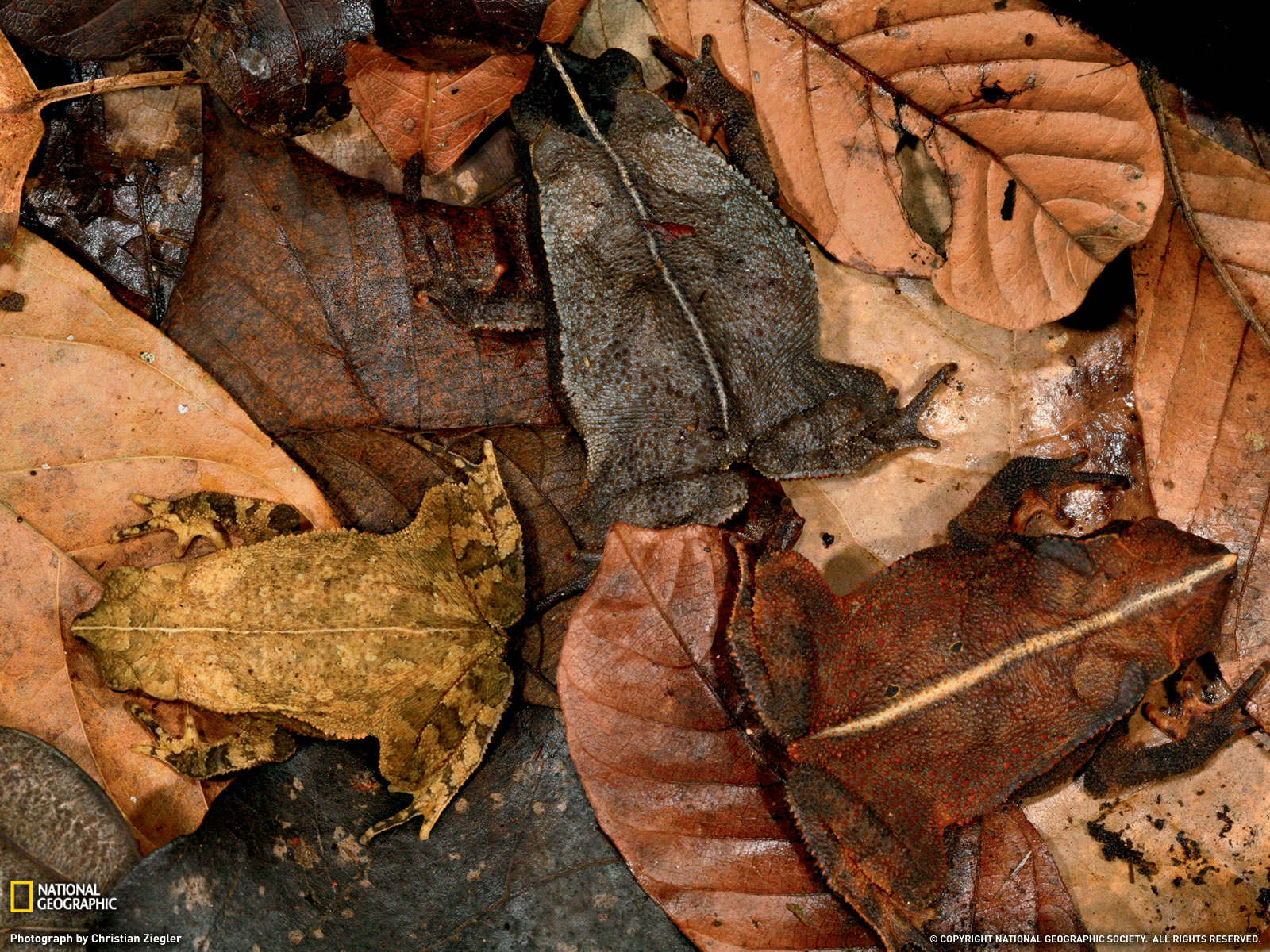
I’m a huge NatGeo Kids fan, with good reason: the kids embrace the books, which are fun, factual, and contain beautiful photographs of the world around us. Know a kid who loves cool stuff? Consider this book. Looking for a summer program to put together on the spot? Maybe a spot the camouflaged creature game – there’s an Awesome 8 list dedicated to Coolest Camouflage, including this picture of three toads – can you find them?

toadsphoto from NationalGeographic.com