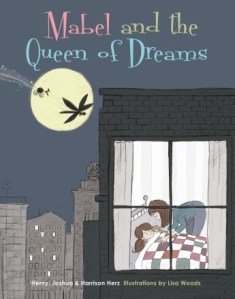
 Mabel and the Queen of Dreams, by Henry, Joshua, & Harrison Herz, (July 2016, Schiffer), $16.99, ISBN: 9780764351372
Recommended for ages 4-8
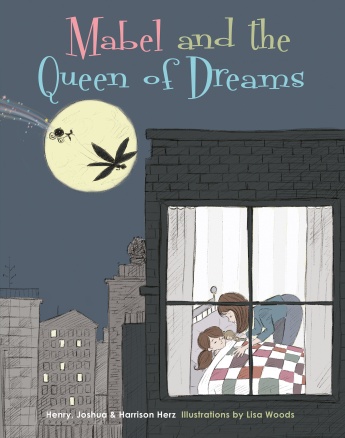
Little Mabel is an expert at not going to sleep. After she’s gone through her usual routine of excuses, she asks for a bedtime story. Mom is too happy to oblige, and spins a tale about the Fae Queen, who paints children’s dreams, but will only visit when Mabel closes her eyes, Mabel’s mom describes the Fae Queen and her hazelnut chariot; her dragonfly steed, and the dreams she paints. The words wrap themselves deliciously around Mabel – and the reader’s – imagination, drawing us into the Fae Queen’s world and leaving us all waiting for a visit.
I love this book. I love that a bedtime story for children is inspired by Shakespeare! The Fae Queen comes from Romeo & Juliet, in a soliloquy spoken by the character Mercutio, when he describes how a fairy queen influences dreams. Lisa Woods’ artwork adds another dimension to the story, with subdued colors and sketch-like illustration; the children’s dreams are portrayed as children’s drawings with bright colors, taking us into their imaginations to see mermaids, superheroes, astronauts, and brave knights. The Fae Queens’ fantasy elements are sweet and inviting, and my favorite part – when Mom tells Mabel how she will feel the Fae Queen’s presence in different ways – are beautifully rendered. I read this to my little one and tickle his nose and neck as the Fae Queen describes hovering and traveling over Mabel. The entire story creates a bedtime experience, lending itself to sweet nighttime cuddling and the promise of a dream adventure. An author’s note at the end gives readers Mercutio’s full speech, and Hamlet’s “What dreams may come” speech.
This book is a wonderful addition to bedtime bookshelves and collections. It’s a hit in our home.

I was thrilled to be able to ask author Henry Herz a few questions about Mabel and the Queen of Dreams – read on!
MomReadIt: I love that you adapted Shakespeare for a picture book audience! What inspired you to create a bedtime story and use the Queen of the Fae as a character?
Henry: There is something that tickles my funny bone about taking a familiar folk tale and tweaking it. Fractured fairy tales are quite popular – consider INTERSTELLAR CINDERELLA by Deborah Underwood or NINJA RED RIDING HOOD by Corey Rosen Schwartz. The idea popped into my head to write a picture book based on a scene from Shakespeare. As I researched, I came across that oft-forgotten (at least by me) scene in Romeo and Juliet in which Mercutio waxes poetic about the little fairy queen Mab. Queen Mab affects sleepers’ dreams as she flies past, and I thought, what a great premise for a bedtime picture book. Plus, I love getting young readers interested in fantasy, and the idea of writing an urban fantasy bedtime picture book was irresistible. I hope that MABEL AND THE QUEEN OF DREAMS may spark in young readers some interest in reading more Shakespeare.
MomReadIt: Is your main character named Mabel as a nod to Queen Mab?
Henry: That is correct. In my story, Mab is a sleep-resistant girl. In the original, tiny fairy queen Mab’s hazelnut chariot is drawn through the air by a dragonfly. And we have the original Shakespearean soliloquy by Mercutio as an author’s note, so that young readers can compare the original with this modern version.
MomReadIt: I see that your sons are co-authors. How did they contribute?
Henry: They’ve been co-authoring with me since they were about 8 and 10 years old when we first collaborated on our self-published high fantasy early chapter book, NIMPENTOAD. I draft the stories and they review them, giving me feedback from a young reader’s perspective. They have also been instrumental in selling the book at book fairs, farmers markets, etc. They’re even better salesmen than they are writers. Although now that they’re 14 and 16, doing this with Dad isn’t as cool as it used to be…
MomReadIt: I hope we’ll see some more classic works for little ones from you and your family in the future. Thank you so much!
Henry: Thank you very much, Rosemary. We appreciate your support! Readers interested in learning more about our books can visit our website at www.henryherz.com.
 The Way Home in the Night, by Akiko Miyakoshi, (Apr. 2017, Kids Can Press), $16.95, ISBN: 9781771386630

 Mom Read It