Weird But True! New York City, by National Geographic Kids, (Sept. 2021, National Geographic Kids), $8.99, ISBN: 9781426372322
Ages 8-10
Finally! NatGeo Kids has put together a Weird But True! collection of facts and photos of my backyard. Welcome to New York City, all! You know the Weird But True/Weird Facts drill, so let’s get to it. I love all the New York history the editors at NatGeo Kids have put in there, including hilarious poop facts for all (when there were horse and buggies were the main mode of transportation, street cleaners cleaned about 500 tons of manure off the streets every day. Enjoy that). I LOVE all the love for my home borough, Queens! Our Queens Museum is home of the New York Panorama and we’ve got the Unisphere in Corona Flushing Meadow Park! There are a wealth of library facts in here, which makes me happy (but hey… there are more library systems than just NYPL, which, admittedly, does have the original Winnie the Pooh toys and a giant reading room). And you know what else New York has? DINOSAURS. Our American Museum of Natural History is where the first installment of the Night at the Museum movies takes place (which figures into one of the facts in Weird But True NY).
Full of fun facts and gorgeous photos, fully indexed, and just a fun read, Weird But True! New York City is the next book you want to have in your NatGeo Kids collection (and New York librarians: this BEGS for a New York Bingo kind of program, which you can totally do virtually).
Now, if you’ll excuse me, I’m going to pull some cool Queens Public Library facts together to send to the good folks at Nat Geo Kids for their updated edition…
I have been WAITING on this book! I’ve been absolutely hooked on the Explorer Academy series from book one, and finally, Dragon’s Blood is here – grab your copy!
The Explorer Academy: The Dragon’s Blood Blog Tour!
To celebrate the release of Explorer Academy: The Dragon’s Blood by Trudi Trueit on October 5th, blogs across the web are featuring exclusive guest posts from Trudi, as well as 5 chances to win all 6 books in the series so far! The 7th and final book in the series will be released in Fall 2022.
What a Character! by Trudi Trueit
“How do you come up with interesting characters?”
It’s the question I got most often from writers. For me, it’s not a magical thing. Most of the time, characters don’t pop into my head fully formed. If you don’t base them on anyone you know (and I don’t) character building takes time. It’s like getting to know a new friend. The more time you spend together the more that person reveals to you.
I almost always start with a name. Until I have that, it’s hard to get into the writing. I tend to stay away from more common names. I also like to mix things up. I might name a villain something soothing, like Serene, or a timid boy, Rocco. Whenever I hear an interesting name, I write it down so I always have a long list to start with when I am creating a character. Once I choose a name, I start asking questions about that character to get a feel for who they are—and I ask A LOT of questions. I fill out a questionnaire for each major character. First, I cover the basics: name, age, physical description, ancestry, family details, pets, hobbies, sports. Next, I ask:
What’s in my character’s purse or pocket right now?
What’s my character’s most prized possession?
Describe my character’s personality in four words.
Then it’s time to go deeper. The answers to these questions will determine how the character will think and act throughout the story.
What’s my character’s biggest flaw?
What’s my character’s greatest hope?
What’s my character’s biggest problem or fear?
What’s my character’s most treasured secret?
And the most important question of all:
What does my character want more than anything in the world?
It’s the protagonist’s goal that will drive the plot, so this is a question that must be answered.
If I get stuck in the development phase, I try writing a letter to myself from the character’s point of view. This gets me out of my head and into theirs, where it belongs. I am free to be open and truthful. Once I am, it usually unlocks the character’s true personality and motivations.
Also, you don’t need to know everything about a character when you begin writing. In fact, it’s better if you don’t. Start with a name, a problem, and a goal. Go from there. The more you write, the more your character will share—just like a friend. And yes, I think of all of my characters as real people. They are, aren’t they?
Just for fun, if you’d like to find out what Explorer Academy character you are most like, take the quiz!
As for me, I am most similar to Emmett but then I already knew that!
“a fully packed high-tech adventure that offers both cool, educational facts about the planet and a diverse cast of fun characters.” —Kirkus
“This exciting, fast-paced, far-flung story is full of science facts and James Bond-like gadgets, accompanied by colored illustrations. The ending is guaranteed to keep readers eager for the next series installment.” –Booklist
“Explorer Academy is exciting and smart.” —Karen Bokram, Editor-in-Chief, Girls’ Life
An explosive revelation and a familiar face heighten the mystery for Cruz and friends in the sixth book in this adventure-packed series.
Still reeling from the life-changing discovery he found buried in the mysterious archive, Cruz Coronado grapples with an important secret as the gang heads to China in search of the second-to-last piece of the cipher. Under the watchful eye of a new adviser, life on the ship returns to almost normal…Almost.
Just as things seem to be going smoothly, a familiar face shocks Cruz back into reality, and the final piece in this life-and-death scavenger hunt veers toward a dead end.
Check out the Explorer Academy website, featuring videos, comic shorts, games, profiles of real-life National Geographic Explorers, chapter excerpts and more.
TRUDI TRUEIT has written more than 100 books for young readers, both fiction and nonfiction. Her love of writing began in fourth grade, when she wrote, directed, and starred in her first play. She went on to be a TV news reporter and weather forecaster, but she knew her calling was in writing. Trueit is a gifted storyteller for middle-grade audiences, and her fiction novels include The Sister Solution, Stealing Popular, and the Secrets of a Lab Rat series. Her expertise in kids nonfiction encompasses books on history, weather, wildlife, and earth science. She is the author of all the narratives for the Explorer Academy series, beginning with Explorer Academy: The Nebula Secret. Trueit was born and raised in the Pacific Northwest, and lives in Everett, Washington.
One (1) winner will receive all 6 Explorer Academy hardcovers (The Nebula Secret, The Falcon’s Feather, The Double Helix, The Star Dunes, The Tiger’s Nest, and the NEW book The Dragon’s Blood)
US/Canada only
Ends 11/1 at 11:59pm ET
Check out the other stops for more chances to win!
Step right up and enter this Rafflecopter giveaway! It’s your chance to win your own copy of Unforgotten: The Wild Life of Dian Fossey and Her Relentless Quest to Save Mountain Gorillas by Anita Silvey.
This is a perfect addition to your biographies, naturalist, and STEM/STEAM collections, or a perfect gift for a burgeoning explorer and researcher/animal lover. Just enter the Rafflecopter giveaway here. Good luck!
U.S. addresses only, please. No P.O Boxes, please!
Unforgotten: The Wild Life of Dian Fossey and Her Relentless Quest to Save Mountain Gorillas, by Anita Silvey, (June 2021, National Geographic Kids), $18.99, ISBN: 9781426371851
Ages 8-12
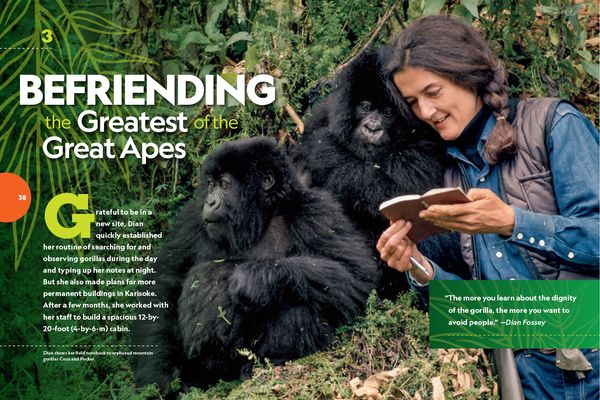
Primatologist, conservationist, and advocate for mountain gorillas, Dian Fossey, brought to the screen by Sigourney Weaver in the 1988 film Gorillas in the Mist, is introduced to new audiences with Unforgotten: The Wild Life of Dian Fossey and Her Relentless Quest to Save Mountain Gorillas. Companion to Anita Silvey’s books on Jane Goodall (Untamed) and Biruté Mary Galdikas (Undaunted), Unforgotten is a testament to Dian Fossey’s life advocating for mountain gorillas and fighting against the poachers who would slaughter them. The book touches on Dian’s special connection to the gorillas, with gorgeous photos featuring Dian with them, cuddling and carrying orphaned babies and interacting with guides and children, all in her quest to educate everyone around her about the amazing creatures we share the planet with. The book discusses her murder and the work that continues to this day, in her name. Colorful maps and profiles on apes that Dian befriended, like Uncle Bert and Poppy, run throughout the book, as do callouts and spreads on the lives of mountain gorillas. Back matter on Dian’s legacy and her gorilla fund, a gorilla scrapbook with photos and biographies of the gorillas she lived with, and a timeline of Dian Fossey’s life will give readers an understanding and, hopefully, a love for the world Dian Fossey fought to protect. An excellent biography and book on conservationism.
Weird but True! Ocean: 300 Fin-Tastic Facts from the Deep Blue Sea, by National Geographic Kids, $8.99, ISBN: 9781426371813
Ages 7-12
I have said this before, and I’ll say it again: these chunky, digest-sized NatGeo books MOVE. I refresh my collection throughout the year, every year, because the kids in my library love them. They love the wild collection of facts across all sorts of subjects, they love that they’re small enough to shove in their schoolbags (or mom’s bag), and they’ll pull them out anywhere (ANYWHERE) to rattle off facts to anyone (ANYONE) who will listen. It’s just great. This volume has loads of facts about the ocean: did you know that otters keep rocks under their arms to help them crack open clams? Or that feeding cows seaweed helps them burp less? Maybe you didn’t know this, but a sea cucumber can expel its organs to distract predators, and grow them back later. There are tons of great and fun facts here, accompanied by incredible color photos. Just add it to your cart; the kids will take care of the rest.
Out of the Blue: How Animals Evolved from Prehistoric Seas, by Elizabeth Shreeve, Illustrated by Frann Preston-Gannon, (May 2021, Candlewick Press), $17.99, ISBN: 9781536214109
Ages 6-9
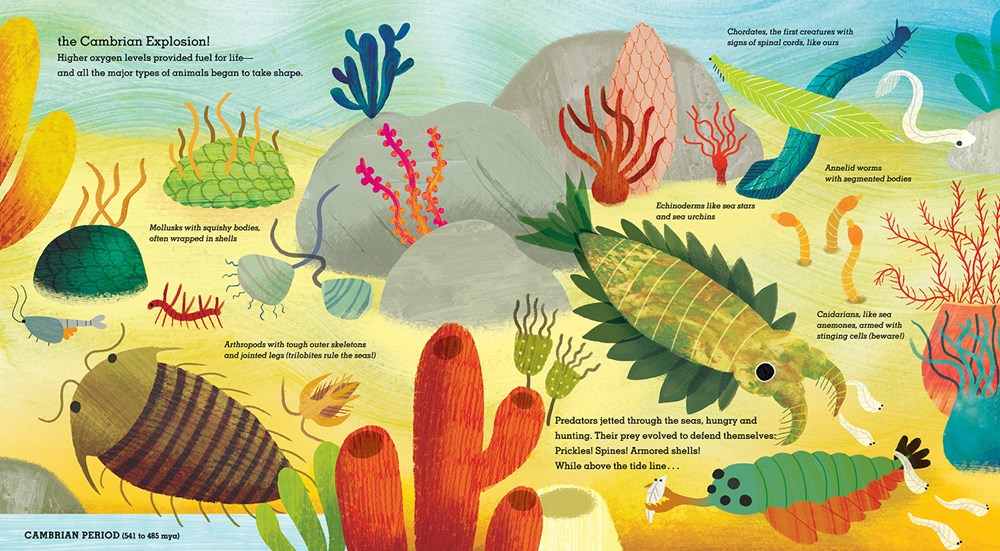
I love this gorgeous book! It’s a “story from out of the blue” about how animals evolved from microbes in the ocean to land creatures through Earth’s timeline. Spread by spread, readers travel through the planet’s history, from the Archean Eon (4-2.5 billion years ago) through the Cenzoic Era (66 million year ago to the present), with colorful illustrations as life evolves from sea-dwelling single-celled organisms, to athropods and echinoderms, to mollusks, dinosaurs, and finally, humans. It’s a compulsively readable history that describes the different types of organisms and illustrates the evolution from single- to multi-celled creatures; the development of fins to limbs, and how we are always connected to the water. Readers learn how animals (and people!) compare to those that came before, and the informative text is chunked into readable paragraphs that respect and never overwhelm readers. Perfect for STEM/STEAM collections.
Out of the Blue has starred reviews from Kirkus and School Library Journal.
Wild is the Wind, by Grahame Baker-Smith, (May 2021, Templar), $18.99, ISBN: 9781536217926
Ages 4-8
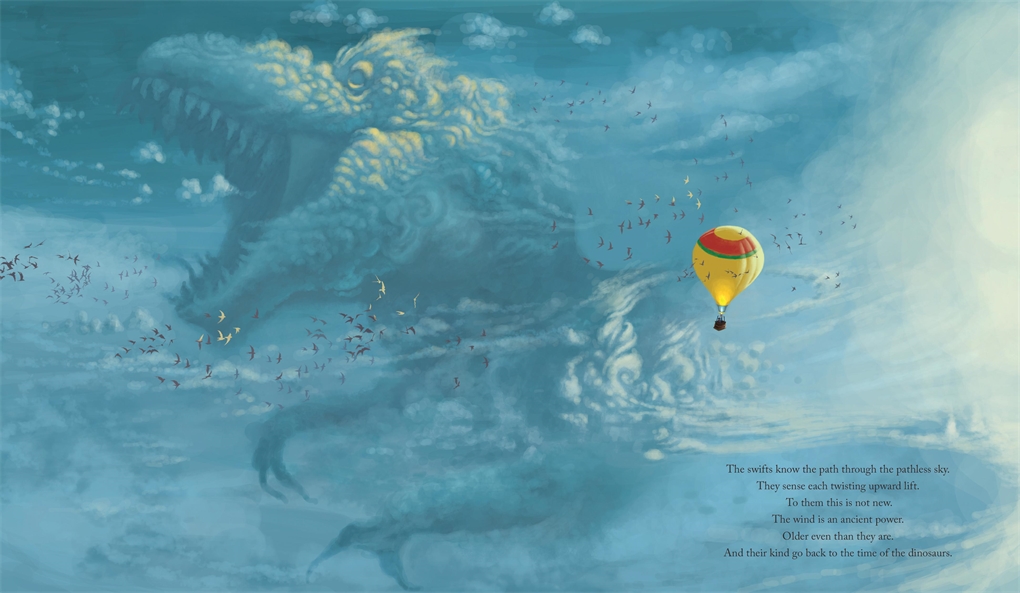
A girl named Cassi watches over a small bird, a swift, that she’s cared for. It’s time to let the bird go; the swifts soar around them, hearing the call of the wind, and Cassi knows that “They are wild and belong to the wind”. This breathtaking book is alternately a story about a girl letting her bird rejoin the world that brought it to her, and a story about the wonder of the wind. Across the world, winds whip into the sky, as ancient as the dinosaurs; they power turbines and give us power; they “howl with power” as storms. Every spread is a gorgeous revelation, with the ever-present swifts traveling the currents. Deep colors and incredible visions in the sky make this a fantasy to sweep readers away and return them, where they’ll never think of an ordinary breeze in the same way again. Grahame Baker-Smith is a Kate Greenaway Award-winning illustrator, and his companion book, The Rhythm of the Rain, is an excellent companion to Wild is the Wind. Have these available for your nature readers and display this with Aaron Becker’s Journey Trilogy.
Wild is the Wind has a starred review from Kirkus.
Little Kids First Big Book of Rocks, Minerals & Shells, by Moira Rose Donohue & National Geographic Kids, (July 2021, National Geographic Kids), $14.99, ISBN: 9781426372223
Ages 4-8
The “Little Kids First Big Book” is another great series from NatGeo Kids. They introduce younger learners to science concepts in a fun, accessible way. It’s NatGeo, so you know the photos are amazing, and the information is organized into easily readable sections of interest. Here, kids will learn how rocks are formed, the difference between rocks and minerals, and how they’re used in just about every facet of our lives. Chapters are organized into Rocks, Minerals, and Seashells, and activities and map-reading activities at the end of every chapter help kids put their thinking caps on and sharpen new and developing skills. Fact boxes and cool callout boxes throughout keep kids turning pages, almost feeling like they’ve got that fun, small digest (see up above, Weird But True) handy, where they can tell everyone cool bits of info (The Great Sphinx in Egypt was carved from limestone!). A Parent Tips section offers fun and safe ways to join your kids in learning about rocks, minerals, and seashells (ahem… STEM program in a book!). There are additional resources, including a Bill Nye video on the rock cycle, and a glossary, and the book is indexed. What a great resource to have handy!
Hope everyone had a restful Fourth, and if you’re off today, enjoy. I’m working on getting caught up, on getting my library together for a July 12th opening, and basically just working on keeping my head together in the middle of a year and a half that is just bananas. Anyway, join me as I escape into a great new nonfiction series by National Geographic Kids.
Go Wild! Pandas, by Margie Markarian & National Geographic Kids, (June 2021, National Geographic Kids), $9.99, ISBN: 9781426371608
Ages 4-8
This is such a cute new nonfiction series for younger readers! The Go Wild! series introduces readers to different animals, in this case, the panda. The book has a conversational, informative tone, inviting readers to “visit the world of pandas”. Readers learn about their habitat, where in the world they are found, their size, anatomy, related animals (like the Sun Bear, Spectacled Bear, and Sloth Bear), food, socialization, and more. The author addresses the need for conservation and addresses a major threat to the panda – deforestation – and offers tips for ways kids can get involved to protect pandas. A fun Name That Animal activity and parent tips on building enthusiasm close out this fun book, which also includes a glossary. Loaded with fast, fun facts and beautiful color photos, this is such a great new series that I know my kiddos will snap up. They already devour my NatGeo Kids Easy Readers (like this Panda book), and this hardcover 8×8 series will fit nicely on my shelves and look great in my displays.
Go Wild! Sea Turtles, by Jill Esbaum & National Geographic, (May 2021, National Geographic Kids), $9.99, ISBN: 9781426371585
Ages 4-8
How adorable is this Go Wild! volume on sea turtles? SO ADORABLE. Color photos and informative, friendly text have lots to say about sea turtles. Did you know that the smallest sea turtle is only about two feet long, but can weigh about as much as four car tires (between 70 and 100 lbs)? Or that a leatherback turtle can hold its breath for nearly an hour and a half? There are great facts to be discovered here, along with photos of the “run for life” to the ocean by hatchlings. A section on threats focuses on the problem of our polluted waters, and offers ways kids can help be part of the solution. Fun activities and parent tips, plus a glossary, make this another win from NatGeo Kids. Their Parent Tips can easily transition into virtual or in-person library programming for anyone interested – my library system is having a sea turtle STEM session at the end of July, and I’d like to put together a little sea turtle bundle with some of these ideas. Stay tuned!
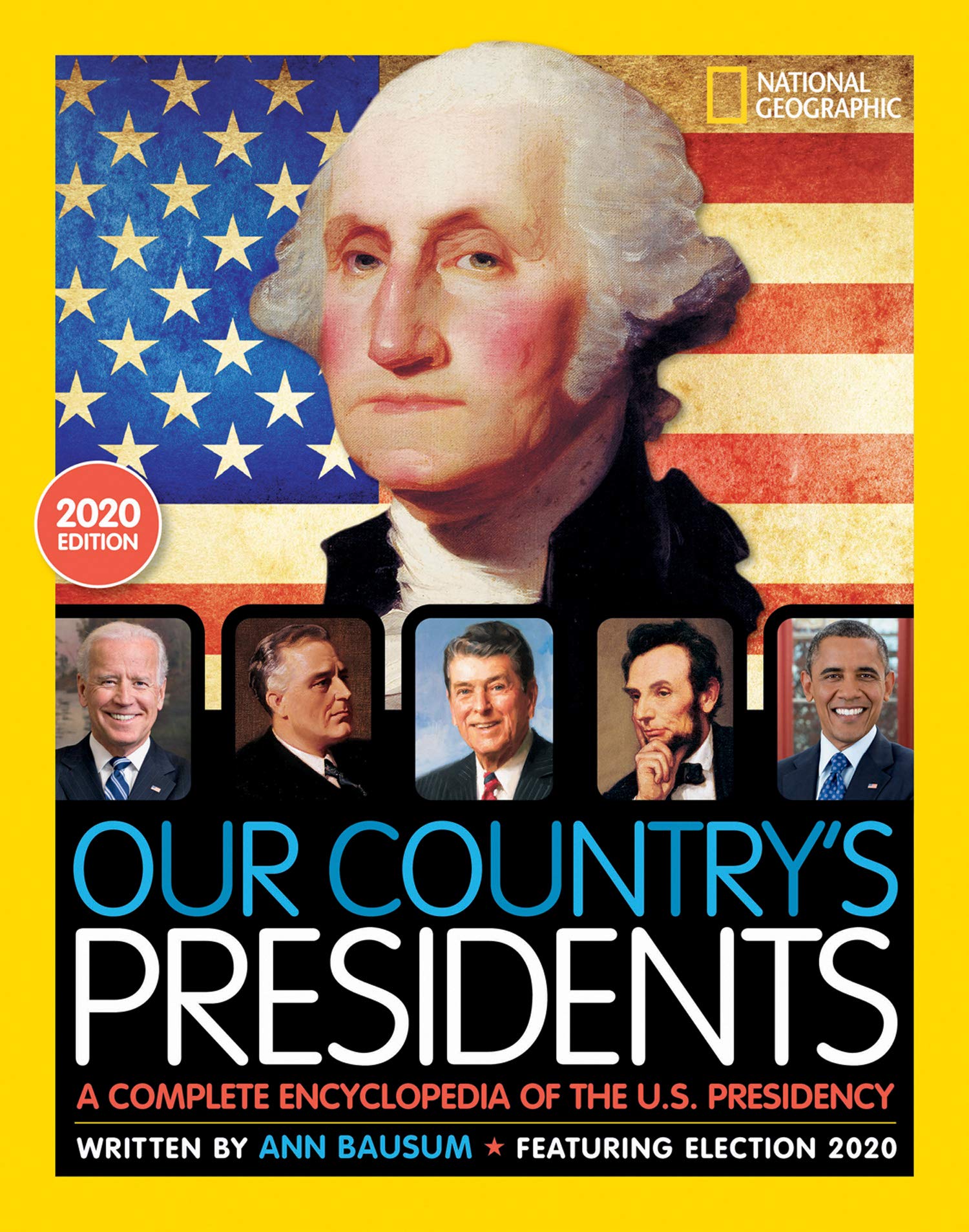
Our Country’s Presidents: A Complete Encyclopedia of the U.S Presidency (2020 Edition), by Ann Bausum, (Jan. 2021, National Geographic Kids), $24.99, ISBN: 978-1-42637199-8
Ages 8-13
This latest update to the NatGeo desk reference includes coverage of the 2020 Presidential election and results. Every U.S. President, from George Washington to Joe Biden, has a profile; there are full-page official portraits, and over 400 illustrations, from period artwork to contemporary black-and-white and color photographs. Six sections examine the Presidency in different eras: The Presidency and How it Grew 1789-1837; From Sea to Shining Sea 1837-1861; A New Birth of Freedom 1861-1897; America Takes Center Stage 1897-1945; Seeking Stability in the Atomic Age 1945-1989; and Pathways for a New Millennium 1989-Present. Each presidential profile includes a facts-at-a-glance box with the President’s signature and fast facts, including landmarks, political party, number of terms, Vice President, and terms of office. Thematic spreads explain important themes to emerge and define different presidencies, and reference aids help direct learners to more resources. A comprehensive resource and great desk reference; get a copy for your Reference section and for your circulating collection if you have the budget.
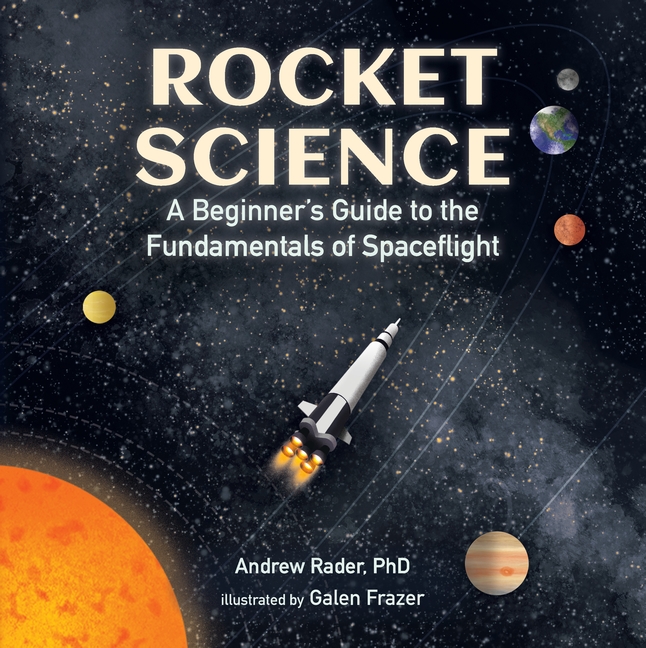
Rocket Science: A Beginner’s Guide to the Fundamentals of Spaceflight, by Andrew Rader, PhD./Illustrated by Galen Frazer, (Nov. 2020, Candlewick Press), $16.99, ISBN: 9781536207422
Ages 10-13
This beginner’s guide to spaceflight is concise, comprehensive, and illustrated in full-color. Andrew Rader is an actual rocket scientist and a SpaceX Mission Manager, and he makes space travel so tempting, you’ll want to get in touch with Elon Musk and secure your spots now. Readers will learn the basics to start: gravity, the solar system, and how we can push through gravity to reach the Moon. That leads in to a discussion on rockets: how they work, the staging series, and how to use rockets to communicate, navigate, and travel. There is information on interplanetary travel, possible life in the universe beyond our planet, and a word about the future of space exploration. Digital illustrations are colorful and detailed. A glossary and list of web resources are available. A spread on spacecraft and the solar system details some of the more well-known spacecraft, in relation to layout of the planets, like the Hubble, International Space Station, Curiosity, and Cassini. A nice intro to rocket science without throwing calculus into the mix, this is a great intro to whet younger readers’ appetitles for space travel.
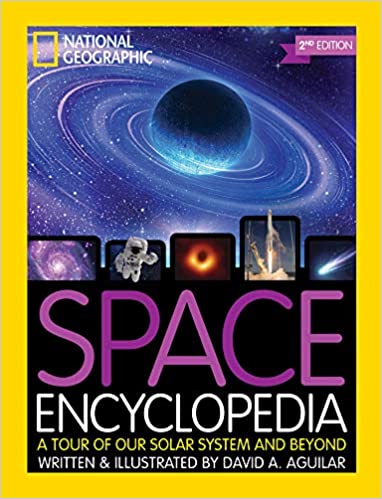
Space Encyclopedia: A Tour of Our Solar System and Beyond (2nd Edition), by David Aguilar & Patricia Daniels, (Nov. 2020, National Geographic Kids), $24.99, ISBN: 9781426338564
Ages 8-12
This is the updated version of the 2013 Space Encyclopedia, and there has been a lot to update! The 2020 version includes updated photos, facts, and profiles on the latest in space exploration, including the first ever image of a black hole, newly discovered dwarf planets, the possibility of life beyond Earth, and the formation of the universe. Profiles on icons in the field include Stephen Hawking, Einstein, and Galileo. It’s a beautiful desk reference, loaded with full color photos and artwork beyond the facts. My Kiddo used this as a reference tool for his report on space and he was beyond excited at how much he was able to use from this source.
I know, the clock is ticking down, and you need stocking stuffers. I’ve got stocking stuffers. Read on.
Show-How Guides: Friendship Bracelets, by Keith Zoo, (Aug. 2020, Odd Dot Books), $5.99, ISBN: 9781250249968
Ages 6-11
Remember friendship bracelets? Wow, I made so many of those back in the ’80s. Well, they’re back! Odd Dot’s Show How Guides are a series of quick and easy, step-by-step books that walk readers through the steps in making different crafts, like hair braiding, making slime and sand, hand-lettering, and making paper airplanes. Odd Dot was kind enough to send me a copy of Friendship Bracelets, which I loved. Two-color illustrations include friendly shapes that talk to the readers; materials needed for each craft are up front, as is a short table of contents. These guides are all about the essentials: the basics needed to get started on your journey. You can always look for more complex stuff when you’re ready to move on. These books are no pressure. There are 10 types of friendship bracelets included here: macramé, zipper, twist, wrap, butterfly, box, fishtail, diagonal, chevron, and braid, and each bracelet has an illustrated, numbered, step-by-step series to complete the bracelet. It’s a great gift idea, especially if you want to pick up some materials (embroidery floss, a tape measure, pair of scissors, and a binder clip or tape) to put together a little starter kit.
Perfect stocking stuffer, and for me? Perfect make and take craft idea to put together for my library kids. Enjoy!
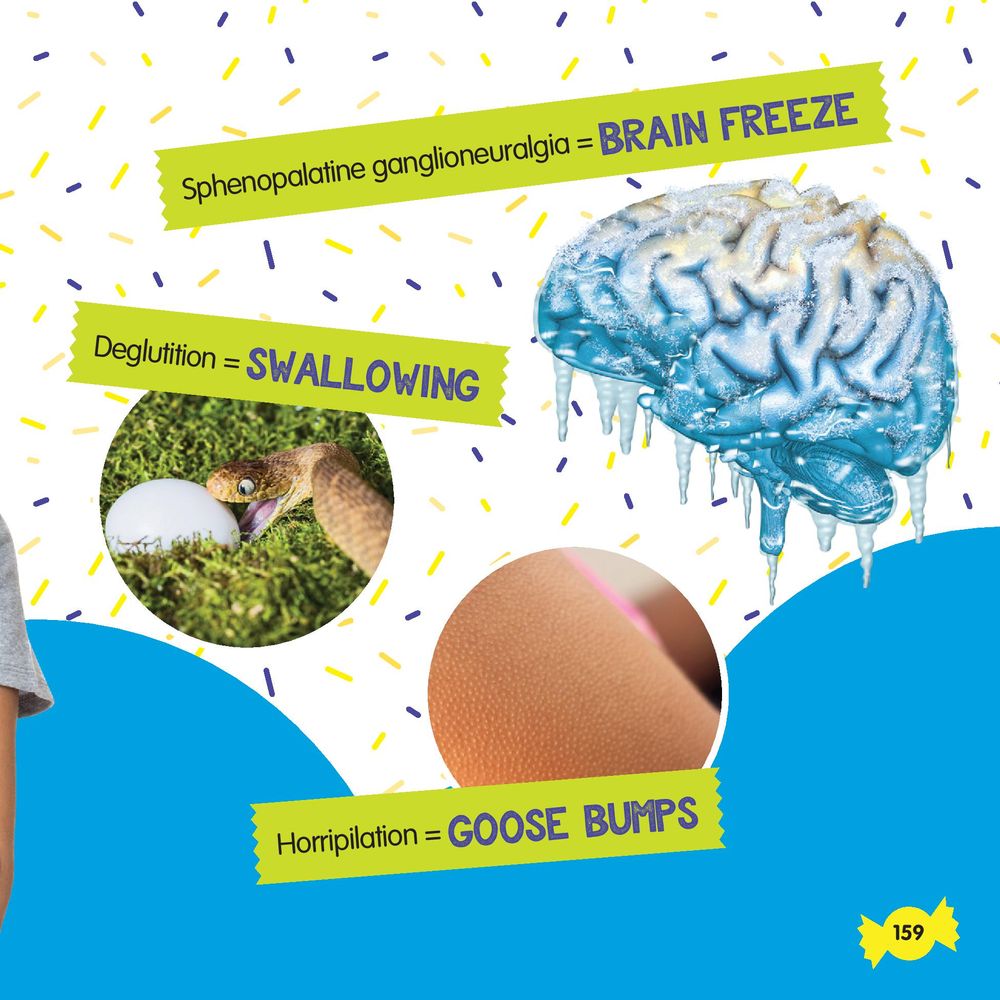
Brain Candy 2: Seriously Sweet Facts to Satisfy Your Curiosity, by National Geographic Kids, (Oct. 2020, National Geographic Kids), $8.99, ISBN: 978-1-4263-3886-1
Ages 7-12
More facts, more photos, more fun! Brain Candy 2 is the second Brain Candy book from NatGeo Kids. It’s digest-sized, fits nicely into schoolbags and Mom’s purse, and is chock-full of the coolest facts about just about everything and anything. Misleading animals names, sneaky animal predators, and wacky whale behaviors are just a few of the facts readers will find in here. Facts go from the giggle-worthy: birds, octopuses, and sloths don’t pass gas – to the spooky: visitors to a German castle report hearing the armor of the knights who once protected it. NatGeo always maintains a respectful sense of conservation and preservation, too, including facts about how much plastic has been pulled from our planet’s waters (hint: A LOT). Always informative, always fun, these digest-sized books are great gift ideas, are worth their weight in gold for my circulation, and are almost impossible to sneak out of my Kiddo’s room so I can review them.
Bundle this with some actual holiday sweets and call it a stocking stuffer. Ta-Da!
Nerdlet (A Little Book of Nerdy Stuff): Animals, by T.J. Resler, (Sept. 2020, National Geographic Kids), $9.99, ISBN: 978-1-4263-38724
Ages 8-12
I’m going to take a moment to bask in the fact that being called a Nerd is having its moment. Okay, I’m done. NatGeo Kids’s Nerdlet is a little book made for “animal nerds”: kids who can’t get enough of reading cool facts about animals. Digest-sized like Brain Candy and Brain Candy 2, Nerdlet has all of the NatGeo-famous gorgeous color photos, with slightly denser text for a more middle-grader reader. Fun Facts and Nerd Alerts – callout boxes with bizarre and brainy facts – run throughout. Nerds of Note introduce readers to animal researchers and professionals. Discover an island of cats on Taiwan, follow a flow chart to discover what type of fox you’d be, and learn to tell the different types of spotted cats apart. Nerdlet has it all and then some. Perfect for animal fans! Buy a little plush or some animal toys (Kiddo has so many of those animal tubes laying around his room) and you’ve saved Christmas.
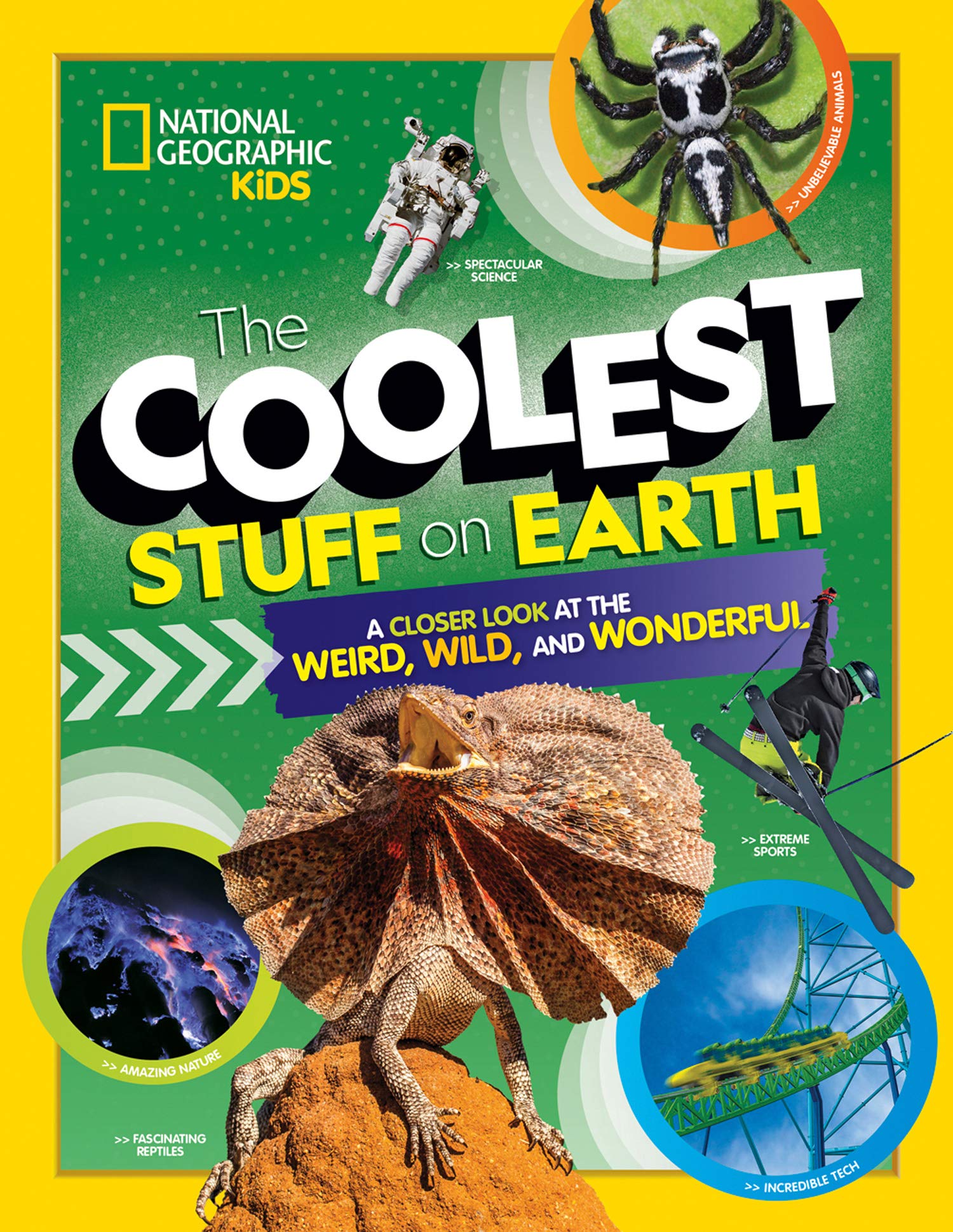
The Coolest Stuff on Earth: A Closer Look at the Weird, Wild, and Wonderful, by Brenda Scott Royce, (Nov. 2020, National Geographic Kids), $19.99, ISBN: 978-1426338588
Ages 8-13
More fantastic facts and photos from NatGeo Kids! Kids can take an armchair world tour with The Coolest Stuff on Earth. Organized into nine areas, kids can learn through stories, photos, infographics, Q&A with expert, and maps: Magnificent Marvels looks at world wonders, where readers can dive into the Secrets of Stonehenge. Travel Unraveled is all about the wacky and wild sites worldwide, and Extraordinary Animals profiles everything from dolphin language to what happens when animals hibernate. History’s Mysteries looks at ancient Pompeii through to California’s Golden Gate Bridge, and Shocking Science offers info about astronauts and technology. Peculiar Planet is all about the natural world, and Spectacular Sports shows readers the science of physical movement. Money Decoded features the secrets of the U.S. $1 bill, and Epic Extremes – one of the most popular reading areas for my library’s kids – is all about the coolest, most extreme stuff going, like deep-ocean robotics and giant sequoia forests. Back matter includes a full index.
 Weird But True! New York City, by National Geographic Kids, (Sept. 2021, National Geographic Kids), $8.99, ISBN: 9781426372322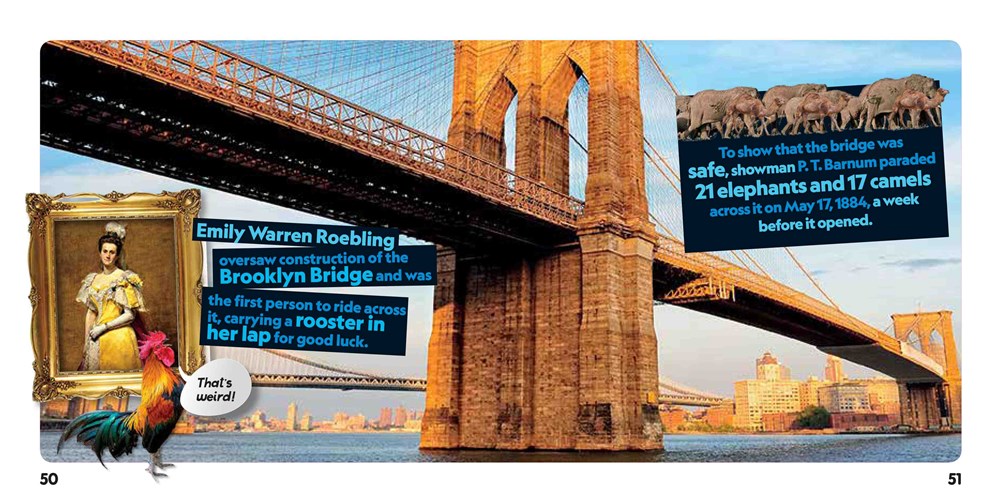











 Mom Read It