Posted in Early Reader, Fiction, Fiction, Intermediate, Realistic Fiction

A school can be anywhere: Armando and the Blue Tarp School

armandoArmando and the Blue Tarp School, by Edith Hope Fine, Judith Pinkerton Josephson/Illustrated by Hernán Sosa (March 2014, Lee & Low), $12.95, ISBN: 9781620141656

Recommended for ages 5-8

Armando’s family are pepenadores -trash pickers – living off things they can use, recycle, and sell from the city trash dump community where they live. Armando works with his father to help support the family, but dreams of being one of Señor David’s regular students. Señor David sets up a blue tarp in his colonia and teaches the children how to spell, count, and learn words in English, and says a school can be anywhere – even on a tarp in a colonia. At first, Armando’s parents discourage him from attending the school, saying that they need him to help the family and that they have always been pepenadores, but slowly, his father sees the importance of an education and allows Armando to attend the school. Shortly after, a fire burns down several homes in the colonia, Armando’s included, and it’s Armando’s picture of the blaze that runs in a newspaper and calls support to the colonia. Money and support come into the community, allowing for a new school building to be built.

Inspired by the real-life Señor David: a New York City special education teacher in the 1980s who went to Mexico to teach children living in the Tijuana colonia – Armando and the Blue Tarp School shows kids that education is a privilege not every child enjoys. Armando desperately wants to learn; he saves bits of erasers, paints, and paper he finds while working alongside his father in the trash dumps, and is thrilled when Señor David returns to his area. Kids will also see that not all parents understand the value of education: Armando’s father scoffs at his son’s “dreams of school”. To many parents in poverty-stricken areas, education takes time away that could be spent working and earning money for the family. For many families, work is survival and education is an expense they can’t afford.

This is a great book to use in classroom, library, and home discussion about how education is perceived throughout the world, and it opens up a chance to find out from kids what they think about education. Do they understand how important it is in the long run? Ask themselves to think about Armando, and put themselves in his place. There are some activities at the Blue Tarp website, some discussion questions, and suggestions for expanding on the story’s theme.

Armando and the Blue Tarp School was a nominee for a California Young Reader Medal and was turned into a stage production in 2009; kids can listen to one of the songs from the show and watch video taken from the show at the Lee & Low blog.

An author’s note at the end of the book provides more information about David Lynch, his Responsibility organization, and the Los Angeles Times article about his work in Mexico that prompted an anonymous donor to donate money to build a school in the Tijuana colonia. There are photos of Lynch and his colonia students, success stories of previous students, and a glossary and pronunciation guide.

A valuable addition to #weneeddiversebooks and school-age collections.


Posted in Middle Grade, Middle School, Non-fiction

What’s Up in the Amazon Rainforest?

rainforest_coverWhat’s Up in the Amazon Rainforest?, by Ginjer L. Clarke (Sept. 2015, Grosset & Dunlap), $8.99, ISBN: 9780448481036

Recommended for ages 8-12

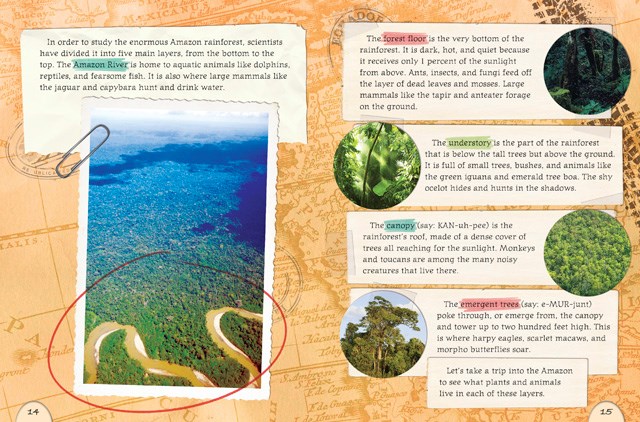
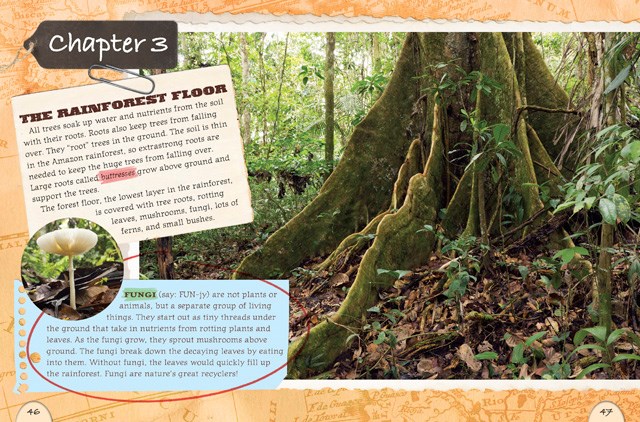
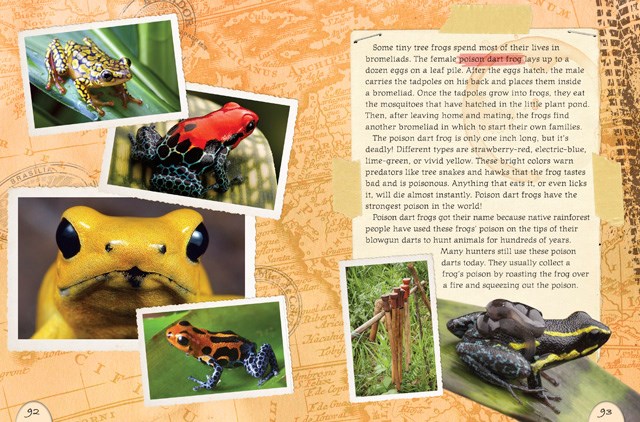
I’ve been doing a lot of weeding in my new library spot, and the first section I hit was the Animals section. Naturally, I need some new books to fill in my shelves, and this beauty fits the bill. It’s a new geography series, loaded with color photos and a fold-out map, and it’s laid out like a dossier file, with photos sharing space with informative text, laid over maps in the background, and little touches like circled paragraphs and paper clips to give the feeling that kids are reading an environmentalist’s journal.

rainforest_1

There’s a ton of information packed into this book: Ginjer Clarke looks at each layer of the rainforest, the flora and fauna that can be found there, and moves on to provide quick profiles on the people that live in the rainforest, products that come from the rainforest (yay, coffee and chocolate!), and most importantly, the importance of conservation and preservation. A bibliography and index round out the book. I’d love to see a glossary and some websites for kids included in future editions – admittedly, I’m working from a galley of the book, so if any of these resources are included in the finished copy, I apologize! In the meantime, her blog offers really cool updates and photos of different places she visits while researching her books. (Wait until you see the size of the oarfish.)

You’ll learn about pink dolphins – who knew there were dolphins in the rainforest? – and howler monkeys, Kapok and cacao trees. Fold-out maps will let kids place themselves in the locations they’re reading about.

Author Ginjer L. Clarke writes popular nonfiction books for kids. She’s got a section dedicated to her Baby Animals series on her website, and sections with more information about her other series, including more of her What’s Up, Out, and Wild Animals series.
Check out some more of What’s Up in the Amazon Rainforest below. The pictures are unbelievable!
rainforest_2 rainforest_3
rainforest_4 rainforest_5
Posted in Fiction, Fiction, Humor, Intermediate, Middle Grade, Middle School, Realistic Fiction, Tween Reads, Uncategorized

Part Judy Blume, Part Dork Diaries: Dream On, Amber

Dream on AmberDream On, Amber, by Emma Shevah (Oct. 2015, Sourcebooks Jabberwocky), $12.99, ISBN: 9781492622505

Recommended for ages 8-12

Ambra Alessandra Leola Kimiko Miyamoto is half Japanese, half Italian, and things are not molto bene (very good) for her at the moment. She thinks her name is ridiculous; she’s managed to put herself in the sights of a bully at school; she’s doing her best to take care of her little sister, Bella, who really feels the absence of a dad in their lives, and she doesn’t feel like she belongs anywhere.

Her dad left when she was six and Bella was one, and he hasn’t even tried to get in touch. She feels like a whole half of herself is missing: she knows nothing about her Japanese side, but she doesn’t look like her Italian mother. And to top things off, she’s been trying to keep up a charade for Bella’s benefit, writing letters to her as their father, explaining why he’s not able to come home in time for her birthday party.

It’s such a relief to find realistic fiction that looks at big ticket items with sensitivity and humor. Amber tackles some tough questions and issues that middle graders face, and she does it with Judy Blume-esque humor, with a touch of Dork Diaries/Diary of a Wimpy Kid slapstick. The book is told in the first person, from Amber’s point of view, complete with illustrations and chapters headed by numbers in English, Italian, and Japanese.

True to life, there are no easy answers waiting for Amber, but she makes some big moves and grows up during the course of the novel. I loved this book and how it uses humor to take the sting out stressful situations facing kids these days. I’d love to read more of Amber’s adventures in the future – I hope we get some!

Posted in Fiction, Middle Grade

Cybils Middle Grade Fiction – A Few Reviews

Hey there!

I’m working hard, getting through my Cybils Middle Grade nominees – there’s so much good fiction out there! – so I thought I’d give a quick update on a few I’ve read so far.

red pencilThe Red Pencil, by Andrea Davis Pinkney, (Sept. 2014, Little, Brown Books for Young Readers), $17, ISBN: 978-0316247801

Recommended for ages 8-14

Amira is a 12 year-old girl living in Darfur. She dreams of going to school, something her mother will not hear. She will marry a husband who can read for her, her mother tells her. That all changes when the Janjaweed come.

When her village is attacked by the Sudanese militia, her life is changed forever. She, and the survivors of her village, make their way to a refugee camp, where she grieves and learns how to start life anew.

Written in verse, The Red Pencil is one of the most powerful books I have ever read. It’s about time we see fiction about this time and place in history hitting our bookshelves. Children need to read this book, and teachers need to discuss it with them. If you don’t have access to this book yet, PLEASE – find it, read it, and share it.


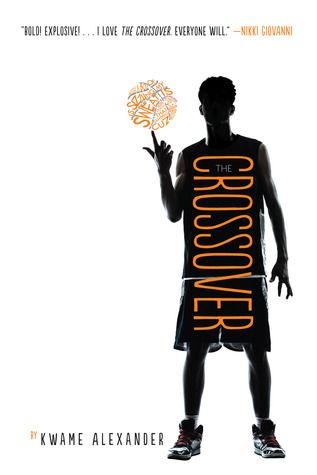
crossoverThe Crossover, by Kwame Alexander, (March 2014, HMH Books for Young Readers), $16.99, ISBN: 978-0544107717

Recommended for ages 8-14

Josh and his twin brother, Jordan, are lightning on the basketball court. The sons of a basketball player whose pro career was derailed by an injury and the assistant principal of their school, they have a strong family background that emphasizes teamwork and schoolwork.

Josh loves to rhyme, cranking out beats in his head as he plays. Jordan has other things in mind these days, though – namely, a girlfriend. Josh has a hard time with accepting this third party in his and Jordan’s relationship. Throw in their father’s health problems that he refuses to seek help for, and you’ve got a compelling read that will appeal to all readers, male and female, sports fans or not. There’s a flow and pacing to this novel, also written in verse, that just moves the pages on its own. Josh is a likable kid, and readers will see themselves in his shoes as he talks about his fears and frustrations.

The Crossover has been designated as a Kirkus Best Children’s Book of 2014, one of Publisher’s Weekly’s Best Children’s Books of 2014, and a School Library Journal Best Book of the Year.

Posted in Preschool Reads

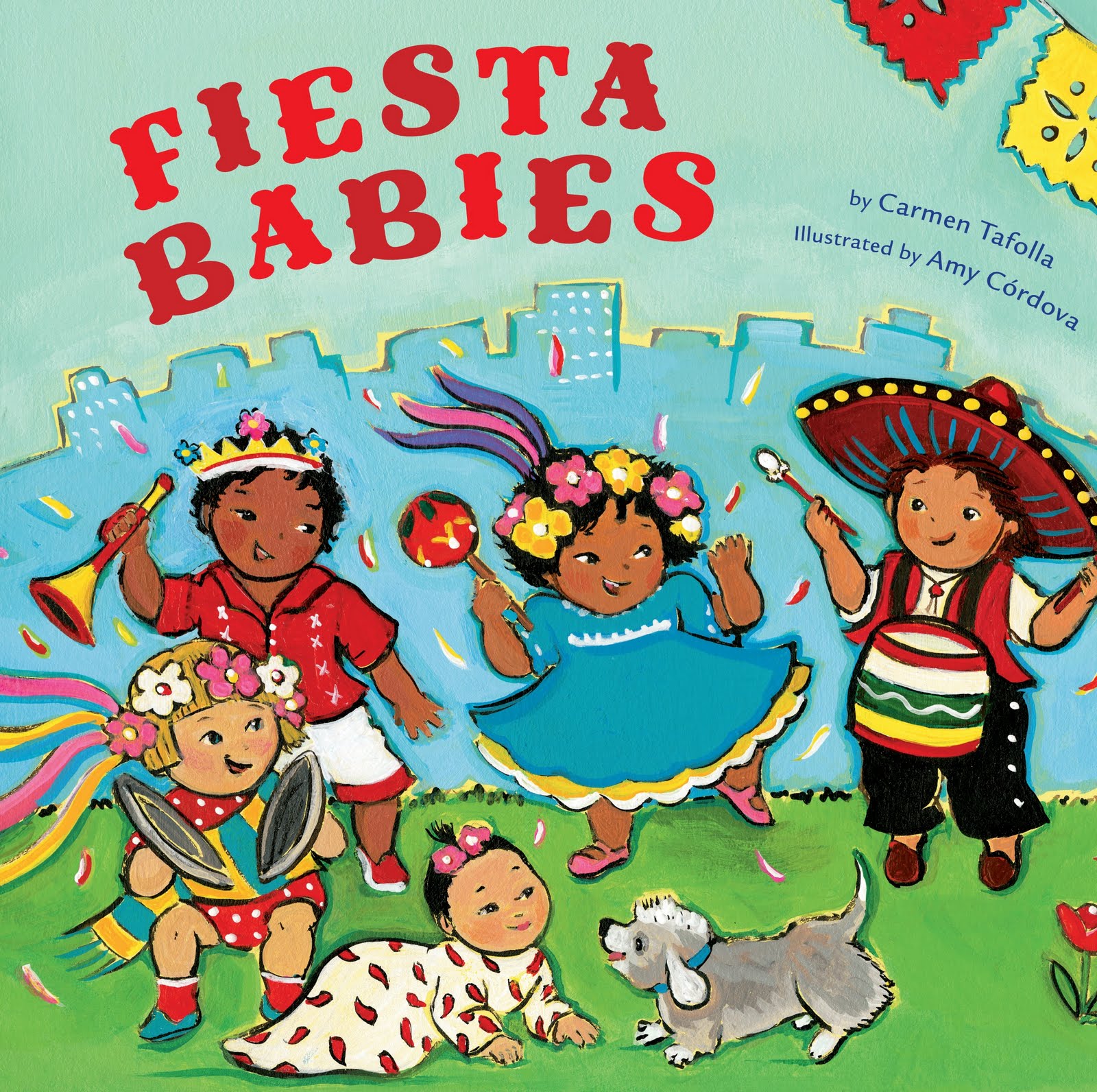
Book Review: Fiesta Babies, by Amy Cordova (Tricycle Press, 2010)

fiesta babiesRecommended for ages 2-5

A multicultural group of babies and their families take part in a cultural celebration, complete with colorful hats, dresses, foods, and dancing. The story, told in rhyme, uses English and Spanish words to bring babies of all ethnicities together in a celebration of Mexican heritage. Amy Cordova received 2011 Pura Belpre Illustration Honors for her bold acrylic colors and brushstroke paintings that bring Ms. Tafolla’s text to life. There are sombreros, serapes, salsa, and happy babies and grownups from diverse backgrounds together to celebrate a grand fiesta. The faces of the participants are joyfully expressive, spreading good feelings. A short glossary at the end of the book defines the Spanish words in simple-to-understand language for young audiences.

The book is a great read-aloud choice. The rhyming text will draw in young listeners, as will the bright colors and exciting new words, for those non-Spanish speakers. There can be a glossary handout for parents and guardians to practice the new words with children after the story time. Fiesta Babies, like Dora the Explorer, can teach children simple Spanish words; some preschoolers may recognize some of the words from Dora episodes. This would be a great multicultural language read-aloud with books like Linda Sue Park and Julia Durango’s Yum! Yuck! A Foldout Book of People Sounds, where children learn common words and phrases in a multitude of languages. There are several websites that offer Spanish language fingerplays and songs and can easily be slotted in to a bilingual story time.

Posted in Preschool Reads

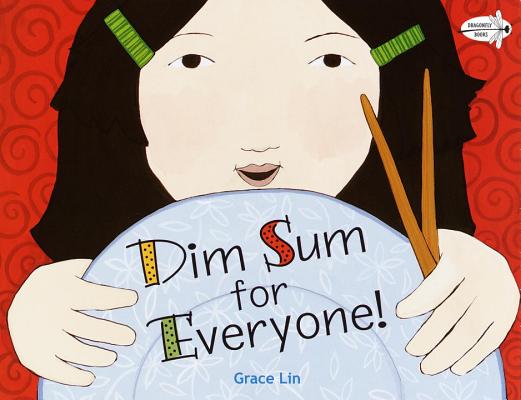
Book Review: Dim Sum for Everyone, by Grace Lin (Dell Dragonfly, 2003)

Dim-Sum-for-EveryoneRecommended for ages 2-5

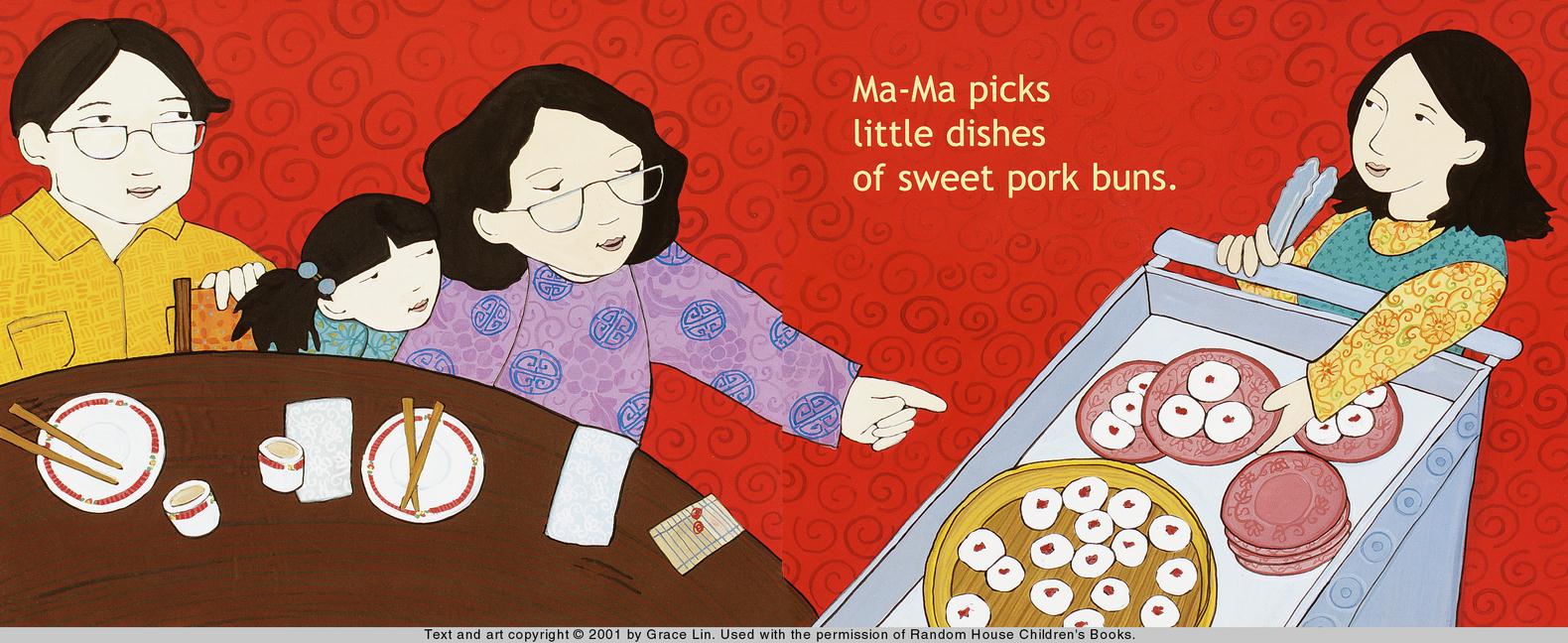
A child describes her dinner at a dim sum restaurant with her family, explaining what dim sum is – little dishes of different foods – and what each member of her family chooses from the little carts that bring food to the tables. Perspective changes to feature each family member as they choose a different food. Multicultural audiences will appreciate learning about new and different foods, and many families will identify with the experience. The illustrations are brightly colored, with the restaurant’s red carpet serving as the background for each spread; the bright silver carts and vibrantly colored foods and clothing add to the visual interest. The front endpapers feature food, condiments and tableware against a bright green background and the back endpapers illustrate almost two dozen dim sum dishes.  The bright yellow font creates a nice contrast from the red background, and occasionally, the text curves around the picture, adding to the visual appeal.

dim sum image

This would be a strong addition to a multicultural read-aloud or a Chinese New Year read-aloud. Preschoolers will be intrigued by the bright colors and names of the characters (Ma-Ma, Ba-Ba, Jie-Jie, Mei-Mei); the interesting new foods could start a fun discussion on other types of ethnic foods. If space permits and the food is available, perhaps there could be a small selection of foods available for audiences to sample. A Chinese New Year read-aloud could also offer printables of the Chinese astrological signs, with explanations for each sign.  Oriental Trading’s website offers many affordable Chinese New Year crafts for little hands, and there are free lantern crafts available online that parents/guardians could help children create.

The author’s webpage offers printables, crafts, Chinese lessons, and recipes.

Posted in Preschool Reads

Book Review: The Snowy Day, by Ezra Jack Keats (Viking Press, 1962)

snowydayRecommended for ages 3-5

In Keats’ beloved classic, a little boy enjoys the wonder of his first snowfall. Peter wakes up to see snow covering everything as far as the eye can see. After breakfast, he ventures outside and plays in the snow, making snow angels, playing with footprints, making a snowman, and climbing a mountain. He goes home and tells his mother about his day, takes a warm bath, discovers that the snowballs he saved in his pockets are gone, and  goes to sleep, only to wake up to another snowy day. The groundbreaking book was the first picture book to feature an African-American child as the hero of his own story and is still popular with audiences of all cultures and backgrounds today; it is the story of a child enjoying a snowy day – preschoolers will enjoy thinking about their favorite snowy day and appreciate moments that Peter experiences that may be familiar to them: the feeling of snow hitting him on the head, getting hit with a snowball when he tries to play with older boys, and the feeling of a  nice, warm bath  when he gets home.

Mr. Keats used illustrations consisting of cut-outs, varied textures, strong watercolors, geometric shapes, and collages, was also considered an artistic breakthrough. The images are not outlined, giving making for a softer appearance and will keep young audiences interested while the plain black font allows for a read-aloud that will keep audiences interested in the pictures while the reader weaves the tale. The endpapers provide a comfortable lead-in and phase-out to the story, with multi-colored snowflakes on a sponge-like background. Peter also appears in Keats’ books Peter’s ChairA Letter to Amy; and Goggles!

The Snowy Day has won numerous awards and accolades over the last 50 years, including the Caldecott Medal (1963) and the Child Study Children’s Book Committee (1995).

This would be a great anchor story for a winter/snowy day read-aloud. There is a board book version available for even younger audiences; it may be a good idea to have copies on hand for toddlers who want to follow along. Multicultural audiences will appreciate the African-American main character. The author’s website has an interactive version of the story with narration and a soundtrack that should be accessible on library computers. The Perry Public Library’s Snow & Winter storytime offers ideas, fingerplays and songs; children can talk about their favorite snow days and could color snow-related printables available on many children’s websites. Children could use precut shapes to make and decorate their own snowmen.

Posted in Toddler Reads, Uncategorized

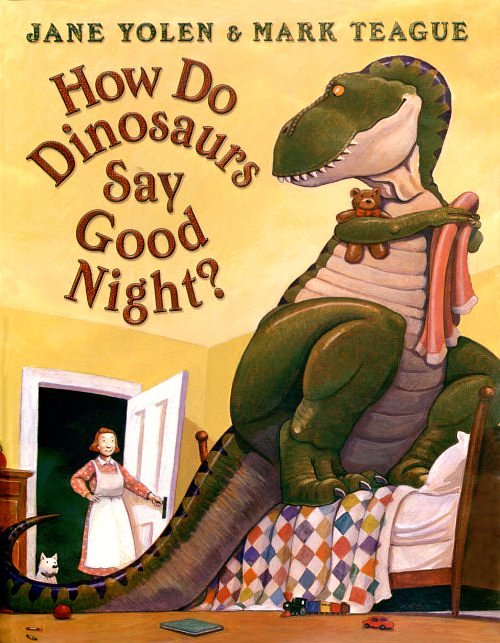
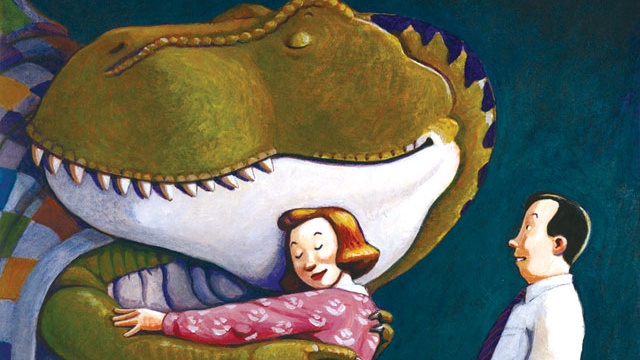
Book Review: How Do Dinosaurs Say Good Night? by Jane Yolen/Illus. Mark Teague (Blue Sky Press, 2000)

how-do-dinosaurs-say-goodnightRecommended for ages 2-5

Do dinosaurs really act up when it’s bedtime? A host of dinosaurs, acting much like preschoolers, react to bedtime and show readers how a dinosaur should say good night.

Dinosaurs are a popular topic among young audiences, and these dinosaurs, loaded with personality, will connect with young readers. Young audiences will see themselves reflected in the dinosaurs and how they approach bedtime. The earthy, colorful paintings offer varying perspectives – some dinosaurs are viewed from up high, some tower over everything around them – and multicultural families will appeal to all families. Dinosaur names are cleverly offered in each room, providing the chance for a fun name hunt. The endpapers illustrate all the dinosaurs found in the story, along with their names.

This is a great story for either a dinosaur-related read-aloud or a bedtime tale, where children and parents/guardians can talk about how they good night in their homes. There are numerous bedtime songs and fingerplays to use in conjunction with the book, and Massachusetts Honor Books offers a fun activity where children can write down “good night” in different languages, posting them on a map of the world.

The book has received numerous accolades, including the ALA Notable Children’s Books: 2001, Colorado: Children’s Book Award Nominees: 2002, Helbie Award: 2001, Maryland: Children’s Book Award Honors: 2003, Missouri: Building Block Picture Book Award Nominees: 2001, Nevada: Young Readers’ Award Nominees: 2003, Tennessee: Volunteer State Book Award Nominees: 2003, Texas: and the 2×2 Reading List: 2001.

The author’s website offers information about her other books, book trailers, and resources for teachers and storytellers. The How Do Dinosaurs series includes How Do Dinosaurs Eat Their Food?, How Do Dinosaurs Go To School?, and How Do Dinosaurs Play With Their Friends?


timthumb

Posted in Toddler Reads

Book Review: My Colores/Mis Colores, by Rebecca Emberley (Little, Brown, 2000)

mis coloresRecommended for ages 0-4

My Colores/Mis Colores is a bilingual board book that teaches readers basic colors and vocabulary words in English and Spanish. Each set of pages follows a formula: the left-hand page names a color in both English and Spanish, with the entire page bathed in that color; the right-hand page offers a cut-paper image in that color, set off against a white background and described in English and Spanish. The author utilizes a cut-paper technique that adds depth and interest to the objects, and the white backgrounds make them pop off the page. The colors and objects featured side by side provide a visual link for children – the sun is yellow; frogs are green; apples are red. Fonts describing colors are large and bold in a Times Roman-type font; object descriptions are smaller, in the same font type.

Encourage older toddlers and young preschoolers to pronounce the words during a read-aloud. There are also bilingual printables on many learning websites that children can color. The author’s website offers more information on her books and artwork.

Posted in Toddler Reads

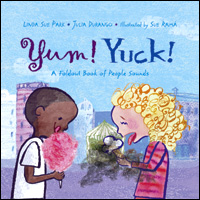
Book Review: Yum! Yuck! A Foldout Book of People Sounds, by Linda Sue Park and Julia Durango/Illustrated by Sue Rama (Charlesbridge Publishing, 2005)

yum yuck

Recommended for ages 0-4

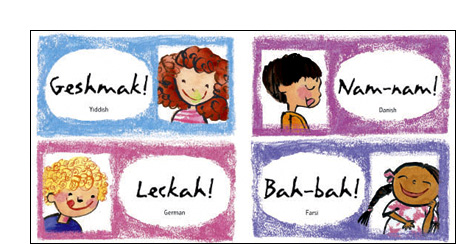
There are a lot of different people speaking different languages, but we all make the same sounds. Yum! Yuck! helps English speakers pronounce words for popular sounds from languages like Farsi, Yiddish, Korean, Chinese and Spanish. Sounds in different languages are presented on a two-page spread, with a lift-the-flap revealing the English version of the sound.

Toddlers and preschoolers will enjoy Yum! Yuck!’s  cartoon artwork. The children’s multicultural children’s faces are expressive and the expressions are written in large, bold handwriting font with its language written in an Arial-type font directly underneath. Large lift the flaps will appeal to little hands.

This book also sets the stage for a fun stoytime, whether at home or in the library. Storytime leaders can encourage speakers of other languages to share their expressions and to think of some that didn’t make it into the book – how do you say “Mommy” or “Daddy” in your language?

Fun craft ideas: Create your own “Yum! Yuck!” artwork using your child’s photo next to an expression in another language and color in the background.

Linda Sue Park’s author website offers more extras for older readers, but there are some links and a “Who Am I?” game for their younger children.

yum yuck interior